
An auction of oil leases in Alaska’s remote Arctic National Wildlife Refuge ended on Friday with just nine bids covering only about 10 percent of the available land, undercutting President Trump’s claims that drilling in the pristine wilderness area would set off an economic boom.
The sale brought in about $3.7 million, nearly half of which came from the state of Alaska’s publicly owned economic development corporation. Most of the 58 tracts available drew no bids at all. No major international oil companies entered bids.
Mr. Trump had campaigned in 2024 on turning oil development loose in the Arctic refuge, an isolated habitat for species including polar bear, caribou and millions of migratory birds, promising that extracting what he called “liquid gold” there would lower the price of gasoline and groceries. Republicans who pushed for opening the region said the refuge would generate a multibillion-dollar windfall as soon as drillers were allowed inside.
Previous sales mandated by Congress during Mr. Trump’s first term also drew little interest. The handful of leases that had been sold were suspended, and then later canceled, by President Joseph R. Biden Jr.
But with the war in Iran sending oil prices spiking and the federal government actively encouraging companies to drill, analysts said they had expected a more robust auction this time.
“We’re in the middle of a massive supply shortfall, and if there was ever a time to look past political and reputational risks, it would be now,” said Kevin Book, managing director of ClearView Energy Partners, a research firm.
Mr. Trump has called the refuge “the biggest find anywhere in the world, as big as Saudi Arabia,” and he has directed the government to expedite development in Alaska. The administration declared the day a success.
“The interest was solid,” Kevin J. Pendergast, the director of the Alaska office at the Interior Department’s Bureau of Land Management, said as he announced the results. The B.L.M. director, Steve Pearce, hailed what he called “strong industry interest.”
When the auction ended, two companies had bid on five tracts of land totaling about 70,000 acres. About 689,000 acres were offered for leasing.
One was the Alaska Industrial Development and Export Authority, a state-owned economic development corporation that is currently the only oil and gas leaseholder in the refuge. The authority had three of the winning bids, totaling about $1.5 million. The other winning bids went to Hex L.L.C., an Alaska-based oil and gas production company.
Mr. Book said he believed that many of the largest oil and gas companies had stayed away because of the logistical challenges of drilling in such remote territory, as well as concern that a future administration could again cancel leases.
The top Democrats on environmental committees in Congress, Senator Edward J. Markey, Democrat of Massachusetts, and Representative Jared Huffman, Democrat of California, called the results “an embarrassment for the Trump administration.”
In a joint statement, they called the auction “an insult to our entire country, by sacrificing and selling off America’s public lands for pennies on the dollar.”
Senators Lisa Murkowski and Dan Sullivan, both Republicans of Alaska, did not respond to requests for comment.
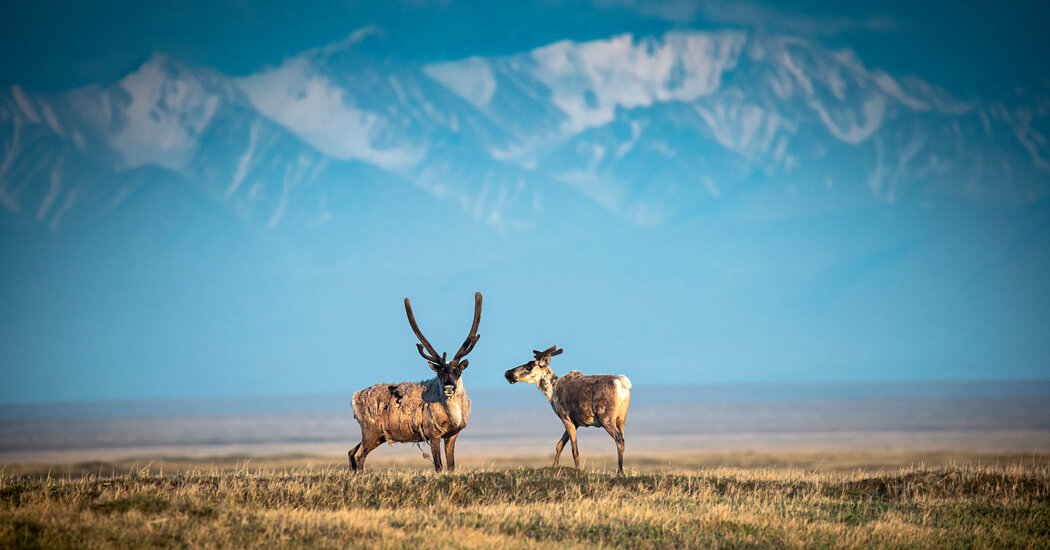
The Arctic National Wildlife Refuge spans roughly 19 million acres along the North Slope of Alaska. One of the last truly wild places in the United States, it is home to migrating caribou, polar bears, musk oxen, millions of birds and other wildlife.
It also includes land considered sacred by the Gwich’in, an Alaska Native group.
But the refuge is estimated to contain as much as 11.8 billion barrels of recoverable oil, according to the U.S. Geologic Survey, though many experts believe that estimate is based on old data. The Alaska corporation currently holds leases in the refuge, but there is no active drilling.
Environmental activists said the tepid sale results and the absence of major oil and gas companies was evidence that the market has little interest in the Arctic refuge.
“The government spent public money to hold an auction no major company showed up for, and that tells you everything you need to know about the economics here,” said Bobby McEnaney, director of land conservation for the Natural Resources Defense Council, a nonprofit environmental group.
Alaska Native communities were divided over the auction. Members of the Gwich’in Steering Committee, who have been fighting oil and gas development in the region for decades, argue that drilling threatens an areas they call the Iizhik Gwats’an Gwandaii Goodlit, “the sacred place where life begins,” and the porcupine caribou herds that Indigenous communities have relied on for thousands of years.
“We will continue to fight the Trump administration’s leasing program, and work with our friends and allies to protect this sacred and irreplaceable landscape from development of any kind,” Kristen Moreland, executive director of the Gwich’in Steering Committee, said in a statement.
Other Alaska Native communities have argued that oil and gas development is critical to economic development.
“It’s a step forward, as far as we’re concerned,” said Nagruk Harcharek, president of Voice of the Arctic Inupiat, which represents Inupiat leadership organizations on the North Slope and supports oil and gas projects. “We look forward to continuing to advocate for it and for the overall self-determination of the folks on the North Slope.”
The controversy over drilling in the Arctic National Wildlife Refuge has spanned almost 50 years. Alaska officials and many Republican lawmakers have long sought to allow drilling there, citing the jobs and revenue it would create. But the refuge was protected for decades, largely by Democrats in Congress.
That changed in 2017 when Republicans, in control of both houses of Congress and the White House, pushed through a tax bill allowing sales of leases of up to 1.5 million acres in the refuge.
Two weeks before Mr. Trump left office in 2021, the Interior Department held the first auction. It was a dud. So was the second auction in 2025, ending without a single bidder.
There will be three more sales in the Arctic Refuge between now and 2035, all mandated in Mr. Trump’s domestic policy bill that passed last year.

