
Riley Sealander, a 26-year-old barista in Greensboro, N.C., is your typically rabid World Cup fan. He wears his favorite team’s jersey and watches its matches as he makes cappuccinos. He drapes the red, white and blue around his workplace and tries hard to rally new supporters to fledging fan clubs.
But Sealander isn’t promoting the U.S. team. Instead, he’s all-in on Team Norway, whose arrival this month in Greensboro has set off a communitywide embrace of the Scandinavian squad, merging Southern hospitality with a bona fide enthusiasm for one of Europe’s trendiest teams after it picked the city as its temporary home.
“We’re not in Raleigh, we’re not Charlotte,” said Sealander, wearing a customized Norway jersey under his apron, “so it was kind of a big deal.”
Since teams began decamping to the United States earlier this month, that mix of small-city pride and the global reach of international soccer has led to an unlikely romance between everyday Americans and squads from around the world, a juxtaposition of diverse cultures that has sparked moments of joy — like a goal in stoppage time — in both hosts and visitors alike.
Americans’ international reputation has dipped in recent years, according to polls, and many of these World Cup testimonials have an element of surprise: The United States, it seems, has all kinds of estimable traits, with visitors praising everything from its alligators to its ice machines.
But that sense of wonder and admiration has gone both ways, and seems particularly acute in less-well-known locales like Greensboro, which has recently turned into a kind of satellite Oslo, its sports bars filled with newly minted Norway fans, its shop windows and front porches adorned with the country’s flags. About 20,000 fans clamored to get tickets to an open practice. And at the team’s headquarters, the red carpet has been rolled out — as has the halibut, which was flown in for the team (and barbecued, because it’s North Carolina).
In all, the first World Cup hosted in the United States in more than 30 years has dispersed thousands of world-class athletes, staff members and supporters around the country, many of whom are experiencing the same excitement and hospitality as in Greensboro.
In Chattanooga, Tenn., locals are camping outside an Embassy Suites for glimpses of Spain’s national team. Residents of Lawrence, Kan., mastered the pronunciation of “Viva l’Algérie!” for Algeria’s team. And sightings of the Egyptian team out and about in Spokane, Wash., are being traded with glee in town forums.
The tournament, among the biggest and more expensive to date, comes at a fraught moment for the United States as the country’s 250th birthday celebrations underscore clashing views of history and set off partisan fighting among organizers. At the same time, the country has long found unity in a passion for sports that is as zealous as ever, bringing together, for example, two million New York Knicks fans across boroughs and state lines to toast their champion team at the team’s ticker tape parade on Thursday.
And some Americans see the tournament in similar terms: as a chance to renew the nation’s reputation as a friendly place for international visitors, amid the aggressive anti-immigrant and foreign policy actions of the Trump administration.
“The people of the country have always been very welcoming and gracious with guests,” said Peter Helseth, 45, an engineer from Greensboro, who took his 6-year-old son to a Norwegian team practice. “And it’s been really nice to see that, as a refreshing break, from national news.”
Others in Greensboro shared that sentiment, and a soft spot for their newly adopted Norwegians.
“I’ll always pull for the U.S.,” said Matt Kirkman, a groundskeeper at the University of North Carolina at Greensboro who spent two months getting the soccer field’s Bermuda grass ready for the World Cup team.
“But if they do win the whole thing,” he said of Norway’s squad, “it will really have been awesome to have been part of that story.”
Here and elsewhere, the contact between teams and towns has often been up close and person-to-person, far removed from tensions over the fate of NATO, say, or the war in the Middle East, or other governmental disputes that often dominate and define one country’s feelings about another.
Indeed, the visitors and communities are bonding over everyday moments, with some online observers calling the World Cup “the Great International Sleepover,” suggesting a homey friendliness. Seeing a superstar athlete going about his day-to-day life — getting coffee or casually shopping — may well do more for détente than many diplomatic discussions.
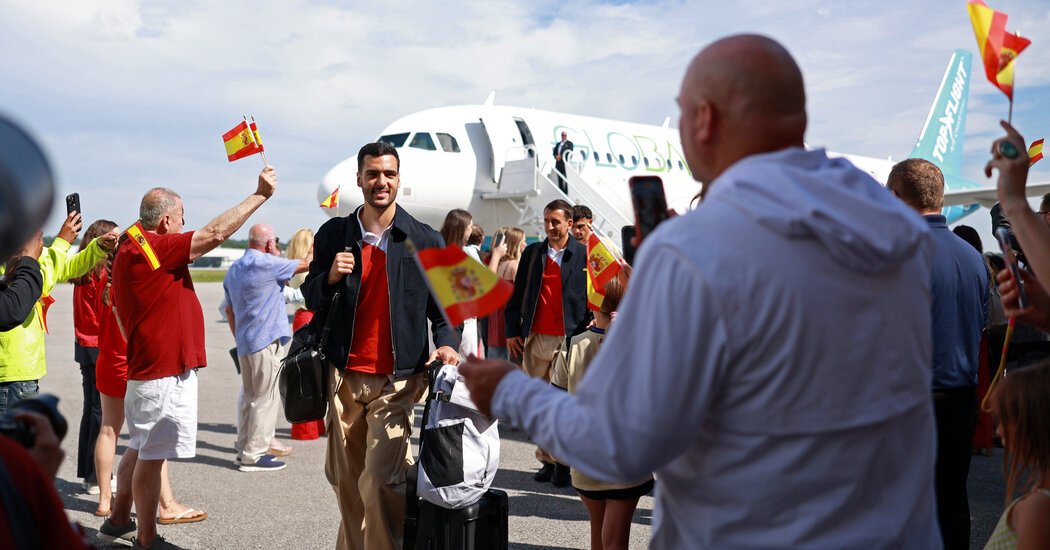
In Chattanooga, with a population of less than 200,000, the Spanish national team, a tournament favorite, was greeted by fans waving flags at the airport after its flight from Europe and was treated to sangria, bacon-wrapped dates and watermelon skewers courtesy of the city’s only tapas restaurant.
Base camp cities — more than three dozen of which are in the United States — are selected by the teams themselves. Some are tiny: White Sulfur Springs, W.Va., where the Iraq team is based, has a population of under 3,000. Greensboro is huge by comparison, with a population of about 310,000.
The Spanish team could have stayed in a larger city but was drawn in part to the low-key environment and the level of anonymity Chattanooga afforded, according to Tim Kelly, the city’s mayor. That said, soccer fans have still staked out the Embassy Suites, which the team bought out for a month, hoping to catch a glimpse of Lamine Yamal, the Spanish team’s teenage star, who has nearly 44 million followers on Instagram.
“We’re calling it ‘Lamine watching,’” said Sam Crickmar, the president of men’s club soccer at the University of Tennessee at Chattanooga.
Some of the hometown cordiality has been driven by another cherished American value: competition.
Lori Jenkins, regional director of sales for the group that owns the Embassy Suites, said she had felt a fire within when a member of Spain’s soccer federation showed her a video of a reception that the team had gotten in another city.
“I was like, ‘Nope, we’re going to top that,’” Jenkins said.
The hotel’s staff got to work turning part of one floor into a game room complete with table tennis, video game consoles, pool tables, poker tables and dart boards. For the hundreds of Chattanoogans cheering outside to welcome the team, they passed out sunglasses, beads and Spanish flags.
“These are the most famous athletes in the world, and we’re folding their laundry,” Jenkins said. “That’s something I get to tell people for the rest of my life.”
Less than an hour from Kansas City’s metro area (where England, Argentina and the Netherlands are training), a similar zeal has been spreading in Lawrence, Kan., a college town with a population of fewer than 100,000 people, where residents have filled the streets with green, white and red, the Algerian team colors.
Chuck Magerl, the owner of Free State Brewing on Lawrence’s main drag, said people might have underestimated the city.
“Kansas is seen as being a flyover area that some people don’t think has much culture or international awareness,” Magerl, 70, said, as he highlighted Lawrence’s diversity. “Those aspects of welcoming other cultures have shown through in how Lawrence has embraced the Algerian team.”
For some avid soccer fans, the sudden appearance of their favorite players in their hometowns has been a stroke of luck: In Spokane, Wash., Hamza Abohoush, a 16-year-old student at West Valley High School, got to meet Mo Salah, the Egyptian soccer star and a hero of his.
“He acts like a normal guy, like us,” Abohoush said.
In a nation built by émigrés, and in a moment of sharp debate about immigration, the World Cup has also offered some a chance to voice pride over their heritage.
The German team is based in Winston-Salem, N.C., with a population of about 250,000, where German flags adorn flower boxes downtown and fly atop the former R.J. Reynolds Building.
And at a team practice at Wake Forest University on Thursday, one 16-year-old fan, Raphael Olivier, wore the country’s jersey and said he had come to that affiliation naturally: Both his parents were from Germany, and spoke German at home.
Olivier called seeing the team up close “once in a lifetime.” “I don’t think I’ve ever seen as many German-speaking fans as I have now,” he said.
Others like Ashley Fritz, 35, a data engineer in Winston-Salem, said they had never been particularly interested in soccer. But then she and her 10-year-old daughter, who likes the sport, were among the 3,500 people to get tickets to attend Norway’s open practice at U.N.C. Greensboro. (More than 20,000 had requested seats, prompting a lottery.)
Fritz said it had been exciting to see “how everyone has kind of embraced each other through this event.”
“I feel like we are in tough times and there can be a lot of turmoil between people,” she added.
“It’s just, like, a good vibe story,” Fritz said.
That sentiment was echoed back at the Norwegian headquarters, the Grandover Resort & Spa, where the mood was relaxed on Wednesday.
One of the team’s chefs, Christian Karllson, prepared to make dinner for friends and relatives of the team, procuring a halibut for the grill and saying they were “going to have an American barbecue because that’s what you guys know.”
Listening in, Heath Putman, a doorman at the resort, later expressed a kind of wonder at the scene: world-class athletes, talking barbecue, right here in Greensboro.
“The South has not always been that reputable in some of our viewpoints,” Putman said.
“But,” he added, “Here we are, with open arms.”
Daniel Walters contributed reporting from Spokane, Wash., and Madison Malone Kircher reported from New York.

