
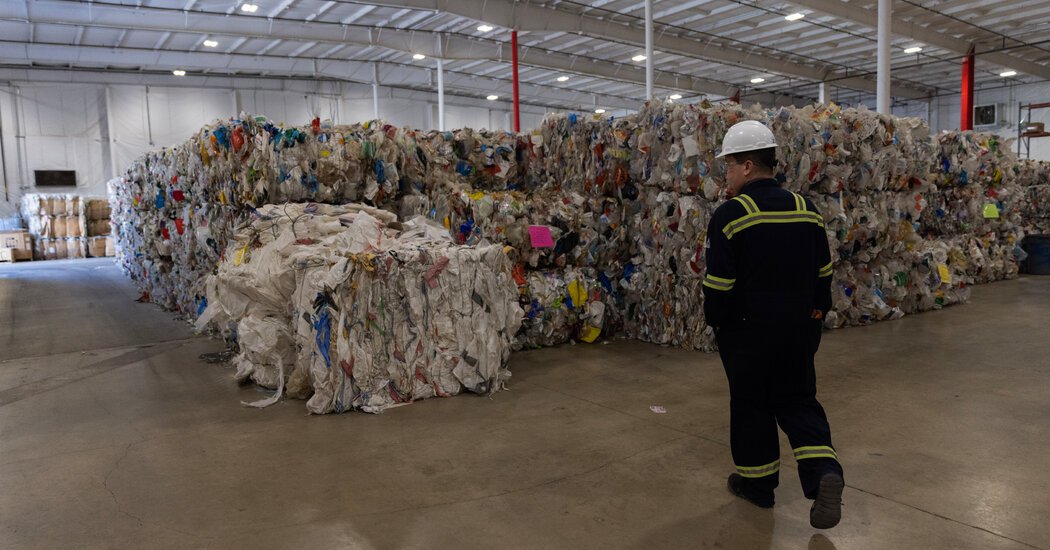
Nationwide, less than 10 percent of discarded plastic gets recycled. A lot of plastic products are tricky to recycle. Most of it goes straight to the landfill.
One possible solution that’s emerged in recent years is advanced recycling.
Advanced recycling, also called chemical recycling, uses heat and chemical reactions to break down plastic waste into its molecular building blocks.
It’s promising on paper, and the chemicals industry has heavily promoted advanced recycling, as has the Trump administration. Except, the industry is running into trouble.
In the past weeks, two of just a handful of advanced recycling sites in the United States have suspended operations: the Freepoint Eco-Systems plant in Hebron, Ohio, and the Braven Environmental plant in Zebulon, N.C.
Both closures followed environmental violations cited by state regulators involving harmful air pollution and hazardous waste.
Now, just seven advanced recycling plants remain in the United States, barely making a dent in the amount of plastic that’s discarded, according to Beyond Plastics, an environmental advocacy group.
That’s down from the group’s tally of 11 facilities in 2023.
The industry’s troubles have bolstered critics who have called advanced recycling a false solution. They say it releases toxic chemicals into the atmosphere and cannot reliably and economically be ramped up.
It’s a ruse put forward by the plastics industry, they say, to counter a growing recognition that the world must curb plastic production instead.
“They’re convincing lawmakers that we don’t need to reduce plastics,” said Judith Enck, president of Beyond Plastics and a former regional administrator at the Environmental Protection Agency.
Asked about the recent closures, Ross Eisenberg, president of America’s Plastic Makers, an industry group, said that, in any emerging manufacturing sector, some operations would scale up while others would close. He said some companies were expanding their advanced recycling capacity and that major brands like Nike were incorporating plastics made from advanced recycling into products, like World Cup soccer jerseys.
One of the big attractions of advanced recycling is the possibility that it could offer a path toward a “circular economy” for plastics.
Unlike the more traditional mechanical recycling, which involves grinding up plastic to process into new products, advanced recycling can theoretically process mixed or contaminated plastics that otherwise end up in landfills.
One type of advanced recycling called pyrolysis offers a way to transform plastic waste into oil, which can be used as industrial heating fuel, a substitute for diesel or as raw material for producing new plastics. That potentially reduces the need to use fossil fuels to make plastic.
But the trouble at the Ohio and North Carolina plants point to some grave challenges.
The Freepoint plant in Ohio stopped operations after being hit with violations for dozens of unreported equipment malfunctions and illegal emissions. It also failed to produce enough pyrolysis oil to meet Ohio’s definition of recycling. That meant it faced reclassification as a waste incinerator, which would have come with stricter regulations.
Freepoint Eco-Systems said in a statement that it had shuttered its plant for commercial reasons and that it was working with the Ohio E.P.A. on a safe shutdown.
Bryant Somerville, a spokesman for the Ohio Environmental Protection Agency, said the state was in communication with the company to ensure that the plant shutdown complied with regulations.
The Braven plant closed after multiple unresolved hazardous waste management violations, according to North Carolina’s regulatory database.
Josh Kastrinsky, a spokesman for the North Carolina Department of Environmental Quality, said the state had not issued orders to close the facility nor rescinded any permits. Still, the agency was aware that closure was underway, he said.
An email sent Wednesday to Braven’s media relations email address bounced back as undeliverable.
The chemicals industry, meanwhile, is backing an effort in Congress, as well as rule-making at the E.P.A., to relax the environmental regulations they must meet.
The Trump administration has been supportive. In November, Lee Zeldin, the E.P.A. administrator, visited ExxonMobil’s Baytown complex in Texas to tour its advanced recycling operations and later appeared in ExxonMobil promotional videos and published an opinion article promoting the recycling technology.
“If America does not invest in scaling this technology now, it stands to lose not just an environmental opportunity, but an enormous economic opportunity as well,” Mr. Zeldin wrote. Nearly 90 advanced recycling facilities are ready to be built across the country, he added.
Can advanced recycling really work in an environmentally friendly way?
Roger Ruan, a professor in renewable engineering and environment at the University of Minnesota, said that current pyrolysis plants, which tended to produce fuel for burning rather than new plastic, were just an “expensive way to burn fossil fuels.”
But he said early failed efforts had given the technology a bad name. He said he still saw a way forward if larger companies with resources and expertise started to adopt the technology.
Jennifer Dunn, a professor of chemical and biological engineering at Northwestern University, cautioned that environmental harms still are not well understood. Many analyses of pyrolysis technologies don’t account for emissions of pollutants beyond greenhouse gases and basic air pollutants, she said.
The best case scenario, Professor Dunn said, would be for advanced recycling plants to install the most stringent pollution control devices and continually monitor their emissions, something they’re currently not required to do. But that would make advanced recycling more expensive.
More promising, she noted, was research into new materials that can reduce the use of plastics . Scientists have been trying to develop plastic substitutes from materials like seaweed and algae, for example.
“We need to keep pressing on these options,” Professor Dunn said.
States are told to change voting rules or lose antiterrorism funds
The Trump administration is requiring states to change the way they conduct elections or risk losing tens of millions of federal terrorism-prevention funds, in its latest move that would make voting harder and undermine trust in results that don’t go President Trump’s way.
The effort would force states to transition to paper ballots, verify citizenship of voters and make other changes to election procedures, according to Federal Emergency Management Agency documents.
FEMA, part of the Homeland Security Department, has told states that it would withhold 20 percent of some terrorism-preparedness grants unless they provide “proof of compliance” with the election security measures, the documents show. The grants help pay for physical barriers and other security measures as well as planning exercises, drills and cybersecurity protections. — Scott Dance, Nick Corasaniti and Hilary Howard
Western Europe just had its hottest June
The region experienced its hottest June on record last month, scientists said this week, as a long heat wave toppled records across France, Britain, Spain and other countries.
On average, June temperatures across Western Europe were 3.05 degrees Celsius, or 5.5 degrees Fahrenheit, above their normal levels from the past few decades, according to Copernicus, the European Union’s climate monitoring service.
For the planet as a whole, it was the second warmest June on the books, Copernicus said. — Raymond Zhong

