
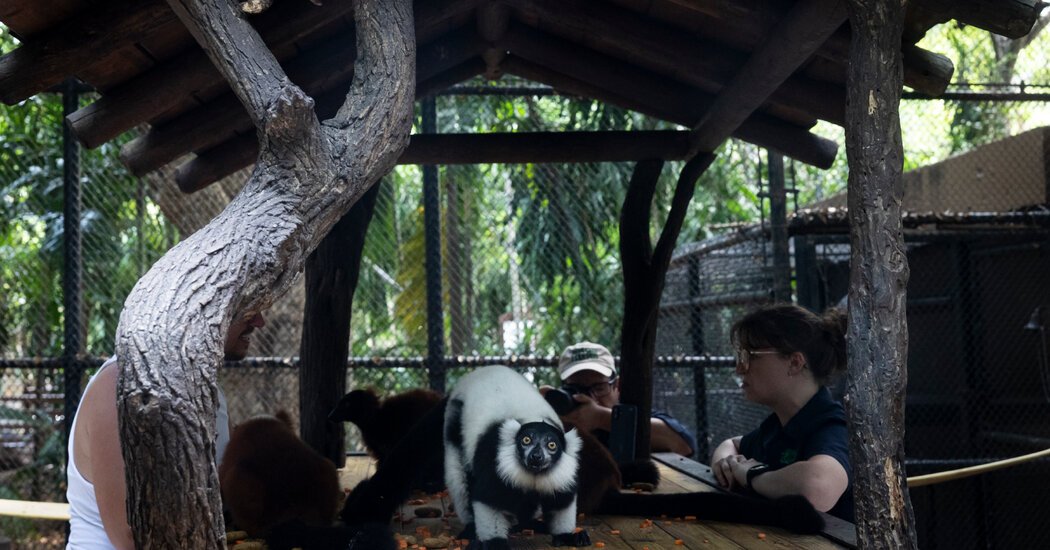
Last summer, federal officials were considering the fate of more than 100 ruffed lemurs, a critically endangered species known for the fluffy fur around its neck.
4J Conservation Center, an animal breeding facility based in Florida, had applied to renew its permit to raise the lemurs in captivity. Without the permit, the business would be forced to pause operations or shut down.
The application landed on the desk of Jenifer Chatfield, a top wildlife regulator at the Interior Department. Dr. Chatfield knew the business well: Her family owns 4J Conservation Center, and its application listed her as one of its veterinarians.
Within a day, Dr. Chatfield advanced the application through the agency’s complex permitting process.
It was not the only time that Dr. Chatfield’s government role intersected with her family’s business, according to hundreds of pages of documents reviewed by The New York Times.
She also helped write a proposed rule this year that would cut costs for facilities like 4J Conservation Center while narrowing the reach of the Endangered Species Act, the bedrock environmental law intended to prevent animal and plant extinctions, the documents show.
Ethics experts told The Times that Dr. Chatfield’s actions appeared to pose a conflict of interest, even if they were not actually self-dealing.
“We expect the federal government to be impartial, to act in the public interest, not to use federal power to help a family business,” said Kathleen Clark, a law professor at Washington University in St. Louis who specializes in government ethics.
Aubrie Spady, a spokeswoman for the Interior Department, declined to make Dr. Chatfield available for an interview or to answer specific questions but defended her record.
“Dr. Jenifer Chatfield has demonstrated nothing other than professionalism and expertise during her dedicated service at the department,” Ms. Spady said.
Dr. Chatfield joined the Interior Department in May 2025 as a senior adviser. She is currently the deputy assistant secretary for fish and wildlife and parks. In that role, she oversees the U.S. Fish and Wildlife Service, the main federal agency tasked with protecting vulnerable plants and animals from threats like climate change and habitat destruction.
In April, Democrats on the House Natural Resources Committee asked the Interior Department’s inspector general to investigate Dr. Chatfield for “potential ethics violations” and “family favoritism.”
Ms. Spady would not confirm whether the inspector general has opened an investigation but criticized the request. “It’s a shame that liberals would try to smear the reputation of a nationally known female veterinarian,” she said.
An Expedited Permit
Established in 2007 in Dade City, Fla., 4J Conservation Center appears to be named after Dr. Chatfield and her immediate family members: her father, John Chatfield; her mother, Jeri Chatfield; and her twin brother, Jason Chatfield.
The center, which is not open to the public, has housed a variety of exotic animals, including colobus monkeys, red kangaroos and ruffed lemurs, according to its government filings. Most of the lemurs are kept in enclosures that measure 12 feet across, 12 to 24 feet long and 8 feet high, the filings show.
Some animal-rights activists and scholars have criticized such enclosures, noting that lemurs like to leap over long distances in their native habitat, the rainforests of eastern Madagascar.
“4J is effectively a puppy mill for lemurs; it’s a pretty bleak existence,” said Delcianna J. Winders, the director of the Animal Law and Policy Institute at Vermont Law and Graduate School, who reviewed the facility’s permit applications at the request of The Times.
Attempts to contact John Chatfield, who serves as the president of 4J, were unsuccessful. An email to the address that he listed on 4J’s registration permit application bounced back. A man who answered a call to the phone number listed on the form said it was a wrong number.
The center sells or loans some of its lemurs to individuals, zoos and amusement parks, according to its permit applications. From 2020 to 2025, it sent more than 40 lemurs to Jungle Island, an “eco-adventure” park in Miami where visitors can pay $85 to feed and play with the animals, the applications show.
To remain in operation, captive wildlife facilities like 4J are required to renew their registration permit from the Fish and Wildlife Service every five years. They must also obtain an import permit or export permit before moving an endangered species across international borders.
Renewing the registration permits is a multistep process. First, the government verifies that the application is complete and publishes a notice in the Federal Register to solicit public comments. Then, the government pores through the public comments and application materials in detail. Finally, the application is approved or rejected.
On July 30, 2025, Dr. Chatfield approved the publication of a notice for 30 permit applications, including 4J’s renewal request, according to the documents reviewed by The Times. In its submission, 4J listed Dr. Chatfield as one of its veterinarians and included a copy of her résumé.
It took Dr. Chatfield one day to approve the notice for 4J. For context, it took her an average of 12 days to approve nine similar notices around the same time, the documents show.
The longest it took her was 96 days in the case of a notice for Zoo Atlanta, which was seeking an import permit to transport two giant pandas from China.
That 96-day delay, combined with a 43-day government shutdown, forced Zoo Atlanta to postpone a carefully choreographed FedEx flight to take the pandas halfway around the world, according to the documents.
A spokeswoman for Zoo Atlanta declined to comment for this article.
A Regulatory Rollback
In December 2025, Dr. Chatfield was appointed the Fish and Wildlife Service’s “new primary dereg P.O.C.,” or primary deregulation point of contact, replacing an employee of Elon Musk’s Department of Government Efficiency, according to the documents reviewed by The Times.
In one of the documents, she wrote that her “No. 1” priority was a proposed rule that would significantly weaken requirements for captive wildlife facilities under the Endangered Species Act.
Currently, such facilities must reapply for a registration permit every five years at a cost of $100. To obtain the permit, they must show that their activities “enhance propagation or survival of the affected species.”
To meet this requirement, the facilities must participate in breeding programs that help preserve genetic diversity and prevent inbreeding. They also must track animal births and deaths in meticulous detail.
Under the changes drafted by Dr. Chatfield in the proposed rule, however, captive wildlife facilities would receive lifetime registration permits for $100. They would no longer need to demonstrate every five years that they were promoting a species’ long-term survival.
To justify these changes, Dr. Chatfield added language to the proposal that said it “reduces paperwork and costs for regulated entities (particularly small breeders, zoos and conservation programs),” according to the documents reviewed by The Times. 4J is considered a small breeder.
In February, Dr. Chatfield sent a draft of the proposal to political appointees in the Interior Department’s Office of the Solicitor, asking for their input, the documents show.
“Attached is some updated language in the proposed rule — I tracked changes to make it easier to see the new stuff,” she wrote. “Looking forward to making the draft even better with you guys tomorrow!”
While Dr. Chatfield consulted with other Trump administration appointees, she bypassed the career lawyers, scientists and regulatory experts who typically played a role in the rule-making process, according to the documents.
In March, one of those career scientists added a comment to the draft saying she could not concur with Dr. Chatfield’s changes. The scientist also voiced concerns to political appointees that the changes lacked a legal basis and threatened the recovery of endangered species, the documents show.
It is unclear when or if the draft proposal will be publicly released.
A Single Ethics Form
Federal ethics laws require senior government officials to file financial disclosure reports that detail their income and assets.
Separately, the Interior Department also requires officials to sign ethics agreements that detail projects that pose conflicts of interest, or the appearance of them. Ethics officials then determine whether the officials should recuse themselves from these projects or obtain waivers to work on them anyway.
In response to a request for all ethics documents for Dr. Chatfield, the Interior Department provided one financial disclosure report stating that Dr. Chatfield stopped working at 4J in December 2023.
However, 4J listed Dr. Chatfield as a “veterinarian-in-charge” in a February 2025 document certifying that several lemurs had a clean bill of health, and as a “consulting veterinarian” in a November 2025 application for a permit to export lemurs to Mozambique — six months after she joined the government.
4J also listed Dr. Chatfield as an officer in an annual report filed with the Florida Division of Corporations in April 2025. But the next month, the company filed an amended report that removed her from the list of officers.
Ethics experts said the apparent discrepancies in the documents raised questions about whether Dr. Chatfield failed to disclose 4J as a more recent employer or client.
“It seems pretty clear that one of these documents must be misrepresenting Chatfield’s role, which itself is a problem,” said Cynthia Brown, a senior ethics counsel at Citizens for Responsibility and Ethics in Washington, a nonprofit watchdog group.
She added, “This scenario reasonably raises a serious question: Is this person using her government position to help her family’s business and financial interests, which she previously had a direct stake in?”
Ms. Brown said it was ultimately unclear whether Dr. Chatfield’s actions violated the federal criminal conflict-of-interest law. But, she said, they could erode the public’s trust in the government to act impartially, whether on endangered species or other matters.

