
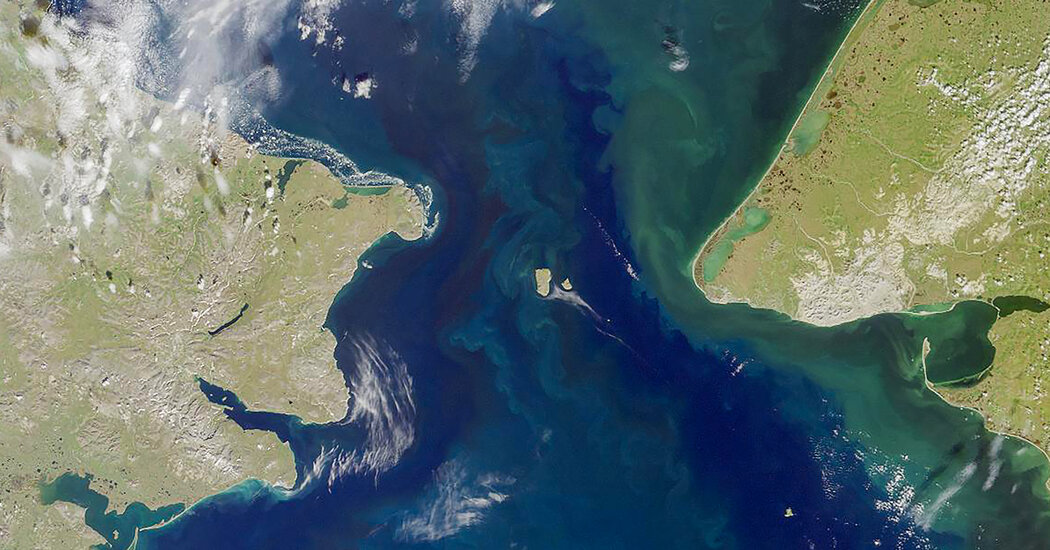
Brightening clouds. Refreezing the Arctic. Floating a giant parasol in outer space. To the ranks of out-there ideas for countering climate change, two Dutch scientists have added this: building a 50-mile-long dam across the Bering Strait, the shallow waterway that separates Russia and Alaska.
In a study published on Friday in the journal Science Advances, the researchers show that, under certain conditions, such a dam could prevent a collapse of a network of ocean currents, known as the AMOC, that plays a central role in regulating Earth’s climate.
The AMOC (pronounced AY-mock) has weakened in recent decades, and a growing body of evidence suggests human-caused warming could someday cause it to shut down or slow significantly, with grave effects on the weather on multiple continents.
The new study is a “proof of concept,” not an action plan, one of its authors, Jelle Soons, a doctoral candidate at Utrecht University in the Netherlands, said. More research is needed to confirm that such a dam would work as intended and to assess its feasibility and environmental side effects, Mr. Soons said.
Still, he said, humanity could someday be forced to take drastic measures to avert the worst effects of global warming. While cutting carbon emissions is still the best way to prevent an AMOC collapse, his findings show that “in a worst-case scenario,” a Bering Strait dam could be an option, Mr. Soons said.
The AMOC, or Atlantic Meridional Overturning Circulation, is part of a giant loop of water that snakes through the world’s oceans. It carries warm, salty water from the tropical Atlantic up past the Eastern Seaboard and toward Europe. There, the water releases its heat into the air and helps moderate the weather in Britain and the Nordic countries. In the process, the water cools, sinks and heads back south, where it goes on to influence rainfall patterns in Africa, South America and beyond.
Now, though, warming from greenhouse gases in the atmosphere is disrupting this vast oceanic conveyor belt. As temperatures rise, the Arctic gets rainier and Greenland’s ice sheet melts, more fresh water is pouring into the North Atlantic, making its surface less salty. That prevents the water of the AMOC from sinking at the loop’s northern end, which in turn causes it to draw less warm water northward from the tropics.
Should the belt stop turning altogether, Northern Europe would grow colder, deprived of the warmth the AMOC brings. With less water moving north through the Atlantic, more of it would slosh toward the U.S. East Coast, raising sea levels there. Tropical rainfall patterns would be rearranged, parching some areas while dousing others.
At first glance, the Bering Strait’s role in all this isn’t obvious. In fact, the strait is a gateway for large quantities of fresh water to flow from the Pacific Ocean into the Arctic Ocean, and from there into the Atlantic. Damming it would change the balance of fresh and salty water between the three oceans.
Using a computer model of Earth’s climate, Mr. Soons and his colleague Henk A. Dijkstra found this could affect the AMOC in major ways.
If the AMOC is strong, then closing the strait would cause less fresh water to flow out the Arctic Ocean and into the Atlantic, they found. That would help keep the North Atlantic salty and the AMOC stable. But if the AMOC is already near collapse, then closing the strait would have the opposite effect, destabilizing the AMOC further. The timing, in other words, is key.
At the moment, though, scientists don’t know exactly how close the AMOC is to collapsing, said Aixue Hu, a climate scientist at the National Center for Atmospheric Research in Boulder, Colo. Some projections suggest it could happen before the end of this century. But “the uncertainty is very, very large,” Dr. Hu said. That makes it hard to be sure whether damming the Bering Strait would help or hurt the AMOC, said Dr. Hu, who wasn’t involved in Mr. Soons’s study.
Even so, given the enormous harm an AMOC collapse could bring, the idea is worth exploring, Dr. Hu said.
In their study, Mr. Soons and Dr. Dijkstra don’t assess in detail how a Bering Strait dam would be designed and built. They estimate that, in depth and total volume, it would be roughly comparable to two giant dikes that already exist, the Saemangeum Seawall in South Korea and Maasvlakte 2 in the Netherlands.
Still, a Bering Strait dam would have one big disadvantage compared with other so-called geoengineering ideas. Once built, a colossal structure in the ocean couldn’t easily be taken down if it didn’t work as predicted. “In terms of geoengineering, this one is relatively permanent,” Mr. Soons said.
To Thomas Haine, a professor of Earth and planetary sciences at Johns Hopkins University, the study’s conclusions are too uncertain, and a dam’s potential consequences for fisheries and ship traffic too great.
“Even if you could be confident that it would stabilize the AMOC, I think there are plenty of reasons it would be a really bad idea,” Dr. Haine said.

