
This article is part of our Design special section on retrofits.
The jewelry district in Providence, R.I., has shape-shifted through the years. Located southeast of downtown, it was a hub for making adornments beginning in the late 1700s, with costume jewelry production surging in the mid-19th century. Tiaras, necklaces, earrings and more were manufactured in stately brick factories until the industry moved offshore, in the 1980s, and local production died.
Now, nearby universities and hospitals have opened research centers there, and the area is known as the knowledge district.
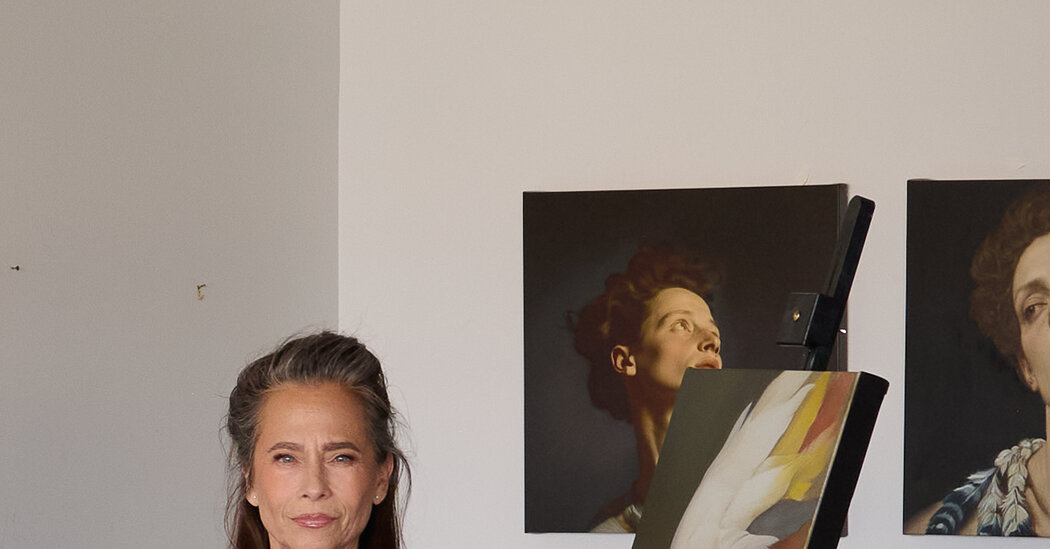
The handsome industrial architecture is what drew Jessica Helfand, an artist, writer and graphic designer, to the quarter. Looking for a live-work space where she could paint — an activity she took up full time only recently — she found it in a factory built in 1907 that later became a photography studio. Previously she had lived in a Brutalist house near New Haven, Conn., with her husband, William Drenttel, an entrepreneur, designer and publisher, and their two children. Drenttel died in 2013 of cancer. “I’m a real believer in second chapters,” Helfand, 66, said. “Because I’m on my sixth.”
In 2021, she commissioned Claire Weisz, a co-founder of the New York architecture firm WXY, to transform a 4,500-square-foot unit in the eight-story building into a place that could evolve with her.
“I’m working on a portrait of a child right now and I said to the grandmother who commissioned it, ‘When I paint children, I’m always aware of who the child is now and who they might become,’ because there’s nothing static about a portrait and certainly not about a child; it’s all about the promise of the future,” Helfand said.
An adaptive reuse project is the same, she went on: “You’re building it for now, but how are you going to accommodate not only your future needs, but what’s best for the environment, the building, your neighbors and the city?”
Weisz, who had worked with Helfand on her two previous homes, employed strategies associated with passive house design, such as the use of energy-efficient systems in a thermally tight building envelope to produce fresh air and consistent interior temperatures. (David White, of Right Environments, consulted on the thermal and air flow modeling.) Some people doubt that retrofitted antique buildings perform as well as contemporary ones, Weisz noted. “I wanted to prove that that wasn’t true.”
In doing so she was determined not to trade the architecture’s beauty for improved efficiency. “I saw it as a challenge,” Weisz said. “How do you get both character and climate?”
She began by gutting the loft. Among the jettisoned items were two walk-in safes left over from the building’s factory days. The floors and ceiling were thickly insulated and furnished with an air-and-vapor barrier to prevent heat loss and improve the home’s sound and air quality. An exposed brick wall was left intact because of its natural ability to regulate temperatures by absorbing and releasing thermal energy. Weisz would have upgraded the 27 windows, but the building’s management refused to allow replacements.
The loft’s asymmetrical trapezoidal shape and Helfand’s professional needs called for a strategic floor plan. The studio, which takes up a quarter of the total area, lies straight ahead of the entrance, on the north side of the building, with artist-friendly indirect light streaming in throughout the day. This room has heavy-duty vinyl tile floors (for comfort), a slop sink, track lighting and a pivoting wall on which artwork can be displayed gallery style.
On the southeastern side, the living and dining area and kitchen are brightened by an angled row of windows nearly 90 feet long. The primary bedroom is on the south side, and is entered through the library, or “portal,” as Helfand described it. She recalled that the first night she spent in her home, “I couldn’t sleep because I kept waking up to see the changing light, which is a very painter thing to do.” The unit has one guest room, located between the studio and storage area for privacy.
The décor is a minimalist composition of black, white and gray, with ebonized wood floors and a white-painted beamed ceiling that disguises mechanical systems within its sculptural form. “I always insist on a lot of texture if you’re doing simple,” Weisz said. An appreciator of objects that are not of-the-moment, Helfand adopted the Valcucine kitchen range from a showroom just as it was about to be replaced with a newer model.
When she relocated from Connecticut, she kept the baggage light: some books and artworks; a grandmother’s grand piano and Biedermeier chairs; a collection of vintage game boards, which adorns a guest room wall (Helfand once wrote an entire book about the spinners used in board games and other recreations); and the antique prints and medical ephemera inherited from her father, William H. Helfand, who was an expert in quackery.
As a result she has plenty of wall area to devote to her own work. Helfand, who is represented by Jim Kempner Fine Art in Chelsea, said she freely moves canvases between her studio and living space so that she can notice details she may want to change and sense when a work is finally complete.
Her current project is on the myth of Icarus. She was drawn to this story about ambition and defeat, she said, because it ranges across generations and cultures: “Everybody knows somebody flying too close to the sun.”
Everybody also knows the frustration of being tethered to the earth. In her previous house, Helfand painted in a room with poor light. Living in Litchfield County, Conn., before that, she used a basement playroom once her children aged out of it. Now her home and creative life are unified.
“I feel like I am a more authentic version of the person I wanted to be when I was 19,” she said.

