
By the end of the century, as many as 13 million American climate migrants could move inland from coastal areas because of sea level rise, according to research.
If those figures come anywhere close to being realized, it’ll be a bigger demographic shift in absolute terms than the Great Migration of African Americans out of the South and the Dust Bowl flight from the Great Plains.
Leaders in one city want to take in some of those migrants to help revitalize their area.
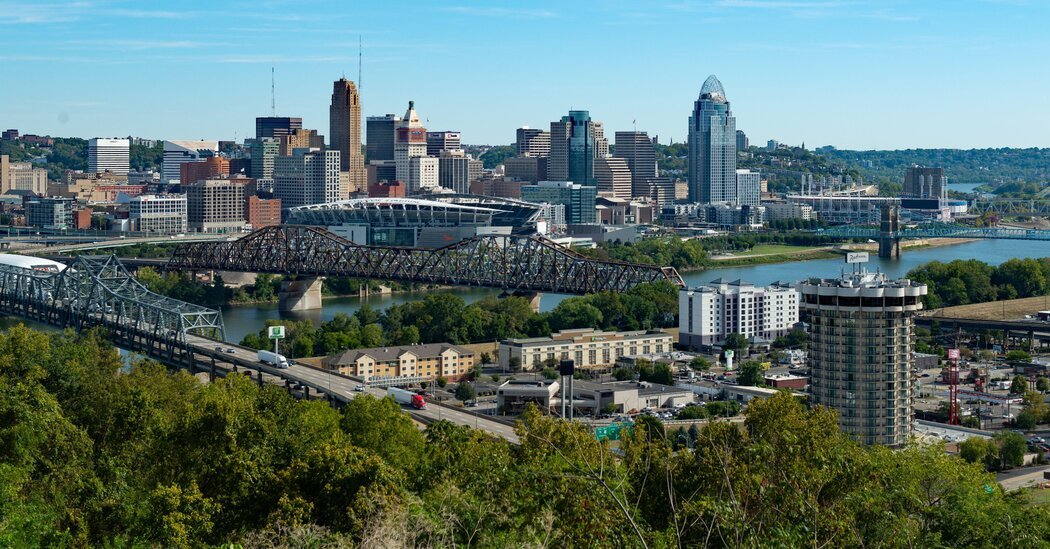
That city is Cincinnati. It recently came up with a Climate Migration Readiness Plan that lays out a blueprint for the metropolitan region to absorb as many as 525,000 newcomers by 2050. (That figure includes possible climate migrants and also accounts for “broader domestic relocation trends.”) It calls for building much denser housing, expanding public transit and decreasing the city’s reliance on fossil fuels. It also involves systematic monitoring of metrics that could presage population shifts, like distress in the housing insurance market.
Experts say the plan is a good opening bid in what could turn out to be a spirited competition for Americans displaced by increasingly common, and increasingly intense, bursts of catastrophic weather, including floods, wildfires and hurricanes.
“I think this is an important step forward, and it’s kind of a big one that probably a lot of cities could build on,” said Hannah M. Teicher, an assistant professor of urban planning at the Harvard Graduate School of Design who writes about climate migration and adaptation. She was not involved in preparing Cincinnati’s plan.
Cincinnati’s mayor, Aftab Pureval, said he was partly motivated by watching New York and Chicago struggle to accommodate migrants bused in from Texas after they crossed the border from Mexico in search of asylum during the second half of the Biden presidency.
“When you have tens of thousands of people show up overnight, it creates a crisis,” Mr. Pureval, 43, said in an interview.
An especially vivid preview of domestic climate migration came in 2005, when Hurricane Katrina devastated New Orleans. An estimated 100,000 to 300,000 people fled to Houston. The city welcomed the newcomers but, over time, tensions emerged.
After winning re-election last year, Mr. Pureval, a Democrat, assigned Oliver Kroner, the director of the city’s Office of Environment and Sustainability, to come up with a plan, which was made public in May.
Part of the strategy, a sweeping zoning overhaul, makes it much easier to build multifamily housing in a city that was, until recently, zoned mostly for single-family homes. A solar array is being built on the site of a former landfill. And, after years of planning, rapid bus transit will get started in 2027.
The zoning changes did not go through unopposed. Some community groups feared that allowing taller buildings and denser housing would dilute the character of neighborhoods, especially the residential Hyde Park Square area on the city’s east side, and lower the value of surrounding properties.
And Mr. Pureval and Mr. Kroner acknowledge that a climate migrant influx may never come to Cincinnati. As in the case of New Orleans residents after Katrina, research shows that displaced people tend to stick as close as possible to their former homes, for reasons that include financial restraints and social ties. Cincinnati may ultimately prove too far for people fleeing floods in Florida or fires in California.
In that case, they hope current residents will benefit from Cincinnati’s climate readiness plan, especially those who have already been dealing with heat islands, parks in disrepair and other vulnerabilities that wealthier residents have generally avoided.
Take the zoning overhaul, which could accommodate thousands of newcomers in multifamily apartment buildings. An increase in housing supply would also drive down prices for Cincinnatians, 29 percent of whom are rent-burdened, meaning that 30 percent or more of their income goes to housing costs.
If migrants do come to Cincinnati in large numbers, they would be less likely to exacerbate a process known as “climate gentrification” by displacing the people already living there.
Money from the sale of the Cincinnati Southern Railway, which yielded $1.6 billion for an infrastructure fund, is also going to projects like park rehabilitation, storm water management and traffic abatement. “Climate migration enables us to double down,” Mr. Pureval said. “This is the right thing long-term.”
That argument may politically insulate him if a migrant wave never materializes in Cincinnati. But whether it does or not, one thing is certain: Climate change is going to reshape the country. America’s aging infrastructure is bound to feel the pressure. Economic disparities could widen. And cities need to be prepared.
“We feel a lot of urgency,” Mr. Pureval said.
Europe’s summer of fire shifts southward
Greek firefighters were working to contain blazes on Crete, Lesbos and in the Peloponnese on Thursday. At least three firefighters have been killed in Greece, and thousands of people have fled their homes. Fires in France and Spain have been mostly contained, officials said.
Much of Western Europe is in the grip of an intense heat wave, the continent’s fourth since May. Officials have warned that a combination of prolonged dry weather, gusty winds, extreme temperatures and low humidity significantly increases the risk that new fires will ignite and spread quickly. Read the latest on the blazes.

