
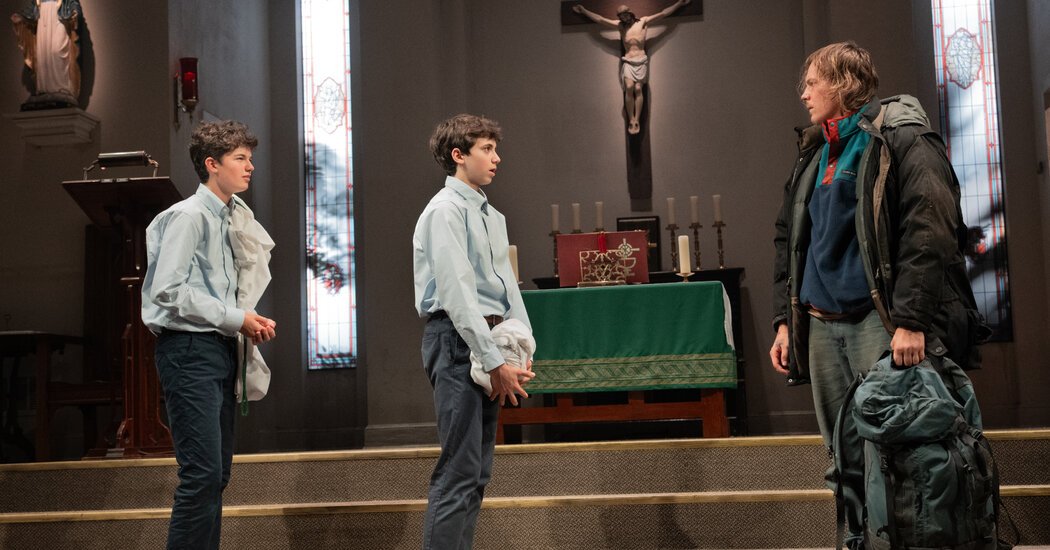
The Atlantic Theater Company’s Off Broadway main stage is a converted Gothic Revival parish hall. When the Atlantic turned the hall into a stage back in the ’90s, they kept its peaked wooden ceiling and air of contemplation. Now, for Bubba Weiler’s play, “The Saviors,” the little theater wants to be a church again.
In Jack Serio’s meticulous production, David Zinn’s set exactly recreates a Roman Catholic chancel: altar, baptismal font, stained-glass windows. Two bustling altar boys — 14-year-old Paul (Julius Rinzel) and 13-year-old Michael (Ivan Howe) — handle the ephemera, sorting bulletins and wielding candle snuffers before and after services. Despite their long white albs, they don’t exactly maintain a holy-of-holies attitude. They’re boys; everything is a race.
One of the waystations in their dash to adulthood is confirmation, the sacrament that binds a Catholic to the church. Michael, who is somehow much, much younger than his friend, cannot stop thinking about choosing his confirmation saint — wouldn’t it be cool if he picked Paul, and Paul picked Michael? He chatters on, thrilled to commit himself to God, an almost romantic surrender that’s tangled up in his intense feelings for Paul. Michael’s fervency troubles Paul in ways neither boy will name.
Weiler — now in his early 30s — wrote the first draft of “The Saviors” when he was 19, looking back on his own time as an altar boy. The actors Rinzel and Howe are around the same age as their characters, yet they confidently carry the entire evening. (They’re small miracles.) It’s a relief, even a thrill, to slough away the imitation adolescence we settle for so often onstage and perceive the real, awkward, thoughtful thing itself.
It wouldn’t be a coming-of-age story without a test of some kind, and so a stranger comes into their charmed circle, an itinerant named Julian (Stanley Simons). He needs literal shelter from a literal storm, but the character keeps blurring into allegory. Julian is also the name of the patron saint of hospitality, so we note which boy extends a welcoming hand. And Simons has been styled by the costume designer, Avery Reed, to look like a scruffy Jesus. He’s a drug addict; he’s a troubled guy. He’s forsaken.
Weiler is a gentle writer, occasionally to a fault. He and his go-to director Serio have already had one huge Off Broadway success this season with the poignant “Well, I’ll Let You Go,” about a grief-stunned widow. In that play, the dead husband narrates, and after a given period of mourning and revelation, he ascends, if you catch my drift, a staircase into death. It’s been a while since a playwright has been so sincere in his use of Christian imagery. (Imagine Samuel D. Hunter’s soulful realism, but with fewer details from the world as it is.)
Michael senses Paul pulling away from him, which he perceives as a religious crisis. He wants to rescue Paul from godlessness, while Paul wants to save Michael from the homophobia in their church. I did occasionally hope during “The Saviors” for more dramaturgical velocity, particularly as Weiler maps out this slow conflict of the boys’ caring clumsily for each other. Serio draws extraordinary performances out of the young men, but the division between sweetness and treacle can be thin.
Thank goodness, therefore, that there’s a fourth character: Judy (Crystal Finn), whose nervous attempts to lead a youth group — only Michael turns up — cover a deeper desperation. Finn, a downtown treasure, has huge Bette Davis eyes; she’s also the best actor alive at conveying daffy warmth. She gives Weiler’s play the comedy, and later the lacerating sadness, that it needs.
A playwright can’t name a character Judas without tipping his hand, but gosh, he comes close with the name Judy. In her, Weiler has written a character with a complicated relationship to betrayal. Judy has an adult perspective on Julian, with whom she has a secret connection, and on lying and charity. We’re never quite sure if she’s right. “Do you forgive me?” Julian asks her. “For what?” Judy says, which is either loving or unbearably cruel.
“The Saviors” as a text contains its own complicated relationship: It relies on its own ending in a way that rebalances the drama. There’s an (almost) final gesture, a gift from Michael to Julian, which indicates what will happen after the play’s time frame is over. This image lends a new weight to everything that’s gone before it; as I think about the show, it seems to blossom backward from that moment.
I was occasionally impatient with the production, but that feeling has dissolved as time has gone by. The more I realized that Serio and Weiler had diverted me with teenage drama from an adult horror beneath, the more I admired the 90 minutes I spent at the Atlantic. This may be a play that needs to be considered twice. And, anyway, that’s what a certain savior would say, right? It is better to live through some sorrows a second time, knowing what’s to come.
The Saviors
Through Aug. 15 at Linda Gross Theater, Manhattan; atlantictheater.org. Running time: 1 hour 30 minutes.

