
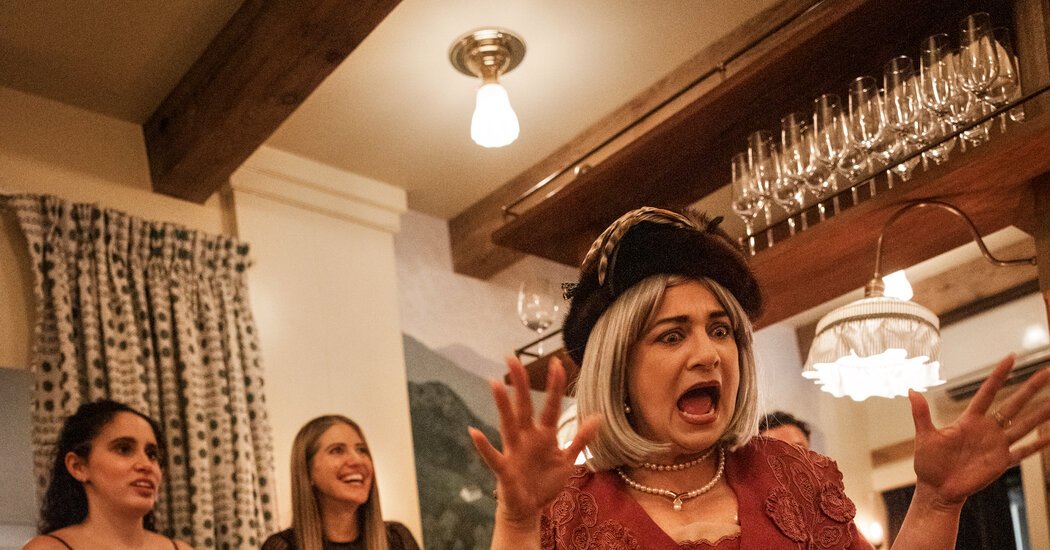
On a spring afternoon, I sat beside a burbling creek and waited for someone to die, violently.
This was at the Six Bells Countryside Inn, an 11-room Hudson Valley guesthouse and tavern that opened last year in Rosendale, N.Y. A boutique hotel, it is the beautifully appareled brainchild of Audrey Gelman, an entrepreneur best known as the co-founder of the Wing, a club and co-working space tailored to women.
The Wing imploded during the pandemic — a consequence of both the lockdown and accusations that workers, particularly those of color, had not been treated fairly. Those spaces were synonymous with a particular aesthetic, a plush minimalism. Six Bells, which has modeled itself on a wholly fictional inn in a wholly fictional English village, prefers lightly macabre cottagecore maximalism. Imagine the Vermont Country Store catalog as illustrated by Edward Gorey.
Like a lot of hotels where a room can run upward of $600 per night, Six Bells sells a fantasy. Do most of those fantasies involve murder? Gelman’s does.
A fan of theme parks and tourist traps, she loves the feeling of immersion they provide. Long before Six Bells opened, Gelman began building out its lore at its sister shop, an upscale Brooklyn home goods store that opened in 2022. In that telling, Six Bells is located in Barrow’s Green, a quaint English town forever suspended in a pastoral fantasy sometime after the invention of electric light and before athleisure.
If you are wondering how someone like Gelman, who once sat at the petal pink center of intersectional feminism, ended up here, where the power wielded by women is exclusively soft and often in an attractive tartan, better just to accept it. And then maybe buy a Six Bells pillow embroidered with feminist mottos. Once the inn was up and running, in June 2025, Gelman began planning an immersive experience: a murder mystery evening that would happen once a month.
“It is just a fundamental yearning people have, particularly as they get older, to have these experiences where they feel like they can be kids again,” Gelman said in a recent video call. “I believe in these playful experiences for adults where they get to be silly.” And at least one adult gets to pretend to be dead, a consequence of an obscure poison.
Immersion is a recent trend in hospitality, a way to make a hotel experience feel distinct. The Marc & Rose Hospitality brand has partnered with IAMA Theater Company in Los Angeles to create theatrical events for each new opening. Hotels as varied as the Legoland properties and the Pierre offer theme dinners, bonfire nights, magic shows.
To assist, Gelman reached out to the theater company What May Come Immersive, having seen its work at the Harry Packer mansion in Pennsylvania. Gelman introduced Sarah Sutliff, the theater company’s artistic director, to the lore, and then gave her free rein to create a classic murder mystery.
“That was a very fun task because we tend to do very dark, very serious hyperrealism,” Sutliff said. Though this was on a separate call, weeks apart, Sutliff echoed something Gelman had said: “Adults don’t have enough opportunities to play.”
Me, I love to play. And if you hand me a book, as someone did on that terrace, that is not actually a book, but a book safe, containing an invitation to a dinner held by Lady Ashbourne, the society maven of Barrow’s Green, I will swoon. This was how the mystery began.
The invitation encouraged attendees to “dress to impress,” so after dropping an overnight bag in Lamplight, a room designed to honor the forbidden love between a vicar and a noblewoman, I changed into something less comfortable. The room’s amenities included a Barrow’s Green newspaper and a shopping guide ensuring that if a wealthier me wanted something in the room, like a quilt or a candleholder, I could have it. Then I went downstairs to the tavern to await the start of “Death for Dinner.”
The cocktail hour was awkward and the 20-some guests, who had interpreted cocktail attire as encompassing everything from gowns to Keds, socialized stiffly. In the candlelit dining room (the gift shop repurposed), the mood loosened and a few guests gamely ad-libbed with the actors. The setup was a dinner thrown in honor of Thomas Beresin, a psychoanalyst who had recently moved to the village. There were hints of marital troubles, rivalries, love affairs. Unexpected guests arrived, to twist the plot further. But everyone stayed alive through the first course, past the entree and into dessert, served in the tavern.
Then at last someone died, and guests were given 15 minutes to question the suspects and solve the mystery.
Reactions among the guests varied. Some were eager — extremely eager — to play detective. “That’s too obvious!” a woman in black lace shouted while dismissing one theory. Others, like a table of young women who were all separately on their phones, were less absorbed. An amateur Poirot, with an assist from his wife, briskly identified the killer. Then the actors changed out of their costumes to mingle and pose for selfies, murder forgotten.
The mystery itself had been a little ridiculous, the acting deliberately showy, which made it a match for the quilt-forward, silk-tasseled space. What was remarkable was the effect on the guests. After the show, most of them stayed in the bar for hours, some of them in their pajamas, chatting like old friends. I know so much about these people now! Their marriages, their dating lives, their children, their careers. Phone numbers and emails were exchanged. As I went up to bed, one woman was trying to convince another to go out on a date with a friend of hers, whom she swore was not too short.
At $400 per meal, irrespective of lodging, I wouldn’t describe the dinner and show as good value for the money. But few of the guests seemed especially budget-minded and the evening provided an amenity that few hotels can: a feeling of community. All it took was a little after-dinner poisoning.

