
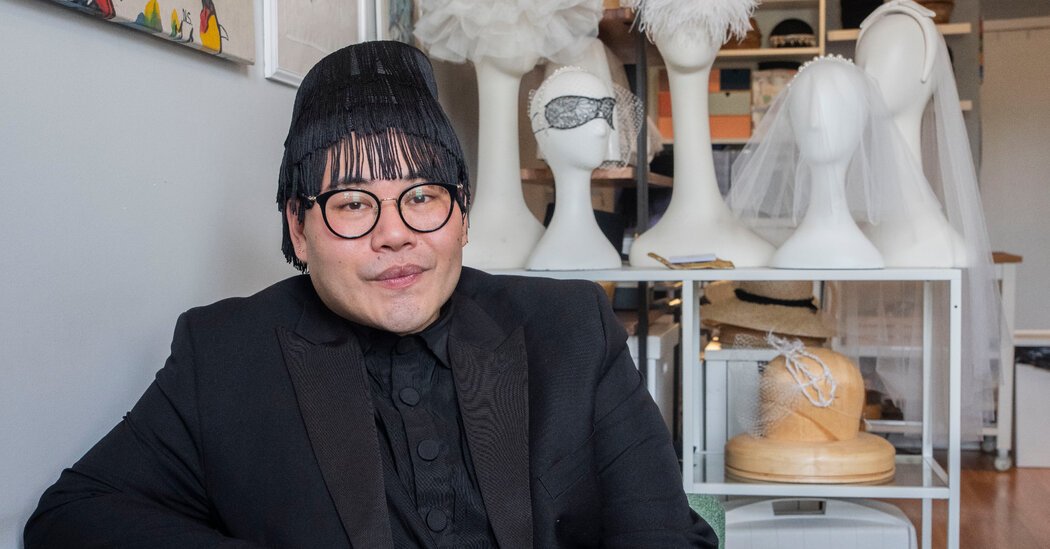
Rowell Concepcion never made it to medical school.
Born in Rancho Cucamonga, Calif., Concepcion veered off the pre-med track after taking a few sewing courses at nearby Chaffey College. He soon headed East, landing at the Fashion Institute of Technology in New York, where he studied millinery and quickly realized he possessed a knack for the centuries-old craft.
“After making my first hat, I just knew, this is it,” Concepcion, 38, said. “I’m actually attuned to this and I’m good at it.”
Initially, Concepcion, the son of Filipino immigrants, aspired to amplify his community and culture, honoring a commitment he had made to his father, who died during the Covid-19 pandemic in April 2020. Concepcion debuted Binata Millinery that August, combining his formal education with his appreciation for Filipino craftsmanship and his whimsical design eye. (“Binata” means bachelor in Filipino.)
Now in its sixth year of business, the brand, which is based in Ridgewood, Queens, has established itself as a must-wear millinery house that’s been donned by the likes of Kerry Washington, Rosalía and Wunmi Mosaku.
But before he became an in-demand hat maker crafting headwear for magazine covers and red carpet appearances, he was cutting his teeth in the bridal space, taking custom orders for brides-to-be — something he still does.
One of his brides, Kemba Geoffroy, 36, who lives in the Bronx, didn’t want “a costume change,” as she put it, but sought out versatility. Concepcion crafted a tiered Juliet cap with cascading silk chiffon scalloped edges for Geoffroy, who was married last September at the Riverdale Yacht Club in the Bronx. “He’s so skilled, very efficient and really understood what I wanted,” she said.
Earlier this year, Concepcion debuted at the Smithsonian Craft Show in Washington, D.C., and Nordstrom began selling his hats. Select Binata bridal designs are now available at the retailer.
The interview was edited and condensed for clarity.
It seems like 2026 is shaping up to be a big year for bridal hats, à la Dua Lipa, who wore a wide-brimmed version by Stephen Jones at her recent wedding to Callum Turner. What are your observations about this evolution?
A lot of brides are going back to traditional millinery, but with a twist, like Juliet caps. I’m using traditional things like buckram and a French lining on the inside — you can also do this in blue for “something blue.”
How does your Filipino heritage show up in your designs?
A lot of the materials I use, like sinamay and abacá, are native to the Philippines. Sinamay is used in a lot of derby style hats. I thought maybe this is the way forward: Build this business, then I can start employing artisans in the Philippines, teaching, training, employing, however I can help. Before, it was me doing everything. I made over 1,000 hats myself.
A thousand hats in what time frame?
Oh, it was the first two years. I was not sleeping. It felt like fashion school. Lady Gaga’s team asked me to make a hat for her Vegas residency in September 2023. When they first called and got in touch, I didn’t think it was a real call. And it was such a huge learning curve because they were like, “Can you overnight this in two days?”
That piece was also made with scraps — I think the Filipino spirit is about being resourceful. That’s what I’m used to seeing. If something doesn’t work out, you find another way.
My mom’s dream was to have a restaurant. On the side, she would cater. I grew up helping her — cooking, making things with my hands. When I think about my business, it literally feels like what my mom did with catering.
Describe your collaboration process with brides.
Most of my brides don’t lead with the hat; they’ll almost always have the dress first. If it’s a summer or fall wedding, we’ll pick materials based on that. I’ll do a few sketches and take it from there. Usually, I can turn around pieces within a month or two.
The brides that come to me seems to be similar in character — they love supporting artisans and definitely want something unique. I can tell the art vibe is always there; they work in an art-adjacent field or wanted to be in the arts.
Hats used to be a mainstay in women’s wardrobes, then they fell out of fashion. How would you characterize this moment we’re in now?
When pill boxes started rising last year, that was also serendipitous for my business because the pillbox is what I started with. I was researching this — about 70 percent of faces in the world are oval. Almost every hat should flatter an oval face, so when people tell me, “Oh, hats don’t look good on me,” I’m just like, it probably does.
I had someone buy a special occasion piece with feathers on it. She said that instead of taking a car back from her event, she took the subway to get more compliments. When people wear hats, people just naturally come to you and gravitate to you, without you having to push for conversation.

