
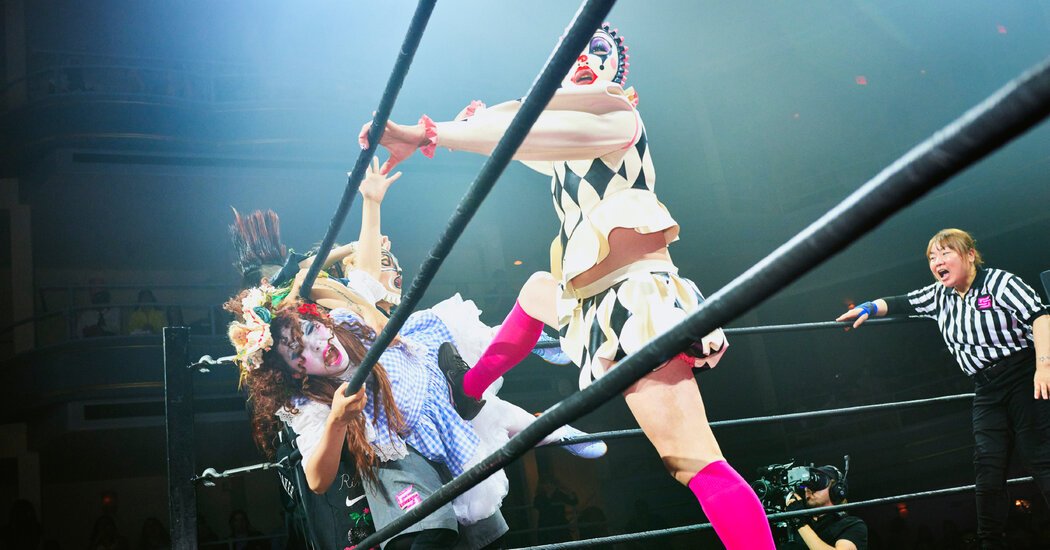
The scene backstage at the Hammerstein Ballroom in Manhattan had all the telltale signs of fashion show prep. On an afternoon in mid-May, dozens of people hummed around, getting the girls into first looks. Pat McGrath’s team was on makeup, painting faces with elaborate clownish and punk expressions. Dennis Lanni was on hair, shellacking a split mohawk into two stiff vertical blades. Stephen Jones had created elaborate hats, including a blue Marie Antoinette-inspired headpiece made with white ostrich feathers. Mei Kawajiri was on nails, applying strawberry-themed tips that needed to be short and relatively simple.
At the center of it all was Olympia Le-Tan, the creative director. Dressed in a black-and-white ensemble of Comme des Garçons, Alaïa and Nike Rifts, with a watch belonging to her father, the illustrator Pierre Le-Tan, strung round her neck Flavor Flav-style, she looked like a fashion referee, surveying the racks of clothes to ensure every look was up to code.
Something was missing. A mini petticoat. “We need it to make Delirious Dolly’s skirt fan out,” Le-Tan said.
A few hours later, Delirious Dolly and her skirt were lying flat out on the ballroom floor between a catwalk and a wrestling ring. She had been leveled by a moonsault — a backflip off the ropes, in wrestling parlance — delivered by a woman going by the name Supersonic, wearing a ruffled latex mask with pig ears. A sold-out crowd, which included the model Lila Moss and the photographers Gray Sorrenti and Craig McDean, looked on and cheered.
It wasn’t technically a fashion show. It was more like fashion wrestling. And it’s called Sukeban.
Fashion history is littered with designers who left the brands they founded and lost the rights to their name when business partnerships soured. Some, like Zac Posen, go on to design for mass retailers. Some change their name. Hervé Léger became Hervé Leroux. But only one, Olympia Le-Tan, has co-founded a Japanese women’s wrestling league.
“I never saw this happening,” Le-Tan said over cake and coconut water at her Lower East Side apartment a week after the Hammerstein Ballroom match. “I was never a wrestling fan. Even now, I’m not a fan of wrestling. I’m a fan of our wrestlers.”
Sukeban is the brainchild of Le-Tan and her partners, Ian Fried and Alex Detrick, her brother-in-law. Envisioned as a hybrid of fashion, beauty, manga, anime and women’s sports, the league follows all the tropes of classic professional wrestling. There are characters, story lines, vicious rivalries. Named for the Japanese girl gangs of the 1960s and ’70s, Sukeban, in Le-Tan’s hands, has experienced a glow-up to the standard of high-fashion editorial. There’s the hair, the makeup, the costumes and the championship belt designed by Marc Newson.
The league’s inaugural fight was held in New York City in September 2023. Sukeban has since traveled to London, Miami, Berlin and the Anime Expo in Los Angeles, where it will return in early July. The production values have escalated along the way. The May fight in New York City was Sukeban’s most ambitious yet. Production was handled by La Mode en Images, which mounts fashion shows for Louis Vuitton, Balenciaga and Loewe.
Paris is on the list, and the league hopes to eventually go to Tokyo, where the stakes are considerably higher. “We’ve been trepidatious because they have such a rich history of wrestling in Japan,” Fried said.
The plot twist in Le-Tan’s story is not as far-fetched as one would imagine. Le-Tan, 48, was born in London and raised in Paris by her French Vietnamese father and English mother. She got her start in fashion in the ’90s when Gilles Dufour, Karl Lagerfeld’s studio director for 15 years, hired her at Chanel. Dufour, a collector of Pierre Le-Tan’s work, met Le-Tan as she drew in her parents’ kitchen. She recalled that he said: “What are you doing? Oh, do you draw? Do you want to work in fashion?”
Le-Tan made her name with a line of charmingly hand-embroidered book clutches made to look like the covers of titles like “Lolita” and “Moby-Dick.” She left the company in 2018 amid an acrimonious split with the controlling shareholder and chief executive, who continues to run the business. (Le-Tan is currently in litigation to reclaim rights to her name.) She moved to New York City to work for Marc Jacobs, freelanced around a bit and developed a short-lived home goods line. Then in 2021, Detrick called with a proposal: Did she want to design costumes for a wrestling league?
Initially, Le-Tan saw the venture as a great way to ruin her reputation. “I can’t suddenly go from Marc Jacobs to wrestling,” she said. But she surveyed friends in Japan, where she had lived and worked as a D.J. “They were like, ‘No, actually you could make it cool, and then it would be genius,’” she said.
The wrestling connection was a matter of two degrees of separation. Detrick is an adviser at Supreme, a brand that bridged skate culture and fashion to become a global phenomenon. Of Sukeban’s founders, Fried is the wrestling connoisseur and has a background in sports, entertainment and politics. (He worked for New York City’s Economic Development Council during the de Blasio administration.) He also did a stint as an independent pro wrestler under the name Orion Dove.
Japan, along with the United States and Mexico, is a professional wrestling capital. The modern era of Japanese wrestling dates back to the post-World War II period when Rikidozan, the country’s first wrestling superstar, rose to fame by obliterating foreign opponents in front of local audiences whose morale had been decimated by the war. Women’s wrestling had similar postwar origins. It grew with its own idols and fan base and peaked in the ’80s. Several leagues still operate in Japan but not with the level of production to which Sukeban aspires.
“They’re basically wearing typical wrestling metallic Lycra bikinis,” Le-Tan said. “They do their own makeup. There’s no fancy lighting. There’s no added effort. It’s basically just women fighting.”
Le-Tan and her partners set about building the world of Sukeban. First, they needed a story. The league is divided into smaller girl gangs based on neighborhoods in Tokyo, each with its own aesthetic, identity and subculture. The Dangerous Liaisons, who take after the neighborhood Ginza, are posh and evil. The Harajuku Stars are kawaii good girls. The Cherrybomb Girls, à la Shibuya, represent a sporty, hip-hop club scene. The Vandals are punk outcasts and based on Shinjuku. Nakano Broadway, a mall in the Nakano neighborhood devoted to otaku, or highly specific hobbies, spawned the Tokyo Toys. Delirious Dolly, a sort of broken Dorothy from “The Wizard of Oz,” is a member.
Also essential to starting a Japanese women’s wrestling league: Japanese wrestlers. Fried recruited Keiko Aoki, a.k.a. Bull Nakano, a mainstay villain of All Japan Women’s Pro-Wrestling in the ’80s and ’90s, as Sukeban’s commissioner. Nakano advised on strategy and choreography. Casting the highest caliber of pro-wrestlers who were also willing to perform suplexes and pile drivers in pink latex “Sailor Moon” garb was not a problem. Many were lured by the promise of travel.
“Most of them didn’t have passports,” Le-Tan said. Taking the show on the road was crucial. Nakano advised against introducing Sukeban in Japan, suggesting instead that they build it up in other markets first.
“There’s always been a long-term plan,” Le-Tan said. “Take it on tour, build the I.P. through manga and anime, work with all these different partners and turn it into a mega-brand.” Sukeban has teamed up with TikTok, Nike, MAC and Starface.
Sukeban merch is already sold at the fights. But Le-Tan has a vision for a fashion line derived from the wrestlers’ costumes. “The dream is to open a dojo shop in Tokyo with a ring in the middle where you can watch the wrestlers training,” she said. “There’d be a little coffee shop there, too, with Sukeban-themed cakes and mini-collections for each stable — one goth, one punk, one kawaii.”
It doesn’t sound so different from designing a collection, having a runway show and sending the merch to a store.
“Well, there’s the athletes,” Le-Tan said. “They’re wearing it and performing it. They’re the expression of it.”

