
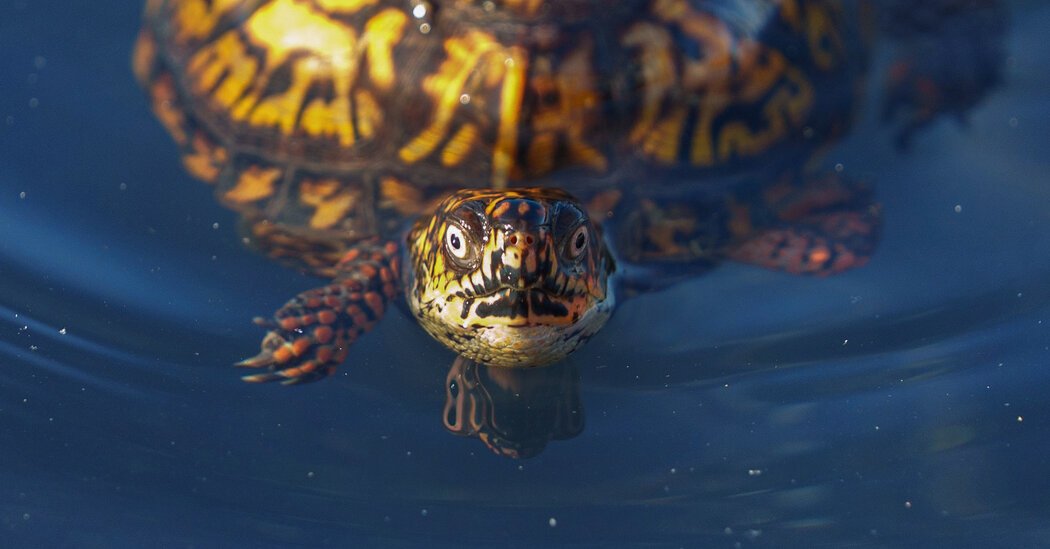
Turtles are weird. They move around in their own armored sanctuary, have adapted to living on land and in water and are among the longest-living animals on the planet. Their anatomy is so unusual that it’s difficult to pinpoint where they belong on the tree of life. Where do they come from? Who, scientists would love to know, is their common ancestor?
Many paleontologists have asserted that turtles originated with an ancient reptile, Eunotosaurus africanus, which lived 260 million years ago and had a broad set of ribs that later developed into a shell. Other studies that focused on genetic evidence, however, have suggested that turtles are actually more similar to crocodiles and birds, and may share a common ancestor with them.
“Turtle origins have always been a tough nut to crack,” said Xavier A. Jenkins, a postdoctoral fellow at the American Museum of Natural History in New York City.
In a new study in Current Biology, Dr. Jenkins and his colleagues claim to have resolved the longstanding debate. They suggest that turtles are not holdovers from the ancient Eunotosaurus, but are instead members of a group of reptiles called archosauromorphs that also includes ancient birds, crocodiles, pterosaurs and dinosaurs. And this time, the researchers have the anatomical evidence to match the DNA.
When turtles first evolved, the world was just emerging from the Permian-Triassic extinction event, the largest mass extinction that Earth had ever seen. Reptiles were fanning out across the Pangea supercontinent in a rapid succession of new forms. Within 40 million years, turtles would radically change: Their unusually wide ribs would fuse together to form a shell; their vertebrae, shoulders and internal organs would completely reorganize; and their skull, neck and legs would become retractable.
These drastic changes have meant that there are a lot of possibilities to consider for the ur-turtle.
In total, Dr. Jenkins and his team examined 226 ancient turtle, archosaur and Eunotosaurus specimens to look for characteristics that would classify them as either turtles or not. The researchers used an X-ray technology to go inside of each fossil and digitally move bones that obstructed their view.
Then, they compared all known specimens of Eunotosaurus with archaic turtle specimens, like Proganochelys, which lived 210 million years ago and was one of the first turtles to have a shell, and Pappochelys, which lived 240 million years ago and had bones on its belly that were fused together but no top shell.
The researchers found that in the earliest turtles and other archosaurs, like crocodiles and birds, the cases that formed the protective barrier around the brain, had a bone called a laterosphenoid, which connects the side of the brain to the top of the skull. Eunotosaurus and early reptiles lacked this bone, as well as a hooked fifth metatarsal, located on the foot.
Turtles, ancestral birds and crocodiles also have a free-floating stapes, a rodlike bone found in the ear that allows for more complex hearing. Early reptiles like Eunotosaurus had a thicker stapes that was firmly attached and made for a poor sense of hearing.
Taken together, these observations show that the earliest turtles “have lots more similarities to birds and crocodiles than we previously thought,” said Jonah Choiniere, who worked on the study and is a professor of comparative paleobiology at the University of the Witwatersrand in South Africa. Their skulls, hearing and feet all point to archosaurs as a common ancestor.
But as comprehensive as the paper might be, it hasn’t yet quieted the origin debate among paleontologists.
Tyler Lyson, a vertebrate paleontologist at the Denver Museum of Nature & Science who was not involved in the study, said he doesn’t agree that Eunotosaurus was not a turtle (he published that it was, in 2016). But he said he still welcomes the research: “Ultimately, I don’t agree with their conclusions, but it’s a good step forward in the debate.”
Spencer G. Lucas, a paleontologist and curator at the New Mexico Museum of Natural History and Science who was not involved in the study, favors the idea that Eunotosaurus was not a turtle. But he doesn’t think that the half-shelled Pappochelys was either, and he isn’t yet enthusiastic about putting turtles in with archosaurs.
But he, too, applauds the research, and says that the reasons we love turtles are also what makes them hard to categorize. In the end, he said, “turtles are just so bizarre.”

