
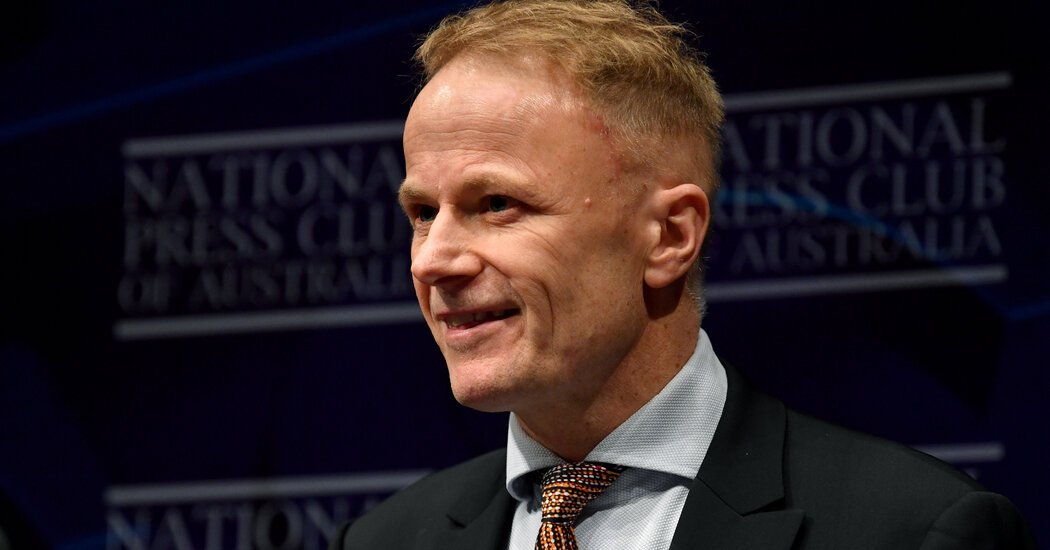
Dr. Richard Scolyer, a world-renowned Australian pathologist whose research into melanoma broadened the medical community’s understanding and diagnosis of what is called the country’s national cancer because of its prevalence, died on June 7 in Sydney. He was 59.
His death was announced by Anthony Albanese, the prime minister of Australia, who said that Dr. Scolyer would receive a state funeral.
In 2023, Dr. Scolyer was diagnosed with advanced glioblastoma and lived well past the median survival time of about a year for the aggressive brain cancer. In the three years since, he described the course of his experimental immunotherapy treatment on social media and in nationally televised interviews and also wrote “Brainstorm,” his 2024 autobiography, with the journalist Garry Maddox.
“The cancer specialist who became his own subject, Professor Scolyer walked his uncertain path, as he called it, with courage, determination and grace and his legacy will always be with us,” Mr. Albanese said after Dr. Scolyer’s death.
Like many Australians, Mr. Albanese had been aware of Dr. Scolyer’s melanoma research and the coverage of his brain cancer and treatment. In 2025, Mr. Albanese announced the Australian government’s contribution of $5.9 million to establish the Richard Scolyer Chair in Brain Research at Chris O’Brien Lifehouse, a cancer-treatment center in Camperdown, a suburb of Sydney.
For more than 20 years, Dr. Scolyer specialized in studying melanoma — the deadliest form of skin cancer — at Royal Prince Alfred Hospital in Sydney and at the nonprofit Melanoma Institute Australia, in Wollstonecraft, a suburb of on Sydney’s Lower North Shore. Melanoma is the third-most-diagnosed cancer in Australia, largely because of sun exposure to its mostly fair-skinned people.
At the melanoma institute — where Dr. Scolyer was one of its medical directors for seven years, until 2025 — he helped develop and run its Biospecimen Bank, a collection of samples from the body’s organs and fluids that are used for research. He was a leader of the institute’s Australian Melanoma Genome Project, which is mapping the melanoma genome to discover the genetic mutations that cause it. And he also consulted on melanoma diagnoses with clinicians inside and outside Australia.
“His knowledge was vast, his skill exceptional, with an unparalleled eye for accurate tissue diagnoses and the precision to apply decades of experience where it mattered most,” Dr. Georgina Long, the institute’s medical director, said in a statement.
Dr. Scolyer was known for research that illuminated why melanoma spreads to the brain and that identified the molecular, immune and pathological features that can predict patient outcomes even more effectively, according to the Melanoma Research Alliance in Washington, which funded some of his research.
“Pathology is viewed as a diagnostic specialty,” Stephanie Kauffman, the president of the alliance, said in an interview. “But he demonstrated that pathology could be predictive and that melanoma tissue could help us understand treatment response, what type of treatments we should be using, and the recurrence risk. That is probably one of his greatest legacies.”
In 2024, Dr. Scolyer and Dr. Long, his colleague at the melanoma institute, were named joint Australian of the Year for trailblazing work that has helped raise the five-year survival rate for advanced melanoma from below 5 percent to more than 50 percent.
“Sadly, everyone knows someone with melanoma,” Dr. Scolyer said when he accepted the award. “It’s as Aussie as our golden beaches and our sweeping plains. We’re the melanoma gold medalists. But this is not a gold medal to be proud of. In most cases, melanoma is preventable with sun-safe behavior, and prevention is always better than a cure.”
Richard Anthony Scolyer was born on Dec. 16, 1966, in Launceston, a city in the Australian state of Tasmania. His father, Maurice, was an auto electrician, and his mother, Jenny, was a school teacher.
Richard was 3 when his mother had the first in a series of strokes and 12 when his father had a skin graft to treat what was thought to be a melanoma on his chest. (It turned out to be a benign mole, Richard discovered years later when he asked for a copy of his father’s slides and pathology report. The correct diagnosis had been reached only after the ultimately unnecessary surgery.)
After earning a bachelor’s degree in medical science from the University of Tasmania in 1987, he stayed on and received two more bachelor’s degrees, in medicine and surgery, three years later.
In the 1990s, he explored various medical disciplines at hospitals in Australia and Britain before becoming a pathology trainee and then a senior staff specialist in anatomical pathology at Royal Prince Alfred Hospital in Sydney. He began his association with the melanoma institute in 2001 and earned his medical degree in 2006 from the University of Sydney, where he also taught.
Dr. Scolyer was a sought-after collaborator in melanoma studies and published more than 800 peer-review journal articles.
“He certainly was present in some of the most important global clinical trials on immunotherapy for melanoma,” Dr. Jedd Wolchok, an oncologist who specializes in melanoma and who directs the Sandra and Edward Meyer Cancer Center at Weill Cornell Medicine in Manhattan, said in an interview. “Now we’re treating people at earlier stages of disease with immunotherapy.”
In addition to his parents, Dr. Scolyer is survived by his wife, Dr. Katie Nicoll; three children, Emily, Lucy and Matthew; and a brother, Mark.
Dr. Scolyer was at a medical conference in Krakow, Poland, in 2023 when he had a seizure, which led to being diagnosed with a brain tumor. He correctly surmised that it was a glioblastoma, the worst possibility.
“I knew it was incurable, and I was distraught and angry to be facing certain death,” he wrote in “Brainstorm.”
In Sydney, Dr. Long devised a plan, which had been informed by her success in treating patients with advanced melanoma that had metastasized into their brains. Like those patients, Dr. Scolyer received a cocktail of immunotherapy drugs first — to activate the body’s immune system to fight his brain cancer — followed by surgery, radiation and a personalized cancer vaccine to further boost his immune system.
“Having helped develop a protocol to assess the pathological response to immunotherapy before surgery,” Dr. Scolyer wrote, “I’d seen the follow-up data on these melanoma patients. Knowing how well they had responded filled me with hope.” He also knew that the drugs could be toxic or shorten his life.
After the treatment, he had a strong immunological response and clear brain scans, although there is no certainty that the pre-surgical immunotherapy was the reason. In 2025, the cancer returned.
“It’s heartbreaking,” he told an Australian TV reporter, who interviewed him periodically. “I’m not ready to die.”
Two of the three drugs that Dr. Scolyer received before surgery are being used in an ongoing clinical trial in the United States and Australia to determine if they can improve the treatment for patients with newly diagnosed glioblastoma.
“It takes a long time to get trials over the line, but to be actually recruiting patients in the United States — and hopefully here soon — means we can test out the drugs to see if they actually make a difference,” Dr. Scolyer told The Brisbane Times earlier this year.
Dr. Mustafa Khasraw, the deputy director of the Duke Cancer Institute Center for Cancer Immunotherapy, ,is the principal investigator of the trial in the United States. “Progress will require us to think beyond convention and pursue new ideas and innovative treatments,” he wrote in an email.
“While it is difficult to find meaning in such a devastating diagnosis,” he added, “Richard’s experience helped raise awareness of the challenges faced by patients with glioblastoma and the importance of continuing to push the science forward.”

