
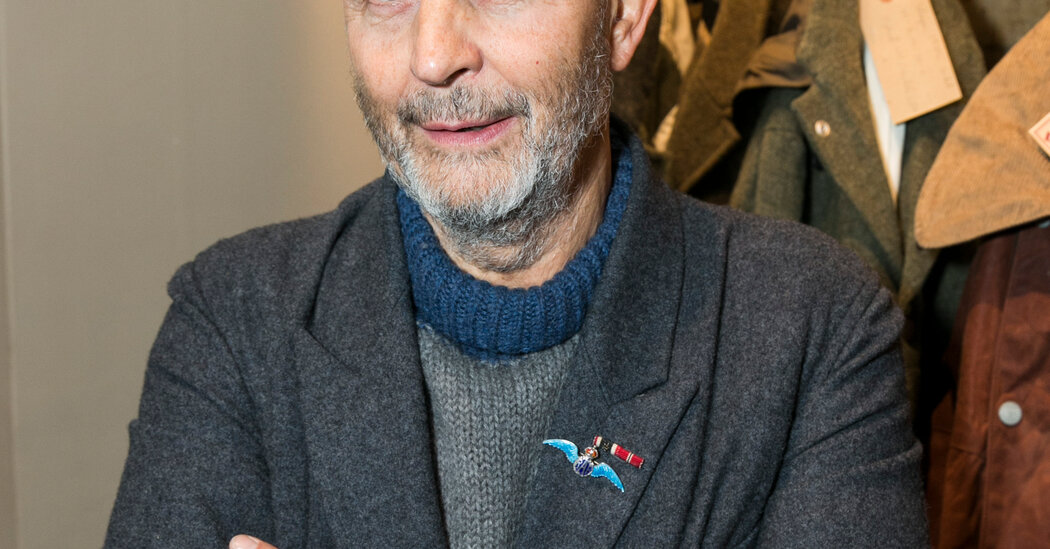
Nigel Cabourn, a British clothing designer whose fascination with heritage materials, vintage Army outfits and rugged work wear made him a venerated figure in men’s fashion, died on June 11 at his home in Newcastle-upon-Tyne, England’s northernmost city. He was 76.
His daughter Sophie Cabourn, an owner of the vintage retailer Re:Bourn, said the cause was prostate cancer.
Mr. Cabourn was part of a wave of British designers who emerged in the late 1960s and early 1970s, including Vivienne Westwood, Margaret Howell and Paul Smith. But while many of his contemporaries gravitated toward the cosmopolitan rush of London, Mr. Cabourn never left northern England, where he was born.
That choice was reflected in his aesthetic: Durable fabrics, muted colors and a certain timeless quality defined the Cabourn look. Most of his garments were (and still are) made in Britain, usually in small workshops or time-tested garment factories.
“I go to great lengths to find manufacturers who make those real clothes,” he told the blog Manufacture & Industry in 2011. “Our cold-weather parkas were worn in the war, and I sourced out the original manufacturer. It makes it really special and authentic. I want it real. Not fashion.”
At his studio in Newcastle, he amassed some 4,000 items of vintage clothing, along with countless books, magazines and advertisements tucked into floor-to-ceiling cupboards. (His studio also held a tournament-size table-tennis table.) All of it provided creative fodder for his collections.
Mr. Cabourn relished rough-hewed, functional fabrics like Harris tweed and Ventile, a water-resistant cotton weave used by the Royal Air Force in World War II.
He insisted that he was indifferent to trends, and for decades he had a niche following. But in the mid-2000s, the growing appeal of products with a sense of heritage and authenticity — as well as a broadening, almost obsessive interest in details and materials — allowed him to move into the mainstream.
“A lot of guys on men’s forums were into Nigel Cabourn, because he would make stuff out of British Ventile, and then people would be like, ‘What’s British Ventile?’” Derek Guy, a men’s wear writer, said in an interview.
Mr. Cabourn went to great lengths to find inspiration. While planning a 2003 collection to mark the 50th anniversary of Edmund Hillary’s conquest of Mount Everest, he flew to Christchurch, New Zealand, to inspect the parka that Mr. Hillary had worn. The resulting garment, almost identical to the original, became the core of his Ascent of Cabourn collection.
“I’m like a big, giant sieve of history, and I turn it into clothes,” he said in an interview for Sneak in Peace, a luxury shoe site, that was posted after his death.
Nigel John Cabourn was born on Oct. 7, 1949, in Scunthorpe, in north central England, and moved with his family to Peterlee, outside Newcastle, as a child. His mother, Edith (Polwin) Cabourn, worked in the local post office, where his father, John, was postmaster.
He became interested in clothing design as a teenager; his first piece was a pair of pants made from his mother’s curtains. He started his first company, Cricket, while studying at the Newcastle College of Art and Industrial Design (now part of Northumbria University) in the early 1970s.
Fashion, as he recalled, was everywhere — in music, antiwar protests and the Vietnam War itself. He was especially taken with the oversize pockets on the fatigue jackets worn by U.S. Marines.
“I was very lucky,” he said in a 2023 interview with The Heritage Post. “Between ’67 and ’71 there was flower power, British and English pop music, there was the Vietnam War, and I was in fashion school studying clothing to work in fashion. Most of the things that inspired me back then led to fashion design.”
Still, much of his early work stuck close to the Day-Glo mainstream of the 1970s. His aesthetic began to evolve in 1978 when Mr. Smith, a former employee who had recently visited Paris, returned with a British military jacket.
“Paul said to me, ‘Nige, this is what you should do,’” Mr. Cabourn told The Heritage Post. “‘You should make army jackets like this.’”
In the mid-1980s, he changed his company’s name to Nigel Cabourn, in part to signal the shift in direction. Around the same time, his clothing began selling briskly in Japan, where he now has 11 stores.
Mr. Cabourn’s first marriage, to Val Smith, ended in divorce in 1983. He married Janet Bell in 1987. An owner of the Nigel Cabourn company, she plans to continue running it.
In addition to her and their daughter Sophie, Mr. Cabourn is survived by two children from his previous marriage, Ben and Lucy Cabourn, and three grandchildren.
Even after the fashion world moved on from its heritage focus in the 2010s, Mr. Cabourn remained fixated.
“Function and quality is key to me,” he told Manufacture & Industry. “I want it to last forever. Everything made by Cabourn has huge longevity; it’s something you can pass down to your kids.”

