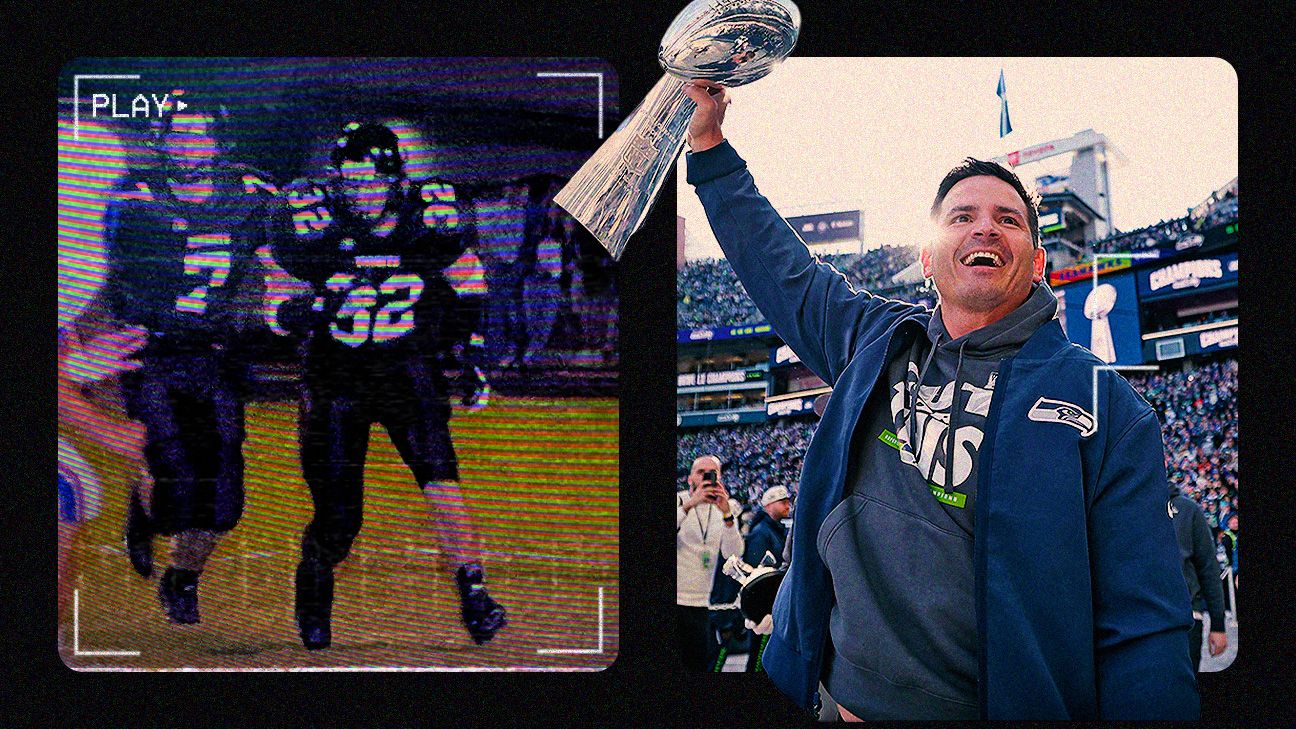
HUGH MACDONALD ARRIVED home from a business trip, went in to give his sound-asleep son, Mike, a goodnight kiss and noticed football equipment in his son’s bedroom.
The equipment caught Hugh by surprise. Mike had mostly been into baseball.
“The next morning, I asked him,” Hugh recalled. “He says, ‘Dad, I want to go play football.’ So, he was a football player.”
As Mike became a middle school football player, lining up at fullback and inside linebacker for the Junior Knights in Roswell, Georgia, Hugh assumed the role of videographer, capturing moments of the team and his son’s play.
More than a decade earlier — before Mike was born on June 26, 1987, Hugh had purchased a camcorder to capture his 2- and 4-year-old daughters opening gifts on Christmas morning.
Now, as Mike took the football field, Hugh dusted off the old family camcorder to preserve every moment.
“He had this, like, gigantic VHS or, like, this gigantic camcorder,” Mike said, grinning. “It was like, the full-shoulder camera.”
“It’s about 800 pounds,” Hugh said, laughing, as he held out his hands to show its weight. “No, it’s about like this, like this, like this. It’s a good 12,15 pounds.”
In reality, the black Sony camera with its original black-and-red strap is a little more than 5 pounds and 15 inches long, though Hugh and Mike, upon seeing it decades later, are still amazed it wasn’t bigger.
At the time, neither father nor son would realize that that camera filming him would become the first of many, and would help tell the story of how, at 38 years old, Mike became the third-youngest head coach to lead his team to a Super Bowl victory when the Seattle Seahawks defeated the New England Patriots 29-13 on Feb. 8, 2026.
“We’d plug it in,” Mike said about the camera. “Play the plays and, you know, digest the tape.”
When Macdonald took over as Seahawks coach in late January 2024, he brought to Seattle the mantra, “Chasing edges.” It’s a guiding belief about finding any detail, big or small, to pursue improvement and reveal competitive advantages.
For the Seahawks, the mantra was new.
For Mike, chasing edges has always been ingrained, even if for a time, it was disguised as watching his recorded camcorder games with his dad.
“It was a way, honestly, for my dad and I probably just to spend time together,” Mike said. “And it was fun.”
IF THERE WAS one thing Mike knew as a teenager playing football, it was that he wasn’t fast.
“I’d be running sometimes, or I know where the play would go,” Mike explained. “I’d tell my body to go faster. It wouldn’t go faster.”
“He was decent at football,” Casey Donovan, 38, a childhood friend and teammate since middle school, said. “He could hit you really well. However, he was about as fast as thunder.”
Mike chuckled, recalling his best effort.
“I’d be carrying the ball, and it would be, ‘Hey, run away from this guy,’ and it was just like, the body would not do it,” Mike said.
Mike’s lack of speed forced him to find other solutions.
“It’s like, ‘OK, well, how else can I go make plays as well?'” Mike said. “I can play with anticipation, or I can understand what formations they’re going to be in.”
Details, solutions and relentless play.
This seemed to be the way Mike’s brain always worked, no matter his age and no matter the sport — baseball or football.
“My family always jokes with me, like their memories of me as a kid. I was just sweaty, so I’d just be outside and I’d come in, get a Gatorade or something. I’m just, you know, my cheeks — just be bright red. I’d be sweating everywhere,” Mike said.
And he’d sweat until well after the sun went down, insisting he remain outside to play catch with his dad — “Five years old, something like that, every night we’d go out in the backyard and I’d throw balls to him at night … and we’d play situational baseball,” Hugh said.
One time, when the neighborhood kids — mostly between the ages of 4 and 6 — were playing baseball in the neighborhood, a kid hit the ball and ran to third base instead of first.
“Mike was so upset,” Hugh recalled. “Afterwards, he came back, ‘Dad, they don’t know the rules. They just don’t know the rules.’ I said, ‘That’s OK, son. You know, just go out and play and have fun and do what you’re supposed to do. Don’t worry about them.'”
Mike detailed the same story, but in a more intense tone than his 77-year-old father.
“We’d be outside playing games. I’d get pissed off because, like, we played baseball in the cul-de-sac, and, you know, my neighbors didn’t abide by the rules,” Mike said. “They’d hit the ball, they go left to third base first. And so, I’d get mad. I’d go home all complaining to my dad that they’re not playing the right way.”
In his newfound love of football during his middle school years, he discovered a place — on the gridiron — to take out that anger. If only he could find the speed to catch others.
This is where Hugh’s videography skills, coupled with his experience as an offensive lineman who played at West Point (graduating in 1971), came into play.
“Mike wants to get things right. He always wants to improve,” Hugh said. “And so it wasn’t really difficult to sit down and review the tape.”
Where some kids might enjoy watching a highlight touchdown and ensuing celebration, Mike wanted to sit with his dad and watch his game film — yes, the middle school game film — to find areas to improve, and hopefully, make up for that lack of speed.
“We didn’t review the tape, like, strategically, like what plays were being called at what point in time,” Hugh explained. “A lot of things we talked about were like angles. So what angles should you take as you block? What angle should you take as far as tackling somebody, which was really key.”
“I always had this feeling of, like, I need every edge I can get so I can go make plays,” Mike said. “Because I knew I wasn’t fast.”
“We used to talk about that from blocking, tackling, running,” Hugh said. “That’s what we spent our time on.”
“He always knew where to be,” said Matt Post, Mike’s high school teammate and backup at fullback and linebacker. “He was always big on ‘pursuit angles’ is what he called it. He’s like, ‘As long as I can have the right pursuit angle, I know I can get there even if the person’s faster than me.'”
Though the initial film reviews were focused on Mike and his play, his interest in film study began to grow.
By the time he reached Centennial High School in Roswell, Mike no longer was trained on just himself.
He realized watching game film could benefit the entire team, especially as the players prepared to face rival Chattahoochee for a second time one season.
“My dad had recorded [the first game], so I was like, ‘Well, we’re going to play these guys again in the whatever championship, so let’s watch the tape and figure out, like, what plays they’re running out of the formations,” Mike said. “And let’s write some notes and report to the guys on what we could do better.”
As Mike recalled this, he realized choosing to watch game film was perhaps extraordinary behavior, again, for a teenager, especially one who wasn’t being recruited to play in college.
“Kind of sounds crazy to me, thinking better right now,” Mike said. “But that’s actually what happened.”
And it wasn’t a one-off situation. Film study and Mike became synonymous.
After games, there’d be sleepovers with teammates.
“The next morning, we’d all sleep over at somebody’s house; it was either his house or our buddy Matt’s, and we’d analyze the tapes,” Donovan said.
By “we,” Donovan meant Mike.
“Mike was the one who would get up in front of all of us and be like, ‘Look what you were doing here. Look what you were doing there. We can do this better,'” Donovan said. “And we did that for every game for four years in high school. …
“He initiated wanting to watch it and actually analyze everything, whereas we were just trying to watch our highlights of what we did well. And he would always point out the stuff that we didn’t do well. So, he’s always been that kind of mentality of, hey, we can always do better. Even though we did well, we can always do better.”
“We would all go hang out after games,” Post said. “Mike was always competitive. We’d either watch film or we’d play video games and even Mike, like, as teenagers, he’s drawing up audibles. He’s changing coverages. He’s changing his playbooks.”
And Mike’s breakdown wouldn’t remain in that room. Especially during his senior season, when a knee injury sidelined him, allowing more time for film breakdown and a job he took upon himself in assisting Centennial’s new head coach.
“We had a brand new high school coach come in, and he didn’t know any of the kids on the team,” Donovan said, grinning. “He didn’t know our strong points, our positions, and Mike kind of rallied around him and helped him basically coach our entire high school team for our senior year.”
After filming practice from the back of a pickup truck during his senior season, Mike would show up to school ready to deliver teammates his thoughts on what they could work on based on his film takeaways.
“Plug [the camera] in, and then you’d play all the plays, you know, digest the tape, and then I’d bring the notes back into the school and tell my friends what they did wrong and everything,” Mike said. “So, that was a joy to be around, apparently.”
ON A HOT spring day last March at the NFL’s annual meetings in Phoenix, Mike stood up from an oversized chair after completing another interview for the highly sought-after defending Super Bowl champion coach.
After spending 20 minutes discussing his childhood penchant for rules, details and finding competitive advantages while watching film, Mike tilted his head and glanced up.
Yeah, maybe all of this really did start there, back in middle school, watching film of the Junior Knights.
It was as though it hadn’t crossed his mind until that moment.
And those competitive advantages should benefit the Seahawks in Week 12 as Seattle travels to San Francisco for a key NFC West matchup on Sunday (4:25 p.m. ET, Fox). For Seahawks safety Julian Love, Mike’s lengthy experience breaking down film is apparent when they watch it together.
“I’ve watched one-on-one. I’ll tell you, he flies through tape. If he’s seeing looks, he’s like,” Love said, as he imitates quickly flipping through tape, “next clip, next clip, next clip, next clip, different game, different game. He’s very fast. But he just knows what he’s looking for. Especially because he’s calling games … knowing what we are going to do for the looks we’re getting. So yeah, it’s unique.
“If you really want to see him at his peak brainpower, you’ve got to watch some tape with him.”
On a late summer day in between joint practices with the Tennessee Titans and the Seahawks’ second preseason game, Hugh sat in a chair and described at length what he and his son were looking for in all those tapes they watched together.
Among the standout keywords? Angles.
When told that’s what his son first mentioned when he was asked about their video sessions and the learnings, Hugh’s face softened and he began to grin.
“Really?” he asked.
Really.
It appeared to be a parent’s best wish come true; 25 years later, a confirmation that years of parenting, teaching and using that 800-pound camcorder had sunk in.
For both, winning the Super Bowl was never the goal, but it became a result.
To Hugh and Mike Macdonald, breaking down film was about cherished time together.
ESPN’s Brady Henderson contributed to this story