
The article below is an excerpt from Steve Fowler’s DriveSmart newsletter. To get the email delivered straight to your inbox every Monday, simply enter your email address in the box above.
It sounds like a simple question, but as with so many things, the answer is more complicated. If your self-driving car crashes, who is responsible for paying for any damages? Could it be your insurer? The car maker? The software company? Or does everyone stand around pointing at each other while the owner wonders why their supposedly clever car has just driven itself into trouble?
For years, the car industry has talked excitedly about autonomous driving. We have been told it will make roads safer, take the stress out of driving and give us back time. But the big question has always been left hanging: if the car is doing the driving, who carries the can when it gets it wrong?
Now BYD has given a very clear answer. In China, at least.
The Chinese giant has announced what it calls Full Damage Coverage for its Urban Navigate on Autopilot (NOA) function, which forms part of its God’s Eye driver assistance system. In simple terms, BYD says that if one of its cars is involved in a legally liable accident while Urban NOA is being used correctly and within the rules, the company will directly cover all resulting economic losses.
That is a big statement. It is a car maker saying: we believe in this technology strongly enough to put our money behind it.
The cover will be offered for one year to new buyers in China, as well as existing owners who upgrade to God’s Eye 5.0. It follows a similar promise for BYD’s intelligent parking system, making the company the first car maker to offer damage cover for both intelligent parking and urban assisted driving.
That should make everyone else in the car business sit up, because this is not just about insurance. It is about trust. BYD is telling customers that its latest driver assistance tech is something the company is prepared to stand behind financially.
BYD says it already has more than 3.15 million cars on the road with intelligent driving assistance systems and claims its God’s Eye system is logging more than 124 million miles every day. Its long-term targets are even more ambitious: zero traffic accidents, driver assistance becoming what BYD calls a “Super Driver”, and AI acting as a “Super Personal Assistant”.
All of which sounds impressive. But if a car maker talks about a “Super Driver”, does that super driver come with super responsibility?
In China, BYD’s answer appears to be yes, within limits. In Europe and the UK, not yet.
Asked whether the company would provide the same level of cover in Europe, Alfredo Altavilla, BYD’s special adviser on Europe, told me: “When it comes to Europe, what I can tell you is that of course we will introduce this technology to the most important insurance companies in Europe. Of course, it is premature and it would be unwise on my end to announce any marketing strategy at this point. But certainly, as we believe that this technology might truly contribute to improving road safety, we would like to explain this to insurance companies. Then we’ll see what happens, but that is the plan.”
That is a careful answer. Europe has its own regulatory systems, insurance structures and legal expectations. The UK has its own rules too. A car maker cannot simply copy and paste a Chinese customer offer and assume it will work everywhere else.
But from a driver’s point of view, the gap is still important. BYD is effectively saying that in China it is confident enough to cover damage that might be caused when its system is being used correctly. In Europe, it wants to talk to insurers first. That makes sense from a business point of view. It is less satisfying from a consumer point of view.
I cannot help thinking this uncertainty is one of the reasons truly autonomous cars still seem to be, excuse the pun, pushed down the road. For all the excitement around self-driving technology, the industry has been promising it for years. We have been told again and again that autonomy is just around the corner, but that corner keeps moving further away. The technology is hard, of course. Roads are complicated and people are unpredictable. But the legal risk must be a huge part of the delay too.
If a human driver makes a mistake, the system knows what to do. There is insurance, blame, a claim and a process. If a car driving itself makes a mistake, it is different. Suddenly the argument is about software, sensors, mapping, data, updates, artificial intelligence, driver monitoring and whether the car maker should have predicted the very thing that just happened.
That could mean very big legal bills. It could mean car companies being found liable not just for one accident, but for the way an entire system behaves. No wonder so many systems are still wrapped in language like “assistance”, “supervised” and “beta”.
Tesla shows how sensitive this language has become. Its system is called Full Self Driving, but the full name is now Full Self Driving (Supervised). That word in brackets is doing an enormous amount of work; it tells you that, however capable the system may look, the driver is still expected to watch the road, stay alert and be ready to take over.
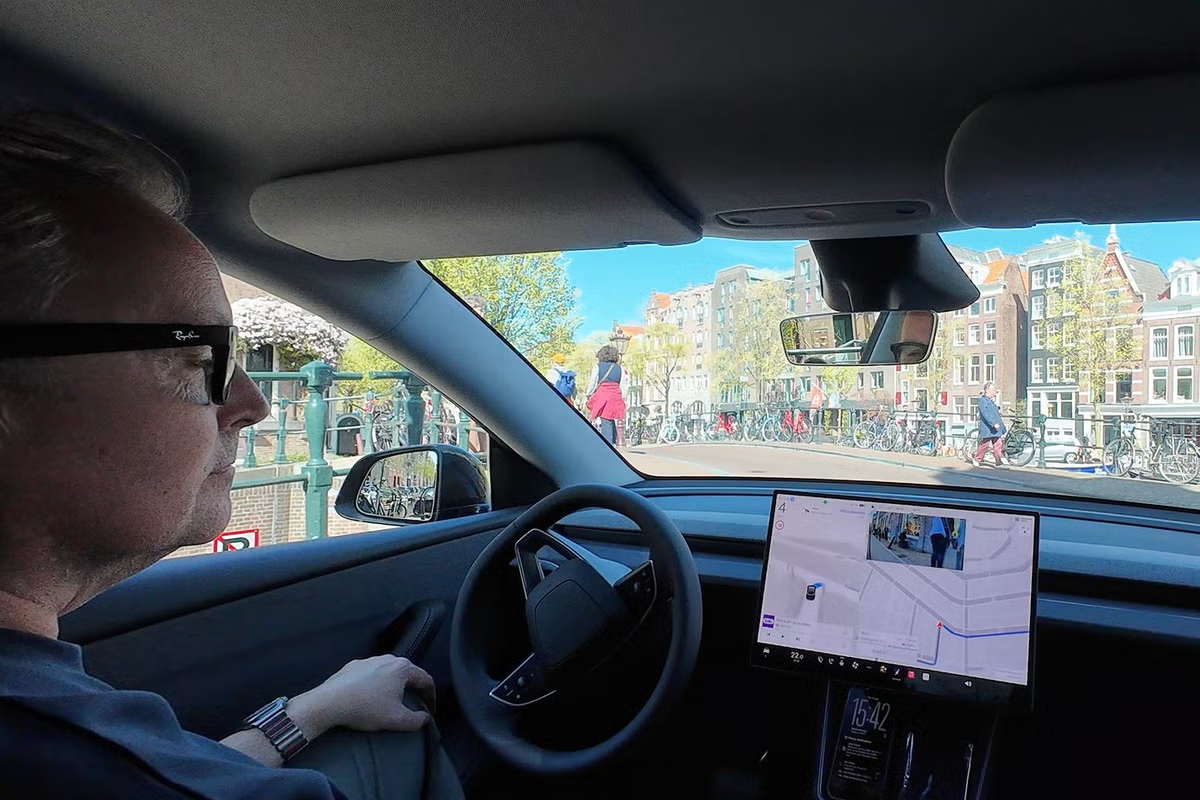
When I recently tried Tesla’s latest system in Europe, it was deeply impressive, calmly making its way through Amsterdam traffic, cyclists, pedestrians, trams and awkward junctions. Tesla’s own figures suggest its computers can be much safer than humans when its systems are active.
But Tesla’s system is still supervised. The driver remains the safety net. The car is helping, not taking legal responsibility. That distinction is vital, because the public language around autonomy can quickly run ahead of the legal reality.
Waymo is perhaps the clearest example of the other route. It is already running truly driverless robotaxis in parts of the US, without a human driver sitting there waiting to grab the wheel. Waymo’s own safety data says its autonomous driver has much lower crash rates than human-driver benchmarks in the cities where it operates: 0.71 any-injury-reported crashes per million miles for Waymo, compared with 3.90 for the human benchmark, and 0.28 crashes involving airbag deployment compared with 1.63.
Those are striking numbers. They suggest that, in the right place, with the right system, self-driving cars can already be safer than people. This technology is not just about being clever. It could save lives.
I often use the same example because it still feels the simplest. Most of us are perfectly happy to go on holiday on a plane that is on autopilot for the vast majority of the flight and may even use computers to help land. Yet when the same idea is applied to cars, we panic.
After experiencing Tesla’s Full Self Driving myself, I got a ride in a self-driving Denza Z9 GT in China
Partly that is because roads feel more personal and cars are around us every day. But it is also because the chain of responsibility is clearer in a plane. There are pilots, airlines, air traffic controllers, manufacturers, regulators and strict operating procedures. Nobody pretends a passenger in seat 22A is supervising the landing.
Some years ago, I reported on Volvo taking a very different tone. Back then, Volvo said it would accept full liability for accidents involving its driverless cars. Erik Coelingh, then Volvo’s chief technical officer, put it neatly: “Everybody is aware of the fact that driverless technology will never be perfect – one day there will be an accident. So, the question becomes who is responsible, and we think it’s unrealistic to put that responsibility on our customers.”
That quote still feels relevant today. Volvo’s point was simple: if the customer is genuinely driving, the customer is responsible. If the car is genuinely driving, the manufacturer should not pretend the customer is still fully in charge.
BYD’s move in China is important because it pushes that debate forward. It is not full autonomy. It is not a blank cheque. The cover only applies if the system is being used correctly and within the rules. But it is still a public promise that the manufacturer will stand behind the system in defined circumstances.
That is why BYD’s European position needs watching closely. If the company brings God’s Eye technology here, buyers will want to know whether the Chinese damage cover comes with it. If it does not, BYD will need to explain why. If it does, rivals will be under pressure to respond.
The technology is racing ahead. The legal and insurance world is trying to keep up. But for ordinary drivers, the answer needs to be simple: if I am driving, I am responsible. If the car is driving, the car maker needs to tell me exactly what it is responsible for.
And if BYD is prepared to pay when its driverless tech crashes in China, UK drivers will quite reasonably ask: what happens if it crashes here?
Sign up for the DriveSmart newsletter
To get the latest motoring insights from EV editor Steve Fowler delivered straight to your inbox, simply enter your email address in the box at the top of this page.
Each edition of DriveSmart offers clear, expert guidance on the fast-moving world of electric vehicles and modern motoring, from trusted reviews and practical tips to the biggest industry news of the week.
You can also head to our newsletter preference centre to sign up for the email.

