
The U.S. plan to open an Ebola quarantine facility in Kenya was meant to help contain the outbreak by isolating American patients exposed to the virus.
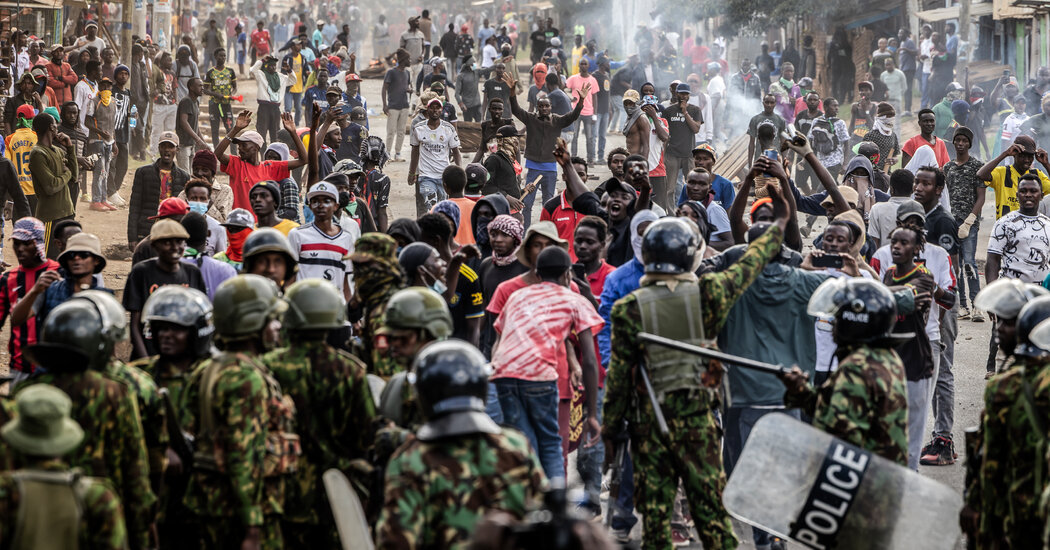
Instead, it has caused an outbreak of violence and political rancor, with hundreds of Kenyans taking to the streets in protest.
Last month, Secretary of State Marco Rubio said that no Ebola patients would be allowed to enter the United States after the World Health Organization announced a dangerous outbreak in the Democratic Republic of Congo. Mr. Rubio later appeared to soften that stance.
U.S. government officials later told reporters that the Trump administration planned to send to Kenya all U.S. citizens exposed to the virus, rather than bring them home. The Americans would be observed and treated at a 50-bed quarantine unit exclusively for them, set up at Laikipia Air Base in central Kenya, the officials said.
The outcry in Kenya has been fierce.
Hundreds of people have marched through the streets of Nanyuki, the town closest to the air base, to protest the facility. The police have used tear gas to disperse crowds, and at least three protesters have been shot and killed, according to the Kenya Human Rights Commission. The Kenyan police did not respond to a request for comment on Tuesday.
Critics of President William Ruto of Kenya accuse him of bowing to U.S. interests and risking Kenyan lives by letting exposed American patients into the country when they are being banned from the United States.
Others have asked why Kenya, which has never recorded an Ebola case, would agree to host the unit when U.S. government officials say Kenyans would be excluded from receiving treatment there.
“We are utterly disgusted by the government’s apparent willingness to trade national biosecurity and the lives of its citizens for foreign aid,” the Kenya Medical Practitioners Pharmacists and Dentists Union said in a statement.
The full details of the agreement between the United States and Kenya have not been made public. But a U.S. official told The New York Times that talks were still continuing when U.S. government officials told reporters about the plan.
In a comment to The Times, the State Department said it planned to provide transportation for Americans to the Ebola unit, but made no reference to whether Kenyans would be admitted.
Kenya’s High Court temporarily suspended the unit from opening last week, after a legal challenge brought by the Katiba Institute, a civil society organization. The court ordered the Kenyan government to disclose the terms of its deal with the United States by Tuesday. It also said it would set a date for the next hearing on the case on June 23.
Despite the court suspension and the protests, a second U.S. official said that U.S. Africa Command was still at work building out the unit at the air base as recently as Saturday, and that around 300 U.S. troops from Djibouti, Europe and the U.S. were helping to erect large tents and set up specialized medical equipment to treat Ebola patients.
The official, who spoke on the condition of anonymity to discuss operational matters, said that the facility could eventually hold up to 250 patients, and that the State Department was coordinating with several Americans who are seeking to leave Congo, but whose exposure to the virus has not yet been determined.
The U.S. military has continued the work on the unit because Mr. Ruto’s government has not told it to stop, the official said. Work on the facility was on hold on Tuesday because of the protests, the official said.
Dr. Mehmet Oz, a top federal health official in the United States, told journalists at the White House last week that the State Department would “be able to work out something with Kenya.”
American health experts have also criticized the plan not to repatriate American patients back to the United States for treatment, arguing that the government had an ethical responsibility to do so.
The Katiba Institute in Kenya said it would likely return to the High Court this week to seek a contempt order over what it called a violation of the court’s ruling. “Kenya has independent courts and they need to be respected,” said Nora Mbagathi, the executive director of the institute.
A former chief justice of Kenya, Willy Mutunga, went further, arguing that disregarding the court’s ruling to stop moving forward with the facility was a violation of the Constitution and highlighted what he said was Western hypocrisy.
“The West constantly pontificates about democracy and the rule of law, but what annoys me is that they also find our supreme law inconvenient,” he said.
The U.S. Embassy in Kenya last week issued a statement that framed the Ebola unit in terms of a decades-long health partnership between the two countries.
Abraham Korir Sing’Oei, a top official in Kenya’s foreign ministry, acknowledged U.S. support in fighting epidemics, and said politics were motivating critics of the facility. He said they were likely looking ahead to next year’s presidential election in Kenya.
But speaking of the deal for the new unit, Mr. Sing’Oei conceded that communication “could have been better.”
One particular source of outrage is that only U.S. citizens — not Kenyans — would be eligible for treatment at the facility. Mr. Sing’Oei said that Kenyans could also be treated, but the U.S. government has so far not publicly agreed to this.
That discrepancy has put the Kenyan government in a difficult position and reflects “clumsy diplomacy,” said Cameron Hudson, an Africa analyst based in Washington.
A failure to finesse the agreement has undermined the administration’s policy of leveraging long-term U.S. support for African countries to secure better terms for future bilateral agreements, Mr. Hudson said.
“The Kenyan government is twisting in the wind and the U.S. doesn’t seem sensitive to what their partner is going through,” he said.
Experts fear the current Ebola outbreak could be the worst on record. Congo’s health ministry on Monday said that there were 550 confirmed cases in the country and 101 deaths.
Apoorva Mandavilli contributed reporting from New York and Brian O. Otieno contributed reporting from Nairobi

