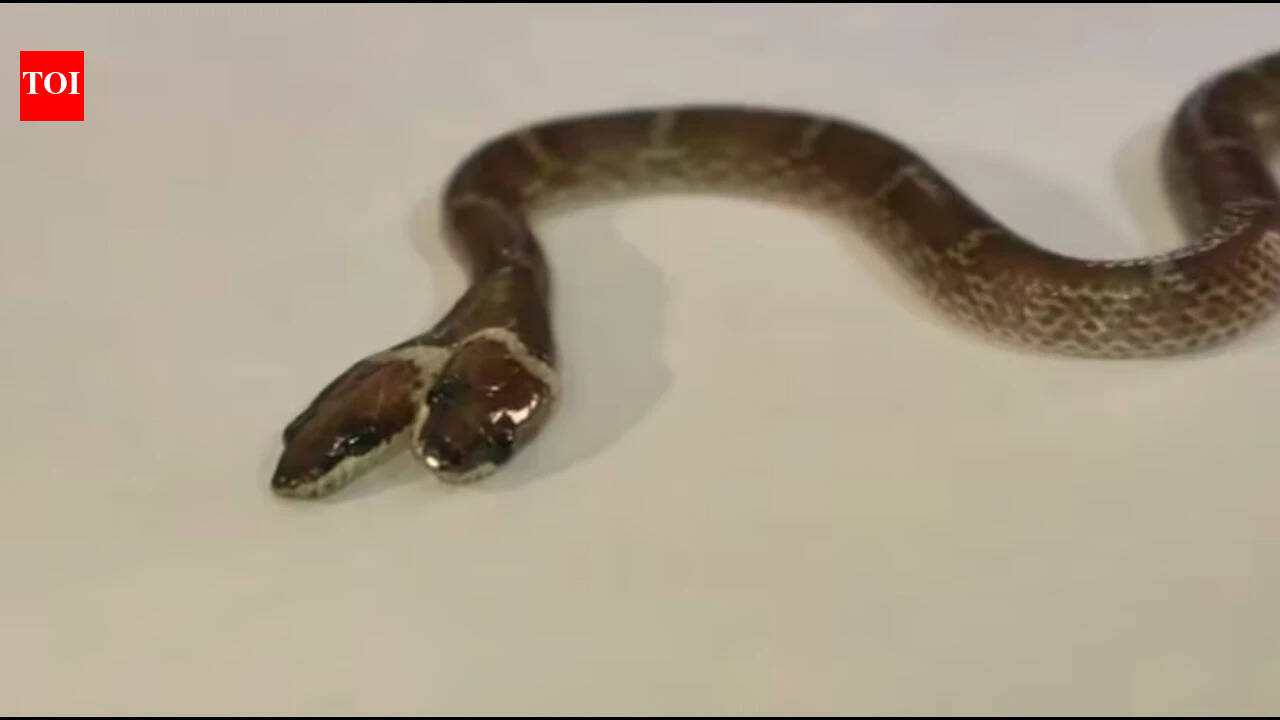
A rare two-headed snake was found in Gujarat by s a nature conservation group and was later handed over to the Forest Department.While these slithering reptiles have a fearsome reputation, most of us walk past a tiny snake without a second glance, or step back in fear. But this rare ‘two-headed snake’ would compel anyone to stand and stare at it.Let us dig in to know more about this snake that seems to belong to a fantasy world
Rare two-headed snake found in Gujarat makes it the first case in the state
A rare two headed snake was found in Gujarat’s Dahod district of a wolf snake hatchling, and it is the first such case reported in the state and the fifth in India, according to a New Indian Express report. The non-venomous baby was found in Dhanpur taluka and rescued by members of the Prakruti Mitra Mandal, a nature conservation group and was later handed over to the Forest Department.The snake was spotted in the Dhanpur range, and the group was alerted. When the team arrived, they found something very unusual, that it had two separate heads, four eyes, and just one body below the neck.According to Kinnar Desai, the group’s convener and rescue team leader, the team first brought the snake safely to Dahod for observation and then sent photographs to experts. “After observing the snake, we sent its photographs to experts for identification. It was found to be a wolf snake, which is non-venomous. It is around five to six inches long and appears to be newly born,” Desai said.
Such cases occur one in a million
The report adds that the hatchling is estimated to be around six months old. Both heads seem to work independently, even though there is only one body. According to Desai, such cases are extremely rare and are believed to occur in about one in a million snakes.The rescue team also shared how this case compares with earlier ones. According to the team, four similar cases have been documented in India before, two involving common sand boas, locally called Varudanti, and two involving cobras. “The snake found in Agasvani is the first such case recorded in Gujarat and the fifth reported case in India. It is also reportedly the third case involving a wolf snake,” Desai said.For now, the hatchling is being kept in a secure place. After consulting the Forest Department, the rescue team handed the snake over to the department’s custody for further care and observation.
How does a snake develop 2 heads?
This condition is described as bicephaly, a rare developmental abnormality in which the front part of the embryo does not separate completely, resulting in two heads or mouths on a single body.This condition is also known as dicephalism, dicephaly, or axial bifurcation. Researchers describe it as a congenital malformation that arises in the embryo. It can mean a partial or total duplication of the skull and/or spine. Snakes are the group where it is reported most often, with more than 1,280 cases among wild and captive animals counted byWallach, the author of the research.
Why does it happen?
There is no specific cause as to why it happens, but there can be multiple reasons for it.Like identical twins, two-headed animals form from a single fertilised egg, but the split stops partway and leaves two heads on one body.Wallach listed eleven possible causes, including partial fusion of two embryos, abnormally low or high incubation temperatures, regeneration after injury, oxygen shortage (anoxia) during development, toxic effects from a prolonged stay in the oviduct, and radiation exposure.Life can be hard for such a snake, as the two heads may act independently, which can cause problems with moving, hunting, and feeding. However, survival may be possible in some cases if the oesophagus develops in a way that lets food pass properly into the digestive system.