
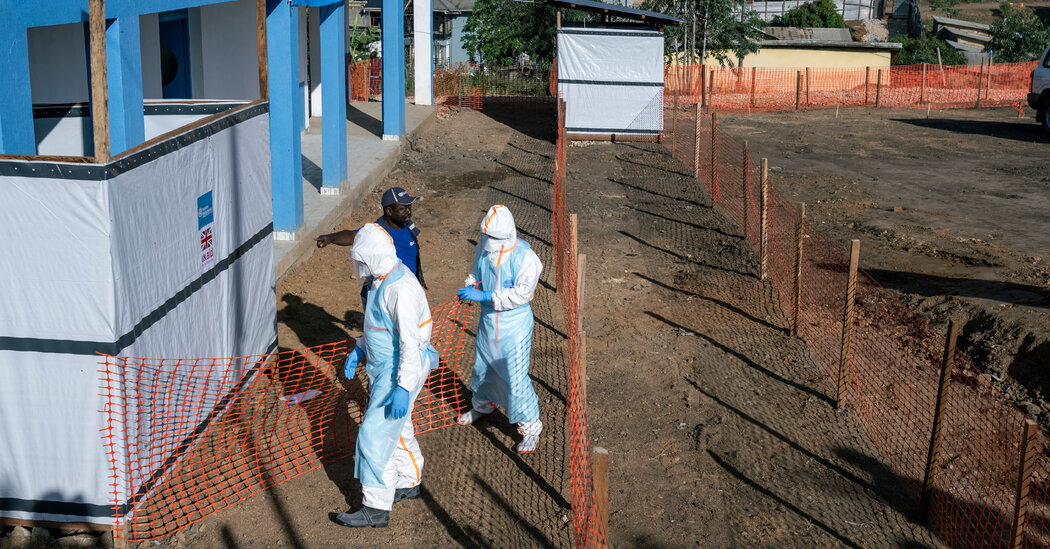
Even as the Ebola outbreak in the Democratic Republic of Congo appears poised to become the largest on record, Trump administration officials have not articulated a clear plan for caring for Americans at risk of the disease.
Hundreds of Americans, including federal officials, aid workers and journalists, are expected to be in parts of Congo, where the disease is rampant, in the coming months. Officials from previous administrations say that there is a clear playbook for when such people are exposed to Ebola or become ill: Bring them home to one of the 13 facilities in the United States built for exactly these circumstances.
The United States does not have the authority to quarantine Americans elsewhere in the world, and cannot prevent them from re-entering the country.
But last week, Secretary of State Marco Rubio declared that the administration “cannot and will not allow any cases of Ebola to enter the United States.”
The Trump administration has already shipped one American physician sickened with Ebola to a hospital in Germany, and six others with possible exposure to the virus to Germany and the Czech Republic for monitoring. Public health experts closely observing the situation said they were unaware of any other Americans with risky exposures.
The administration announced plans to build a 50-bed quarantine unit in Kenya for others who may become exposed or ill. But the fate of the unit is now uncertain. On Tuesday, a Kenyan court delayed efforts to build it by at least three weeks, and the plan for Americans who may need help in the meantime is unclear.
A State Department official said on Tuesday that officials were optimistic about resolving any objections to the Kenya plan. But the department did not answer repeated questions about whether U.S. citizens who decline transport to Kenya or wish to be treated in the United States will be allowed into the country.
Decisions would be made on a case-by-case basis, the department added.
“American citizens are being kept in the dark at a time of great risk to their lives,” said Lawrence O. Gostin, the director of the World Health Organization Collaborating Center on National and Global Health Law.
“I find the United States response to this outbreak to be opaque, confusing and contradictory,” said Mr. Gostin, who has worked with multiple administrations on Ebola responses.
The outbreak in Congo and Uganda so far has 359 confirmed cases, including one American, and 61 deaths. Those numbers are expected to grow as officials track down other cases and contacts. The disease is thought to have been spreading for months before it was detected.
Ebola spreads via contact with bodily fluids. It can ravage organ systems and lead to a swift death. Unlike Covid, the disease does not typically spread from patients without symptoms, so people who have merely been in proximity to the infected are often advised to simply monitor for symptoms.
The Kenyan unit was intended for monitoring Americans exposed to Ebola over the 21-day quarantine period, as well as providing some treatment if they develop symptoms. But even with equipment shipped from the United States, it is unlikely to match the sophistication of American facilities. A similar medical unit set up in Liberia during the 2014 Ebola outbreak had a survival rate of 56 percent, compared with 81 percent for those treated in the United States.
“I don’t know how you can deploy Public Health Service officers and not commit to bring them home if they get sick,” said Stephanie Psaki, the coordinator for global health security in the Biden administration, a role that is now vacant. “It just is unethical.”
Dawn O’Connell, who served as the assistant secretary of health for preparedness and response from 2021 to 2025, said she had authorized the purchase of specialized equipment during her tenure, including two mobile biocontainment units, that “would allow for extraordinarily safe transport between airports and hospitals.”
“There is a system in place to be able to do this,” she said.
On Tuesday, Mr. Rubio told lawmakers that the administration was considering “a couple of people” for a role coordinating the federal government’s Ebola response.
His statement last week echoed President Trump, who said on social media in 2014 that the “U.S. cannot allow EBOLA infected people back,” adding: “People that go to far away places to help out are great — but must suffer the consequences!”
The administration has also invoked a public health law known as Title 42 to bar immigrants and legal permanent residents who have been in Congo, Uganda or South Sudan in the previous 21 days from entering the United States.
On Tuesday, Tommy Pigott, a State Department spokesman, suggested that quarantine in the Kenyan unit was “voluntary” for Americans who are not symptomatic. But he said that those who decline would “remain subject to relevant U.S. and foreign government health, travel and screening measures.”
The plan for those who test positive for Ebola or have symptoms is even less clear. Officials may arrange evacuation to certain places designated as safe, the State Department said, without specifying possible locations.
In the absence of a clear plan, “the concern would be that people would hide their exposures,” said Dr. Nahid Bhadelia, the director of Boston University’s Center on Emerging Infectious Diseases, who has also been part of multiple Ebola outbreak responses.
“I would imagine it’s a very real equation for people who are deploying right now, and particularly if you can’t give clear answers of what will happen to them if they go to Kenya,” she said. Some may hesitate to volunteer to help with the outbreak at all, she added.
The workers may have reason to worry. In 2014, U.S. officials set up the Monrovia Medical Unit in Liberia, to help treat health care workers of other nationalities who became sick. Of the 18 patients confirmed to have Ebola who were treated there, only 10 survived.
“We were not prepared to intubate anybody,” recalled Dr. Karen Wong, a former Public Health Service officer who was part of the first group to be deployed to the unit. “We didn’t have that kind of equipment or the necessary personnel to be able to do that kind of thing.”
By contrast, of the 27 Americans who were repatriated and treated in the United States during the 2014 Ebola outbreak in West Africa, all but five survived. About 26 percent of those Americans required invasive mechanical ventilation, and 70 percent needed supplemental oxygen.
Even a sophisticated medical unit in Kenya is likely to face shortages of oxygen or even basic supplies like IV fluids, and may not have ventilators or other equipment needed to treat Ebola. A Department of Health and Human Services spokesman declined to say whether such equipment would be available.
And the training the Public Health Service officers who were deployed to the Kenyan unit received may not be enough to treat Ebola. The three-day training offered this time was much less in-depth than the one in 2014, according to a person familiar with both programs who spoke on condition of anonymity to avoid retaliation from the Trump administration.
Without specific training, even health care workers at U.S. hospitals have been ill-prepared to deal with Ebola. The officers in Kenya will need to care for patients while wearing full-body protective gear in a hot climate, and without much equipment.
“I would feel profoundly uncomfortable caring for patients with Ebola with three days of training,” said Dr. Fiona Havers, an infectious disease physician and former Public Health Service officer. Dr. Havers served in Liberia with the Centers for Disease Control and Prevention during the 2014 outbreak, but did not treat patients. She resigned from the agency last year.
Kaci Hickox, a nurse epidemiologist, was in Sierra Leone in 2014 and forcibly quarantined in a makeshift tent outside Newark Liberty International Airport when she returned, even though she did not have symptoms. She later successfully sued the state of Maine for attempting to quarantine her.
“This plan makes the U.S. look weak,” Ms. Hickox said. “It makes it look like we can’t take care of our own people, and we can.”

