
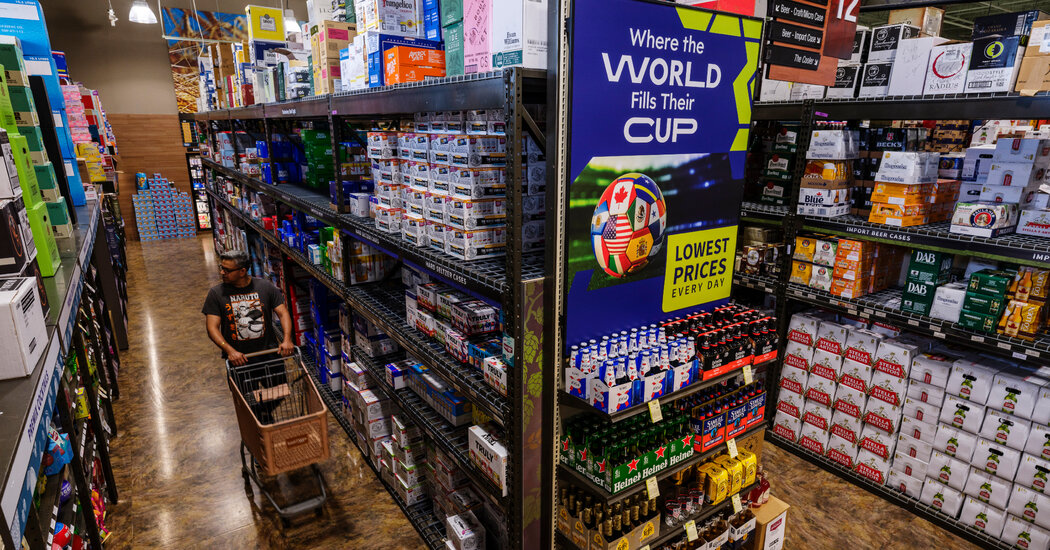
Butch McGuire’s, a pub in downtown Chicago, is planning on holding watch parties for some World Cup soccer games. But the family-owned business isn’t ordering more beer.
“Soccer is growing here in the United States, and there will be games that draw a big crowd,” said Bobby McGuire, who took over the business from his father 20 years ago. “But it’s still not likely to be as big as a basketball playoff or football playoff for us.”
Beer companies are placing huge bets on the World Cup, spending tens of millions of dollars on sponsorships and advertising deals to promote their brands during the 104 matches that will be played in the United States, Canada and Mexico in June and July. And they’re counting on bar owners like Mr. McGuire.
“We want to make a huge push on bars, because the bars will be the places where people will get together to watch the games,” Michel Doukeris, the chief executive of Anheuser-Busch InBev, told investors and Wall Street analysts on an earnings call in early May. “And there is nothing like watching your team around friends and family on a nice bar over a cold one.”
The heavy promotion around the World Cup is an attempt to reverse — at least briefly — years of declining beer consumption. From 2014 to 2024, global beer consumption fell 3 percent, according to IWSR, a company that tracks the alcohol industry. But in the United States, consumption plummeted 17 percent.
Anheuser-Busch InBev, the world’s largest brewing company, is spending more than $110 million on advertising and FIFA sponsorships to make its Michelob Ultra and other brands the official beverages of the tournament, according to analysts.
Yet days away from the first game on June 11, the outlook for beer sales is hazy. Soccer isn’t as popular in the country as football or basketball. Expensive tickets for matches as well as high travel costs and concerns about immigration policies for tourists have tempered early expectations for attendance.
“The host cities will probably have more beer and alcoholic beverage consumption than others, but it’s going to depend on the number of travelers that arrive, and, right now, the forecasts are all over the place,” said Taylor Barnebey, vice president of marketing at Total Wine & More, which stocks more than 2,500 varieties of beer at its nearly 300 stores around the country.
Mr. Barnebey said the company was increasing orders for all of its alcoholic beverages. “I can promise you, there will be more beer sales this June than there was last June. I just can’t tell you the numbers,” he said.
Mr. McGuire said he isn’t worried if interest in the games surges. He gets beer delivered twice a week and can easily increase his order. “They’re not going to sell out of beer,” he said.
Historically, summertime has been the beer industry’s biggest season in the United States. But other than a small bump in 2020 and 2021 during the Covid-19 pandemic, beer consumption has been in a slump for years.
Myriad factors are driving the decline. Young consumers aren’t drinking as much as older generations. Other consumers are turning to cannabis or ready-to-drink hard seltzers, teas and cocktails, a relatively new category. Consumption of those beverages increased 58 percent from 2019 to 2024, according to IWSR.
And consumers are cutting back on nonessential purchases like beer because of higher grocery and gas prices.
“The macroeconomic environment — money in the wallet — is the single biggest indicator of whether consumers are going to drink more or less, and right now, people don’t have more money in their wallets,” said Marten Lodewijks, the president of IWSR.
Still, for beer manufacturers, the World Cup is a giant, multiweek, Olympics-meets-Super-Bowl sporting event that FIFA, soccer’s international governing body, projects will draw a global audience of six billion.
There are early signs that beer orders will rise during the World Cup. In April, a forward-looking indicator of beer purchases expanded for the first time in 21 months, said Lester Jones, the chief economist for the National Beer Wholesalers Association, in an email.
“Host cities for World Cup events will certainly experience an increase in both on- and off-premises beer sales as consumers enjoy the games,” he said.
Beer industry analysts say Americans’ attention to the tournament will depend, in large part, on how far the U.S. team advances.
Even if there is a lukewarm reception in the United States, the games are likely to draw big viewership in countries like Mexico, where beer consumption has soared 48 percent over the past decade, and Brazil, where it rose 16 percent, according to data from IWSR.
That global audience will be important to Anheuser-Busch InBev, as 85 percent of its beer is consumed outside North America.
InBev, which declined to comment, has been the beer sponsor for the World Cup for 40 years. Earlier this month, Mr. Doukeris, the chief executive, told investors on the earnings call that the tournament had contributed significantly to beer consumption, depending on its location and the time of the year it was held.
The last World Cup, in Qatar in 2022, was challenging for beer sales, partly because the games were held in November and, at the 11th hour, the conservative Middle Eastern monarchy banned the sale of alcohol at the stadiums.
The centerpiece of this year’s Michelob Ultra campaign is a commercial featuring a throng of veteran and new soccer stars, including Argentina’s Lionel Messi and the U.S. star Christian Pulisic, playing a match in a hotel lobby for a bucket of the beer. Ultimately, the actor Billy Bob Thornton comes down from his room to claim — and share — his Michelob Ultra.
“There are maybe 10 different players in that spot, from legendary guys from Mexico and Argentina to some of the current players from the U.S. team,” said Graham McKenna, the chief marketing officer for XR Extreme Reach, a technology company that works with advertisers and who was not involved in the Michelob campaign. “They’re taking big-name talent that hard-core fans will recognize. Even if you’re a bandwagon fan, you’re likely to recognize some of the players.”
And while it isn’t an official World Cup sponsor, Molson Coors, the second-largest brewer in the country, said it would spend about 60 percent more on advertising this year for its top brands, Coors Light and Miller Lite. The amount, which the company did not disclose, is the most Molson Coors has spent on a live sporting event in the past decade.
As part of its promotion in stores, the company is selling a large, limited-edition soccer ball on a stand for $19.75 that can fit up to 12 cans of Miller Lite. (The company notes the soccer ball should not actually be kicked.)
“There’s big opportunity for the beer industry as people come together to revel in one of the nation’s most exciting sporting events in recent memory,” Sofia Colucci, the chief marketing officer for Molson Coors, said in an email. “There’s a chance to connect with longtime beer lovers and newer beer drinkers alike.”
Whether the beer industry can hold on to those consumers after the games are over is the bigger, more important question, some analysts say.
“If, after putting so much groundwork into these games, it doesn’t give beer sales a sizable bump, then we’re going to have a whole host of other questions about what the reality looks like for the industry going forward,” said Dave Williams, president of Bump Williams Consulting, which works with the alcohol industry. “Beer needs a win here.”

