
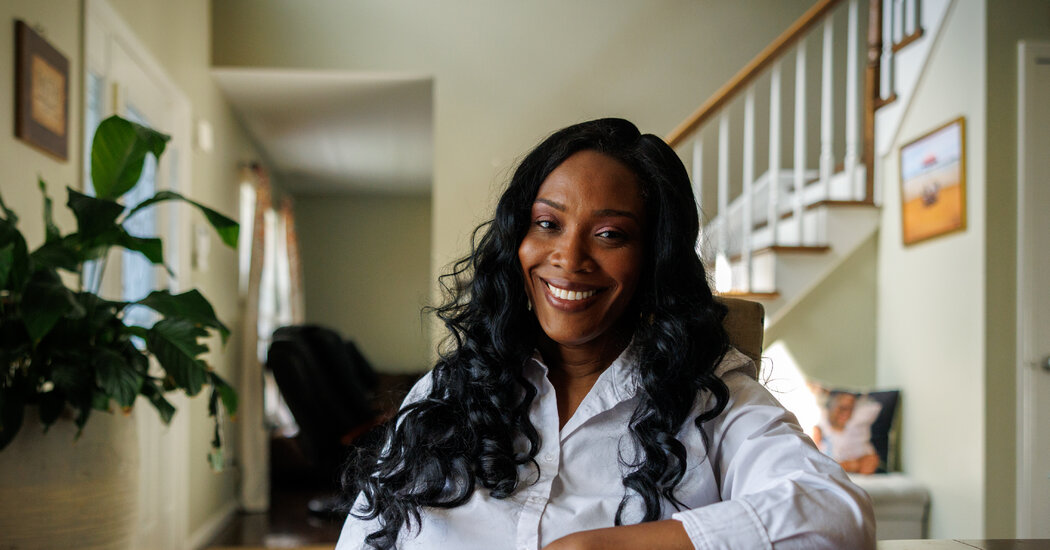
When Sandy Smith’s stepfather lost his job during the Great Recession, she found herself supporting multiple family members and two households.
Her family, which emigrated from Jamaica, had always been frugal, but to make her budget work, she became a “crazy personal finance person” for her friend group. She kept a binder of coupons and let her friends know what deals they should check out, bought her clothes at Walmart, plugged the holes in her shoes with cardboard and skipped vacations for years while her friends traveled.
Her experiences led Ms. Smith, 48, to start a personal finance website called Yes I Am Cheap in 2008.
“There definitely is a negative connotation with being cheap, and that’s why I embraced it,” Ms. Smith said. “Let me not even play with the word frugal — I’m cheap,” she said. “I had to be.”
She started a Facebook Messenger group among her close friends, an annual Zoom pajama party to set financial goals and quarterly check-ins to discuss their finances. Ms. Smith has gone from being $200,000 in debt to having a net worth of more than a million dollars. Friends who initially thought she was “out of her mind” now come to her for advice.
A friend like Ms. Smith can shift the financial future of not only a close group but a wider social network. Networks spread behavior — a concept called social contagion — but some members of a group, such as those with more education and those who are most connected, can shape what the crew believes and does more powerfully. A 2024 study from the National Bureau of Economic Research, for example, showed that the more connections you have with people who earn a high income, the more likely you are to invest and save.
“No one should be surprised that people are affected by the financial decisions of those around them — even indirectly,” said Nicholas Christakis, the Sterling professor of social and natural science at Yale, who also directs the university’s Human Nature Lab. “You are affected not only by your friends but by your friends’ friends and your friends’ friends’ friends — people you don’t even know.”
Dr. Christakis has conducted research and experiments on the spread of obesity, smoking and even altruism through relationships. In a randomized controlled study published in Science in 2024, he and his colleagues showed that behaviors spread more efficiently in a community when introduced through well-connected people.
Because it’s efficient to copy others, and actually is a good strategy most of the time, Dr. Christakis said, we evolved to use the people around us as models for behavior. Each person can act as an influencer within his or her friend group, with more responsible financial decisions affecting people the influencer has never even met. And each social member you recruit to your beliefs and actions adds to the likelihood they’ll be adopted by everyone, for better or worse.
“Even though I pride myself as someone who thinks for himself, and who studies this phenomenon, I also find myself sometimes making stupid decisions,” he said. “I look around and say: ‘Well, everyone else is doing this. I should do it, too.’”
Dr. Christakis wouldn’t recommend simply ditching friends because of their bad financial habits, but he relates it to the way Alcoholics Anonymous uses social networks to encourage sober behavior.
“If you’re finding yourself having really bad financial habits because all of your friends have terrible financial habits, that can reinforce what you’re doing,” Dr. Christakis said. “It would be helpful to you if you got a new community.”
Becoming the Frugal Friend
Jill Sirianni met Jen Smith in St. Petersburg, Fla., when she was living and traveling in an R.V. to cut expenses and pay down her $60,000 debt. During their first meeting, they bonded over the fact that Jen Smith, 37, and her husband had chosen the very bar they were in because it had free parking and gave out free shots at sunset, as they were trying to pay down their own $78,000 debt in two years.
“We became fast friends because we found this safe space to be able to talk about money,” Ms. Sirianni, 36, said. She added, “We were able to do fun things together, knowing we had this shared or similar financial goal.”
The two friends started a podcast, “Frugal Friends,” and co-wrote a book, “Buy What You Love Without Going Broke.” Ms. Smith said cutting down on her spending to pay off debt gave her clarity in her social life.
During her two years of intense frugality, she saw much less of one of her best friends from college, who was enjoying married life with weekend trips, sushi dinners and coffee shop dates. After she paid off her debt, the friendship picked back up with a moderate level of frugality, with cooking meals together or occasional takeout.
These days, with two children under 10, Ms. Smith is navigating mom groups. Recently, outnumbered and entering a well-established friendship culture not of her own making, she found herself going to a mom dinner that ended up costing around $75, more than she wanted.
“They’re newer friends, so it’s not like I felt safe being like, ‘You know, sorry, I wrote a book on how to spend money, and so this is not my vibe,’” she said. “You also have to navigate social norms when you’re trying to go against the flow.”
Having a friend walking a similar financial path helped normalize a more frugal lifestyle and a feeling that she wasn’t the only one, Ms. Sirianni said.
“It was almost a badge of honor to say, ‘I got this for free,’ or ‘I got this secondhand,’” she said.
Ms. Smith says social media superpowers the mirage of what’s normal.
“Everybody’s looking at the same things on social media, thinking this is the way every friend group operates: We’re going to brunch, we’re going on vacation together, we’re having $6,000 bachelorette parties,” she said. “Now it’s just perceived normalization, and it just takes one little act of bravery to shift things.”
She suggested limiting your intake of scrolling, adding more in-person connection and curating your feed to people you actually have a relationship with or those who influence you toward more financial stability.
She relates the spending culture of a friend group to a flowing river. It’s easiest to flow along with it, while just standing still can feel scary, let alone trying to change the course of the flow.
“But I do think on the other side there’s a lot of reward and a lot of self-understanding, problem solving, creativity that can be implemented,” she said.
Ms. Smith suggests being vocal about your bigger goals, such as trying to pay off credit cards, as well as the time frame it will take you, so your friends understand it won’t be forever. She and Ms. Sirianni suggest not declining invitations, but adjusting them to a less expensive option, such as inviting people over.
“If they respect you, they’ll respect that you have a goal that you want to achieve,” Ms. Smith said. “They’re going to come to some kind of compromise if they really want to be in a relationship with you.”
Finding Real Community
Sandy Smith, of the Yes I Am Cheap website, suggested that people who felt self-conscious about needing to spend less could make quiet changes, such as slowing down the frequency with which they get certain services done or lowering the quality of products they buy.
“You prioritize what makes sense for you, and you adjust elsewhere,” Ms. Smith said, advising against black-and-white thinking of frugal versus normal. “There’s a whole lot of nuance out there, and the worst thing I think I would want somebody to do is to cut to the bone, then look back and regret not doing something.”
But she said she had no regrets about the choices she had made to cut expenses, including not seeing family in Jamaica for years because the hundreds of dollars for a flight looked more important to spend on a bill.
“I feel like, especially these days, everything is luxury,” Ms. Smith said. She described her friend group as solidly employed and taking vacations that aren’t too extravagant.
“Nobody wants to be the person on the budget watching paychecks and stuff, but if you’re lucky, there’s that one person in the friend group that kind of reins it back in, and I’m that person,” she said.

