
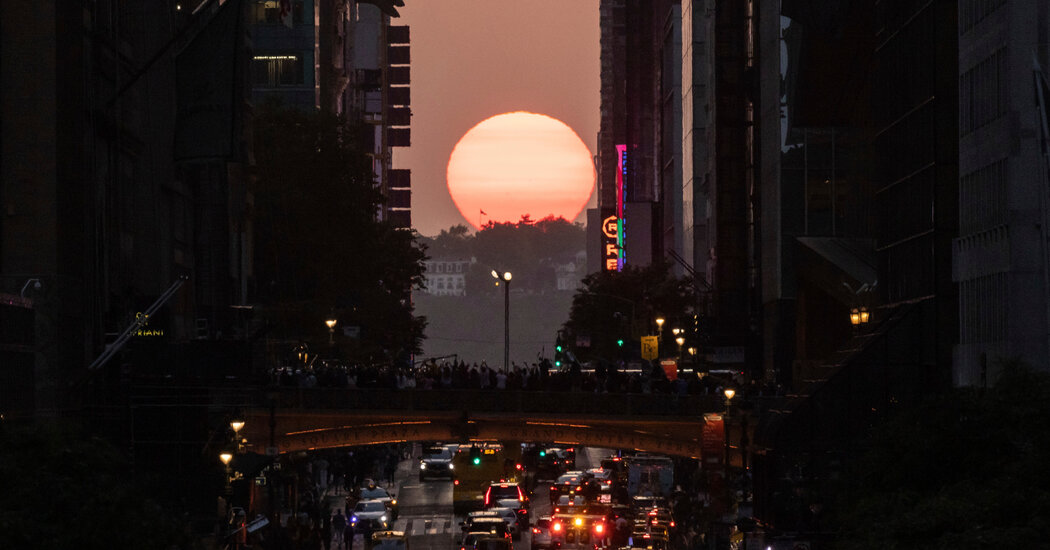
It’s that time again, New Yorkers. Manhattanhenge is upon us.
Each year at the end of May, and again in the middle of July, residents and tourists alike flood the streets of Manhattan for a spectacular view of the sun setting in the west, flanked by the city’s famous streetscapes. Nicknamed Manhattanhenge, the event attracts more people each year, and some gatherings are so dense that they block the streets.
“There is a feel of urgency that some people have, that they don’t want to miss it,” said Jackie Faherty, an astronomer at the American Museum of Natural History who has computed the dates and the times for Manhattanhenge for two decades. And “people that don’t know what’s going on get very curious and jump in,” she added.
According to Dr. Faherty, drivers and police officers may get mad, because the crowds hold up traffic. “But at the same time, I think of it as a unifying moment,” she said. “It’s one of the few times as a New Yorker that you engage pretty readily in conversation with somebody, because everybody’s interested in what’s happening.”
When is Manhattanhenge?
This month, Manhattanhenge’s first night occurs on Thursday, May 28. A second opportunity to see it occurs on Friday, May 29.
According to the American Museum of Natural History, Manhattanhenge will reach its fullest effect at 8:14 p.m. Eastern time on Thursday and at 8:13 p.m. on Friday.
The sunset will appear differently on consecutive days. On May 28, the top half of the sun will align with the city grid, but the next day, the full sun will be visible.
If you miss it this week, or the weather gets in the way, there will be two more chances to see it on the evenings of Saturday, July 11, and Sunday, July 12.
Will clouds get in the way?
Viewing conditions look promising on Thursday, with mostly clear evening skies expected, according to Brian Ciemnecki, a meteorologist with the National Weather Service office serving New York City.
Friday may also offer an opportunity to view and photograph Manhattanhenge, although conditions are expected to be less favorable. Mr. Ciemnecki said “it’ll be a close call” because of partly cloudy skies in the forecast, which could obscure the spectacle.
“It looks like we’ll start off mainly clear,” he said. “And then it looks like some clouds move in later on Friday.”
While viewing may still be possible during breaks in the clouds on Friday, Mr. Ciemnecki said, “Thursday looks like the best day.”
Why should I see it?
Like solar eclipses and the sun’s dancing aurora, Manhattanhenge is another instance of how our home star can bring people together.
“I think it’s joyous,” Dr. Faherty said. “It’s something we should all just celebrate.”
Longer days, warmer weather and the winding down of the school year in New York City make Manhattanhenge somewhat of a kickoff event for summer. According to Dr. Faherty, the days between May Manhattanhenge and July Manhattanhenge are also a season of “epic sunsets” in a city whose urban canyons often obscure such views.
“It’s my ‘welcome to the sun’ moment,” Dr. Faherty said, referring to the first Manhattanhenge in May. Every day after that, she added, “I make it a point to watch the sunset.”
Why does Manhattanhenge happen?
The sun setting perfectly between Manhattan’s skyscrapers results from the geometry of the sun and the Earth.
The sun sets in a different location every day because Earth is tilted on its axis as it orbits the sun. If you were to watch the sun set in the spring each day from the same spot, you would observe it set a little more north relative to the horizon, compared with the previous sunset. After the summer solstice, which occurs on June 21 this year, the sunsets start inching back south.
That’s also why there are two chances to see Manhattanhenge, in May and in July; the dates occur on either side of the summer solstice. July’s Manhattanhenge sunsets occur roughly seven minutes later than the two dates in May, an effect caused by the changing speed of Earth’s orbit around the sun.
Between these dates, viewers can still catch the sun emerging from behind the city’s skyscrapers as it sets, though it will appear higher in the sky. But only when the bottom or the midpoint of the sun grazes the city grid, Dr. Faherty said, is it considered a Manhattanhenge.
How did Manhattanhenge start?
In the 1800s, city planners designed New York City as a grid: Its avenues run roughly north to south, and its cross streets are laid out at 90-degree angles, running approximately east to west.
That means Manhattanhenge is “not just going to happen at one street,” Dr. Faherty said. “It happens across the entirety of the grid.”
As long as this grid has existed, people have most likely noticed the phenomenon, she said.
The earliest mention of this effect that Dr. Faherty has been able to track down is a 1997 comic strip published in the Natural History magazine. Neil deGrasse Tyson, director of the Hayden Planetarium, coined the name “Manhattanhenge” in 2002, inspired by the ancient Stonehenge monument in England.
Since then, excitement surrounding the event has grown every year.
Where can I see Manhattanhenge?
Among the most popular places to watch this special sunset is the Tudor City overpass, a pedestrian walkway above 42nd Street. The vantage point offers a good view of the Chrysler Building, Grand Central Terminal and Times Square.
That’s the mecca, Dr. Faherty said. “It’s a really, really beautiful view.”
Another favored location for photographers is the Park Avenue Viaduct a few avenues west, near Grand Central Terminal. But pedestrians aren’t allowed up there, and police officers will most likely show up to clear any gathering crowds.
But any street running east to west in Manhattan with good visibility of New Jersey is fair game. “The key to watching Manhattanhenge is you have to be in the middle of the street,” Dr. Faherty said. For the best views (and photos), she recommends finding a wide road framed by notable city structures.
On some parts of 34th Street, you can also see the Empire State Building; elsewhere on 42nd Street, you might be able to position Times Square in your frame. Wide roads like 14th Street, 23rd Street and 57th Street are also popular. Uptown on 145th Street and at Gantry Plaza State Park in Queens offer less populated places to catch the view.
According to Dr. Faherty, more and more people discover the event each summer, and she always receives photos from new Manhattanhenge viewers. There are also those who return faithfully to watch the event each year.
“People come back religiously because they want to see it again and again,” she said. “Because it’s beautiful.”
Nazaneen Ghaffar contributed reporting.

