
France is in a New York state of mind.
This month, in honor of the United States’ semiquincentennial, a constellation of 65 French luxury houses and cultural institutions — several of which predate the signing of the Declaration of Independence — will converge on Manhattan to appear in the exhibition “Hidden Treasures: 250 Years of Franco-American Luxury Stories.” The show, which runs from May 26-31, will be staged in the Lizzie and Jonathan Tisch Skylights and Lab, on the rooftop at the Shed in Hudson Yards.
Billed as the largest delegation of French luxury houses to appear in the United States, the showcase will include fashion and jewelry houses, makers of champagne, cognac and crystal; palace hotels and the Palace of Versailles, museums, monuments and even the “Mona Lisa” (though not the original).
The event is framed as an ongoing conversation that, despite diplomatic ups and downs, has been shaped in real time for two and a half centuries.
“Luxury is a living force,” said Bénédicte Épinay, president and chief executive of Comité Colbert, the event’s organizer. “The emotion behind what our countries have brought each other is stronger than geopolitics.”
Founded in 1954, Comité Colbert is the largest luxury association in the world, responsible for promoting the heritage, interests and cultural influence of 96 French houses, museums and cultural institutions. It is named after Jean-Baptiste Colbert, Louis XIV’s finance minister, who promoted luxury craftsmanship as a driver of national prosperity.
Centuries on, America’s love affair with all things French shows no sign of cooling. The United States remains the leading market for the French luxury sector, which last year generated 72.6 billion euros (about $85 billion) in exports worldwide, according to a recent report by France’s Ministry of the Economy and Finance.
The exhibition’s point of departure is the bond forged in 1777, when the Marquis de Lafayette sailed to fight for the American cause. Each maison’s contributions — objects, photographs, advertisements, letters and other archival documents — are presented like a cabinet of curiosities set inside purpose-built shipping crates, a dual reference to cultural cross-pollination.
For some houses, “Hidden Treasures” presented a chance to rediscover their own archives. A Christian Dior New York golden silk satin gown from 1951 is accompanied by a long-forgotten bottle of Miss Dior, made in Baccarat crystal and produced for a bicentennial celebration in New Orleans. From the champagne house Charles Heidsieck comes an anecdote about how its founder was sprung from a Louisiana jail with help from President Abraham Lincoln.
“It’s always fun to revel in history, but the truth is that luxury houses are always looking to the future,” Épinay said. “This is a way for visitors to look at famous brands with a fresh eye.”
Here are some highlights.
Museums and Institutions
Americans have always flocked to Paris as expats, travelers and collectors. But many of its gilded monuments have other stories to tell. The Grand Palais, built for the 1900 World’s Fair, was converted into a field hospital during the First World War; archival photographs show its vast nave repurposed for the wounded. In September 1944, weeks after the Liberation of Paris, more than 3,000 G.I.s gathered at the Palace of Versailles for a performance by Fred Astaire and Dinah Shore.
But it was Benjamin Franklin who sealed the Franco-American alliance by commissioning the Libertas Americana medal struck by the Monnaie de Paris — the Paris Mint. The original mold, an allegory of the United States as an infant while Minerva, symbolizing France, fends off a lion.
To mark the 250th anniversary of the United States, the Monnaie on May 26 will release a new interpretation of the coin, featuring Minerva and Lady Liberty side by side. It is available in gold and silver versions.
Hotels: Americans in Paris
Three Paris palace hotels — the Ritz Paris, Le Meurice and the Plaza Athénée — are bringing stories of literature, art and film.
In tribute to its famous American loyalist, Ernest Hemingway, the Ritz Paris is showing photographs of its Bar Hemingway alongside two first editions of his memoir “A Moveable Feast.” Hemingway wrote it in the bar and left behind a manuscript of it at the hotel in 1928, retrieving it only in 1956, said Arnaud Leblin, the hotel’s head of corporate affairs and heritage.
And while Paris is now rife with rooftop gardens, Le Meurice can lay claim to opening its first one, in 1907. A clutch of press clippings, including an advertisement published in this paper in 1908, describe “Paris in the sky.” And speaking of views, a video produced by the Plaza Athénée recaps some of the hotel’s most famous pop culture cameos, including in “Sex and the City,” “Emily in Paris” and “The Devil Wears Prada.”
À Table
A century ago, French crystal, porcelain and silver found an ideal stage on ocean liners. In the 1930s, the Parisian silversmith Christofle supplied nearly 45,000 pieces to the S.S. Normandie, from serving platters to champagne buckets. But it was not alone: the silversmith Ercuis also furnished the liner with cutlery and tea services, further burnishing its legend as a seafaring ode to the French decorative arts.
For the crystal maker Saint-Louis, part of the Hermès group, the New York exhibition provided an occasion to display the Jersey crystal service designed for the ocean liner S.S. France — and offered as a gift to the Kennedys in 1961 — and also to reissue it. “It’s definitely a design of its time,” said Olivier Péchou, vice president of Saint-Louis Americas. “Now it has a vintage feel, but then it was more modern and casual, and definitely more stable than other styles.”
Jewelry: From Paris to the Moon
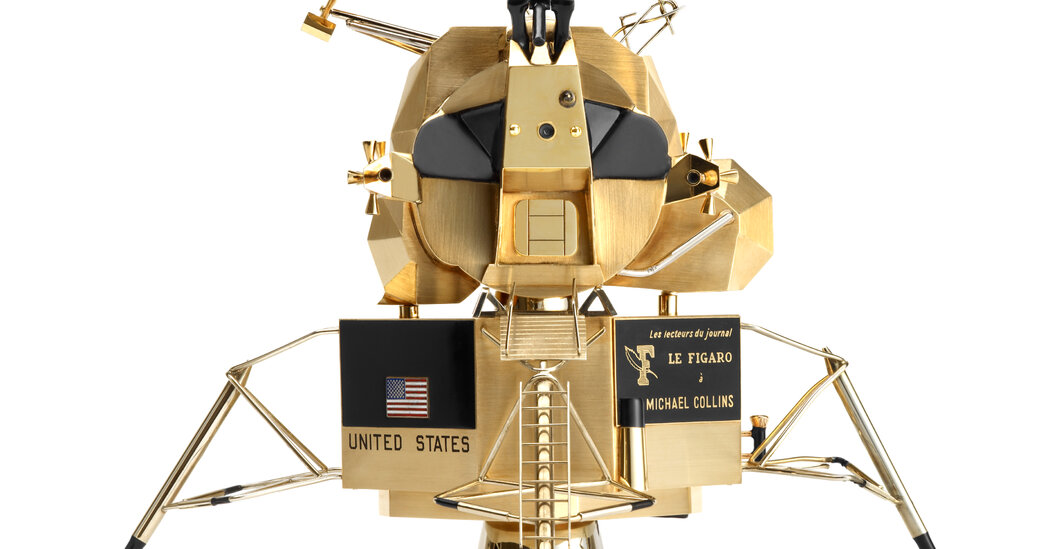
In 1969, Cartier created scale models of the Lunar Excursion Module spacecraft that landed on the moon. Made of yellow and white gold, black lacquer, and red, white and blue enamel, the trophies were commissioned by the French newspaper Le Figaro and were presented to the Apollo 11 astronauts, Neil Armstrong, Buzz Aldrin and Michael Collins, in Paris later that year.
The exhibition also includes images of jewels made for Gilded Age patrons, like a gold peacock feather choker by Mellerio, the oldest jeweler in France, for the American artist and heiress Alice Pike Barney. And from Boucheron comes a replica of a Belle Époque necklace set with 621 diamonds made for Marie Louise Mackay, the wife of the silver baron John William Mackay.
Fashion, Trans-Atlantic Style
If there is one American whose soft-power savvy remains inseparable from French flair, it’s Jacqueline Kennedy.
Givenchy pays tribute to Kennedy’s style with the pink haute couture coat from fall-winter 1959 that she wore during the Kennedys’ first official state visit to France, in 1961.
From Hermès, a black calfskin Kelly bag keeps company with an image of Grace Kelly on the set of “High Society,” bag in tow. The design, which was introduced in the 1930s, became indelibly associated with Kelly in the ’50s when she used it to hide her pregnancy from photographers.
And a purple lace, organza and horsehair gown by Cristóbal Balenciaga represents the Kentucky-born countess Mona von Bismarck, whose wardrobe Balenciaga designed right down to gardening clothes.

