
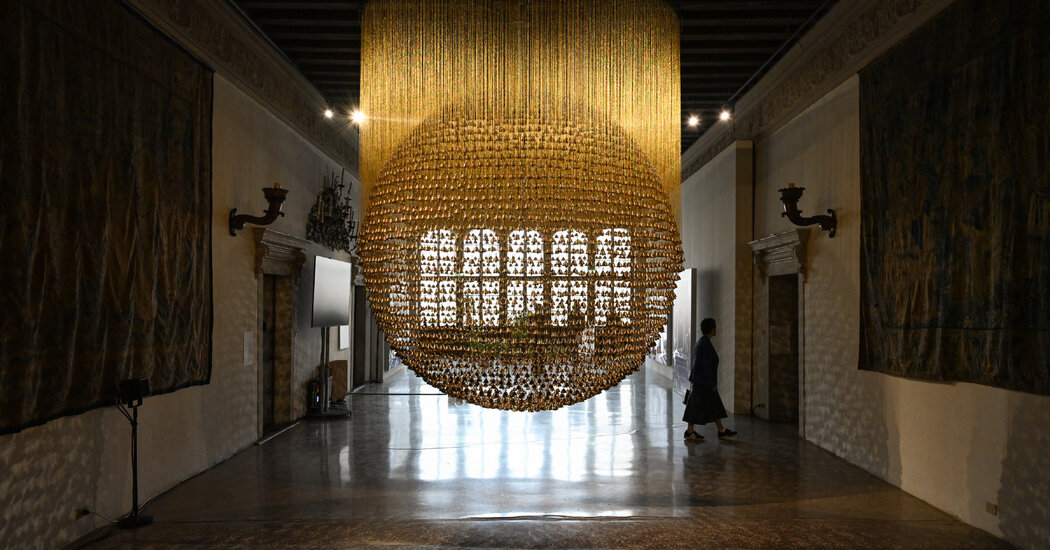
Venice at any time of the year is an open-air museum, overstuffed with Renaissance altarpieces and 18th-century palaces. But during the Venice Biennale — which opens to the public Saturday and runs through Nov. 22 — the entire city is given over to art exhibitions large and small.
The city’s public museums time their most significant shows to coincide with the official Biennale exhibition. Private foundations, some richer than others, mastermind presentations in permanent digs or on private islands. Foreign galleries rent out palazzi for pop-up shows. Even the august Accademia, home to one of the great collections of Italian old masters, has invited in the Serbian performance artist Marina Abramovic and her acts of endurance.
My fellow critics and I saw them all, or just about. Here are our picks of the best. — JASON FARAGO
Richard Prince and Arthur Jafa are two of our greatest “appropriators,” grabbing bits and pieces of popular culture and presenting them as gripping art. We see them doing it again and again in “Helter Skelter,” the fascinating two-artist show curated by Nancy Spector for the Prada Foundation.
But what’s most fascinating about the show is how deeply different its artists turn out to be, despite a shared approach: Appropriation seems nearly as flexible as painting in oils.
Prince presents some of his classic subjects: biker molls astride their boyfriends’ choppers, in images enlarged from cheap magazines; an actual chopper, with long front forks and teardrop gas tank but still awaiting its engine; the hoods of muscle cars reworked to function as sculpture.
Is Prince celebrating a manly culture of the open road? Or calling it into question? Or looking at it from a neutral, ironic distance? Prince gives us appropriation as almost pure “ostension” — just pointing at things in the world, and letting us decide what to feel about them, if anything. He comes off as one of Marcel Duchamp’s most talented heirs, fully committed to Duchamp’s non-commitment. (Spector bills Duchamp as her artists’ patron saint.)
And then there’s Jafa, who also grabs images out of the passing flow, but makes their content feel urgent.
In a fabulous slide show called “SloPEX,” 841 photos and fragments of film speed by in half an hour, exposing us to everything from Angela Davis to dismembered corpses to the Earth rising over the moon.
In the videos that first made Jafa famous, we get mash-ups of found footage that focus more closely on the Black experience Jafa has known.
There’s no single take-home in any of this, but somehow Jafa insists that we need to think deeply about what he shows. His work seems to capture how being Black in America makes the world an inherently charged place that requires constant negotiation. For Jafa, Prince’s cool, Duchampian distance just isn’t available. — BLAKE GOPNIK
Dayanita Singh
State Archives of Venice
What if I told you the most compelling art show in Venice right now consisted of black-and-white photos of Italian archives?
The New Delhi-based artist Dayanita Singh has been taking pictures for 25 years of these repositories, located in public institutions, private homes and hidden libraries: bundled papers, acid-free boxes lined up neatly on shelves, books swaddled in protective fabric, even piles of 17th-century wills, unopened because the archivist has no authority to open them.
The photos themselves are fascinating, but just as extraordinary is how the exhibition came together.
Showing work in Venice is generally an expensive proposition, requiring sponsorship by rich art patrons, galleries or corporations. Yet Singh’s show, “Archivio,” was done on a shoestring.
The wood towers on which the photos are displayed fold flat for easy shipping; they were designed to be lightweight enough so that the artist could put them together herself, bypassing the cost of art installers. She got students from a nearby college to act as docents in exchange for mentorship. A local restaurateur she befriended on her research trips catered the opening reception. And she asked the State Archives of Venice to let her use one of their newly restored storage rooms. They happily agreed, and the show is the first time the archive has allowed such a degree of access for the public.
Singh’s sponsors weren’t the Medicis of our age. Instead of money, her patrons — whose portraits are included in the show — made introductions, offered hospitality and provided moral support. Every aesthetic decision here is a radical proposition, challenging us to rethink patronage, and to imagine an art world that doesn’t need billionaires, luxury brands and high production values to sustain itself. It’s refreshing, imaginative and joyful. — ARUNA D’SOUZA
‘Still Joy: From Ukraine into the World’
Pinchuk Art Center
“Still Joy: From Ukraine into the World,” at the Pinchuk Art Center, is one of the most focused group shows I’ve seen. It is organized by Björn Geldhof, the Pinchuk’s artistic director, but I think President Vladimir V. Putin of Russia needs a co-curator credit: Without all the chaos and pain that Ukraine has borne at this hands, the show would not be as tightknit a package.
Simone Post fills a room with full-size chandeliers made of candy. In any other setting, their sight and smell would be simply cheery. In a show about Ukraine, they stand for all the sweetness and pleasure that Putin has denied his victims.
A piece called “Conversations With My Mother” is just that: nine recordings of everyday phone chats that the Canadian Janet Cardiff, of the Cardiff & Miller art duo, once had with her mom. But in times of war, many Ukrainians can’t count on reaching their mothers with anything other than urgent news. Thinking of them, this work comes to stand for a lost past or very remote future.
A gripping video by Roman Khimei and Yarema Malashchuk shows a Ukrainian son reaching out to his mother — via a robotic dog that he has sent in his place, since he has sought refuge in Poland. A war machine helps close the distance that conflict has put between the boy and his home.
Again and again, works that seem to have their own private meanings get a special gravitas because of the setting they’re in, including pieces by art-stars such as Ryan Gander and Tacita Dean, but also by lesser-known Ukrainian artists.
The show seems to look forward to the day when these works can go back to speaking about something other than war and suffering. — BLAKE GOPNIK
‘Canicula’
Complesso dell’Ospedaletto
On view in this 16th-century building that over the years has served as a hospital and a care home, “Canicula” is the final chapter of “Trilogy of Uncertainties.” Organized by the Fondazione In Between Art And Film, a relatively new entity founded by a member of the Bulgari family, the series takes as its starting point an atmospheric condition that impacts vision.
In this case, it is the dog days of summer, the moment when the sun is closest to the Earth and heat and light intensify, becoming almost unbearable. Eight commissioned video projects explore this idea from different directions — the environmental realities of a warming planet, for one, and the pressures created by the relentlessness of contemporary life as well.
In one room of the Complesso dell’Ospedaletto exhibition space, Lawrence Abu Hamdan’s “450XL: The Story of a Fugitive Sound” presents accounts from a moment of chaos at a silent vigil in Belgrade in March 2025, when 300,000 people gathered to protest the Serbian government. Forensic research by artist’s audio research agency, Earshot, found that the Serbian and Russian authorities had deployed a sonic weapon, the LRAD 450XL, against the crowd, one of its first documented uses.
Across 15 screens with a musical score, we see crowd-sourced film footage and texts of “earwitness” testimonies, a virtual silent film interrupted only by a brief simulation of the weapon’s effect, a blow against collective solidarity.
Elsewhere, P. Staff offers up “Terminal Lucidity,” a term referring to the mental clarity many people experience in the moments before death. Flashes of intense color appear on the screen, followed by periods of black — since our eyes create afterimages in complementary colors. The installation extends to the spiral staircase, with strobe lights flashing the same colors, making the space feel treacherous.
Yuyan Wang’s “Boring Billion” assembles online video clips about industrial manufacture, including the creation of automatons. Over the course of the film, the human workers’ movements seem more robot like, and the robots more human.
Then there is the indelible “Wishful Thinking,” in which the Ukrainian artists Roman Khimei and Yarema Malashchuk imagine a future in which older Russian soldiers come to terms with what they perpetrated during the war. Delivered by Ukrainian actors, who are often shown in stylized hospital settings, the rationalizations — and, occasionally, regrets — encourage us to think about what repair might look like in the aftermath of canicula, when the intensity passes. — ARUNA D’SOUZA
Amar Kanwar
Palazzo Grassi
At the Palazzo Grassi, “Co-Travelers” brings together two works by the New Delhi-based multimedia artist and filmmaker Amar Kanwar. It is, at root, a question about how art can function politically: How can it reveal, in its own distinctive ways, the violence that people experience in their lives?
First is “The Torn First Pages” (2004-08), inspired by a bookseller in Myanmar who tore out a page containing a government-mandated statement of its political objectives from every book he sold — a micro-act of political defiance.
Shown on 19 video screens across three rooms, the installation brings together archival footage and photographs of Burmese military leaders and murdered political dissidents; of men carrying a perverse joint portrait of Mahatma Gandhi, India’s prophet of nonviolence, and one of the leaders of Myanmar’s bloody regime; of propagandistic announcements on state television newscasts; and other images and text passages that speak directly and indirectly to that country’s history.
It is a nuanced, often tragic, account of the struggle for democracy, told obliquely, as a poem might be.
Then there is “The Peacock’s Graveyard” (2023), a sort of parable in which the artist asks us to “Imagine the formal presentation of poetry as evidence in a future war crimes tribunal.”
On each of seven screens, Kanwar has adapted South Asian folk tales or imagined other ones that speak to contemporary conditions. The stories, which unfold through images and text like a spatialized collage, include those of an angry priest who dams a river as revenge for a perceived slight; a hangman who proudly enacts state violence, only to be betrayed by the state in death; a greedy landlord whose exploitation of a poor tenant results in a lifetime of pain; and a politician who is murdered by his speechwriter. The tales speak by turns to environmental destruction, capitalist extraction, political corruption.
The final story, of two men so engrossed in a philosophical argument that they avoid a group of assassins who kill all of their neighbors, suggests that it is only by paying attention to the big questions — questions of art — that we might survive the chaos around us. — ARUNA D’SOUZA
Joseph Kosuth
Berggruen Institute
A lot of the art at this Biennale is hot and romantic, even overwrought. So it’s a pleasure to float over to the island of Giudecca and take in the cool, self-possessed art of Joseph Kosuth, 81, who helped launch American conceptualism back in the 1960s. At the Berggruen Institute, Mario Codognato and Adriana Rispoli have curated a show called “The-Exchange-Value-of-Language-Has-Fallen-to-Zero” that acts as an elegant mini-survey of Kosuth’s work.
Downstairs, a large empty room presents a new commission: a frieze of white neon that tops the room’s walls, reproducing a text by the French philosopher Michel Foucault. It’s too long to quote here, but I think that’s OK: Once appropriated by Kosuth, Foucault’s words no longer carry a fixed meaning, but get us thinking about meanings and texts and what we can do with them.
Upstairs, we get a sampling of Kosuth’s classic pieces from the 1960s and ’70s.
“One and Three Mirrors,” from 1965, is a signature work: It gives us the printed-out dictionary definition of the word “mirror,” an actual mirror, and a photograph that matches what we see in that mirror: the opposite wall of the room. This is mirroring reflecting on itself.
But I was particularly taken with “Text/Context,” a 1979 project in which Kosuth filled advertising billboards with long texts about text. Instead of being told to buy cigarettes, a passerby would read: “This text/sign would like to explain itself, but even as it does, you continue to try to look beyond it to something else.”
It’s possible to parse Kosuth’s art in deep and complex philosophical or linguistic terms. And that can pay off. But in a lovely little building in Venice, his works came off as more lighthearted than that. Solemnity floats away, and their language games truly feel like play. — BLAKE GOPNIK

