
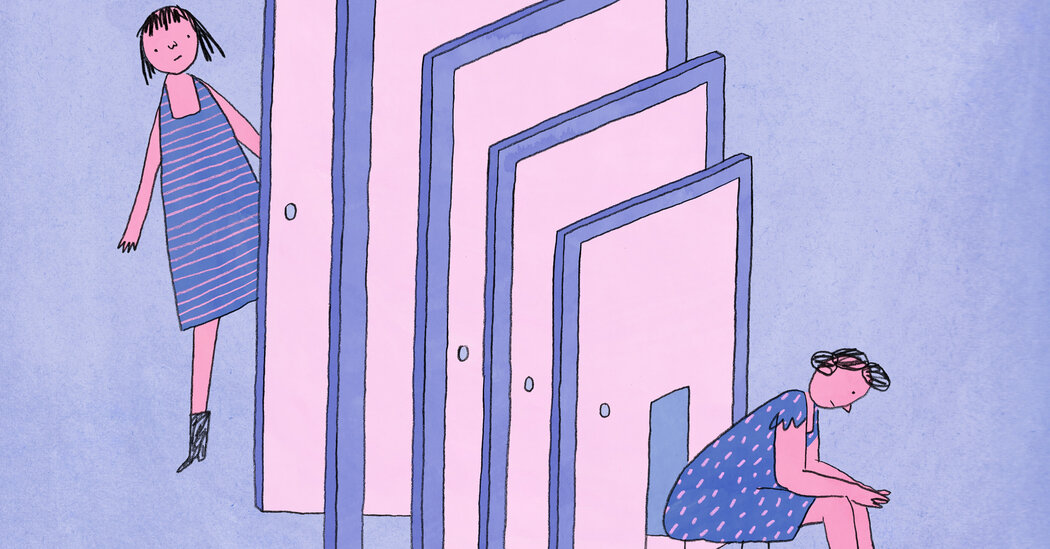
For three days in 2002, my mother secluded herself in our guest room in Santa Monica, furious and depressed over my second published short story. I had known she would see my work as a cruel funhouse mirror, so when my story ran in the Santa Monica Review, I stashed my four copies on a high shelf.
Conspicuously identical, they had caught her eye.
The mother in the story, Helen, starved herself of food and starved her teenage daughter, Leah, of affection. A child of Holocaust survivors, Helen was a “wire” mother who raised a nervous girl drawn to science and the safety of facts.
Whereas my mother embraced and kissed me. She taught me to read, curated novels for me as I grew and raised a writer who produced — as I pointed out when my first published story distressed her — fiction.
Still, there lay in my work an encoded truth about how she had mothered me when I was young. She called herself a “psychoanalyst by marriage,” given my father’s profession, so I knew she would perceive that truth in Helen’s relationship with Leah.
Until I was 12, my mother slipped repeatedly from her adoring and caretaking self into depressive states so deep they turned her stony, cold, verbally nonresponsive. This robotic mother made dinner and ironed my father’s shirts, but if she loved me, or even quite knew me, I couldn’t tell.
It terrified me.
In that state of fear, I, too, went numb. Burned into my memory is the image of a girl and her mother silently reflecting each other across a tiny, dark apartment — the parent in her distress looking vacantly away, the daughter in dread, watching carefully from the white of her eye.
Always, I felt enormous relief when she returned to her loving self, reading to me, stroking my cheek.
That time in Santa Monica, I tiptoed past the guest room door and watched my father bring her meals on a tray. “Dyl,” he said, “she’s angry about how you portrayed Helen.”
I had a hundred questions and asked none. Was she having a flashback? Did she hate me? Did my writing make me a terrible daughter? My father didn’t say. I loved my mother madly; I wanted her back.
I hadn’t seen her like this in decades. At 46, I felt 4 again, in the grip of that ancient fear that my mother might wash her hands of me. For three days I felt paralyzed, afraid to knock on her door.
At the same time, I wanted to barge in and defend myself. It’s a short story, I would have said. Sometimes a cigar is just a cigar!
When she finally emerged, my mother was civil. She didn’t speak about Helen — and my father and I didn’t press her, any more than we had in my childhood. We had acted then like she’d been fine during her depressive spells. She mutely served meals as if they were clay, and my father, still just in grad school for his psychology Ph.D., gamely tried to break the spell with cheerful conversation.
Perhaps it was his inexperience as a psychoanalyst-in-training, but I don’t remember him ever confirming for me that something was wrong with my mother. He would have been devastated to think that his upbeat behavior left me feeling frightened and very alone.
Now I understand that my mother had flashbacks around that time from her own brutal childhood. They spilled over into the horrific stories she sometimes told when she tucked me in — of the medical experiments performed in the Nazi camps, or of how her own mother relentlessly beat her for years.
I remember how her careful detail overwhelmed me, how it kept me voiceless. Memories of childhood violence must have swamped her; why else would she unburden herself to a child?
And all these years later in Santa Monica, she must have felt the slap of judgment in my innocent — or not so innocent — short story.
Five years after the guest room crisis, my mother was helping me tie cushions to my patio chaise longues when she abruptly stopped and stared off with a hard expression.
“You have no idea how difficult it was for me back then,” she said.
I looked at her in alarm; we had been talking about staging my house for sale.
“When you were born on Avenue B, I carried the groceries, the baby carriage and the laundry up and down six flights of stairs. No one helped me. You weren’t fair to Helen at all.”
She had been chewing on that for five years. I wanted to shout: Helen is fictional — are you still on that?
In her criticism, I heard only rebuke, not the underlying hurt, and fumbled a defensive response that I still regret. She had tried to open a dialogue. It was I who couldn’t face her anger. Now I wish I’d said, “You’re right. My stories do fail to tell Helen’s truth: the weight of your despair, how angry and unseen you must have felt.”
What an act of love that would have been. If I had managed that, I might have added, “Can we also discuss the emotional truth the stories do tell?”
But it never happened. Her closed door still frightened me. I did once ask if she’d had therapy as a young mother, and she said we’d had no money for it. She consulted a psychiatrist, though, who offered Elavil. It put her to sleep, and she threw it out. Psychiatry in the early 1960s had little to offer a woman like her — brilliant, literary, wilting in the home while her husband bloomed in grad school.
Philip Roth once told a young Ian McEwan, “You have to write as though your parents are dead.” Blunt, even cruel advice, yes. But as I hear it, he wasn’t preaching contempt. He was speaking to honoring one’s separateness and private truth as an artist, even if it causes pain for those we love. Then, one hopes, we work to negotiate that pain.
And perhaps it’s good counsel for anyone trying to navigate their own truthful path — struggling to come out to a conservative family or explaining to parents bent on rearing a doctor that one yearns to be an arborist. At any rate, I kept on writing like that long after my mother emerged from the guest room.
So it might seem logical that I would start hiding all my published work, sparing my mother’s feelings and purchasing my literary freedom.
But my parents would have known. They had Google alerts! My mother, a great reader, was fiercely proud of having a writer for a daughter. Had I hidden my successes, even with a loving explanation, she and my father would have felt just as injured.
It was a weight I chose to negotiate. When they came to readings, I curated selections for minimal emotional damage. And I relished my parents’ pride when my first story collection came out in 2009. Still, they both delved into the stories as if analyzing my dreams, and I deflected their questions, craving privacy.
“Fiction is not a mirror,” I protested at one point.
My father, his arm around my mother on their sofa, laughed and said, “Yes, it is.”
If I’d had gentler material in my head, I would have written it. Yet family themes still obsessed me as I made notes for a novel. Fiction writing remains the only language I have found to express and expunge that dreamlike dread I remember from childhood.
I was still writing as if my parents were dead when their health lurched toward failure. I spent five panicky years in a state of devotion. In my family, one did not “visit” the hospital, one moved in, and so I often found myself writing on a narrow banquette in my father’s hospital room by day, then heading to my mother’s hospital room to sleep.
Each time they recovered, they asked about my work, but, weakened, settled for elided answers: “It’s going great, thanks!”
I missed my vigorous parents. But they gave me an unexpected and liberating gift, because the second manuscript was even more radioactive than the first.
When the hardcover came out in 2014, both parents were in wheelchairs, unable to focus on printed matter and grieving the loss of reading.
I recall my mother receiving the novel on her lap as if I’d handed her a kitten, the tenderness of her touch as she weighed it in her delicate hands. She stroked the pink and orange cover, then held it up for my father to admire.
“Oh, darling,” she said, and her tone filled my heart, because here was the loving mother whose constancy I had craved as a child, and now finally had. “What a beautiful book.”

