
Some 425 million years ago, leggy creatures called myriapods crawled onto land and never looked back.
Today, the 13,000 species of centipedes, millipedes and other living myriapods (from the Greek words for “countless” and “legs”) are found in nearly every terrestrial environment on Earth, including caves, houses and the leaf-strewn grounds of Central Park. Some even live hundreds of feet underground.
Determining how myriapods adapted to dominate dry land has proved difficult because of a scarcity of fossils from the group’s early days, when its fully aquatic ancestors scuttled across the floors of ancient seas.
A team of scientists recently examined a trove of fossils unearthed in Wisconsin and discovered a new species of myriapods that possessed the streamlined, segmented legs similar to those of its modern millipede relatives. The researchers’ findings, published on Tuesday in the journal Proceedings of the Royal Society B, revealed that these animals were well adapted for life on land long before they left the water.
“In a sense, myriapods had a head start when they arrived on land,” said Derek Briggs, a paleontologist at Yale who was the lead author of the new paper.
The newly described fossils were found in a stone quarry in Waukesha, a suburb west of Milwaukee. During the early Silurian period around 437 million years ago, this area of Wisconsin was a balmy coastline near the Equator, inhabited by trilobites, jawless vertebrates, the earliest known leeches and ancestral scorpions.
Ancient Waukesha was far from a tropical paradise. One shallow bay was salty and devoid of oxygen. As carcasses from the surrounding sea washed in, microbial mats entombed the remains in a sticky film. This preserved the animals interred in this Silurian cemetery in impeccable detail.
The paleontologists Donald Mikulic and Joanne Kluessendorf collected many of these spectacular Waukesha fossils. In 1985, the pair teamed up with Dr. Briggs to publish a preliminary paper about the Waukesha fossils, which mentioned “myriapod-like animals.”
It would take more than 40 years for scientists to formally describe those enigmatic fossils. Dr. Briggs and his colleagues examined 35 myriapod-like fossils in the collection of the University of Wisconsin Geology Museum in Madison. Some of the fossil creatures are curled like moving caterpillars, while others are oriented like question marks. The largest specimens measure slightly longer than a paper clip.
Several of the fossils preserve a surprisingly detailed look at the ancient animal’s internal anatomy. Blue-tinted splotches represent muscles that ran down the animal’s trunk and were replaced by the mineral francolite, a carbonate-rich mineral found in sedimentary rocks, as they decayed. Dark, shiny patches indicate the ladderlike internal structure that secured the muscles in place. Some of the fossils contain vestiges of the animal’s small eyes, while one specimen might even preserve the trace of a heart.
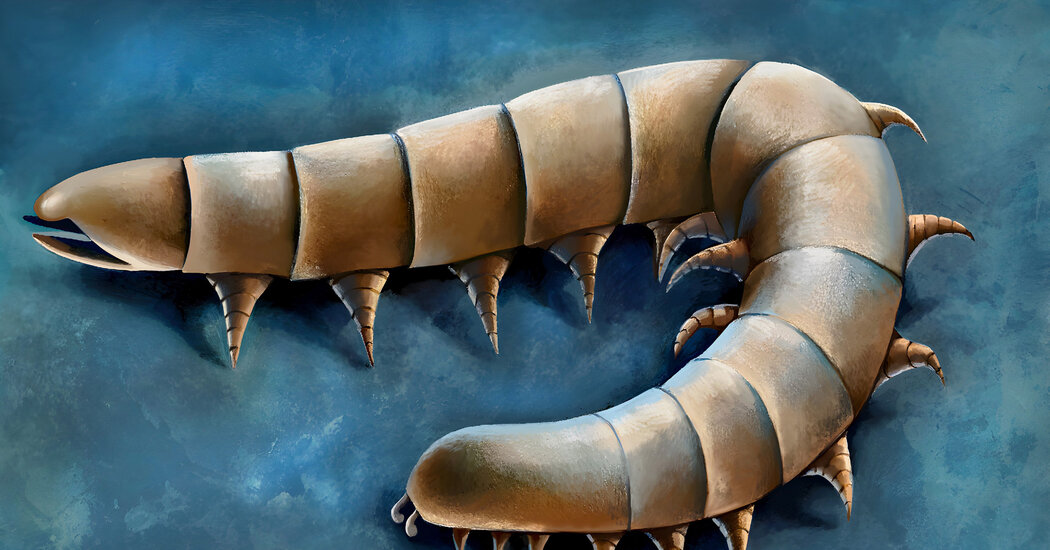
The researchers named the new species Waukartus muscularis. The ancient arthropod’s flexible body was composed of 11 segments and a backside ending in a pair of mysterious, blade-shaped structures. Like modern myriapods, Waukartus was covered with pairs of appendages, including a small set at the front of the head that may have helped it sense or feed. The limbs running down Waukartus’s trunk were short and segmented, allowing the animal to creep along the sea floor in a similar fashion to the way modern millipedes move.
The simple structure of Waukartus’s limbs is notable. Many contemporary critters like trilobites had branching limbs, with one part for movement and another part that served as a breathing apparatus. In contrast, Waukartus’s legs are devoid of gill-like structures, suggesting that ancient myriapods fine-tuned their footwear before they made their fateful trek onto terra firma.
Paul Marek, an entomologist at Virginia Tech who studies the evolution of millipedes but was not involved in the paper, thinks that other fossils from this part of the Silurian Period may preserve other groups of animals that were also gearing up for life on land.
“This is an important time frame to understand this critical transition to really sophisticated terrestrial forms,” he said. “I’m not surprised that these animals streamlined important structures like legs when they were still living underwater.”

