
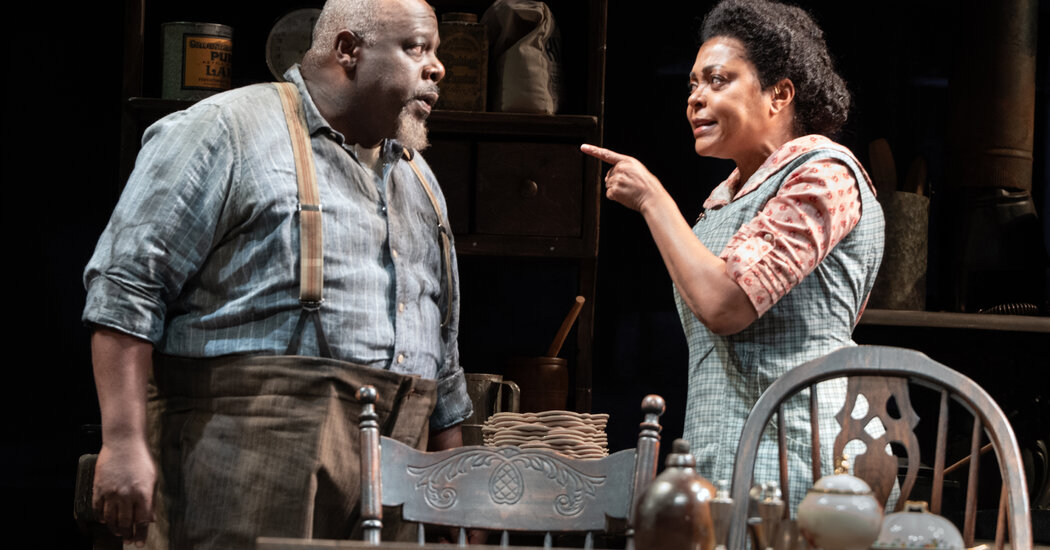
Seth’s one longtime boarder, the old “conjure man” Bynum (Ruben Santiago-Hudson), has several gifts. His name comes from his talent for binding people to their “song,” his term for a person’s purpose, and to each other. In Bynum, the playwright also binds together metaphysical worlds, intertwining ancestral African root work with Christianity’s blood-sacrament. Bynum knows where the road goes: He talks about once following a “shiny man” into the realm of spirit, where he met with the dead. All Bynum wants is to find this man again — “shining like new money” — perhaps so he can cross the veil for good.
Bynum also hugely annoys practical-minded Seth, and their crotchety double-act gives the play its comic charge. Santiago-Hudson, a longtime Wilson expert (and Tony winner for “Seven Guitars”), provides their duet’s wry high-hat dazzle, but Cedric the Entertainer’s deadpan performance is the dry bass drum, so hilarious that I would have signed up for another hour. Seth loves to carp, tutting at the “foolish” migrants; at the deals he gets from the peddler Rutherford Selig (Bradley Stryker); at Jeremy’s musical ambitions. “That boy done carried a guitar all the way from North Carolina. What he gonna find out? What he gonna do with that guitar?” he complains to Bertha, delighted to be exasperated.
And then the burning-eyed Herald Loomis (Joshua Boone) knocks at the door. Allen has Boone appear first in silhouette, the sliding shadow of his flat-brimmed hat making him appear like a cowboy or, possibly, the devil. Herald, traveling with his 11-year-old daughter Zonia (I saw Savannah Commodore), has finally been released from a work-gang in Tennessee, and he is on the road, trying to find his wife, Martha.
Even when Herald seems to be losing his mind, chanting in tongues, Bynum sees both that Herald has prophecy in him — think about his name, after all — and that he has been deprived of more than a wife. And here Wilson tells us the story of the blues song that serves as the play’s title. The lyrics haunt Herald because they refer to his own abduction: Like the voice in the song, he too was snatched up by Joe Turner, the Tennessee governor’s demonic brother, on the barest pretext and forced onto a chain gang for seven years. (When Black men vanished, those left behind would say, Joe Turner’s come and gone.)

