
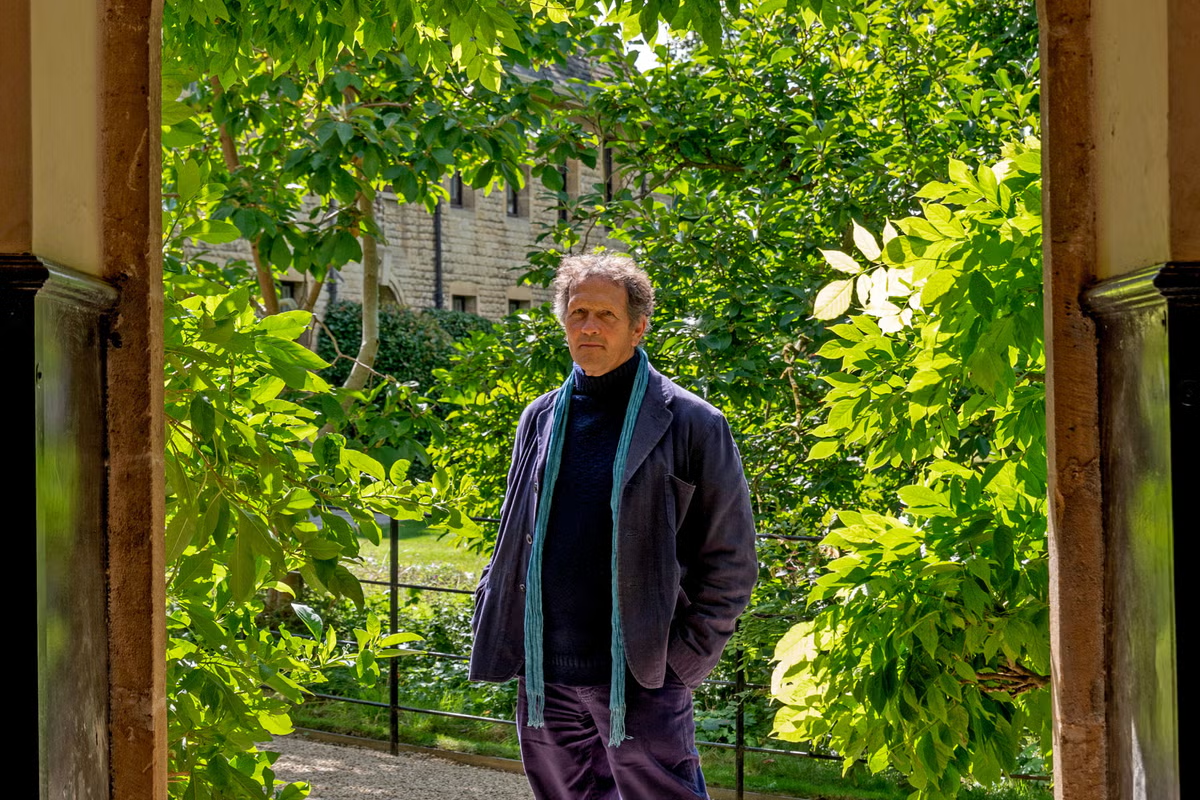
He’s travelled the world, from the Arctic Circle to the Australian outback, the Amazonian jungle to Japan, visiting all kinds of gardens.
Now filming the latest series of Gardeners’ World in his own garden at Longmeadow in Herefordshire, he and the crew work around the weather.
“I want people to think that the camera just turns up and follows me pottering around the garden, then we pop off to look at Adam (Frost) or Carol (Klein) doing something else, then after an hour we say bye bye.
“The reality is it’s quite a big production team. It takes weeks to prepare – two days to film, six days to edit. It’s full on. In-between filming, which we do two days a week, we then have to prepare the garden for what we’re filming thereafter.
“I brace myself. For the crew and I, it’s like going back to school.”
Yet the broadcaster and author has found time to write a coffee table tome, British Gardens, a tie-in for his BBC series last year, in which he looks at the great and the good, the private and the public, the subtleties and the wow-factor of our some of our outstanding gardens and all they have to offer.
He covers gardens from Scotland to Cornwall – and everything in between.
So, what makes British gardens so unique?
“The first is simply climate. We have the best weather. And although we complain about the weather all the time, it’s actually perfect for a wider range of gardening than any other country in the world,” he says.
Our love of gardening comes a close second, he continues.
“Napoleon said we’re a nation of shopkeepers. He got it wrong. We’re a nation of gardeners. Even today, when more and more people under 30 or even 35 are finding it hard to have their own home and therefore their own garden, I think the figure is 83% of the population has access to a garden.
“That’s gone down in the last 25 years from over 90% but it’s still very, very high. It’s still a dramatically large majority of the population.
“That process of gardening cuts across class, race, gender, age and unites us and is a common bond.”
Here he picks some of the outstanding gardens featured in the book.
Birkhall, Cairngorms National Park
“It has to be the King’s garden. It is private and was therefore a privilege and an act of friendship, almost, to let us film there. I know the King a little bit and the Queen. I wouldn’t suggest that we’re friends but I’ve had doings with them over the years.
“They are keen gardeners, proper gardeners and they love it. To have insight into the private world of probably the most public figure in the country was momentous.
“It’s a curious mixture – it’s a royal garden, beautifully gardened with great big kitchen gardens, lawns and woods, but it feels domestic, private.”
Scampston Hall, North Yorkshire
The walled garden was designed by Dutch nurseryman Piet Oudolf who created a complete compartmentalised garden within the walls around the 4.5 acre site.
“It includes his use of structure and hedges and space in a way that he abandoned 15 or 20 years ago. I like his early gardens better than his late gardens. It has a bit of everything – prairie planting, incredible hedges, the mound, it has the water and it’s beautifully restored and looked after.”
It’s subdivided by hedges into 10 different areas or rooms – all of which are a sight to behold.
Wollerton Old Hall, Shropshire
“That is a ‘wow’ garden. It is the epitome of the British garden, and two of the four acres are woodland. It’s not so much lots of small rooms as different areas connected by sight lines and paths, so they all interlink but they all have their own character.
“It’s very much on a domestic scale, not a great big grand house.”
The garden has been created by Lesley and John Jenkins over 40 years, in what started off as a field when they had a young family.
“They make a perfect team,” Don enthuses. “The quote she says is, she uses plants and he grows plants. So what you have is that she designs it, chooses the plants, thinks of the colour scheme. And he will produce the perfect variety to achieve that effect, that loves the soil and loves the conditions and makes sure it’s looking its very best.
“Between them they have established one of the most magical gardens ever made.”
Balmoral Cottage, Kent
Topiary, says Don, is an essential component of the British garden and this one has been created by Charlotte and Donald Molesworth, who moved there in 1983 when it had become very overgrown.
“When they got married she only asked for two presents. One was cuttings and seedlings of yew and box and the other was curtains. She grew the cuttings and seedlings on and made this topiary garden.”
Today, you walk down a brick path flanked by high box hedging studded with box balls, along with topiary and hedging with everything else in the garden, he writes.
The topiary ranges from figurative birds and animals, as well as cloud pruning and geometrically shaped hedging.
“It’s a cottage, not huge, in a village in the country but is the most charming, quirky, eccentric but tasteful epitome of the very British garden. It’s just magical,” he says.
Rousham, Oxfordshire
“This is one of the greatest gardens ever made. It’s a landscape garden and is undoubtedly the finest survivor of the landscape movement, better than any of Capability Brown’s gardens.
“It was made in the 1730s whereas Brown didn’t start working till a quarter of a century later and is pretty much unchanged. No change could improve it.
“It is open to the public but very eccentrically. There’s a big sign saying ‘No dogs, no children (under 15), which some people get very cross about but you take it as it is.”
“It’s entirely evergreen with lots of statues and water.”
British Gardens by Monty Don & Derry Moore is published by BBC Books, priced £35. Photography by Derry Moore. Available now

