
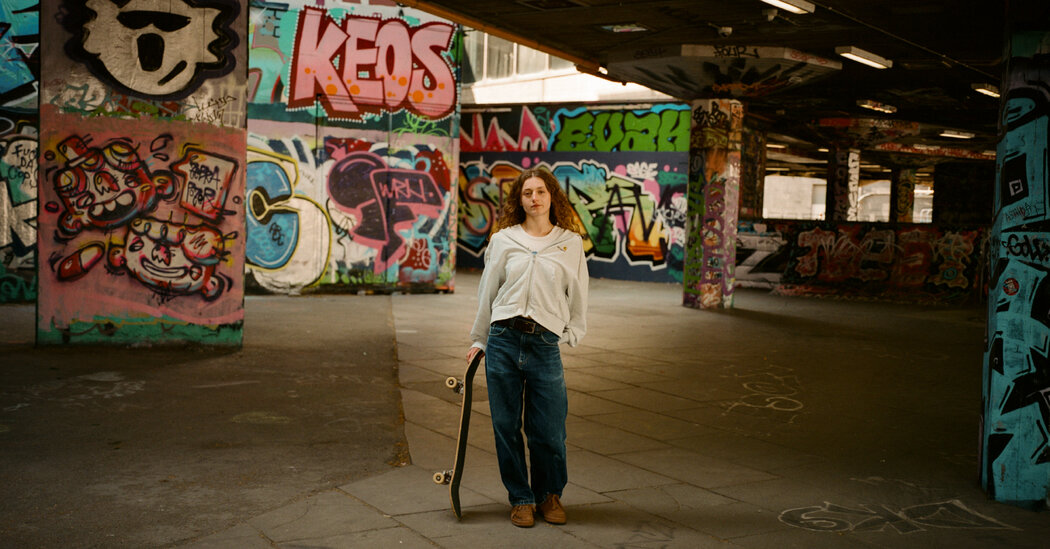
When Réda Tahiri was a teenage skateboarder growing up in Casablanca, Morocco, there were a few spots around the world where he dreamed of skating: Love Park in Philadelphia, the plaza in front of the Museu d’Art Contemporani in Barcelona and the Undercroft Skate Space, part of the Southbank Center in London.
Such was his long-distance affection for these spots that in 2013, when he saw that a group of skaters had started a campaign to prevent the Undercroft from being redeveloped into retail units, he immediately signed its petition. His signature was one of 150,000 that helped save the space.
Two years ago, Tahiri moved to the British capital “for a master’s degree, but really it was for skateboarding,” he said, perched on a ledge at the Undercroft on a recent afternoon as the thwack of boards hitting concrete echoed around him. Skating here regularly, sometimes alongside the “legends” whose videos he used to watch, has been “like coming home to your family,” Tahiri, now 37, said.
For 50 years, the Undercroft has been a place of pilgrimage and community for skaters from around the world who are drawn to its concrete banks and steep angles. The space is now recognized as the world’s oldest continually used skate spot, and its history is the focus of a new exhibition at the Southbank Center, Britain’s largest arts complex. Its survival also offers an example of a beloved community space that was rescued from gentrification by a grass-roots campaign.
The relationship between the Undercroft skaters and the Southbank Center has at times been fraught, especially as the space’s value to the skaters who use it has contrasted with the market value of such prime London real estate.
The center’s collection of playfully Brutalist buildings, many of which opened in the 1960s, was designed by members of the avant-garde architecture collective Archigram to be Britain’s new cultural hub as the country emerged from the ravages of World War II. The upper levels house august concert halls and art galleries, while the architects always intended the street-level Undercroft — dotted with ledges, stairs and distinctive sloped pillars — to be a public space, ideal for experimentation. Accessible 24 hours a day, the Undercroft has become its own sort of cultural destination since the first generation of London skateboarders discovered it in the early ’70s.
One of those early arrivals was Jim Slater, who first visited the Undercroft in 1976 when he was a 13-year-old slalom skater looking for somewhere to skate on rainy days. Soon, he said in a recent interview, he was spending every long London summer day there, and a “brotherhood” formed among the skaters, who came from diverse backgrounds and encouraged one another to try new tricks.
On a recent Saturday, with a pint of beer in hand, Slater leaned against the railings separating the skate space from the crowds of tourists walking past, under an exhibition poster showing him skating in the same spot in 1978. Now 63, he still comes back as often as he can to see longtime friends and watch the new generation of skaters and BMX riders.
The creativity required to skate in “found” spaces has long been a central premise of skateboarding, starting with the sport’s originators using the curved sides of drained swimming pools in the Los Angeles suburbs to emulate the feeling of surfing. So in 2013, when the Southbank Center announced plans to move the Undercroft to a purpose-built skate park nearby and turn the original space into shops and restaurants to help fund the center’s renovations, a group of skaters rallied to oppose the plans.
Calling themselves Long Live Southbank, the campaign set up a table in front of the space to garner public support, sold merchandise, wrote a book and reports about the space and secured pro bono legal help.
“There was never any doubt about what needed to be done,” said Stuart Maclure, 32, a skater who wrote his college dissertation on the Undercroft and is now the campaign’s manager.
After fierce negotiations and in the face of significant public pressure, in 2014, the Southbank Center withdrew the redevelopment plans, and the space was legally protected by an agreement between the center and the local city authority guaranteeing that the Undercroft would remain a skate spot.
Now working with the Southbank Center, the campaign raised more than 1.1 million pounds, about $1.5 million, to restore the Undercroft, which reopened in 2019 with new lights and more skateable space. Today, the Southbank Center oversees its day-to-day maintenance and this year included it in the center’s 75th anniversary celebrations.
“The Undercroft and the skaters who use it are woven into the very fabric of the Southbank Center,” Mark Ball, the center’s artistic director, said in a statement. “What has grown under our concert hall is just as important as the concerts we put on inside it,” he added.
Other favorite global skate spots have not been so lucky, even as the cultural mainstream, especially fashion, has embraced skating culture. In 2016, the city of Philadelphia demolished the Love Park plaza, a skating mecca that was reconstructed in Malmo, Sweden. And in Barcelona, where tensions have bubbled for years between skaters and the Museu d’Art Contemporani, the city in 2020 banned skating on the plaza in front of the museum on Saturdays. Last year, a major expansion of the museum began, with plans that include a redesigned plaza.
Maclure, who now works in skate park design and construction, said he was still contacted at least once a week by people around the world wanting to know how the Southbank campaign managed to succeed.
Ultimately, he said, it “celebrated what was important and told the truth about why you should value certain things or places,” especially “blank slate spaces” where community can grow organically. The team also took “quite a mature approach,” Maclure added, one of “let’s be open to negotiation and compromise, and let’s be realistic.”
In recent years, the increased demand for outdoor activities during the coronavirus pandemic and the addition of skateboarding as an Olympic sport also led to a surge in people taking up the sport, which is partly reflected by the Undercroft’s current generation of skaters. Some of its best regulars are now sponsored by brands like Nike, Supreme and Palace. (Because the Southbank is a tourist hot spot and the skate space is a rare covered space in central London that’s open to all, it’s still worth keeping an eye on your possessions.)
On a recent sunny afternoon, a group of women was getting a skate lesson as people lined up against the space’s barriers to watch, cheering when the skaters landed a trick. The coach, Joseph Duggan, 35, has been skating in the space since he was 12, and founded Skate School London in early 2020. Business has boomed, he said, and after hiring extra teachers, the school now gives 100 lessons a week to adults and children at spaces across London.
That day, he was coaching the London Skate Mums, a group founded by Aiwa Saito, 47, after her children started skating during a pandemic lockdown. Saito said that although the Undercroft could be intimidating, the beginners had found a welcoming community. “Every skater started from the same spot, so they know how scary it is,” she said.
After one group member, Esther Sayers, 56, looped across the sharp banks, holding Duggan’s hand for the trickiest angles, she described the experience of skating as “pure joy.” Plus, she added, “you feel like you’ve achieved something so much greater because you’ve skated the beast that is Southbank.”
To keep the beast skateable for the next 50 years, “we’ve still got work to do,” Maclure said. He reeled off a list of repairs that will make up the next phase of refurbishments to remedy the daily wear and tear of hundreds of skateboards and bikes. The Undercroft will continue to be a “constantly evolving thing,” he said — just as its original architects intended.

