
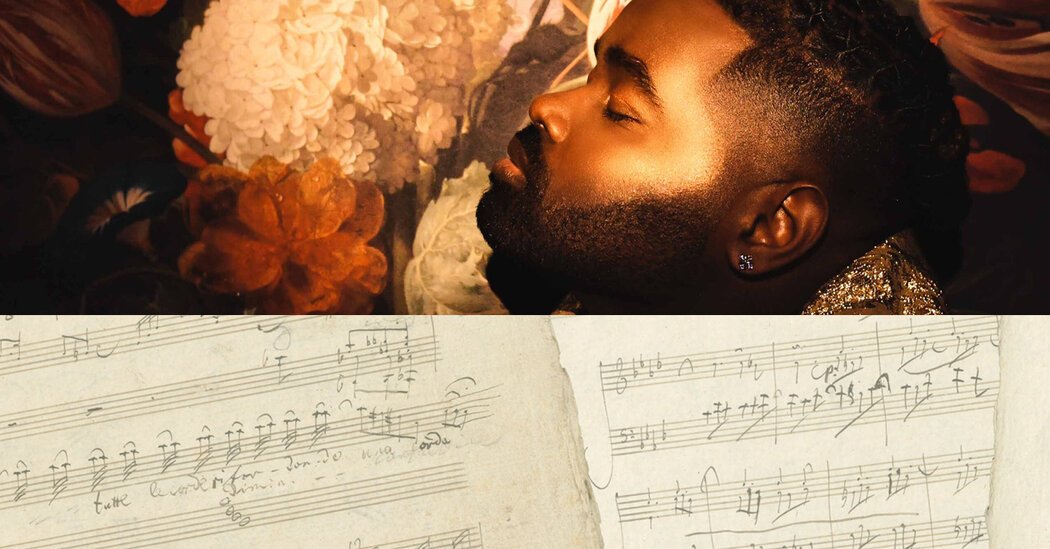
Julius Eastman Vol. 5: ‘Gay Guerrilla’
Wild Up; Christopher Rountree, conductor (New Amsterdam)
▶ Listen on Spotify, Apple Music Classical or YouTube Music
“A guerrilla is someone who is, in any case, sacrificing his life for a point of view,” Julius Eastman said in his spoken introduction to the premiere of his “Gay Guerrilla” in 1980. This declaration hints at something essential in the piece’s character: Other Eastman works such as “Femenine” and “Stay On It” reach for wildness and ecstasy. “Gay Guerrilla,” written for four pianos but presented by the superb Los Angeles-based group Wild Up in a full-ensemble version, has a confrontational edge.
It opens by bringing a march-like rhythm out of silence and letting it accumulate into a colossal mass of sound. That ostinato is never absent from the music for long, though it alternates with smeared washes of instrumental color. About two-thirds of the way through, Eastman sets Luther’s chorale “A Mighty Fortress Is Our God” in an almost psychedelic swirl of brass and winds. If that moment might represent sanctification, the finale section — in which the march rhythm builds to a climax of tremendous emotional power before ebbing away — can be heard as a last, defiant statement of commitment to Eastman’s being wholly himself amid a world in which he was always an outsider.
— David Weininger
‘Ukrainian Mixtape’
BBC Symphony Orchestra; Dalia Stasevska, conductor (Platoon)
▶ Listen on Spotify, Apple Music Classical or YouTube Music
In pre-streaming, pre-algorithm days, a mixtape was a way to share favorite songs and introduce underground artists. Getting one from your crush could cement your “soul mate” status — that is, if it was any good. The music on this bite-size album from the conductor Dalia Stasevska and the BBC Symphony Orchestra certainly is. With short orchestral works by four composers — some dug up from archives, some slightly more familiar — the album gives listeners an introduction to a few of Ukraine’s defining artists.
Stasevska begins with Levko Kolodub’s anything-but-solemn “Solemn Overture,” then turns to Borys Lyatoshynsky’s 20th-century tone poem “Grazhyna,” based on a poem by the Polish writer Adam Mickiewicz. By turns mysterious, lyrical and stirring, “Grazhyna” could go toe-to-toe with the greatest tone poems of the 19th century. But two Impressionism-inflected nocturnes from Fedir Yakymenko most intrigued me, and not just because Yakymenko was one of Stravinsky’s early teachers; these are luscious, languorous pieces, perfect for sultry nights. Mykola Lysenko’s overture to “Taras Bulba,” based on the Gogol novella, closes the album with dark drama that gives way to martial triumph. As with any good mixtape, you are left hungry to hear more.
— Gabrielle Ferrari
Beethoven: The Last Three Piano Sonatas
Mitsuko Uchida, piano (Decca)
▶ Listen on Spotify, Apple Music Classical or YouTube Music
What’s particularly thrilling about Mitsuko Uchida’s live album of Beethoven’s final piano sonatas is her attention to the music’s many joins.
Two moments from the finale of Op. 110 stand out. An opening fugue serves as an elaborate preparation of the dominant, in expectation of resolution to the home key. At its climax — a delicious arpeggio, spread wide across the piano — Uchida denies this closure in a curt, gently cutting way; the music falls into another theme through bleak, low minor-key chords. A few minutes later, a similar low figure appears, now in a major key. Uchida’s growth through those nine repeated chords is a fire catching light, flooding a hearth with heat and beginning to roar.
This is some of Beethoven’s most mystical writing, as he plays with the remnants of his exploded formal structures; by the final Arietta of Op. 111, the music, with its long chains of trills, becomes all join. By this point, Uchida’s subtle distinctions between joist and join have dissolved: The final stanza is carried to its eventual expiration on a single column of air. In this live recording from Suntory Hall in Tokyo, you can tell the audience is sitting in silent rapture.
— Hugh Morris
‘Over My Head’
John Holiday, countertenor; Kevin Miller, piano (Pentatone)
▶ Listen on Spotify, Apple Music Classical or YouTube Music
Musicality like John Holiday’s can’t be taught. When he sings, the sheet music’s bar lines and notations fall away, and he sets the music free.
Familiar melodies turn unfamiliar in mesmerizing ways. Robert L. Morris’s witty realization of the spiritual “Scandalize My Name,” which Paul Robeson recorded with stony authority, sounds sly, gossamer and unbothered. Holiday’s silky way with the same composer’s “Gospel Blues,” abetted by Kevin Miller’s graceful, unhurried blues piano, glimmers with mournful, luminous colors. Each of the American standards, “Fly Me to the Moon,” “Summertime” and “Strange Fruit,” is a little jewel. Accompanying himself at the piano, Holiday spins threads of supple, gleaming sound, and octave-spanning runs tickle the bass in his voice. When he pivots to H. Leslie Adams’s lesser-known “Nightsongs,” they glow with plain-spoken intimacy.
The album opens with Hall Johnson’s emphatic “I’m Gonter Tell God All O’ My Troubles.” It’s a homegoing song until the narrator decides that he must live to serve as God’s vessel. Holiday, who grew up with church, builds it to a praise-rattling climax, but it could also be a statement of Holiday the artist, sharing the music in his head as he was intended to do.
— Oussama Zahr
Joe Hisaishi: Symphony No. 3 & Harp Concerto
Royal Philharmonic Orchestra; Emmanuel Ceysson, harp; Joe Hisaishi, conductor (Deutsche Grammophon)
▶ Listen on Spotify, Apple Music Classical or YouTube Music
Joe Hisaishi — a composer at home in both a film-scoring studio and the concert hall — subtitled his Third Symphony “Metaphysica,” Latin for metaphysics. This is a work that ponders the big questions.
The first movement, “existence,” opens with bold, blocky strokes, fronting a long melody that branches and splinters under the weight of the ensuing counterpoint. Set against chirping rhythmic cells, the music fades into monotony despite its busyness. “Where are we going?” is a slow string lament, and the last movement, “Substance,” fronts boisterous, interlocking rhythms, punctuated with ringing silences. Hisaishi has said that this movement, which only uses six different pitches, nods to Sudoku’s grid patterns. The effect, as with the opening, is a slide toward tedium. This could be intentional given the symphony’s philosophical premise. Unraveling the work’s meaning is a pleasure.
The album also features Hisaishi’s Harp Concerto, more sparsely scored by necessity to allow the soloist to slice through the textures. Emmanuel Ceysson, principal harp of the Los Angeles Philharmonic, propels the first movement forward with perpetual motion; when the orchestra imitates these athletic passages, however, it plods. The second movement is a chanson, with a murky cadenza featuring extended techniques bridging to a mechanical, driving finale.
— Jeremy Reynolds

