



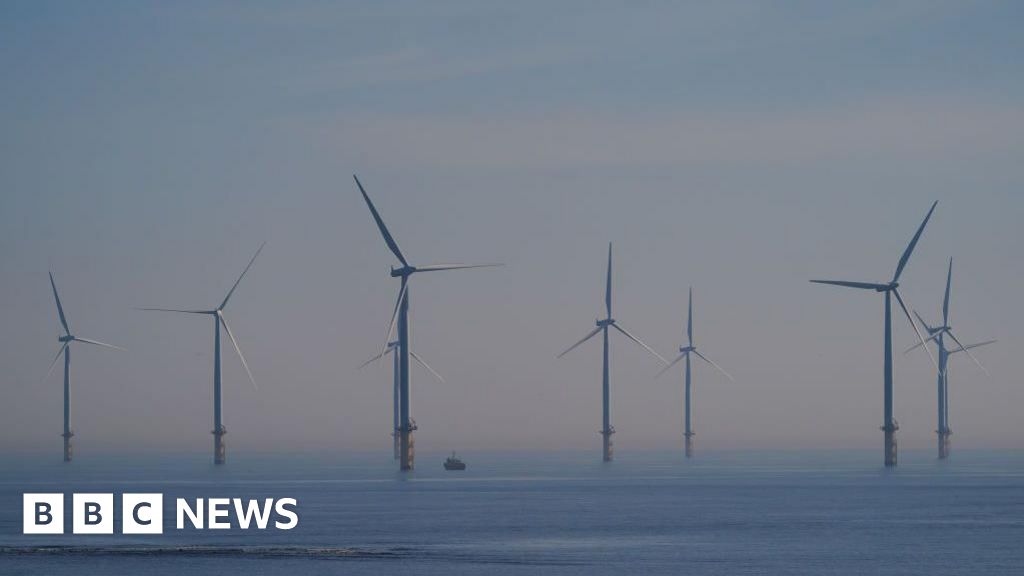
The UK has awarded contracts to build a record amount of offshore wind projects as part of its efforts to grow the country’s clean electricity sources.
The projects span England, Scotland and Wales, including what could be the world’s largest offshore wind farm off the coast of Scotland in the North Sea.
But some analysts warn that despite the record haul of offshore wind, the government will still struggle to meet its 2030 “clean power” target.
The government argues that wind projects are cheaper than new gas power stations and will “bring down bills for good”, but the Conservatives have previously accused climate targets of raising energy costs.
The largest successful project is Berwick Bank in the North Sea, which is the largest planned offshore wind farm worldwide.
Other projects to be awarded contracts include the Dogger Bank South wind farm off the coast of Yorkshire and the Norfolk Vanguard project off the coast of East Anglia – while Awel Y Mor was the first successful Welsh project in more than a decade.
The government wants at least 95% of Great Britain’s electricity to come from “clean” sources by 2030, partly to reduce emissions of planet-warming gases from fossil fuels. These clean sources include renewables – such as solar and wind – and nuclear energy.
Offshore wind is widely seen as the backbone of the UK’s future clean electricity system, with plentiful wind resources off the country’s coastlines.
The government wants at least 43 gigawatts (GW) of offshore wind by 2030 to help meet its clean power target.
That is a big step-up from the UK’s current offshore wind capacity, which stands at 16.6GW, with a further 11.7GW under construction, according to the government.
Building offshore wind and connecting it to the grid takes time – and many analysts have viewed this auction as crucial to get enough wind to meet its target.
The 8.4GW secured at this latest auction just about keeps the offshore wind target in reach, several analysts have told the BBC. But all those projects will still need connecting to the grid to generate electricity.
“Getting that amount of capacity online by 2030 [will be] extremely challenging,” said Nick Civetta, project leader at the Aurora Energy Research think tank.