






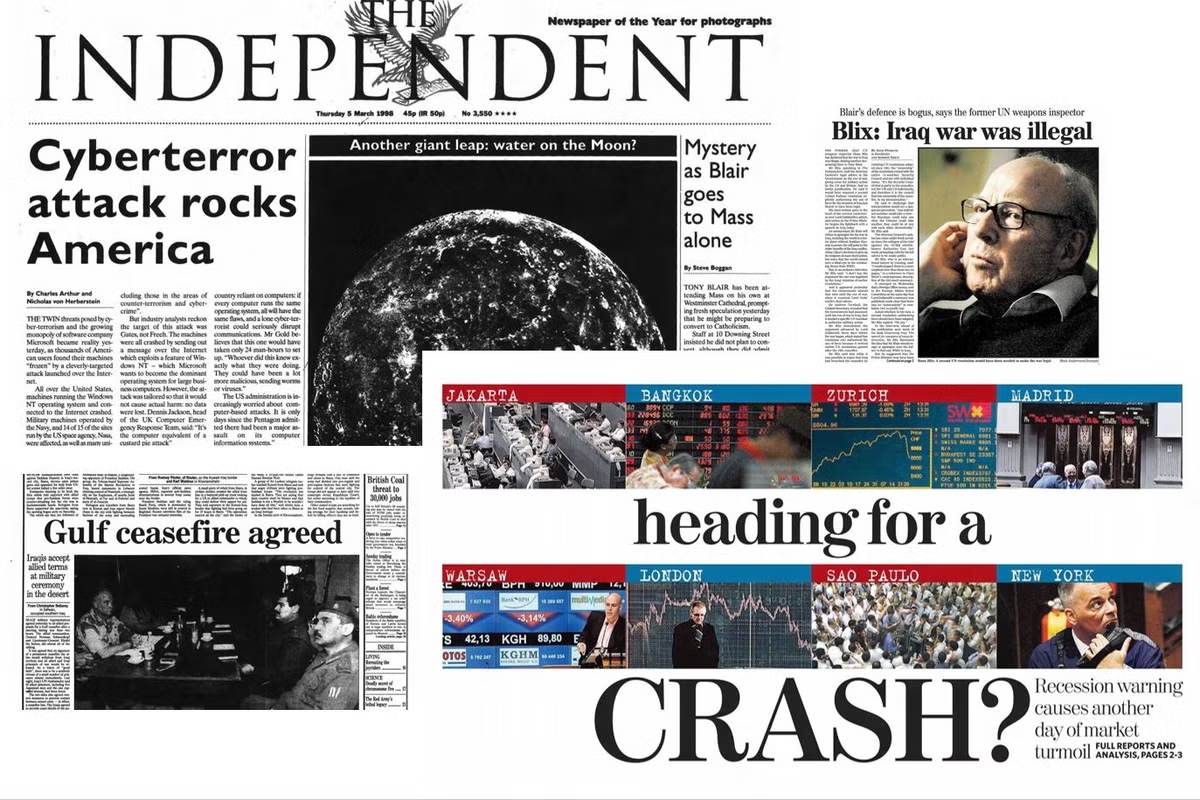
War runs like a faultline through this week’s headlines. Ukraine is on the brink of “disaster” as Russian troops mass in Crimea. Ceasefire in the Gulf brings a swift military campaign to a close. Years later, Hans Blix brands the Iraq war “illegal” in a political bombshell. Meanwhile, a new theatre of conflict emerges in the late nineties as cyberterror cripples networks across the US. Yet, there are flickers of détente too, as Soviet proposals to scrap intermediate nuclear missiles in Europe revive hopes of a Cold War breakthrough. All and more are charted across these front pages of The Independent.
3 March 1987 – US and Soviets in nuclear missile talks
US and Soviet negotiators agree to prolong talks on intermediate-range nuclear weapons, raising hopes of a breakthrough in efforts to eliminate an entire class of nuclear missiles in Europe. Moscow’s willingness to decouple the negotiations from President Ronald Reagan’s controversial “Star Wars” defence programme signals a shift in the arms-control deadlock. The discussions led later that year to the landmark INF Treaty, the first agreement to abolish a category of nuclear weapons.

6 March 1989 – Buddhist monks lead deadly protest in Lhasa
Buddhist monks lead pro-independence demonstrations in Lhasa that end in violent confrontation, with Chinese security forces opening fire on protesters. At least 11 people are reported killed and around 100 injured, in what officials describe as the most serious unrest in Tibet for decades. The clashes mark a renewed flashpoint in tensions between Beijing and Tibetan separatists, evoking memories of the 1959 uprising and its suppression.

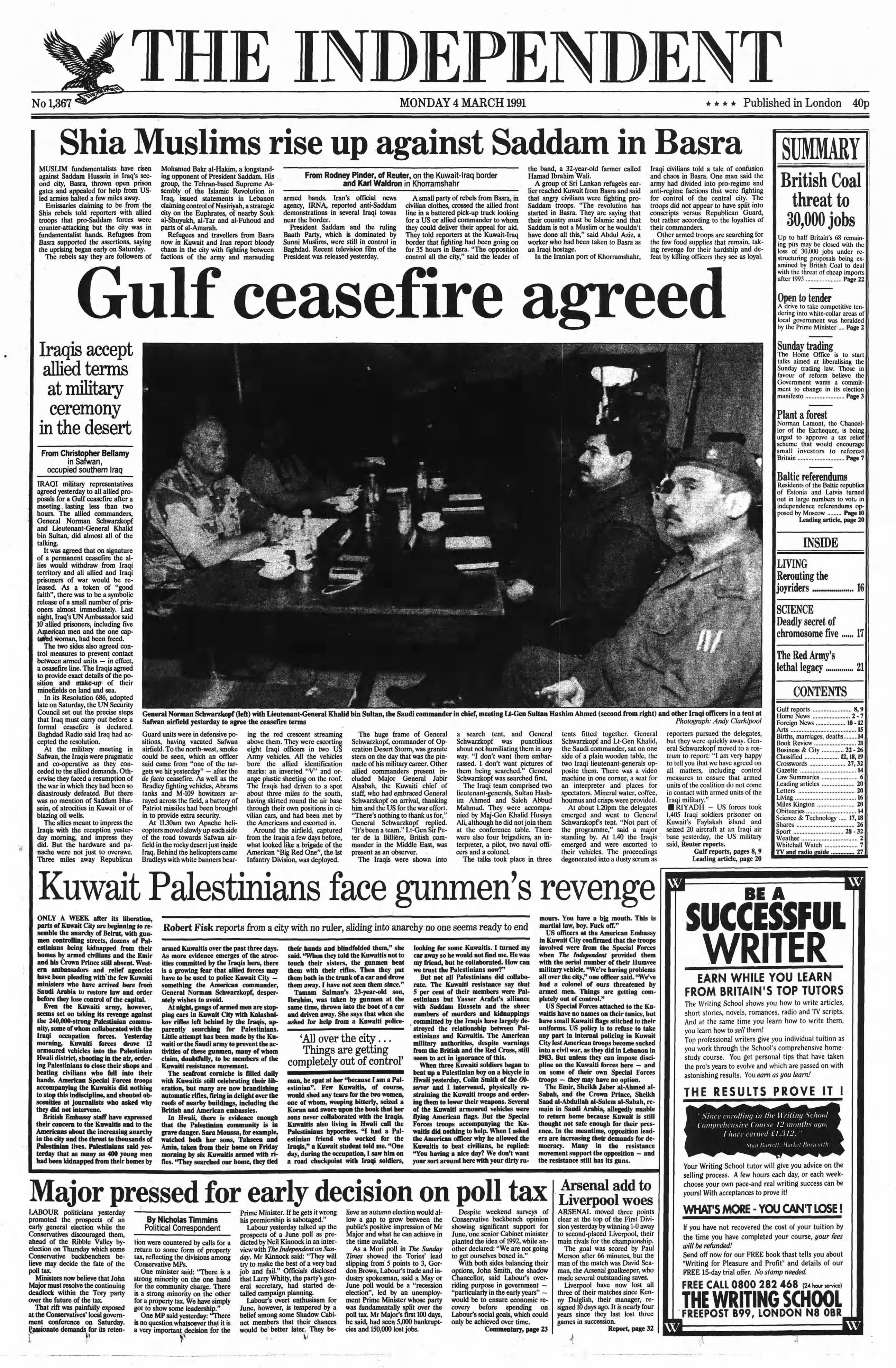
4 March 1991 – Gulf ceasefire agreed in desert ceremony
Iraqi military officials accept allied ceasefire terms at a brief desert meeting, formally ending combat operations in the Gulf War after the liberation of Kuwait. The agreement provides for the release of prisoners of war and the withdrawal of coalition forces from Iraqi territory. As the ceasefire takes hold, Shia uprisings erupt in southern Iraq, including in Basra, but without direct coalition intervention, Saddam Hussein’s regime moves swiftly to suppress the rebellion, remaining in power for another decade.
5 March 1998 – ‘Cyberterror’ attack hits US
Thousands of computers across the United States grind to a halt after a targeted internet attack crashes machines running Microsoft’s Windows NT system. The disruption, described as an early brush with “cyberterror”, strikes just hours before Bill Gates appears before a Senate committee over Microsoft’s growing dominance. As the internet era accelerates, the episode exposes how vulnerable the new digital frontier may already be.

2 March 2003 – 9/11 ‘mastermind’ captured
Pakistani authorities announce the capture of Khalid Sheikh Mohammed, the alleged architect of the 11 September 2001 attacks and a senior figure in al-Qaeda’s military strategy. Arrested in a raid near Islamabad, Mohammed had long been one of the FBI’s most wanted men and was accused of playing a central role in plotting the hijackings that brought down the World Trade Center towers, as well as involvement in earlier extremist attacks. Following his arrest, he was transferred into US custody and held at secret CIA “black sites” before being moved to Guantánamo Bay.

5 March 2004 – Blix declares Iraq war ‘illegal’
Hans Blix, who had retired from the UN and was chair of the Weapons of Mass Destruction Commission, tells The Independent that the invasion of Iraq lacked lawful justification, insisting only a second UN resolution authorising force could have made it legal. His comments cut to the core of the controversy over Tony Blair’s legal case for war, as doubts deepen over intelligence and the missing weapons of mass destruction.

2 March 2007 – Markets reel as recession fears mount
After three days of banking and market turmoil, The Independent asks: “Are we heading for crash?” Investors across Asia, Europe and the United States retreat sharply following an unexpected global equity sell-off, fuelling fresh anxiety about the health of the world economy. Within 18 months, the global financial crisis would erupt in full, bringing the collapse of major banks, deep recession across much of the world and the most severe economic downturn since the 1930s.

3 March 2014 – Ukraine on the brink
Ukraine’s acting prime minister warns the country is on the “brink of a disaster” as Russian troops mass and seize strategic positions in Crimea. Across the peninsula, civilians link arms outside military bases in fragile acts of defiance, while world leaders caution President Vladimir Putin against further escalation. The standoff marks the beginning of a profound rupture between Moscow and Kyiv and, within weeks, Crimea is formally annexed by Russia.

3 March 2016 – Trump is Republican ‘hair apparent’
After a string of commanding victories on Super Tuesday, Donald Trump emerges as the Republican Party’s “hair apparent”. The Independent notes that while Hillary Clinton remains the favourite in national polls, the deep polarisation of the electorate points to a volatile and tightly contested race. Trump would go on to secure the Republican nomination and win the presidency later that year.

8 March 2023 – Tracey Emin’s ‘Marriage to Myself’
For International Women’s Day, Tracey Emin unveils “Marriage to Myself”, an exclusive artwork for The Independent. In an accompanying reflection, the artist writes about womanhood, ageing and the hard-won contentment she has found in later life. Drawing on an old idea suggested by her friend Vivienne Westwood – of walking down the aisle alone – Emin reframes marriage as an act of self-commitment, celebrating autonomy and survival.