
KARACHI:
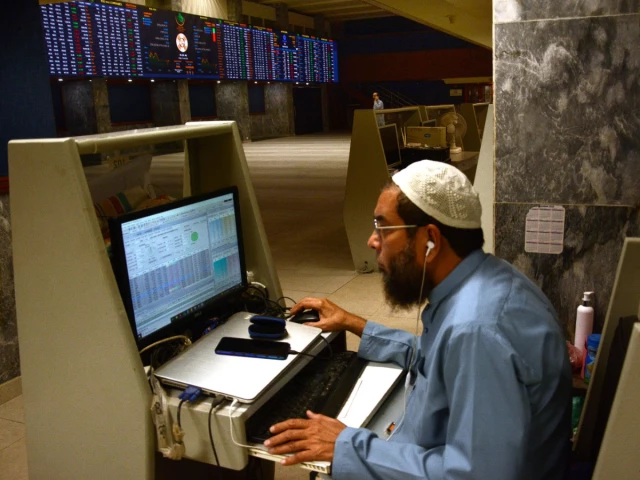
Pakistan’s stock market remained under heavy pressure during the week ended February 13 as the benchmark KSE-100 index plunged 4,526 points, or 2.46% week-on-week, to close at 179,604 amid heightened volatility, weak corporate earnings, and investor concerns surrounding developments related to the Reko Diq mining project.
Market sentiment remained fragile due to persistent selling across major sectors, while analysts also linked the downturn to rising political and security tensions, which weighed on risk appetite and triggered cautious trading activity throughout the week.
On a day-on-day basis, the Pakistan Stock Exchange (PSX) started the week with a big loss, when the KSE-100 dived 1,789 points (-0.97%) to settle at 182,340. On Tuesday, the bourse experienced a consolidation phase as the index closed at 182,154, down 187 points (-0.10%).
However, the market staged a rebound from its intra-day low near 182,000 on Wednesday, settling at 183,049, up 896 points in a largely range-bound session. The second last day of the week witnessed a negative session, which erased 2,537 points (-1.39%) and closed at 180,513. The PSX extended its losses on Friday, with the KSE-100 declining by 909 points (-0.50%) at 179,604, breaching the key psychological support level of 180,000.
Arif Habib Limited (AHL), in its weekly commentary, noted that the KSE-100 remained bearish throughout the week, losing 4,526 points (-2.46% WoW) and ending at 179,604. The bearish trend was observed due to selling pressure, some lower-than-expected corporate results and high volatility stemming from concerns related to Reko Diq. During the week, Moody’s revised Pakistan’s banking system outlook from positive to stable, which indicated that while macroeconomic indicators had shown improvement, the recovery in the operating environment continued to be gradual.
Moreover, remittances from overseas Pakistanis increased by 15% year-on-year to $3.5 billion during January 2026 compared to $3 billion in January 2025. On a month-on-month basis, remittances decreased by 4%. Auto sales increased to 23.1k units, up by 74% MoM in Jan’26, while on a YoY basis, it rose by 35%.
In the MSCI Index review for Feb’26, Abbott Laboratories was deleted from the MSCI FM Standard Pakistan Index, while Security Papers and Zarea Ltd were included, and Lalpir Power was deleted from the MSCI Small Cap Index, AHL said.
Gas production was down by 7.8% WoW to 2,798 million cubic feet per day, while oil production fell significantly by 11.7% WoW to 59,121 barrels per day during the first week of Feb’26. The central government debt rose by 1.3% MoM to Rs78.5 trillion (+9.6% YoY) as of Dec’25 compared with Rs71.6 trillion in Dec’24. Meanwhile, the State Bank-held reserves increased by $20.6 million to $16.18 billion, with import cover now standing at 2.53 months, AHL added.
Wadee Zaman of JS Global said the KSE-100 index remained under pressure during the week, declining 4,526 points (-2.5%) WoW amid cautious investor sentiment driven by rising political tensions and security concerns in Balochistan, creating uncertainty around the Reko Diq mining project.
On the macro front, an IMF mission is expected later this month to start discussions for the third review under the $7 billion Extended Fund Facility. Pakistan has met three out of five major conditions so far.
Remittances for Jan’26 stood at $3.46 billion, up 15.4% YoY, taking 7MFY26 inflows to $23.2 billion, up 11% YoY. In the MSCI review, Pakistan saw two additions and two deletions across the Frontier Market and Small Cap indices, effective February 27.
On the fiscal side, PSDP spending reached Rs273 billion in 7MFY26, reflecting only 27% utilisation out of the FY26 allocation of Rs1 trillion, while the Finance Division reported a primary surplus of Rs4.1 trillion in 1HFY26, equivalent to 3.2% of GDP.
On the sectoral front, Moody’s revised Pakistan’s banking sector outlook to stable from positive, citing a gradual recovery. Meanwhile, four-wheeler auto sales surged 38% YoY to 23k units in Jan’26, marking a 43-month high and taking 7MFY26 growth to 43% YoY.
