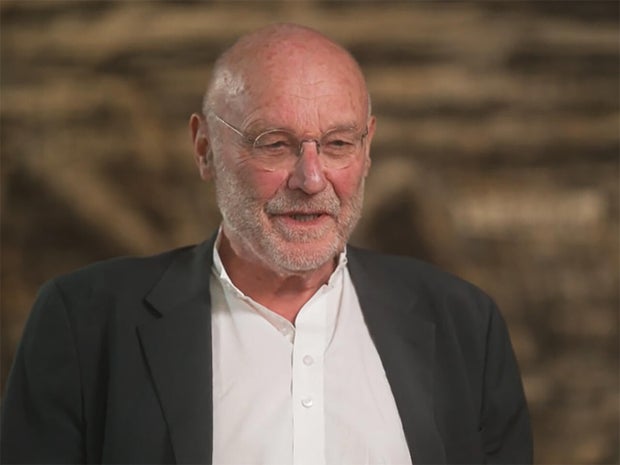
Even on a casual walk, German artist Anselm Kiefer is always searching for inspiration. “Look at this tree,” he said walking alongside the Mississippi River. “This is a fantastic tree, you know?”
And here in St. Louis, Missouri, it’s an American river that’s fired his imagination. He said, “This river goes through America, and so with this conscience I have an inner overview of America, of the continent, of the world.”
Kiefer has turned those reflections into a series of paintings, each three stories tall. They are now holding court at the Saint Louis Art Museum, home to an Anselm Kiefer retrospective. Dozens of Kiefer works are on display, but it’s these monumental canvases that are the showstoppers.
“Becoming the Sea,” a new show of works by German artist Anselm Kiefer, at the Saint Louis Art Museum.
CBS News
The paintings depict the Mississippi and Europe’s Rhine River – waterways brimming with history, symbolizing the cycle of life. Kiefer said the inspiration for their name, “Becoming the Sea,” came from Beat Generation poet Gregory Corso: “Spirit is life … like a river unafraid of becoming the sea.”
“You know, a river is something special; a river dissolves itself in the sea,” he said. “And it’s not afraid of this. As I am not afraid of my death, you know?”
“Grenze (Border)” by Anselm Kiefer, 2024. Emulsion, oil, acrylic, shellac, gold leaf and sediment of electrolysis on canvas.
Mortality is a common theme for Kiefer. Born in 1945 in Germany, he grew up in the ruins of World War II, and the aftermath of the Holocaust. It’s a chapter many Germans tried to forget. “You know, after the war, there was not so much knowledge about what happened,” he said. “The Germans, they put it underneath the carpet. Nobody spoke about [it].”
Artist Anselm Kiefer.
CBS News
Kiefer spent his career breaking through that silence, like when, as a young art student, he photographed himself giving the Nazi salute, not as an endorsement, but as a reckoning.
Asked about the role of the artist in society, he said, “If the artist is in the world, like I am in the world, as I look what happens, then automatically you have a role.”
Over the decades, Kiefer continued to explore themes of memory and loss – mostly with abstract landscapes, and materials. As Kiefer showed “Sunday Morning” in 2018, at his studio outside of Paris, melted lead and fire are normal sightings in his work. So is a bit of chemistry, creating unexpected colors.
Today, Kiefer is one of the most prolific living artists, at the peak of his career, with works selling for millions, and in museums around the world. It would be a proud moment for most, but Anselm Kiefer has always had his own way of seeing things.
I asked him, “So at 80, what are you most proud of in terms of the work you’ve done?”
“You ask strange questions! I am not proud. I am disappointed!” he laughed. “I’m really disappointed. Because every morning I go in the studio and say, ‘Oh, what I have done yesterday?’ You know, and then I continue. I continue. Proud? No, no. I don’t know this word for me, proud.”
Closeup of a work by Anselm Kiefer.
CBS News
For more info:
Story produced by Sara Kugel. Editor: Lauren Barnello.
Anselm Kiefer, one of the world’s most prolific living artists, is now the subject of a retrospective in St. Louis. He talks with Mark Whitaker about how rivers cutting through America’s Midwest, and a Beat Generation poet, inspired his three-story-tall abstract canvases, in a show entitled “Becoming the Sea.”
new video loaded: What It Takes to Drill Into an Antarctic Glacier
Our climate reporter Raymond Zhong meets with Paul Anker, a drilling engineer aboard the icebreaker Araon, to discuss the stakes, preparations and pressure of the mission to drill a hole in the Thwaites Glacier to measure the water beneath.
By Raymond Zhong, Chang W. Lee, Christina Thornell, Jon Miller, Leila Medina and Stephanie Swart
Traci Hurley says watching her husband battle cancer in late 2021 was harrowing. “It was heartbreaking, and it was awful,” she said. “I lived in fear every day.”
A battle made worse, she says, because so many of the skirmishes were with their insurance company. “No family should have to go through having to fight to get treatment recommended by their physician covered, while fighting for their lives,” she said.
Millions of Americans say they are struggling to get medical care: either unable to pay sky-high deductibles, or, like Dan Hurley, denied coverage for tests and treatment by health insurance companies. Not only were both the Hurleys doctors; Dan, an ear, nose and throat surgeon, was also skilled in cutting through insurance red tape for his patients.
Dr. Dan Hurley, who often fought for his patients when insurance companies denied them coverage, found his own claims denied after being diagnosed with chondrosarcoma, an ultra-rare bone tumor.
Family Photo
“And yet, we still ran into issues a lot,” Traci said. “If we, as two physicians, had to struggle the amount that we had to struggle to get care approved, what about people who do not have medical knowledge? What’s happening to them every day?”
Dan was an avid hiker, until a nagging backache turned out to be cancer. He was diagnosed with chondrosarcoma, an ultra-rare bone tumor. To try to save his life, the tumor, along with Dan’s hip, had to be removed. Insurance only covered a portion of the costs.
Traci said, “Many of his treatments were denied. We had PET scans, we had CT scans denied. We had chemotherapy, we had radiation, we had certain medications that required prior-authorization, and were denied.”
The basis for the insurers’ denials, Traci said, was that they were “not medically indicated.”
“Make their lives as difficult as possible”
Ron Howrigon, now a consultant, spent two decades working for health insurance companies. “Health insurance companies know that five percent of their members account for 50 percent of all the costs,” he said. “So, I have this huge financial incentive to make their lives as difficult as possible.”
Howrigon says the business model is unlike other industries: “The more your customers use your product, the less money you make. Your incentive is to keep them from using your product.”
How often do insurance companies refuse to cover the cost of medical treatments? It’s hard to tell; health insurance companies are only required to report denial data for plans purchased through healthcare.gov.
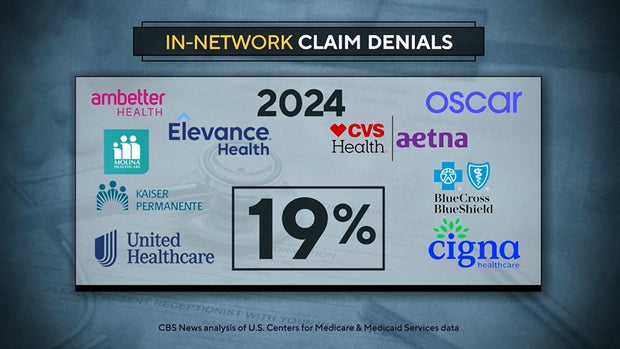
A CBS News analysis of about 1.3 billion federal health insurance claims across three years shows that, in 2024, insurers denied 19% of in-network claims – about 1 in 5.
CBS News
But for the biggest insurer, United Healthcare, that was a steep drop from the preceding two years, when it denied as many as one-third of its federal claims.
While it did not provide data to support it, United Healthcare says that, across all its plans, their initial denial rate is 10%. They also point out that when employers are self-insured, the plans they choose for their employees dictate coverage decisions.
“About 165 million Americans are enrolled in employer-sponsored health care plans, and 65% of them are enrolled in what’s called a self-insured plan,” United said in their statement. “The health insurance company they select provides administrative services such as handling calls from members and paying claims. But as the phrase ‘self-insured’ suggests, it’s the employer’s funds that cover claims payments. …
“Self-insured employers can design their health plans and determine what will and won’t be covered for their employees,” United continued. “It’s important to remember that your health insurer probably isn’t the one that designed it that way. Your employer did.”
“Insurance is out of control”
Dr. Elisabeth Potter, a surgeon who sees as many as 60 patients with breast cancer each week at her RedBud surgery center in Austin, Texas, said, “The insurance companies have, honestly, made it more difficult to be healthy in the United States.”
She says insurance denials actually add to costs: “I have two employees who spend almost all day navigating insurance. It seems that everywhere we turn, there’s an issue, whether it’s an insurance company saying, ‘You know, we won’t cover your surgery at that surgery center,’ or ‘We won’t pay for that medication, we want you to be on a different medication.'”
Dr. Elisabeth Potter performing surgery in Austin.
CBS News
Case in point: On an early morning this past Fall, Jeannie Lee, a 40-year-old mother with breast cancer, was being prepped for a procedure – a lymphovenous bypass – that could have been done two weeks earlier during her double mastectomy, but both her and her husband’s insurance companies refused to cover the cost.
Lee is at high risk for developing a condition known as lymphedema where, Potter said, “It becomes very difficult to just use your arm. It can be painful. It’s swollen. It’s also deforming.”
Lee said, “I’m 40 years old. I have three young kids. It’s very necessary to do this procedure.”
Once Lee was able to obtain financial assistance through a new non-profit set up by Dr. Potter, she was back in surgery. “This patient is having an extra surgery, a separate general anesthetic, because her insurance company wouldn’t cover the surgery,” Potter said. “We could have done this very easily at the same time [as her mastectomy ].”
When she isn’t in surgery, Potter is often on the phone defending her treatment decisions to insurance company medical directors who, she says, often know little about her area of medicine. “Sometimes I get, you know, an ophthalmologist, an eye doctor. It was just completely absurd,” she said.
She sometimes posts her side of those conversations online.
Potter: “So, we’re speaking about lymphedema of the arm. So, this is not an area that you’re familiar with, correct?”
But a video she posted in early January 2025, she says, ended up putting her entire medical practice at risk. While she was in the operating room, Potter says she got a call from United Healthcare. That “urgent” call, she says, was to question why her patient needed an overnight stay in the hospital.
“It’s never happened before. I didn’t know what was going on, but they said it was urgent and I needed to call, and so I did,” she said. “I am operating. I’m doing the right thing for the patient. I’m going to keep her overnight. I walked out of the hospital and I just filmed myself in my unfiltered, you know, moment.”
Potter: “It’s out of control. Insurance is out of control.”
Shortly after she posted that video, she got a letter from the insurance company threatening to sue her for defamation. “I’m taking great care of patients. They’re just trying to scare me into being quiet,” Potter told us.
I asked, “And weren’t you scared?”
“I was scared,” she replied.
United Healthcare has not taken Dr. Potter to court. They declined an on-camera interview, but a company spokesperson says the call was due to an erroneous order, and a doctor would never be asked to leave surgery for a call about an insurance matter.
“It was such a gut punch”
Miranda Yaver, an assistant professor at the University of Pittsburgh, says insurance companies know that only a small percentage of people will actually appeal claim denials.
“All of us are vulnerable to being denied,” she said. “Not all of us can weather the storms easily when it comes to appealing and overcoming these barriers.”
“A lot of people don’t know that they even can appeal,” Yaver said.
I asked, “You’re saying that it’s not really the denial that ends up keeping people from getting care, it’s that people give up? “
“Fewer than one percent of those in-network claim denials result in appeal, even though people were winning roughly half the time,” Yaver said.
Clearly, it does pay to appeal, but some patients, like Dr. Dan Hurley, fighting an aggressive cancer, run out of time. Much of his last months were spent, says his wife Traci, on the phone with insurance company personnel: “He would go line by line with them and they’d say, ‘Okay, yeah, we need to get a supervisor involved. We’ll call you back.’ And then they don’t.”
Dan’s goal, she says, was to see insurance companies held to a standard similar to doctors, making them liable for malpractice when they deny lifesaving care. “The act of signing that denial is practicing medicine,” Traci said, “the same way, if a patient came to me and I made a decision about treatment and that decision went sideways, I’m liable. That’s how it works.”
Dan Hurley died on August 3, 2023. One week later, his wife got a letter from the insurance company asking her to pay $80,000 for a round of chemotherapy that had been pre-authorized, but was suddenly retroactively denied. “It was such a gut punch to get it that day,” she said. “This is unbelievable, right? Almost laughable.”
Dan Hurley’s battle has become his widow’s. “There’s a part of me that says, ‘Oh, he would be so proud of me,’ but there’s also part of me that he’d be like, ‘Come on, chop, chop, you got this, let’s go, pick it up, don’t be sad, you know, keep going.’ Because that’s what he was like.”
For more info:
Story produced by Sari Aviv. Editor: Jason Schmidt.
Millions of Americans are struggling with medical care – either unable to pay high premiums, burdened with high deductibles, or denied coverage for necessary tests and treatment by health insurance companies. Erin Moriarty of “48 Hours” talks with doctors and health experts about how medical care is being eroded by insurers motivated by profit. As one doctor says, insurance companies have “made it more difficult to be healthy in the United States.”
Missing out on adequate sleep could be taking years off your life.
New research from the Oregon Health & Science University (OHSU), published in the journal Sleep Advances, found that poor sleep may shorten life expectancy more than other lifestyle factors like diet, exercise and loneliness.
The researchers analyzed nationwide CDC survey data, identifying trends associated with average life expectancy by county, according to a press release.
The study found that lack of adequate sleep led to higher mortality risk in every U.S. state and was the top behavioral driver compared to other factors, only behind smoking.
Senior study author Andrew McHill, Ph.D., associate professor and director of the Sleep, Chronobiology, and Health Laboratory in the OHSU School of Nursing, noted in a statement that he did not expect sleep to be “so strongly correlated” to life expectancy.
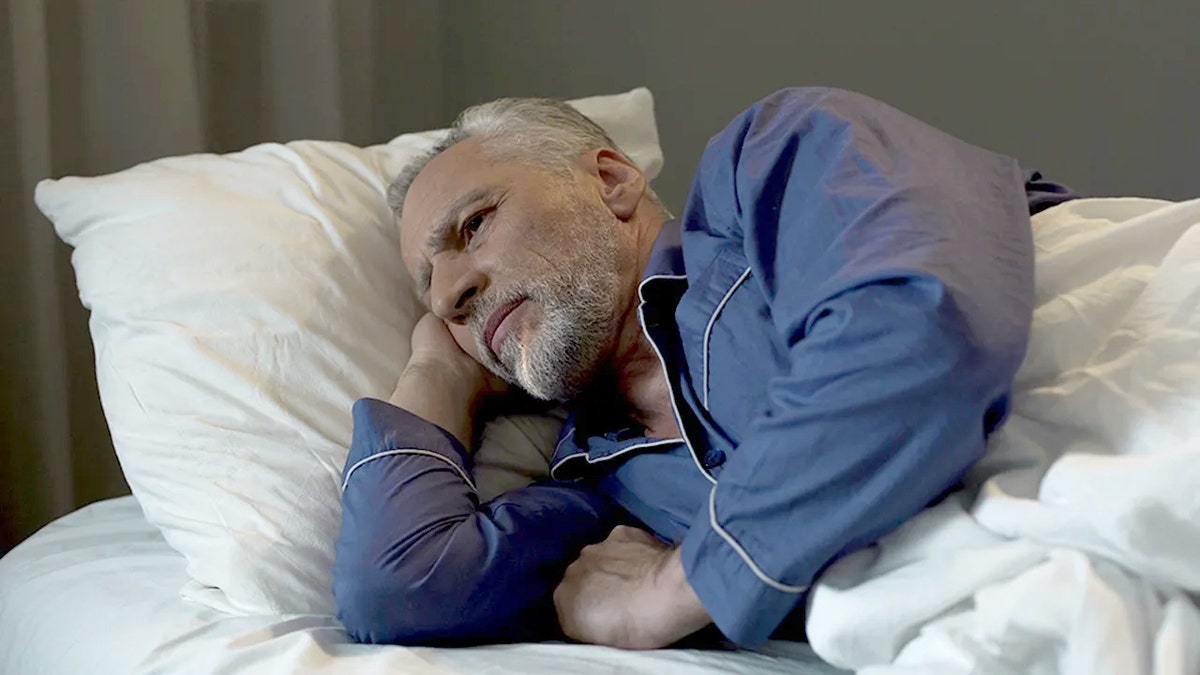
Poor sleep is directly correlated with shorter life expectancy, the study reveals.(iStock)
“We’ve always thought sleep is important, but this research really drives that point home: People really should strive to get seven to nine hours of sleep, if at all possible,” he said.
“This research shows that we need to prioritize sleep at least as much as we do [in] what we eat or how we exercise.”
In a previous interview with Fox News Digital, Dr. Daniel Amen, psychiatrist and owner of Amen Clinics in California, emphasized how important sleep is for brain function and longevity.
Researchers suggest people should prioritize sleep just as much as diet and exercise.(iStock)
“Sleep is so important,” he said. “When you sleep, your brain cleans and washes itself. And if you don’t sleep seven to nine hours at night, your brain looks older than you are — there’s less blood flow, and it increases inflammation in the brain.”
“Your brain doesn’t have enough time to get rid of the toxins that build up during the day.”
Lack of adequate sleep can lead to poor decisions and foster toxic cycles, the doctor warned.
CLICK HERE TO DOWNLOAD THE FOX NEWS APP
“If your brain has less activity in the front part, not only are you tired, but you’re also hungrier, and you’re more likely to not make the best decisions,” he said.
“Which, of course, will stress you out, and then you won’t sleep well the next night.”
A doctor suggests being “purposeful” about going to bed and waking up each day.(iStock)
One small change to promote longevity and brain health is to try getting to bed 15 minutes earlier, Amen suggested.
Transactions Tracked By Income Tax Department: Imagine you buy a coffee, pay for your movie ticket, or transfer money to a friend. Most of these everyday transactions go unnoticed, yet some payments, investments, and bank movements quietly catch the attention of the Income Tax Department. Have you ever wondered why certain transactions are tracked while others are not? In this article, we will explore which financial activities the tax authorities monitor and which ones remain beyond their radar.
Transactions Tracked By Income Tax Department
According to Section 285BA of the Income Tax Act and Rule 114E of the Income-tax Rules, 1962, certain high-value transactions that exceed specified limits in a financial year must be reported to the Income Tax Department. This is done by filing a Statement of Specified Transactions using Form 61A. The purpose of this reporting is to maintain transparency in financial dealings and help detect any cases of tax evasion.
Add Zee News as a Preferred Source
The Income Tax Department keeps an eye on certain high-value financial transactions. For instance, cash deposits exceeding Rs 10 lakh in savings or fixed deposit accounts are tracked, as are cash deposits or withdrawals over Rs 50 lakh in current accounts. Credit card payments above Rs 1 lakh in cash, or Rs 10 lakh through other modes, also attract attention.
Adding further, the property transactions worth Rs 30 lakh or more, whether purchases or sales, are monitored, along with investments in bonds, shares, or mutual funds exceeding Rs 10 lakh. These thresholds help the authorities track significant financial movements while routine transactions usually remain beyond their radar.
Transactions Not Tracked By Income Tax Department
The Press Information Bureau’s (PIB) fact-checking unit clarified a viral claim suggesting that the Income Tax Department monitors citizens’ emails, social media accounts, online shopping, digital payments, and personal apps. According to the official statement, the Income Tax Department does not track online shopping, digital payments, app-based transactions, or any form of personal spending behaviour. There is no mechanism to monitor an individual’s digital or online activity.
Income Tax Refund Delay In 2026: Key Reasons
If you filed your income tax return (ITR) for FY 2024–25 and are still waiting for your refund in 2026, you are not alone. Many taxpayers are feeling uneasy as refunds seem slower this year. For returns filed for FY 2024–25 (Assessment Year 2025–26), the department has time until December 31, 2026 to process them under Section 143(1) of the Income Tax Act. This means refunds can legally take several months, even after successful filing and verification.
Several factors can cause delays. Very high refund claims can trigger extra checks, while mistakes or mismatches in your information are another common reason. It’s important to ensure your bank details are correct and that your PAN is linked to your Aadhaar. On top of that, any unpaid taxes from previous years can block or reduce your refund. Paying attention to these details can help your refund reach you faster.
A view of the Greenlandic flag near the beach in Nuuk, Greenland, March 29, 2025. — Reuters
Nordic diplomats rejected US President Donald Trump’s claims of Russian and Chinese vessels operating near Greenland, the Financial Times reported on Sunday.
There have been no signs of Russian or Chinese ships or submarines around Greenland in recent years, the FT said, citing two senior Nordic diplomats with access to Nato intelligence briefings.
Reuters could not immediately verify the report. The White House and Nato did not respond to Reuters requests for comment.
“It is simply not true that the Chinese and Russians are there. I have seen the intelligence. There are no ships, no submarines,” the FT quoted one senior diplomat as saying.
Another Nordic diplomat said claims that waters around Greenland were “crawling” with Russian and Chinese vessels were unfounded, adding that such activity was on the Russian side of the Arctic.
Trump has repeatedly said Russian and Chinese vessels are operating near Greenland, a claim Denmark disputes. He has not provided evidence to support it.
Trump said on Friday the US must own Greenland, an autonomous part of the Kingdom of Denmark, to prevent Russia or China from occupying the strategically located and mineral-rich territory.
“The image that’s being painted of Russian and Chinese ships right inside the Nuuk fjord and massive Chinese investments being made is not correct,” Danish Foreign Minister Lars Lokke Rasmussen said earlier this week.
Vessel tracking data from MarineTraffic and LSEG show no Chinese or Russian ship presence near Greenland.
Greenland’s assembly said late on Friday it would bring forward a meeting to discuss its response to US threats to take control of the island.
Trump’s renewed push for Greenland, after US military intervention in Venezuela, worries many of the island’s 57,000 inhabitants, whose widely held goal is to eventually become an independent nation.
As temperatures drop, these looks make one thing clear: investing in a great leather jacket isn’t just practical – it’s timeless fashion.
(L-R) Kriti Sanon and Mouni Roy show how to style leather jackets this season.
Few wardrobe pieces balance practicality and polish quite like a leather jacket. Season after season, it remains winter’s most dependable layer. It is effortlessly warm, endlessly versatile, and always stylish. This year, Bollywood’s leading women have reaffirmed its cult status, showcasing how leather can move seamlessly between casual cool, high-fashion drama, and refined elegance. From oversized bombers to cinched coat silhouettes, these five actresses offer a masterclass in modern winter dressing.
Deepika Padukone leans into relaxed sophistication with a vintage brown oversized bomber layered over a fitted beige dress. The contrast between volume and structure creates a flattering, contemporary silhouette that feels intentional rather than accidental. With minimal styling and undone hair, the look channels quiet confidence.
Mouni Roy: Jewel-Toned Drama With A Polished Edge
Mouni Roy brings colour into the leather conversation with an emerald green, waist-cinched leather coat paired with black tights and thigh-high boots. The jewel tone adds instant depth, while the tailored fit keeps the look sharp and elegant. Finished with oversized sunglasses and flowing hair, her ensemble feels cinematic, making it an ideal blend of old-school glamour and modern winter layering.
Kriti Sanon: The Timeless Moto Formula
Kriti Sanon proves that nothing beats a classic. Her brown leather moto jacket, styled with blue jeans, delivers effortless everyday appeal. The textured finish and warm tone add character, while the clean styling keeps it relatable and wearable. It’s a reminder that a well-cut leather jacket doesn’t need embellishment. It simply needs good balance.
Malaika Arora: Elevating Leather With Accessories
Malaika Arora redefines the black biker jacket by pairing it with bold jewellery and elevated accessories. Statement rings, layered bracelets, and a sleek updo transform the traditionally edgy piece into something undeniably luxe. Her look shows how leather can serve as the perfect canvas – strong enough to hold its own, yet versatile enough to be dressed up with thoughtful styling.
Rashmika Mandanna: Sleek, Modern Sophistication
Rashmika Mandanna opts for clean lines and polished simplicity in a tailored black leather jacket. Styled with geometric earrings and luminous makeup, the look feels refined rather than rebellious. Her slicked-back hair and minimalist approach highlight how leather can shift from edgy to elegant with subtle styling choices.
Location :
Delhi, India, India
First Published:
January 11, 2026, 19:01 IST
Newslifestylefashion From Bombers To Bikers: 5 Celeb-Approved Ways To Style A Leather Jacket This Winter
Disclaimer: Comments reflect users’ views, not News18’s. Please keep discussions respectful and constructive. Abusive, defamatory, or illegal comments will be removed. News18 may disable any comment at its discretion. By posting, you agree to our Terms of Use and Privacy Policy.
Masturbation is a neurobiological and psychological experience, not just a habit
Customised Masturbation Consultancy is built on understanding how the body regulates pleasure and arousal. (AI generated)
Sex may permeate our popular culture, but conversations about it are still associated with stigma and shame in Indian households. As a result, most individuals dealing with sexual health issues or trying to find information about sex often resort to unverified online sources or follow the unscientific advice of their friends. To address the widespread misinformation about sex, News18.com is running this weekly sex column, titled ‘Let’s Talk Sex’. We hope to initiate conversations about sex through this column and address sexual health issues with scientific insight and nuance
In this article, we explain how masturbation can be scientifically customized to support better sexual satisfaction and overall well-being.
New Year, new conversations around sexual health. As 2026 begins, doctors and sexual wellness experts are encouraging people to move beyond shame, myths, and copy-paste advice when it comes to self-pleasure. One such emerging concept creating curiosity is Customised Masturbation Consultancy—a medical, psychological, and science-backed approach to understanding how self-pleasure impacts an individual’s body and mind. In an era where sexual health is finally being discussed openly, experts believe the time has come to ask a bold question: Can masturbation really be customised scientifically?
Understanding Masturbation from a Scientific Lens
Masturbation is not merely a physical act. From a medical standpoint, it involves the integration of neurochemistry, endocrine responses, sensory stimulation, and cognitive processing. When a person engages in self-pleasure, the body activates:
The central nervous system
The dopaminergic reward pathway
The hypothalamic-pituitary-gonadal (HPG) axis
Emotional centres such as the limbic system
Any repetitive behaviour that stimulates these systems can train the brain and body—either positively or negatively. Experts emphasise that repeated, unexamined patterns may lead to desensitization, dependency, or altered arousal responses over time.
What Is Customised Masturbation Consultancy?
Customised Masturbation Consultancy is built on understanding how the body regulates pleasure and arousal. Dopamine levels influence excitement and motivation, but excessive or overstimulating patterns may reduce sensitivity over time. Oxytocin plays a role in emotional satisfaction, which is often overlooked when self-pleasure becomes rushed or stress-driven. Elevated cortisol, commonly seen in high-stress lifestyles, can suppress arousal and reduce pleasure.
Customised Masturbation Consultancy is a personalised sexual wellness approach where experts guide individuals based on their:
Physical health
Hormonal balance
Mental well-being
Sexual history
Relationship status
Stress levels and lifestyle habits
Unlike generic advice found online, this consultancy focuses on individual patterns, not assumptions. Experts explain that masturbation is not a one-size-fits-all activity. What works for one person may lead to discomfort, dissatisfaction, anxiety, or even sexual dysfunction in another.
Why Generic Masturbation Advice Often Fails
Many people unknowingly follow habits they picked up during teenage years or from internet content. According to sexual health experts, this can lead to:
Reduced sensitivity over time
Delayed orgasm or difficulty climaxing
Loss of interest in partnered intimacy
Anxiety or guilt after self-pleasure
Dependence on specific positions, pressure, or fantasy patterns
Doctors emphasise that repetitive and unexamined habits may train the brain and body in ways that later interfere with natural sexual responses.
Why One-Size-Fits-All Advice Doesn’t Work
Online content often promotes universal ideas such as:
“More is better”
“Faster techniques give stronger orgasms”
“Specific pressure or grip styles are normal for everyone”
Medical experts warn that such advice ignores biological variability. Some common consequences of repetitive, non-customised patterns include:
Reduced genital sensitivity due to excessive pressure
Delayed ejaculation or difficulty climaxing
Arousal mismatch during partnered intimacy
Performance anxiety
Emotional dissatisfaction despite orgasm
Doctors explain that the nervous system adapts to specific stimulation patterns, making flexibility crucial for long-term sexual health.
Why Customisation Matters
Dopamine Regulation: Dopamine drives motivation and pleasure. Excessive or repetitive stimulation can cause dopamine downregulation, reducing excitement and satisfaction.
Oxytocin Balance: Oxytocin promotes relaxation and bonding. When masturbation is rushed or anxiety-driven, oxytocin release may be limited.
Cortisol Interference: High stress levels elevate cortisol, which suppresses sexual arousal. Customisation considers timing, frequency, and mental state.
Autonomic Nervous System: Healthy sexual arousal requires parasympathetic dominance. Overstimulation can push the body into sympathetic (stress) mode.
Experts explain that scientific customisation aims to restore balance, not eliminate pleasure.
How Experts Design a Customised Plan?
A scientific masturbation consultancy may involve:
Detailed sexual history assessment
Evaluation of frequency and recovery time
Identification of discomfort, numbness, or emotional distress
Assessment of lifestyle factors like sleep, diet, and stress
Alignment with relationship or fertility goals
Doctors then guide individuals on:
Technique modification
Frequency optimisation
Sensory awareness
Mindfulness integration
Reducing overstimulation
The objective is functional sexual health, not restriction.
Does Customisation Mean Giving Up Masturbation?
Experts are clear that scientific customisation does not advocate abstinence. Instead, it encourages mindful and body-aware practices that preserve sensitivity and emotional satisfaction. When aligned with the body’s natural responses, masturbation can support relaxation, mood regulation, and sexual confidence. In fact, professionals believe that personalised guidance often improves partnered intimacy by reducing performance pressure and unrealistic expectations.
Moving from Taboo to Science
In societies where sex education remains limited, masturbation is often surrounded by guilt and misinformation. Medical experts argue that silence does not prevent sexual behaviour; it only prevents healthy understanding. As sexual health becomes recognised as part of overall wellness, personalised approaches are emerging as a logical extension of modern medicine. Masturbation is a neurobiological and psychological experience, not just a habit. When understood scientifically and approached with personalisation, it can become a tool for self-awareness rather than confusion or dissatisfaction.
First Published:
January 11, 2026, 19:00 IST
Newslifestyle Let’s Talk Sex | Can Masturbation Be Scientifically Customised? Experts Explain This New-Age Sexual Consultancy
Disclaimer: Comments reflect users’ views, not News18’s. Please keep discussions respectful and constructive. Abusive, defamatory, or illegal comments will be removed. News18 may disable any comment at its discretion. By posting, you agree to our Terms of Use and Privacy Policy.