Thousands of nurses at some of New York City’s biggest hospitals could go on strike Monday during a severe flu season, three years after a similar walkout forced some of the same medical facilities to transfer some patients and divert ambulances.
The looming strike could impact operations at several of the city’s major private hospitals, including Mount Sinai in Manhattan, Montefiore Medical Center in the Bronx and NewYork-Presbyterian/Columbia University Irving Medical Center.
Nearly 15,000 nurses could walk off the job early Monday if a deal is not reached, amounting to the largest nurses strike in city history, according to Nancy Hagans, president of the New York State Nurses Association. As of Sunday morning, little progress had been made at the bargaining table, Hagans said. A vast majority of the union’s nurses voted to authorize the strike last month.
Like the 2023 labor fight, this year’s dispute involves a complicated array of issues, claims, counterclaims and hospital-by-hospital particulars. Once again, staffing levels are a major flashpoint: Nurses say the big-budget medical centers are refusing to commit to — or even backsliding on — provisions for manageable, safe workloads.
Safety concerns at issue
This time, the nurses’ union also wants guardrails on hospitals using artificial intelligence, plus more workplace security measures. A gunman strode into Mount Sinai in November, and a man with a sharp object barricaded himself in a Brooklyn hospital room this week; both men ultimately were killed by police.
The private, nonprofit hospitals involved in the current negotiations say they’ve made strides in staffing since 2023. Some of them suggest the union’s demands, taken as a whole, are far too expensive.
Scores of nurses rallied Friday in Manhattan, insisting their primary concern was proper caregiving and accusing the medical centers — whose top executives make millions of dollars a year — of greed and intransigence.
“My hospital tries to cut corners on staffing every day, and then they try to fight historic gains we made three years ago,” said Sophie Boland, a pediatric intensive care nurse in the NewYork-Presbyterian hospital system.
The hospitals, meanwhile, have called the union’s strike threat “reckless.” They vowed in a statement Thursday to “do whatever is necessary to minimize disruptions.”
Hagans, the union president, has also stressed that patients should not delay care during a potential strike.
Still, New York Gov. Kathy Hochul expressed concern that a strike could affect patient care, urging both sides on Friday “to stay at the table and get a deal done.”
Hospitals prepare for a walkout
Mount Sinai has hired over 1,000 temporary nurses and held preparatory drills for a strike that could affect its 1,100-bed main hospital and two affiliates — Mount Sinai Morningside and Mount Sinai West — with about 500 beds each.
NewYork-Presbyterian said it also had arranged for temporary nurses but, if the strike happens, some patients might be moved to new rooms or advised to transfer to another facility. Montefiore posted a message assuring patients that appointments would be kept.
A Mount Sinai Hospital Emergency Medical Service ambulance is a participating member of the FDNY 911 ambulances and can respond to similar emergencies as the Fire Department EMS.
Deb Cohn-Orbach | Getty Images
The same union mounted a three-day strike at the Mount Sinai flagship facility and Montefiore in 2023, when nurses emphasized their sacrifices during the exhausting, frightening height of the COVID-19 pandemic and the national nurse staffing crisis that followed.
The walkout prompted those hospitals to postpone non-emergency surgeries, tell many ambulances to go elsewhere and transfer some intensive-care infants and other patients. Temporary nurses and even administrators with clinical backgrounds were tapped to fill in, but some patients noticed longer waits and more sparsely staffed wards.
The strike ended with an agreement on raises totaling 19% over three years and staffing improvements, including the possibility of extra pay if nurses had to work short-handed.
Now, the union says, the hospitals are retreating from those guarantees and falling short on other promises.
Montefiore, for example, agreed to “make all reasonable efforts” to stop keeping some emergency room patients in hallways while they wait for space to open up in other wards. Yet three years later, nurses still scramble to treat “hallway patients,” Montefiore intensive care nurse Michelle Gonzalez said Friday.
Montefiore has suggested it’s made some progress: The hospital told elected officials in a letter in October that there has been a 35% reduction in the time it takes from emergency admission to a clinical unit bed.
Overall, the hospitals say they have greatly reduced nursing job vacancy rates in the last three years, and Mount Sinai and NewYork-Presbyterian/Columbia Irving University Medical Center say they also have added hundreds of nursing positions.
In recent days, several smaller hospitals — including multiple Northwell Health facilities on Long Island — averted potential walkouts by striking deals or making what the union viewed as adequate progress.
Rob Demovsky is an NFL reporter at ESPN and covers the Green Bay Packers. He has covered the Packers since 1997 and joined ESPN in 2013. Demovsky is a two-time Wisconsin Sportswriter of the Year as selected by the NSSA.
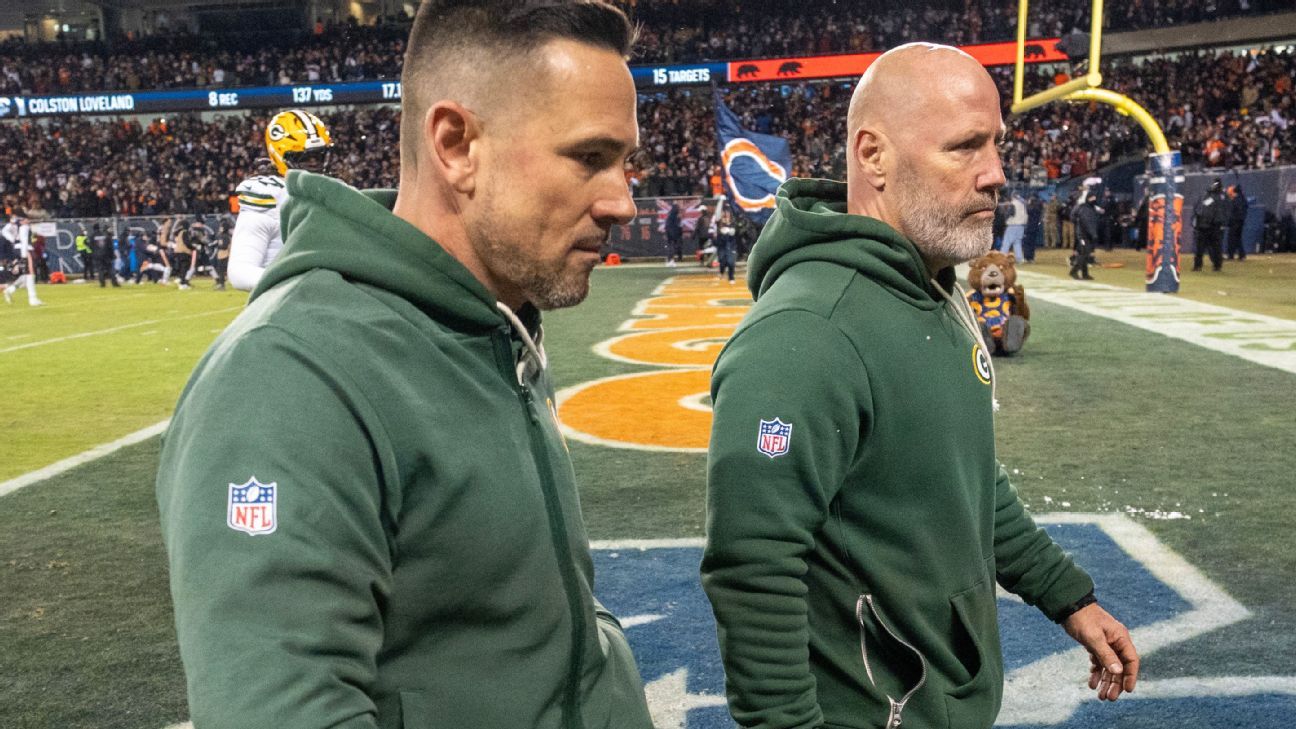
CHICAGO — Matt LaFleur could not have made it much clearer: He wants to remain the Green Bay Packers coach.
But after blowing an 18-point lead in Saturday night’s NFC wild-card playoff loss to the Chicago Bears, LaFleur declined to say whether he expected to return next season for an eighth year.
“With all due respect to your question, now’s not the time for that,” LaFleur said shortly after the Packers’ 31-27 loss. “I’m just hurting for these guys. I can only think about what just happened, and there will be time for that.”
LaFleur and general manager Brian Gutekunst each have one more year left on their contracts. First-year team president Ed Policy said before this season that he would prefer not to have a coach or general manager go into a so-called lame-duck year.
That ramped up the pressure this season, which began with a 9-3-1 record only to see the Packers lose five straight games to end the season, although in one of those games — the regular-season finale — they rested most of their starters.
LaFleur has a 76-40-1 regular-season record and has led the Packers to the playoffs in six of his seven seasons, but Green Bay has not reached a Super Bowl during his tenure and has not been to a conference championship game since the 2020 season, the second of back-to-back appearances in LaFleur’s first two years.
Three times after Saturday’s loss, LaFleur was asked about his job security, and each time he said it wasn’t the time to discuss it.
However, he explained what the Packers’ job means to him.
“It means everything to me,” LaFleur said. “This is the greatest organization in the world, in my opinion. It’s very humbling. I’m certainly disappointed right now, disappointed mostly for — well, not mostly — I’m disappointed for everybody that’s associated with the Green Bay Packers. I’m disappointed for our locker room. I’m disappointed for our fans. I’m disappointed for our leadership, all our employees, everybody involved with the Green Bay Packers right now.”
A playoff loss like this could have long-term implications, and several players acknowledged that possibility.
“I’m not going to jump to any conclusions or anything,” Packers quarterback Jordan Love said. “We’ll see what happens going forward. That’s the case for every end of the season, and going into the offseason, that’s always the case. We’ll see if anything comes forward, if anything. So, we’ll see.”
Love threw his support behind the only head coach he has had in the NFL.
“I definitely think Matt should be the head coach,” Love said. “I’ve got a lot of love for Matt, and I think he does a good job. And that’s it.”
“He’s our leader,” Williams said. “I’ll tell you that much. We have full faith in him, in all of his decisions. I can’t speak on any extension or anything that’s in his future. I know business is business, but he’s been my only head coach and really the only one that I see needing moving forward. Feel like he’s done a great job of putting us in positions to win and in scenarios like today, we’ve just got to find a way to finish.”
Saturday’s loss was rife with mistakes and miscues. Love and the offense, of which LaFleur is the playcaller, managed only six points after scoring touchdowns on the first three drives of the game to take a 21-3 lead into halftime.
LaFleur said Love “played his ass off” but added that they “obviously didn’t do enough around him.”
It was the second time this season that the Packers blew a lead against the Bears. Their overtime loss at Soldier Field in Week 16 looked much the same as this one. That one cost the Packers the NFC North. This one cost them their season.
“We’ve just got to do a better job of keeping our composure as a football team and going out there and doing the fundamental things that we practice all the time,” LaFleur said. “I think when you get into these types of big games, when you don’t execute simple fundamentals, it comes back to bite you. That’s exactly what happened.”
Their skid to finish the season coincided with defensive end Micah Parsons‘ season-ending knee injury. The Packers did not win a game after Parsons got hurt, and their defense suffered. Green Bay allowed just 19.0 points per game and 287.2 yards per game in its first 13 games. Those numbers spiked to 28.8 points per game and 402.6 yards per game in its last four.
The Packers gave up 25 points in the fourth quarter, only the third time in NFL history that a team has allowed that many in the fourth quarter of a playoff game.
“When you have a team on the ropes, it’s just finishing them,” Packers linebacker Isaiah McDuffie said. “It’s as simple as that.”
Special teams, which have cost the Packers in the postseason before, cost them again when kicker Brandon McManus missed an extra point attempt and a field goal try in the fourth quarter. McManus called it the “biggest disappointment in my career. Just an embarrassment of a performance.”
After last year’s playoff exit, Gutekunst said it was time the Packers got back to competing for championships, but after a second straight first-round loss, the Packers got no closer.
“It’s going to take a lot of work, a lot of work,” LaFleur said. “And we’re not where we want to be. I know we fought through a lot of adversity this year. Unfortunately, we didn’t do enough to overcome that adversity. That’s all of us collectively. We’ve got to do more. We’ve got to be better because it’s never an excuse. I know we lost some key players, but you’ve got to find a way to overcome that because I think we do have a lot of talent on our team. It’s just, it’s disappointing.”
Jennifer Lawrence opens up about her most demanding film role
Jennifer Lawrance dished on one of the hardest roles of her acting career for which she prepared meticulously.
The 35-year-old actress recently made an appearance at 92NY Kaufmann Concert Hall in New York City on January 7 to promote her new movie Die My Love.
During the onstage Q&A, Jennifer, who won a Golden Globe for Best Actress for her role in Silver Linings Playbook, revealed that preparing for her role in Red Sparrow was the hardest one.
In the 2018 movie, Jennifer portrays Dominika, an ex Russian ballerina turned dangerous spy.
“Well, I mean, technically speaking, Red Sparrow, because I had to learn a Russian accent,” she told the moderator at the event.
For the Hunger Games star, not only learning Russian accent was challenging, but also training her body to learn ballet for the character.
“Part of preparing for Dominika was the physical training with the ballet,” Jennifer explained in a featurette for the movie. “It was something that was on my mind constantly throughout the entire script.”
Jennifer’s ballet choreographer, Kurt Froman, also remarked in the short film, “I worked with Jen six days a week, three hours a day.”
In a previous interview with Vanity Fair, Jennifer also opened up about how strictly she dieted to play Dominika.
“Red Sparrow was the first time that I was really hungry, and disciplined. I can’t be in character as an ex-ballerina and not feel like an ex-ballerina,” she told the publisher at the time.
Photo: Nikki Glaser shares set of rules for roasting stars at ‘Golden Globes’
Nikki Glaser has revealed her standards as she gears up to host this year’s Golden Globes.
In a new interview with PEOPLE Magazine, the comedian shared that she will be careful not to cross the line with her banter this time around.
She said she only targets people she genuinely respects and enjoys, making it clear that her jokes are meant to come from a positive place.
“I’m writing from a place of love, and I wouldn’t do a joke about someone that I actually didn’t like.”
Glaser went on to explain that being teased by her is actually a compliment, not an insult.
“So if I do write a joke about you or do a joke to you, it’s because I admire you and I think you are probably cool and have a good sense of humour.
“I don’t do jokes about people who I just don’t think are cool, and that I don’t really even care to talk to or give the time of day,” she revealed before conclusion.
Earlier this week, Glaser also revealed that she had been warned about making jokes at the expense of Julia Roberts in her Golden Globes monologue.
Speaking on CBS Mornings, the comedian said, “I’m trying out my monologue around LA, at the clubs here, and just even any joke about Julia Roberts, they are not there for.
“You cannot make fun of America’s Sweetheart,” she explained.
She concluded by rationalizing, “So, whatever I end up saying about her, that is the most fine-tuned joke that I’ve worked on so hard, because it is very delicate.”
Safe to say, after recent star turns in “The Gilded Age” and the monologue of the year about friendship in “The White Lotus,” Carrie Coon is having a moment.
I asked her, “Would you agree with me that where you used to say you’re at the bottom of the A-List …”
“I think I used to say, ‘The bottom of the B-List,’ but yeah,” she corrected.
“But don’t we need to revise our assessment as where you are?”
“Maybe,” said Coon. “But the thing that’s changed for me is that I was on ‘The White Lotus,’ and now I can be in a Broadway play. That wasn’t true for me five years ago.”
Carrie Coon starring in “Bug,” now on Broadway.
CBS News
The play is “Bug,” which opened just this past week. Coon is leveraging her newfound star power to play the demanding, harrowing lead role in this examination of paranoia, conspiracy, and loneliness. And she is adamant that her success should not obscure a larger, sadder reality of the theater these days: “We live in a country that is fundamentally unsupportive of the arts. So now, in order to do a play on Broadway, you have to do ‘The White Lotus,’ or else you’re not allowed. They have to replace you with somebody more famous.”
“Hang on, if you hadn’t done ‘White Lotus’ and ‘Gilded Age’ and hadn’t sort of blown up as a star …”
“Yeah. We wouldn’t be sitting here, absolutely not,” Coon said.
“Your acting ability, what you do on stage, not enough?” I asked.
“No, that’s not how we make those decisions anymore,” she said. “And you can ask all these extraordinary theater actors who don’t do plays anymore because celebrities are doing plays. It’s just a different world that we’re living in now.”
Tracy Letts is the playwright of “Bug.” He’s in love with Coon’s fearlessness. “She has ice water in her veins,” he said. “In another life, she’d make a great assassin.”
Actress Carrie Coon and playwright Tracy Letts during rehearsals for “Bug.”
CBS News
He’s in love with her acting chops. “She’s a great stage actress,” he said. “For the people who’ve only seen her do ‘Gilded Age’ or ‘White Lotus,’ they just don’t know what a stage animal she is.”
Letts is in love with her. He and Coon have been married for the last dozen years.
I asked, “Your partners, your life partners, they had to be theatre people, right? Because it’s such a consuming world?”
“I came to that conclusion a long time ago that, whoever my partner was had to be in the profession; civilians just don’t get it,” Letts laughed. “They just don’t get it. It’s a hard life.”
Playwright and actor Tracy Letts and actress Carrie Coon, collaborators on stage and off.
CBS News
A couple of Midwesterners (Coon is from Ohio, Letts from Oklahoma), they met in 2010 doing “Who’s Afraid of Virginia Woolf?” at the Steppenwolf Theatre in Chicago. Letts said, “We had a palpable attraction to each other. We just wanted to be with each other.”
Coon said, “When we confessed to our director and our castmates that we were officially together, they were like, ‘Yeah. Of course.’ We thought it was shocking, this shocking revel – [and they’re] like, ‘Yeah, hello! We’ve been here the whole time.'”
When the show got to Broadway in 2013, Letts won a best actor Tony. That’s some impressive artistic range, considering his Pulitzer Prize for writing the play “August: Osage County” in 2008, and his steady presence in film and TV for the last several decades, from “Seinfeld” and “The Big Short” to “A House of Dynamite.”
He’s been around a while. Coon noted, “Tracy’s entering into sort of this …”
“Oldness?” Letts offered.
Letts is now 60; Coon is 44.
“He always gave me room to grow, because I was not in the same place in my life as him,” Coon said. “Like, what you’re sitting in contemplation of at this stage in your life is different than where I am in mine.”
So, how does that meld? “Oh, a lotta jokes,” said Coon. “Like, ‘Your second husband’s gonna love this couch.'”
Whether playwright and actor, or husband and wife, what makes this partnership work, they told us, is honest feedback and mutual respect. Letts said, “She knows I’m gonna tell her the truth. She’ll put on a dress and say, ‘How does this look?’ And I’ll say, ‘It doesn’t look good.'”
“No, no, no, no….” I said.
“It’s true!” Letts reiterated. “And she appreciates it, because she knows I’m not lying to her.”
“Isn’t rule number one of husbanding, Not bad? Which we all know means… “
“No. We don’t do that,” Letts said. “So when she puts on something and I go, ‘You look fantastic,’ or when she’s in this play and I say, ‘My God, you’re a great actress,’ she knows I’m not bulls****ing her.”
Later, I asked Coon, “If you have something to say, whether it’s praise or criticism, you know it’s the truth?”
“Yes,” she replied. “Even with things I wear.”
Letts smiled. “See?!”
While any couple might recognize that trust required to navigate life’s challenges, Letts and Coon’s “moment” is providing some uncommon tests. Take Coon landing the “White Lotus” role: “I turned to Tracy and I said, ‘There’s no way I can go away to Thailand for six months.’ We had a three-year-old and a six-year-old. And Tracy was the one who turned to me and he said, ‘We’re gonna figure this out.’
“Tracy was doing every morning. He was doing dinner and bedtime every night, and bath time by himself. So that was a really hard six months.”
“I wasn’t doing anything extraordinary; I was taking care of the kids while she was gone doing a job,” he said.
“We know when the undeniable thing comes along, and we’ll both make room for that to happen,” Coon said.
Which is why this chance to collaborate on Broadway is so important for them. The best way to handle a whirlwind is to find a place to anchor. For these two, that’s always been the theater.
“This is where we’re most comfortable,” Letts said, “in a rehearsal room preparing this on a stage, doing this in a theater. This is what we know. You just have a sense of accomplishment and gratification in the theater. You’ve told a story over the course of the night. You don’t get to do that when you make a film or TV show.”
Carrie Coon and Tracy Letts are a couple now living in some of the culture’s brightest lights. But they’re theater people – bright lights don’t faze them. “I got my first credit card at 43,” Letts laughed. “It’s a tough gig!”
Besides, they have work to do, the kind that’s most affirming for them: Work they can do together.
Letts said, “I needed somebody who understood what it means to be an artist in America.”
“And I needed somebody who reminded me that it was important to be an artist,” Coon said, “and that it was powerful, and necessary.”
In this web exclusive, actress Carrie Coon, star of the TV series “The Gilded Age” and “The White Lotus,” talks with Jim Axelrod about her return to Broadway in the play “Bug,” written by her husband, Tracy Letts. She also talks about the state of Broadway today.
In this web exclusive, actor and playwright Tracy Letts, and actress Carrie Coon, star of the TV series “The Gilded Age” and “The White Lotus,” talk with Jim Axelrod about their marriage, and their collaboration in the new Broadway production of “Bug.”
Our first question to Oprah Winfrey: “You always wear really beautiful clothes. Always have. And I wonder if it’s a joy to get dressed now?”
“I can tell you what a joy it is to actually pack clothes that you know are gonna fit and you’re gonna feel good in them,” Winfrey replied. “I mean, it is a joy to get dressed. That is such a powerful first question, Jane Pauley, really!”
Powerful is one of the superlatives befitting Oprah Winfrey, one of the best-known and most-admired people on the planet, and one of the richest. But for all her success, she seemed powerless against a weight problem, a deeply personal struggle she has waged publicly and openly.
In 1985, when her talk show, “AM Chicago,” was getting national attention, Oprah appeared on “The Tonight Show” with guest host Joan Rivers.
“And I’m sitting there, and we’re toward the end of the interview, and Joan turns to me and, ‘So, tell me, you know, how’d you gain the weight?'” Oprah recalled. Her response? “I ate a lot.”
“I was stunned in that moment, when I look back and I see that moment. But I left feeling humiliated and embarrassed, but not the least bit anger, not the least bit of anger or being upset about it,” she said.
Why? “Because I thought, ‘She’s right.'”
Jane Pauley interview Oprah Winfrey.
CBS News
Over the next 40 years, Oprah would gain and lose hundreds of pounds. In the fall of 1988, after a strict four-month liquid diet, a new svelte Oprah appeared wearing size 10 Calvins, weighing 145, and pulling a wagon with 67 pounds of animal fat
It was all back, plus 25 more, when she went to the Daytime Emmy Awards four years later. “And I go to the Emmys praying not to win, literally praying not to win, because I don’t want to have to get up out of my seat and have everybody watch me do that walk to the stage,” she said.
She started over again the next day, working out with an on-call personal trainer this time. In 1994 she even ran a marathon.
Oprah knew how to lose weight … she did it over and over. She says her body was seeking a range of 211 to 218. “So usually, by the time I would hit 211 when I first went on the diet for the wagon of fat and pulled out the wagon of fat, when I did my first marathon, once I get to 211, I go, ‘Oh, I gotta do something.’ But now I understand that the biology of me, which is different than the biology of you and everybody else – every body, all of us, has our own – but no matter what I did, no matter how hard I worked, no matter what, it was always trying to get my body back to 211.”
Not because 211 is her ideal weight, but rather a “set point”: a genetically-influenced weight range. Oprah calls it the “enough point.”
“Enough” is also the title of a new book she co-wrote with Dr. Ania Jastreboff from the Yale School of Medicine, who says, for most people, an enough point is “the weight that they kind of always gravitate to.”
Avid Reader Press
So, to lose weight, you cut back on calories, and start craving high-fat food , or you eat less – but nothing changes. “Our body’s like, ‘Well, if you’re gonna eat less, then I’m gonna make you more efficient. I’m gonna make you burn less,'” said Jastreboff. “So what happens is, together, collectively, we end up eating more, and burning less.”
“It’s the enemy within, which is in our brains,” I said. “So, now that we know what the problem is, the hormones that drive people, why don’t people just stop obeying it?”
“That would be like trying to control something that is not in your control,” Jastreboff said. “That would be like holding your breath for the rest of your life. Every time somebody says, ‘Just eat less, move more,’ we’re asking our patients to control their biology and hold their breath. And it’s just not possible. And why would we do that? We don’t do that for any other disease.”
And that’s what the American Medical Association says obesity is — a disease. A treatable disease. But the good news is that, if it’s a disease, it’s not your fault.
“It’s not my fault, Jane! It’s not my fault,” Oprah said. “And I could weep right now, could weep right now. I’m not going to! But I could weep right now for all of the many days and nights I journaled about this being my fault, and why can’t I conquer this thing?”
In the last decade, nearly a dozen weight management drugs have been approved for chronic weight management. And for millions, drugs like GLP–1s are the answer to their prayers. Finally, a scientifically-supported, medically-approved weight-loss strategy that worked. And yet, Oprah resisted. “I was so motivated by shame that I felt I could not take the drug,” she said, “because if I took the drug – I, who had been the poster child for I can do it, I can do it, I can do it, willpower, willpower, let’s just get more willpower – if I couldn’t do it, then I would be shamed, and ashamed of myself for not being able to do it myself.”
The medications don’t work for everyone, and some can’t tolerate side effects ranging from nausea to gallstones. But it’s been two years since Oprah finally started medication, and it’s working for her. She says she is now down to her marathon weight of 155. “And so, that’s it for me. I’m gonna just try to maintain,” she said.
“Well done. Because I thought 160 was your goal weight?” I asked.
“Yeah, yeah, it was,” Oprah said, “but as I continue to work out here the combination of the medication and hiking every day and resistance training has given me the body that I had when I was running a marathon. So, I was 40 and feeling really good, but to be able to be 71 and feel that I am in the best shape of my life feels better than it did when I was 40.”
“I would submit that you would have been a phenomenal success, but I don’t think you would have become ‘Oprah’ if you hadn’t had the weight issue and been open about it and shared it,” I said.
“Yeah. I would agree with that,” she said. “And that’s why I don’t have any regrets about it. There’s a wonderful spiritual, African American spiritual, called, ‘I Wouldn’t Take Nothing For My Journey Now.’
I wouldn’t take nothing for my journey now for my journey now for my journey now I wouldn’t take nothing for my journey now.
“I wouldn’t change the journey,” she said. “because I think the struggle with the weight actually helped me be more relatable and relate more to other people who were in their own struggles. But I’m glad now to be in a position where I feel the healthiest and strongest I have ever been.”
Oprah Winfrey grew up riding on dirt roads. Now, on her sprawling Montecito estate near Santa Barbara, California, she owns the road. She took me for a ride: “This used to belong to my neighbor,” Oprah said. “So, this is 23 acres. Her house used to be right there. We took this fence down, so this became my whole backyard, this.”
Around here, all of the views are spectacular, especially the one looking back.
Born in Mississippi in 1954, Oprah Winfrey was a teen beauty queen who became a local TV reporter in Nashville, and then an anchor in Baltimore. “The beautiful thing about my life was that I started out in local television, as you did,” Oprah said. “And when you start out locally, you get this, like, little teeny-tiny thing. But I failed. I failed in Baltimore.
“They brought me in as a 22-year-old with an anchor guy, white-haired Jerry Turner, who was the most popular local anchor in the country, not just Baltimore. And he totally hated me. He resented me. He would do everything he could to condescend to me any way. I remember one time we were on the set and he said to me, ‘So, you’re from Mississippi? Can you name all the tributaries of the Mississippi River?’
“And I was, like, ‘All the tributaries of the Mississippi River? No, I can’t.’ He goes, ‘Well, what school did you go to?’ ‘Well, I went to Tennessee State.’ ‘Was that an accredited school? So, you got a degree?’ I mean, that kind of thing. This is in-between the commercial breaks.”
“Boy, that happened to me in Chicago,” I said. “Started in September, basically was taken off the late news in the spring.”
Maybe we share a few things. I was a shy kid from Indiana who started as a local reporter in Indianapolis, and wound up on national TV – and Oprah was watching. “You were such an inspiration. I remember calling Gayle that morning, ‘Oh my God.’ It just, it was unbelievable.”
“Well, that I inspired you!”
But Oprah famously went on to build her worldwide media empire, and a following that some world leaders can only dream of.
I asked, “You have such power. Now that you are this woman undeterred by weight – ‘weight noise’ – what are you gonna do?”
“That’s a beautiful question, but I don’t feel compelled to do anything,” Oprah replied. “I don’t know what it means actually, other than I feel free.”
And what about her name being credibly bandied about for the presidency? “No, it’s not gonna happen,” she said. “What I really want to do is to continue to use who I am and what that represents as a force in the world, as a force for good, and to allow people to not let the noises of the world steal their joy.”
“You are such a person of positivity!”
“I am indeed,” she agreed.
For all of her astonishing success, it seems that Oprah is still always aware of how far she’s come – how she became something so much bigger than television. “I have to say, there’s a wonderful poem by Countee Cullen called ‘Yet Do I Marvel.’ And I would have to say, yet do I marvel at that, myself,” she said.
“Sometimes in the early spring, the frogs are in the pond, and I can open the door and I can hear the frogs out at night. And it sounds just like Mississippi, being on the porch in Mississippi. But the distance from Mississippi to Montecito cannot be measured. It just cannot be measured. And I marvel at, how did this happen? How did it happen that I was able to navigate the waters of racism and sexism and misogynism and all the things that we had to endure? Yet do I marvel!”
And marvelous, it is.
I said, “We have little bits of things in common, I’m happy to say. Little bits of things.”
“Yes. A lot,” Oprah said, “because we were women of this business at a time when it was really tough to be in this business. And now it’s become something else. It’s become something completely new.”
“But both. It was a time that was tough to be a woman in the beginning. But boy, was the timing good!”
“Boy, was the timing good! We made the best of it. Yes, we did.”
We may receive an affiliate commission from anything you buy from this article.
Broadcasting superstar Oprah Winfrey, who has struggled with weight for much of her life, and Dr. Ania Jastreboff, of the Yale School of Medicine, have teamed up to examine the biology of obesity, offering a new way forward.
Prefer to listen? Audible has a 30-day free trial available right now.
Enough Shame and Blame
My patient Alice began experiencing self-blame in childhood. Her well-intentioned mom put her on diets when she was in her early teens. Even before that, she had started to develop what she eventually called the “self-hatred voice.” She vividly remembers when she was ten years old, sitting in the front yard with her legs bent, seeing the inside curvature of her leg and wanting it to be smaller. “This is the line where your muscle is, and on the inside is a curve. That’s the fat and the extra skin. I thought, ‘Oh, if I could just cut that off, then my leg would be perfect.’ I had a pen, and I drew the line where I thought my legs should be and where the fat should be cut off. I just knew that I was larger than I wanted to be.” Alice lived in Vermont at the time, and her mother had a garden where she grew all sorts of vegetables—lettuce, carrots, cucumbers. “I just remember eating salad, so much salad!” Alice recalls. At thirteen, she sat at the table, thinking, “Here’s a plate with three pieces of lettuce and a carrot,” and wondering how she was going to get through basketball practice or soccer without passing out or blowing the game for her teammates.
A few years later, her mother put herself and Alice on a no-carb diet. “Atkins was kinda big,” Alice says. Her father and two younger brothers were exempt; it was only for the girls of the family. Which basically meant Alice and her mother were still eating everything from the garden, except no turnips, because turnips had “too many carbs.”
After three days, Alice revolted. She reached for some crackers in the cupboard: “Mom, I just ate an entire sleeve of saltines!” Hearing this, her mother was not upset with her. Alice shared, “She was desperate for carbs, too, and ate three saltines herself. And then dutifully returned to her no-carb diet.”
At sixteen, Alice started tracking her weight for sports. The self-hatred voice in her mind began to be very specific and explicit. “The cupcake you just ate—what is the number of calories in it? What is the number of carbs?” She described that it wouldn’t let up, not even for just one tiny-teeny bite. It was unrelenting.
Fast-forward more than thirty years, and by the time Alice was nearly fifty, she had tried every diet and workout program under the sun: forty-seven of them, to be exact. Atkins, keto, South Beach, the Zone, low carb, no carb, ultra-low fat, liquid only, Jillian Michaels, Jane Fonda, Suzanne Somers, full-body HIIT workouts, gym memberships, a YMCA weight coach, DietBet, StepBet, a Mediterranean diet, a vegetarian diet, the raw food diet, intermittent fasting. She’d even tried hypnosis. She had three teenagers, a fulfilling job in communications, and a loving boyfriend. She struggled with obesity despite spending much of her adult life tracking every morsel of food, eating mostly healthful meals, and exercising every day. She had successfully lost weight countless times. That wasn’t the issue. The problem was that she always gained it back. She always blamed herself for having obesity. She did not know about the biology of obesity, yet.