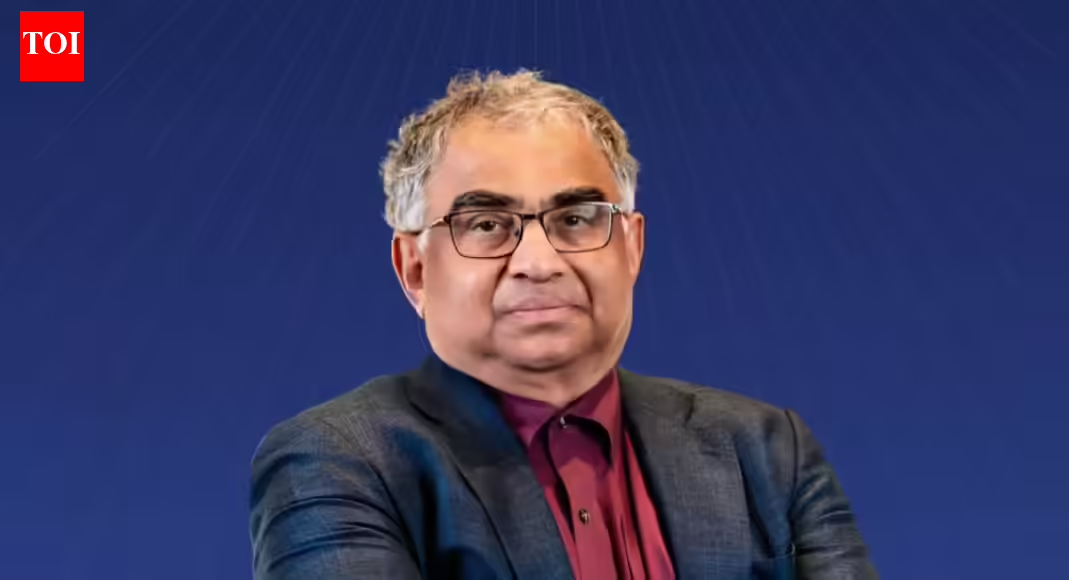
Shri Kulkarni, an Indian-origin astronomer and one of the world’s leading figures in modern astrophysics, has been awarded the Gold Medal of the Royal Astronomical Society (RAS). It is the highest honour conferred by the UK-based scientific body.Awarded annually since 1824, the RAS Gold Medal recognises exceptional contributions to astronomy and geophysics. Past recipients include some of the most influential names in science, making the honour one of the most prestigious in global astronomy.
Shri Kulkarni recognised for transforming time-domain astronomy
In its citation, the Royal Astronomical Society credited Kulkarni for his “sustained, innovative and ground-breaking contributions to multi-wavelength transient astrophysics.” This field focuses on short-lived and rapidly changing cosmic phenomena.Born in Maharashtra, India, Kulkarni earned his master’s degree from IIT Delhi in 1978 before completing his doctorate at the University of California, Berkeley in 1983. His journey from India to the forefront of global astronomy now culminates in one of the field’s most coveted honours.
A career defined by landmark discoveries
Over a career spanning more than four decades, Kulkarni has played a central role in shaping time-domain astronomy, the study of how the universe changes over time rather than appearing static. His work has helped scientists understand some of the most extreme and fleeting events in the cosmos.Kulkarni’s scientific impact dates back to his early years. In 1982, while still a graduate student, he co-discovered the first millisecond pulsar, a rapidly spinning neutron star that transformed understanding of stellar remnants.After joining the California Institute of Technology (Caltech) in 1985, Kulkarni went on to contribute to several major breakthroughs. In 1995, he and his colleagues identified the first brown dwarf, a class of celestial objects that lie between stars and planets. Two years later, his team demonstrated that gamma-ray bursts originate far beyond the Milky Way, overturning long-held assumptions about their nature.More recently, in 2020, Kulkarni was part of the team that identified the first fast radio burst detected within the Milky Way, strengthening evidence that these mysterious flashes are linked to highly magnetised neutron stars known as magnetars.
Building the tools that watch the changing sky
Beyond discoveries, Kulkarni is widely recognised for his role in building the instruments that made many of them possible. He led the development of the Palomar Transient Factory and its successor, the Zwicky Transient Facility (ZTF). These survey projects systematically scan the sky for transient and explosive events.The Royal Astronomical Society noted that the two projects have “revolutionised time-domain astrophysics at optical wavelengths.” The Zwicky Transient Facility continues to survey the entire northern sky every two nights, enabling astronomers to detect supernovae, asteroids, flaring stars and other rapidly evolving phenomena.Kulkarni has repeatedly emphasised the importance of instrumentation in scientific progress. He has often said that building the right tools allows nature itself to reveal new discoveries.
Ongoing work and global recognition
Kulkarni remains deeply involved in future-facing research. He is currently working on NASA’s Ultraviolet Explorer (UVEX) mission, planned for launch around 2030, which aims to conduct the most sensitive ultraviolet sky survey to date. He is also the principal investigator for Z-Shooter, a next-generation spectrometer being developed for the W. M. Keck Observatory in Hawai‘i.His latest honour adds to a long list of accolades, including the Shaw Prize, the Alan T. Waterman Award from the US National Science Foundation, and the Dan David Prize. He is a member of several leading scientific academies, including the US National Academy of Sciences, the Royal Society of London, and the Indian Academy of Sciences.With the Royal Astronomical Society’s Gold Medal, Shri Kulkarni joins an elite group of scientists whose work has fundamentally reshaped how humanity understands the universe as a dynamic and ever-changing cosmic landscape.
Jeff Borzello is a basketball recruiting insider. He has joined ESPN in 2014.
Before the men’s college basketball season tipped off, Nebraska was picked 14th in the preseason Big Ten media poll and Vanderbilt was picked 11th in the SEC edition.
Three months later, those teams are not only clearly ahead of those predictions, they’re No. 10 and 11 in the AP Top 25.
Following marquee wins over the past week — Nebraska over Michigan State, Vanderbilt over Alabama — the unbeaten Cornhuskers and Commodores have also vaulted into the top 10 of our Power Rankings.
Vanderbilt has had metrics on its side for weeks. The Commodores are in the top five at KenPom and rank inside the top 10 in six of the seven metrics on the NCAA team sheets. What they were missing was a marquee win, with their strongest victories heading into this week coming against Saint Mary’s, SMU and UCF — and they got it against the Crimson Tide.
Nebraska doesn’t have the same efficiency metrics as Vanderbilt, but the Cornhuskers own a slew of impressive wins, including a road victory at Illinois and a home win over Michigan State.
Vanderbilt and Nebraska are two of the six remaining unbeatens in college basketball, own the best Quad 1 records in the country (both 5-0) and have clearly done enough to warrant their rises. Now let’s dive into the rest of our updated top 25.
Previous ranking: 1
We highlighted how freshman Brayden Burries has added a new dimension to the Arizona offense in the Dec. 18 edition of these rankings — and he hasn’t cooled off with Big 12 play underway. After averaging 7.8 points through his first five games, Buries put up 17.9 points and shot 55.9% in his final eight nonconference games. The star guard went for 17 points and 11 rebounds in last Saturday’s conference opener, then notched a career-high 28 points against Kansas State on 12-for-16 shooting to go with 9 rebounds and 4 assists Wednesday.
Next seven days: at TCU (Jan. 10), vs. Arizona State (Jan. 14)
Previous ranking: 2
For the first time in almost two months, Michigan finally had to sweat — and it was against arguably the worst team in the Big Ten. The Wolverines led Penn State by 15 midway through the second half but made just three shots in the final 10:40. They survived a missed 3-pointer at the buzzer from Freddie Dilione V to escape with the 74-72 win. Michigan’s margins of victory in its previous 10 games: 25, 40, 30, 40, 41, 28, 18, 52, 41, 30. They were bound to get tested this season, and in some ways coach Dusty May might be happy his team finally came down to earth.
Next seven days: vs. Wisconsin (Jan. 10), at Washington (Jan. 14)
Previous ranking: 3
Joshua Jefferson‘s National Player of the Year push hasn’t slowed down since Big 12 play began. He opened conference play with a triple-double against West Virginia on Friday: 10 points, 10 rebounds and 10 assists, throwing in 5 combined blocks and steals for good measure. And on the road at Baylor on Wednesday, he finished with 19 points, 17 rebounds and 3 assists while racking up 3 steals. There’s a strong case to be made that Jefferson has the best chance of any returnee to win the Wooden Award. He is second in the KenPom Player of the Year standings and ranks in the top three of win shares and box plus/minus.
Next seven days: vs. Oklahoma State (Jan. 10), at Kansas (Jan. 13)
Previous ranking: 4
When Silas Demary Jr. committed to UConn last spring, he was considered one of the most sought-after guards in the transfer portal and an important addition for the Huskies. He had shown flashes over the first two months of the season — including a 21-point performance against BYU — but there was also a six-game stretch during which he averaged only 4.8 points. Down 13 in the second half to Providence on Wednesday, Demary turned in his best game since arriving in Storrs. He finished with 23 points, 15 assists and 5 steals, with 18 points, 7 assists and 5 steals coming after halftime. Demary was a spark on the defensive end and made several key shots to key the comeback. Per ESPN Research, he’s just the third Division I player over the past 30 seasons with 20 points, 15 assists and 5 steals in a game.
Next seven days: vs. DePaul (Jan. 10), at Seton Hall (Jan. 13)
Previous ranking: 5
Caleb Foster is coming off arguably the best game of his Duke career and has been at his most consistent recently, since arriving in Durham. He opened ACC play with 12 points and 4 assists against Georgia Tech, then followed it up with 13 points and 6 rebounds against Florida State. He made three 3s in each. In the game against Louisville, Cameron Boozer and Isaiah Evans carried the Blue Devils in the first half, but coach Jon Scheyer needed a third option in the second half — and Foster stepped up. He had 16 of his 20 points after halftime, shooting 7-for-8 from the floor.
Next seven days: vs. SMU (Jan. 10), at California (Jan. 14)
play
1:19
Duke Blue Devils vs. Louisville Cardinals: Game Highlights
Duke Blue Devils vs. Louisville Cardinals: Game Highlights
Previous ranking: 7
Looking back, the blowout loss to Iowa State on Dec. 6 might have been a wakeup call for Purdue. The Boilermakers have barely been tested since then, winning their next five games (four against high-major competition) by an average of 26.6 points. They then comfortably handled Washington on Wednesday, with the final margin of eight not indicative of their dominance — they led by as many as 23 points in the second half. Braden Smith was the most aggressive he has been on the offensive end in several weeks, finishing with 23 points, his most since scoring 29 against Alabama on Nov. 13.
Next seven days: vs. Penn State (Jan. 10), vs. Iowa (Jan. 14)
Previous ranking: 12
When Fred Hoiberg was at Iowa State, he was considered one of the best offensive coaches in the country. His final four offenses in Ames ranked in the top 25 nationally, including the 2013 and 2014 teams, which were inside the top 10 at KenPom. He hasn’t had the same success at that end of the floor in Lincoln, but there has been a fascinating flip: The Cornhuskers’ defense has ranked ahead of their offense in five of his seven seasons at the helm. That’s the case this season, too. The Cornhuskers have a top-20 defense and recently held Michigan State to 0.87 points per possession. Only five of their 15 opponents have surpassed 1 point per possession.
Next seven days: at Indiana (Jan. 10), vs. Oregon (Jan. 13)
Previous ranking: 13
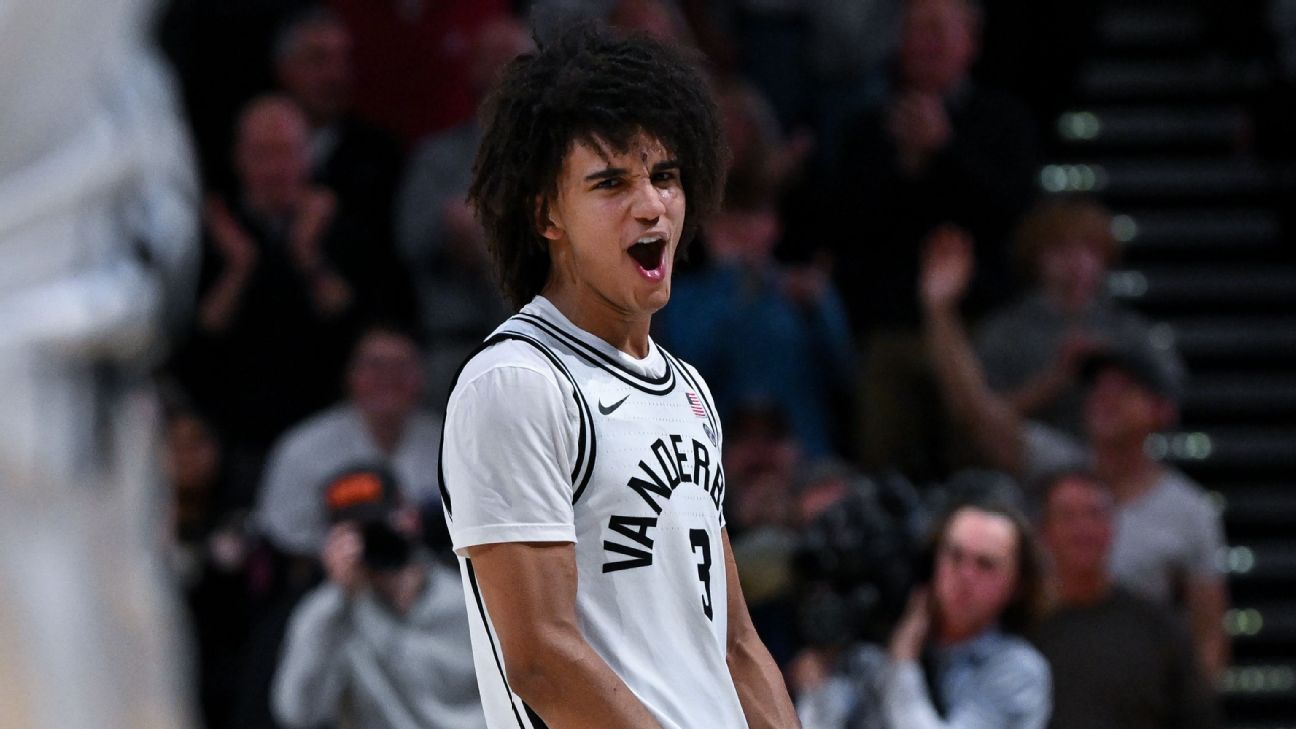
There’s no more questioning Vanderbilt’s legitimacy after Wednesday’s 96-90 win over Alabama. Tyler Tanner has cemented himself as one of the country’s elite point guards and is playing like a legitimate All-American. He finished with 29 points, 7 assists and 4 steals against the Crimson Tide. He received plenty of help, too — especially in the first half — with Duke Miles adding 17 of his 19 points before halftime to go with 5 steals before he fouled out. With Tanner and Miles creating problems for opponents at both ends of the floor, the Commodores aren’t slowing down.
Next seven days: vs. LSU (Jan. 10), at Texas (Jan. 14)
Previous ranking: 6
Since we last updated the rankings, Mark Few has made another change to his starting lineup: He went back to Braeden Smith at point guard and moved Mario Saint-Supery to the bench. Smith started the first four games of the season before Saint-Supery took over for the following nine. And now Smith has started the most recent four, all in WCC play. From an analytical perspective, Hoop Explorer has Gonzaga slightly better offensively with Smith on the floor and slightly better defensively with Saint-Supery in the game. There’s not a massive difference in which player starts or comes off the bench, however; Few has used the backup point guard for more minutes than the starter six times this season.
Next seven days: vs. Santa Clara (Jan. 8)
Previous ranking: 12
Despite a string of close wins since Christmas — by 9 points over Middle Tennessee, by 7 points at Cincinnati, by 4 points over Texas Tech, while trailing well into the second half in the latter two contests — Houston is now 14-1, and looking more like a Kelvin Sampson defense. The Cougars held Cincinnati and Tech to below 1 point per possession, and have forced 48 turnovers in their past three games, with all three opponents coughing it up on at least 21% of their possessions. In Houston’s previous nine games, only four opponents turned it over on more than 18% of their possessions.
Next seven days: at Baylor (Jan. 10), vs. West Virginia (Jan. 13)
Previous ranking: 10
We might not see a better example of Kevin Young’s big three model than in BYU’s 104-76 win over Arizona State on Wednesday. Richie Saunders scored 31 points and made six 3s; Rob Wright had 27 points and 4 assists; and AJ Dybantsa finished with 23 points, 7 rebounds and 5 assists. Those were career-high point totals for Saunders and Wright. The three stars combined to take 41 of BYU’s 61 shots and scored 81 of the team’s 104 points. It was even more noticeable in the first half, when the trio scored 39 of the team’s 45 points and made 14 of its 16 field goals.
Next seven days: at Utah (Jan. 10), vs. TCU (Jan. 14)
Previous ranking: 8
Jaxon Kohler‘s development as a face-up threat has been fairly remarkable. He attempted five 3-pointers combined as a freshman and sophomore — and didn’t make any of them. Last season, he averaged about one make every two games, but more than 76% of his field-goal attempts were from inside the arc. Through 15 games this season, Kohler is a ridiculous 53.7% from 3, making nearly two per game. He went 5-for-6 from beyond the arc against Nebraska, and 3-for-3 against USC. Even crazier, 12 of his 25 3-point misses came in the first five games of the season. Over his past 10 games, Kohler is making 3s at a 64% clip.
Next seven days: vs. Northwestern (Jan. 8), vs. Indiana (Jan. 13)
Previous ranking: 16
There aren’t many guards in the country — freshman or otherwise — playing better than Darius Acuff Jr. He has scored at least 20 points in five of his past six games, finishing with 26 points and 9 assists in Wednesday’s win over Ole Miss, with 20 points and 6 assists coming in the second half. Acuff has been at his best in big games, averaging 21.7 points and 6.7 assists in the six games Arkansas has played against ranked teams, including his 29-point performance against Ja’Kobi Gillespie and Tennessee in Saturday’s win.
Next seven days: at Auburn (Jan. 10), vs. South Carolina (Jan. 14)
play
1:14
Arkansas Razorbacks vs. Ole Miss Rebels: Game Highlights
Arkansas Razorbacks vs. Ole Miss Rebels: Game Highlights
Previous ranking: 11
North Carolina’s seven-game winning streak was snapped Saturday, when it went to SMU and gave up 97 points — the Mustangs scored 58 points in the second half — in a 14-point loss. The Tar Heels’ two losses this season have come in their two worst defensive performances by far: allowing 1.22 points per possession to Michigan State in November, and 1.40 to SMU last weekend. The common factor in those games was facing high-level opposing point guards that were just too quick and too athletic for UNC’s backcourt to consistently keep out of the lane. Michigan State’s Jeremy Fears Jr. had 19 points and 7 assists; SMU’s Boopie Miller went for 27 points and 12 assists.
Next seven days: vs. Wake Forest (Jan. 10), at Stanford (Jan. 14)
Previous ranking: 15
Zvonimir Ivisic‘s minutes have fluctuated at both Arkansas and Illinois. But, despite starting only four games, he’s having the most efficient season of his college career, making a case as one of the premier defensive players in the sport. He’s third nationally in block percentage and in the top 35 in defensive rebounding percentage — good for first in the Big Ten through three conference games. He has blocked 11 shots in just 53 minutes over his past three games. He’s also had more games with three or more blocks (seven) than games with more than one foul (four).
Next seven days: vs. Rutgers (Jan. 8), at Iowa (Jan. 11), at Northwestern (Jan. 14)
Previous ranking: 14
When Labaron Philon Jr. went to the sideline with 16:06 left in Wednesday’s loss at Vanderbilt, the Commodores led by one point and Philon had 18 points in 20 minutes. The All-American guard never returned to the game, though, going into the locker room then coming back to the Crimson Tide’s bench. Nate Oats’ offense simply doesn’t have the same dynamism without Philon on the floor, given his ability to get his own shot and consistently make contested shots against a set defense. Nate Oats said after the game that Philon was dealing with “full-body cramps” and had to get an IV.
Next seven days: vs. Texas (Jan. 10), at Mississippi State (Jan. 13)
Previous ranking: 19
With just a few minutes to go Tuesday against TCU, it looked like the wheels could come off for Kansas’ season. The Jayhawks were coming off a loss to UCF on Saturday, they were down 15 at home to the Horned Frogs with five minutes left, and Darryn Peterson had subbed himself out of the game after appearing to tweak his lingering hamstring injury. But Kansas erased a 9-point lead in the final minute to send the game to overtime on three Peterson free throws with 1.7 seconds left — then won it in the extra period with Peterson on the bench. The star freshman still finished with 32 points in 32 minutes, and Bill Self could end up looking back at Tuesday as a key momentum changer for the season.
Next seven days: at West Virginia (Jan. 10), vs. Iowa State (Jan. 13)
play
1:21
TCU Horned Frogs vs. Kansas Jayhawks: Game Highlights
TCU Horned Frogs vs. Kansas Jayhawks: Game Highlights
Previous ranking: 18
Tech let a potentially massive win slip through its hands Tuesday night, falling by 4 points at Houston after leading by 6 late in the game. But it was another impressive performance for freshman guard Jaylen Petty, who moved into the starting lineup after Christmas and has been one of Grant McCasland’s most consistent players since. As a starter, he’s averaging 17.3 points, 5.0 rebounds and 2.0 assists and shooting 61.5% from the field and 52.4% from 3; coming off the bench, he was averaging 7.2 points and shooting 31.6% overall and 34.5% from 3.
Next seven days: at Colorado (Jan. 10), vs. Utah (Jan. 14)
Previous ranking: 20
After struggling to make shots against Arkansas on Saturday, Ja’Kobi Gillespie bounced back in a major way against Texas on Tuesday, finishing within 34 points, 4 rebounds, 5 assists and 3 steals on 12-of-20 shooting, including 5-for-8 from 3. He helped the Vols overcome a quiet night offensively from Nate Ament, and also highlighted the difference in Gillespie’s production in his team’s wins and losses. In Tennessee’s 11 wins, he’s averaging 20.9 points, shooting 60.9% from 2 and 41.6% from 3. In Tennessee’s four losses, he’s averaging 12.5 points, shooting 40.5% from 2 and 20.7% from 3.
Next seven days: at Florida (Jan. 10), vs. Texas A&M (Jan. 13)
Previous ranking: 17
Mikel Brown Jr. missed his fifth straight game Tuesday, and Louisville is now 2-3 with its star point guard sidelined. Adrian Wooley has been solid as Brown’s replacement from a scoring perspective, averaging 12.0 points as a starter, but the Cardinals have clearly been worse at both ends of the floor without Brown. Over those five games, their assist numbers are way down, and they’ve been held below 1 point per possession twice. Defensively, they’ve had two of their worst performances and allowed at least 80 points in all three losses in that stretch.
Next seven days: vs. Boston College (Jan. 10), vs. Virginia (Jan. 13)
Previous ranking: 21
It has been a season of ebbs and flows for San Francisco transfer Malik Thomas, who averaged 19.9 points for the Dons last season and was expected to be a big-time scorer upon his arrival in Charlottesville. That was the case early, as he reached double-figures in five of his first six games — including with 24 points against Butler on Nov. 23 — before averaging just 7.2 points over his next five. But he has broken out of his slump since ACC play began, averaging 19.7 points in three conference games, going for 26 against Virginia Tech on New Year’s Eve and 20 against California on Wednesday.
Next seven days: vs. Stanford (Jan. 10), at Louisville (Jan. 13)
play
1:12
California Golden Bears vs. Virginia Cavaliers: Game Highlights
California Golden Bears vs. Virginia Cavaliers: Game Highlights
Previous ranking: Unranked
It doesn’t appear to be a vintage season for the second tier of conferences — excluding the WCC’s Gonzaga, of course — but Utah State might be the best of that group. The Aggies improved to 13-1 with a 37-point road win at Air Force on Tuesday, and have already notched wins over notable mid-majors VCU, Illinois State and Colorado State. The Aggies’ lone loss was to South Florida back in early December. We should know more about Jerrod Calhoun’s team after upcoming games at Boise State and home against Nevada, but right now, it’s producing at an incredibly efficient rate on offense. Former Virginia Tech and Vanderbilt transfer MJ Collins Jr. has been a key performer.
Next seven days: at Boise State (Jan. 10), vs. Nevada (Jan. 14)
Previous ranking: 25
After beating Auburn in overtime Saturday, Georgia really struggled in the second half against Florida on Tuesday en route to a 15-point loss. Entering the week, the Bulldogs had been one of the elite offensive teams in the country, scoring 100-plus points on seven occasions. But they had just 77 against the Gators and were held below 1.07 points per possession for the first time this campaign (KenPom logged them at 0.99 points per possession). Georgia couldn’t finish at the rim, shooting 11-for-28 on dunks and layups, and went 4-for-19 from 3.
Next seven days: at South Carolina (Jan. 10), vs. Ole Miss (Jan. 14)
Previous ranking: Unranked
Saint Louis landed a statement win Wednesday, going to VCU — the Billikens’ stiffest competition for the Atlantic 10 title — and knocking off the Rams by nine. Saint Louis led by 14 before VCU came all the way back to take the lead, then the Billikens finished the game on a 10-0 run. It was Saint Louis’ most impressive win of the season, and the Billikens’ lone loss was by one point to Stanford in late November on a 3-pointer with 0.8 seconds left. Don’t be surprised to see Josh Schertz’s team go on a long winning run, either; it’s likely to be heavily favored in every game until at least late February.
Next seven days: at La Salle (Jan. 10), vs. Fordham (Jan. 14)
Previous ranking: Unranked
Iowa looked elite against UCLA this past Saturday, leading by as many as 24 points in the first half before winning by 13. Three days later, the Hawkeyes went to Minnesota and suffered a three-point defeat after missing three open 3s on the final possession. They could have used the momentum entering a difficult three-game stretch: vs. Illinois, at Purdue, at Indiana. The key could be Alvaro Folgueiras. The former Robert Morris transfer has played himself onto NBA draft boards and scored at least 13 points in four straight games entering Tuesday before going scoreless in 11 minutes against the Gophers.
Next seven days: vs. Illinois (Jan. 11), at Purdue (Jan. 14)
Even on a casual walk, German artist Anselm Kiefer is always searching for inspiration. “Look at this tree,” he said walking alongside the Mississippi River. “This is a fantastic tree, you know?”
And here in St. Louis, Missouri, it’s an American river that’s fired his imagination. He said, “This river goes through America, and so with this conscience I have an inner overview of America, of the continent, of the world.”
Kiefer has turned those reflections into a series of paintings, each three stories tall. They are now holding court at the Saint Louis Art Museum, home to an Anselm Kiefer retrospective. Dozens of Kiefer works are on display, but it’s these monumental canvases that are the showstoppers.
“Becoming the Sea,” a new show of works by German artist Anselm Kiefer, at the Saint Louis Art Museum.
CBS News
The paintings depict the Mississippi and Europe’s Rhine River – waterways brimming with history, symbolizing the cycle of life. Kiefer said the inspiration for their name, “Becoming the Sea,” came from Beat Generation poet Gregory Corso: “Spirit is life … like a river unafraid of becoming the sea.”
“You know, a river is something special; a river dissolves itself in the sea,” he said. “And it’s not afraid of this. As I am not afraid of my death, you know?”
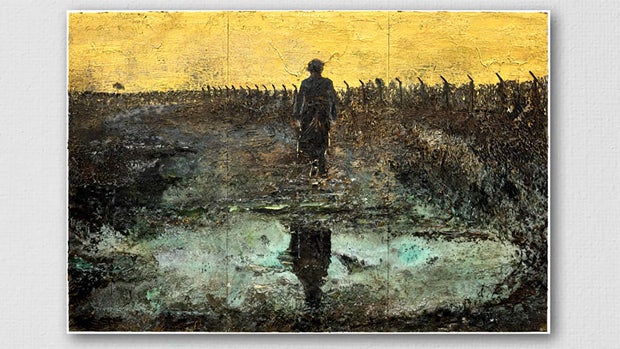
“Grenze (Border)” by Anselm Kiefer, 2024. Emulsion, oil, acrylic, shellac, gold leaf and sediment of electrolysis on canvas.
Mortality is a common theme for Kiefer. Born in 1945 in Germany, he grew up in the ruins of World War II, and the aftermath of the Holocaust. It’s a chapter many Germans tried to forget. “You know, after the war, there was not so much knowledge about what happened,” he said. “The Germans, they put it underneath the carpet. Nobody spoke about [it].”
Artist Anselm Kiefer.
CBS News
Kiefer spent his career breaking through that silence, like when, as a young art student, he photographed himself giving the Nazi salute, not as an endorsement, but as a reckoning.
Asked about the role of the artist in society, he said, “If the artist is in the world, like I am in the world, as I look what happens, then automatically you have a role.”
Over the decades, Kiefer continued to explore themes of memory and loss – mostly with abstract landscapes, and materials. As Kiefer showed “Sunday Morning” in 2018, at his studio outside of Paris, melted lead and fire are normal sightings in his work. So is a bit of chemistry, creating unexpected colors.
Today, Kiefer is one of the most prolific living artists, at the peak of his career, with works selling for millions, and in museums around the world. It would be a proud moment for most, but Anselm Kiefer has always had his own way of seeing things.
I asked him, “So at 80, what are you most proud of in terms of the work you’ve done?”
“You ask strange questions! I am not proud. I am disappointed!” he laughed. “I’m really disappointed. Because every morning I go in the studio and say, ‘Oh, what I have done yesterday?’ You know, and then I continue. I continue. Proud? No, no. I don’t know this word for me, proud.”
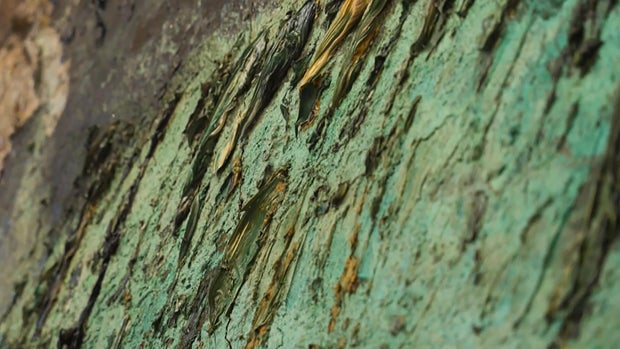
Closeup of a work by Anselm Kiefer.
CBS News
For more info:
Story produced by Sara Kugel. Editor: Lauren Barnello.
Anselm Kiefer, one of the world’s most prolific living artists, is now the subject of a retrospective in St. Louis. He talks with Mark Whitaker about how rivers cutting through America’s Midwest, and a Beat Generation poet, inspired his three-story-tall abstract canvases, in a show entitled “Becoming the Sea.”
new video loaded: What It Takes to Drill Into an Antarctic Glacier
Our climate reporter Raymond Zhong meets with Paul Anker, a drilling engineer aboard the icebreaker Araon, to discuss the stakes, preparations and pressure of the mission to drill a hole in the Thwaites Glacier to measure the water beneath.
By Raymond Zhong, Chang W. Lee, Christina Thornell, Jon Miller, Leila Medina and Stephanie Swart
Traci Hurley says watching her husband battle cancer in late 2021 was harrowing. “It was heartbreaking, and it was awful,” she said. “I lived in fear every day.”
A battle made worse, she says, because so many of the skirmishes were with their insurance company. “No family should have to go through having to fight to get treatment recommended by their physician covered, while fighting for their lives,” she said.
Millions of Americans say they are struggling to get medical care: either unable to pay sky-high deductibles, or, like Dan Hurley, denied coverage for tests and treatment by health insurance companies. Not only were both the Hurleys doctors; Dan, an ear, nose and throat surgeon, was also skilled in cutting through insurance red tape for his patients.
Dr. Dan Hurley, who often fought for his patients when insurance companies denied them coverage, found his own claims denied after being diagnosed with chondrosarcoma, an ultra-rare bone tumor.
Family Photo
“And yet, we still ran into issues a lot,” Traci said. “If we, as two physicians, had to struggle the amount that we had to struggle to get care approved, what about people who do not have medical knowledge? What’s happening to them every day?”
Dan was an avid hiker, until a nagging backache turned out to be cancer. He was diagnosed with chondrosarcoma, an ultra-rare bone tumor. To try to save his life, the tumor, along with Dan’s hip, had to be removed. Insurance only covered a portion of the costs.
Traci said, “Many of his treatments were denied. We had PET scans, we had CT scans denied. We had chemotherapy, we had radiation, we had certain medications that required prior-authorization, and were denied.”
The basis for the insurers’ denials, Traci said, was that they were “not medically indicated.”
“Make their lives as difficult as possible”
Ron Howrigon, now a consultant, spent two decades working for health insurance companies. “Health insurance companies know that five percent of their members account for 50 percent of all the costs,” he said. “So, I have this huge financial incentive to make their lives as difficult as possible.”
Howrigon says the business model is unlike other industries: “The more your customers use your product, the less money you make. Your incentive is to keep them from using your product.”
How often do insurance companies refuse to cover the cost of medical treatments? It’s hard to tell; health insurance companies are only required to report denial data for plans purchased through healthcare.gov.
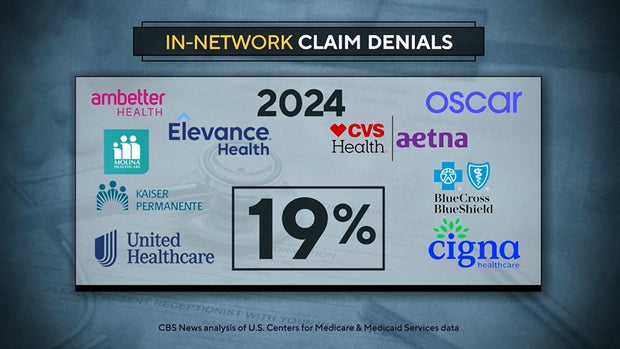
A CBS News analysis of about 1.3 billion federal health insurance claims across three years shows that, in 2024, insurers denied 19% of in-network claims – about 1 in 5.
CBS News
But for the biggest insurer, United Healthcare, that was a steep drop from the preceding two years, when it denied as many as one-third of its federal claims.
While it did not provide data to support it, United Healthcare says that, across all its plans, their initial denial rate is 10%. They also point out that when employers are self-insured, the plans they choose for their employees dictate coverage decisions.
“About 165 million Americans are enrolled in employer-sponsored health care plans, and 65% of them are enrolled in what’s called a self-insured plan,” United said in their statement. “The health insurance company they select provides administrative services such as handling calls from members and paying claims. But as the phrase ‘self-insured’ suggests, it’s the employer’s funds that cover claims payments. …
“Self-insured employers can design their health plans and determine what will and won’t be covered for their employees,” United continued. “It’s important to remember that your health insurer probably isn’t the one that designed it that way. Your employer did.”
“Insurance is out of control”
Dr. Elisabeth Potter, a surgeon who sees as many as 60 patients with breast cancer each week at her RedBud surgery center in Austin, Texas, said, “The insurance companies have, honestly, made it more difficult to be healthy in the United States.”
She says insurance denials actually add to costs: “I have two employees who spend almost all day navigating insurance. It seems that everywhere we turn, there’s an issue, whether it’s an insurance company saying, ‘You know, we won’t cover your surgery at that surgery center,’ or ‘We won’t pay for that medication, we want you to be on a different medication.'”
Dr. Elisabeth Potter performing surgery in Austin.
CBS News
Case in point: On an early morning this past Fall, Jeannie Lee, a 40-year-old mother with breast cancer, was being prepped for a procedure – a lymphovenous bypass – that could have been done two weeks earlier during her double mastectomy, but both her and her husband’s insurance companies refused to cover the cost.
Lee is at high risk for developing a condition known as lymphedema where, Potter said, “It becomes very difficult to just use your arm. It can be painful. It’s swollen. It’s also deforming.”
Lee said, “I’m 40 years old. I have three young kids. It’s very necessary to do this procedure.”
Once Lee was able to obtain financial assistance through a new non-profit set up by Dr. Potter, she was back in surgery. “This patient is having an extra surgery, a separate general anesthetic, because her insurance company wouldn’t cover the surgery,” Potter said. “We could have done this very easily at the same time [as her mastectomy ].”
When she isn’t in surgery, Potter is often on the phone defending her treatment decisions to insurance company medical directors who, she says, often know little about her area of medicine. “Sometimes I get, you know, an ophthalmologist, an eye doctor. It was just completely absurd,” she said.
She sometimes posts her side of those conversations online.
Potter: “So, we’re speaking about lymphedema of the arm. So, this is not an area that you’re familiar with, correct?”
But a video she posted in early January 2025, she says, ended up putting her entire medical practice at risk. While she was in the operating room, Potter says she got a call from United Healthcare. That “urgent” call, she says, was to question why her patient needed an overnight stay in the hospital.
“It’s never happened before. I didn’t know what was going on, but they said it was urgent and I needed to call, and so I did,” she said. “I am operating. I’m doing the right thing for the patient. I’m going to keep her overnight. I walked out of the hospital and I just filmed myself in my unfiltered, you know, moment.”
Potter: “It’s out of control. Insurance is out of control.”
Shortly after she posted that video, she got a letter from the insurance company threatening to sue her for defamation. “I’m taking great care of patients. They’re just trying to scare me into being quiet,” Potter told us.
I asked, “And weren’t you scared?”
“I was scared,” she replied.
United Healthcare has not taken Dr. Potter to court. They declined an on-camera interview, but a company spokesperson says the call was due to an erroneous order, and a doctor would never be asked to leave surgery for a call about an insurance matter.
“It was such a gut punch”
Miranda Yaver, an assistant professor at the University of Pittsburgh, says insurance companies know that only a small percentage of people will actually appeal claim denials.
“All of us are vulnerable to being denied,” she said. “Not all of us can weather the storms easily when it comes to appealing and overcoming these barriers.”
“A lot of people don’t know that they even can appeal,” Yaver said.
I asked, “You’re saying that it’s not really the denial that ends up keeping people from getting care, it’s that people give up? “
“Fewer than one percent of those in-network claim denials result in appeal, even though people were winning roughly half the time,” Yaver said.
Clearly, it does pay to appeal, but some patients, like Dr. Dan Hurley, fighting an aggressive cancer, run out of time. Much of his last months were spent, says his wife Traci, on the phone with insurance company personnel: “He would go line by line with them and they’d say, ‘Okay, yeah, we need to get a supervisor involved. We’ll call you back.’ And then they don’t.”
Dan’s goal, she says, was to see insurance companies held to a standard similar to doctors, making them liable for malpractice when they deny lifesaving care. “The act of signing that denial is practicing medicine,” Traci said, “the same way, if a patient came to me and I made a decision about treatment and that decision went sideways, I’m liable. That’s how it works.”
Dan Hurley died on August 3, 2023. One week later, his wife got a letter from the insurance company asking her to pay $80,000 for a round of chemotherapy that had been pre-authorized, but was suddenly retroactively denied. “It was such a gut punch to get it that day,” she said. “This is unbelievable, right? Almost laughable.”
Dan Hurley’s battle has become his widow’s. “There’s a part of me that says, ‘Oh, he would be so proud of me,’ but there’s also part of me that he’d be like, ‘Come on, chop, chop, you got this, let’s go, pick it up, don’t be sad, you know, keep going.’ Because that’s what he was like.”
For more info:
Story produced by Sari Aviv. Editor: Jason Schmidt.
Millions of Americans are struggling with medical care – either unable to pay high premiums, burdened with high deductibles, or denied coverage for necessary tests and treatment by health insurance companies. Erin Moriarty of “48 Hours” talks with doctors and health experts about how medical care is being eroded by insurers motivated by profit. As one doctor says, insurance companies have “made it more difficult to be healthy in the United States.”
Missing out on adequate sleep could be taking years off your life.
New research from the Oregon Health & Science University (OHSU), published in the journal Sleep Advances, found that poor sleep may shorten life expectancy more than other lifestyle factors like diet, exercise and loneliness.
The researchers analyzed nationwide CDC survey data, identifying trends associated with average life expectancy by county, according to a press release.
The study found that lack of adequate sleep led to higher mortality risk in every U.S. state and was the top behavioral driver compared to other factors, only behind smoking.
Senior study author Andrew McHill, Ph.D., associate professor and director of the Sleep, Chronobiology, and Health Laboratory in the OHSU School of Nursing, noted in a statement that he did not expect sleep to be “so strongly correlated” to life expectancy.
Poor sleep is directly correlated with shorter life expectancy, the study reveals.(iStock)
“We’ve always thought sleep is important, but this research really drives that point home: People really should strive to get seven to nine hours of sleep, if at all possible,” he said.
“This research shows that we need to prioritize sleep at least as much as we do [in] what we eat or how we exercise.”
In a previous interview with Fox News Digital, Dr. Daniel Amen, psychiatrist and owner of Amen Clinics in California, emphasized how important sleep is for brain function and longevity.
Researchers suggest people should prioritize sleep just as much as diet and exercise.(iStock)
“Sleep is so important,” he said. “When you sleep, your brain cleans and washes itself. And if you don’t sleep seven to nine hours at night, your brain looks older than you are — there’s less blood flow, and it increases inflammation in the brain.”
“Your brain doesn’t have enough time to get rid of the toxins that build up during the day.”
Lack of adequate sleep can lead to poor decisions and foster toxic cycles, the doctor warned.
CLICK HERE TO DOWNLOAD THE FOX NEWS APP
“If your brain has less activity in the front part, not only are you tired, but you’re also hungrier, and you’re more likely to not make the best decisions,” he said.
“Which, of course, will stress you out, and then you won’t sleep well the next night.”
A doctor suggests being “purposeful” about going to bed and waking up each day.(iStock)
One small change to promote longevity and brain health is to try getting to bed 15 minutes earlier, Amen suggested.
Transactions Tracked By Income Tax Department: Imagine you buy a coffee, pay for your movie ticket, or transfer money to a friend. Most of these everyday transactions go unnoticed, yet some payments, investments, and bank movements quietly catch the attention of the Income Tax Department. Have you ever wondered why certain transactions are tracked while others are not? In this article, we will explore which financial activities the tax authorities monitor and which ones remain beyond their radar.
Transactions Tracked By Income Tax Department
According to Section 285BA of the Income Tax Act and Rule 114E of the Income-tax Rules, 1962, certain high-value transactions that exceed specified limits in a financial year must be reported to the Income Tax Department. This is done by filing a Statement of Specified Transactions using Form 61A. The purpose of this reporting is to maintain transparency in financial dealings and help detect any cases of tax evasion.
Add Zee News as a Preferred Source
The Income Tax Department keeps an eye on certain high-value financial transactions. For instance, cash deposits exceeding Rs 10 lakh in savings or fixed deposit accounts are tracked, as are cash deposits or withdrawals over Rs 50 lakh in current accounts. Credit card payments above Rs 1 lakh in cash, or Rs 10 lakh through other modes, also attract attention.
Adding further, the property transactions worth Rs 30 lakh or more, whether purchases or sales, are monitored, along with investments in bonds, shares, or mutual funds exceeding Rs 10 lakh. These thresholds help the authorities track significant financial movements while routine transactions usually remain beyond their radar.
Transactions Not Tracked By Income Tax Department
The Press Information Bureau’s (PIB) fact-checking unit clarified a viral claim suggesting that the Income Tax Department monitors citizens’ emails, social media accounts, online shopping, digital payments, and personal apps. According to the official statement, the Income Tax Department does not track online shopping, digital payments, app-based transactions, or any form of personal spending behaviour. There is no mechanism to monitor an individual’s digital or online activity.
Income Tax Refund Delay In 2026: Key Reasons
If you filed your income tax return (ITR) for FY 2024–25 and are still waiting for your refund in 2026, you are not alone. Many taxpayers are feeling uneasy as refunds seem slower this year. For returns filed for FY 2024–25 (Assessment Year 2025–26), the department has time until December 31, 2026 to process them under Section 143(1) of the Income Tax Act. This means refunds can legally take several months, even after successful filing and verification.
Several factors can cause delays. Very high refund claims can trigger extra checks, while mistakes or mismatches in your information are another common reason. It’s important to ensure your bank details are correct and that your PAN is linked to your Aadhaar. On top of that, any unpaid taxes from previous years can block or reduce your refund. Paying attention to these details can help your refund reach you faster.
A view of the Greenlandic flag near the beach in Nuuk, Greenland, March 29, 2025. — Reuters
Nordic diplomats rejected US President Donald Trump’s claims of Russian and Chinese vessels operating near Greenland, the Financial Times reported on Sunday.
There have been no signs of Russian or Chinese ships or submarines around Greenland in recent years, the FT said, citing two senior Nordic diplomats with access to Nato intelligence briefings.
Reuters could not immediately verify the report. The White House and Nato did not respond to Reuters requests for comment.
“It is simply not true that the Chinese and Russians are there. I have seen the intelligence. There are no ships, no submarines,” the FT quoted one senior diplomat as saying.
Another Nordic diplomat said claims that waters around Greenland were “crawling” with Russian and Chinese vessels were unfounded, adding that such activity was on the Russian side of the Arctic.
Trump has repeatedly said Russian and Chinese vessels are operating near Greenland, a claim Denmark disputes. He has not provided evidence to support it.
Trump said on Friday the US must own Greenland, an autonomous part of the Kingdom of Denmark, to prevent Russia or China from occupying the strategically located and mineral-rich territory.
“The image that’s being painted of Russian and Chinese ships right inside the Nuuk fjord and massive Chinese investments being made is not correct,” Danish Foreign Minister Lars Lokke Rasmussen said earlier this week.
Vessel tracking data from MarineTraffic and LSEG show no Chinese or Russian ship presence near Greenland.
Greenland’s assembly said late on Friday it would bring forward a meeting to discuss its response to US threats to take control of the island.
Trump’s renewed push for Greenland, after US military intervention in Venezuela, worries many of the island’s 57,000 inhabitants, whose widely held goal is to eventually become an independent nation.