Home Blog Page 2936

Why luxury carmakers are now building glitzy skyscrapers

0
Why luxury carmakers are now building glitzy skyscrapers

Sameer HashmiBusiness reporter, Dubai

Binghatti Properties The Bugatti Residences building under construction in Dubai Binghatti Properties

The Bugatti Residences building in Dubai is currently under construction

Bugatti is synonymous with high-performance, ultra-expensive supercars. But now the luxury French brand is entering a very different kind of race – not on the track, but in the skyline.

In the heart of Dubai, in the United Arab Emirates, Bugatti is building its first residential tower.

With the cheapest apartments set to cost $5.2m (£3.9m), the company is entering a fast-growing marketplace for the world’s super rich – branded residences.

Being constructed by a growing number of luxury firms, including fellow carmakers Porsche and Aston Martin, they typically offer glitzy, fully-furnished apartments, where the company’s brand name or logo is often prominently, and repeatedly, on show.

Other businesses that have entered the sector are Swiss watch firm Jacob & Co, and Italian fashion houses Fendi and Missoni.

Bugatti is building its 43-storey Dubai tower in partnership with UAE-based developer Binghatti Properties. The most expensive penthouses in the Bugatti Residences By Binghatti building will include large, private lifts for the owner’s cars, so they can park them inside their apartments.

“For many car or watch enthusiasts, it’s not just about owning the vehicle or the timepiece, but experiencing the brand in their everyday life through real estate,” says Muhammed BinGhatti, chairman of Binghatti Properties.

The buyer list for the Bugatti project includes Brazilian football star Neymar Junior and opera singer Andrea Bocelli, adds Mr BinGhatti. Neymar is said to have paid $54m for one of the penthouses.

Global demand for branded residences has “accelerated” in the past two years, according to a new report by estate agent company Knight Frank.

It adds that while there were 169 such schemes in 2011, today there are 611, and the number is forecast to rise to 1,019 by 2030.


Binghatti Properties An artist's impression of how the Bugatti Residences building will look at night when it has been completedBinghatti Properties

The cheapest apartments in the the Bugatti Residents building will cost $5.2m

Currently, the US has the highest number of branded apartment buildings, centered on the skylines of Miami and New York, but Knight Frank says that the Middle East, in second place, is seeing the biggest growth. It says this is being “driven largely by rapid expansion in the United Arab Emirates (UAE) and Saudi Arabia”.

“Branded residences appeal most to individuals with extreme brand loyalty – people who want to live and breathe a particular brand,” says Faisal Durrani, head of research at Knight Frank Middle East.

On a city-by-city basis, Dubai in the UAE now leads the way when it comes to the number of branded residences projects in development, according to a separate report on the sector by fellow property firm Savills.

This is said to be fueled by the continuing high number of wealthy people relocating to the city and purchasing luxury homes.

Durrani adds that prices for branded apartments in low-tax Dubai are often cheaper than elsewhere in the world. He describes the cost of such properties in the city as “extremely affordable compared with cities like New York and London”.

Aston Martin One of the apartment interiors at Aston Martin Residences in MiamiAston Martin

Aston Martin’s residential tower in Miami opened in 2024

Until recently, branded residences were dominated by hotel chains such as Four Seasons and Ritz-Carlton, but luxury consumer brands are now increasingly leading the sector.

Porsche’s Design Tower in Miami opened in 2017, while Aston Martin’s Residences Miami launched last year, and Jacob & Co’s project on Al Marjan Island in the UAE is due to be ready in 2027.

For such companies, real estate offers a new revenue stream with relatively low risk, as property development partners handle construction, and buyers pay a premium for the aesthetic and exclusivity associated with their brand.

According to BinGhatti, branded apartments are typically between 30 and 40% more expensive than non-branded luxury homes.

Many new branded schemes feature private members’ clubs, wellness facilities and exclusive services – from chauffeured cars and yacht access, to private jet partnerships.

A new tier of branded properties is also being marketed around shared passions like gastronomy, wellness, and even longevity science.

In London, the forthcoming Six Senses Residences in Bayswater, being built by the Six Senses hotel chain, will include a biohacking centre. This will offer therapies including as cryotherapy, or extreme cold treatment, which is marketed as boosting energy levels and enhancing skin tone.

Meanwhile, in Texas, Discovery Land Company’s upcoming residential Austin Surf Club is centred around a vast man-made surf lagoon.
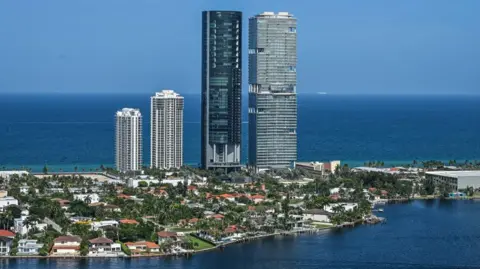
AFP via Getty Images The Porsche Design Tower in Miami, black, centre, opened in 2017AFP via Getty Images

The Porsche Designer Tower, black, centre, opened in Miami in 2017

Business and consumer psychology experts say the boom in luxury branded apartments reflects a broader desire for social signalling and exclusivity.

Giana Eckhardt, a professor of marketing at King’s College London, argues that such homes have become a new form of “social status currency”, akin to a rare handbag or huge diamond ring.

“Ultra-wealthy consumers increasingly want status assets and goods that are not available to everyone,” she says.

Eckhardt who specialises in consumer behaviour, branding and consumer culture, adds that luxury brands communicate a “person’s place in a social hierarchy”. “They want the social rewards that come with being associated with these brands,” she adds.

BinGhatti agrees that exclusivity is central to the appeal. “Clients really get the highest level of exclusivity.

“Every unit is unique and that gives them a special feeling of owning a one-of-a-kind [apartment] across the entire planet.”

Yet business psychologist Stuart Duff, of UK firm Pearn Kandola, cautions that many people may find the idea of branded apartments to not be in good taste, especially if the brand name is excessively on show.

“Having the presence of a brand everywhere within an apartment block could well reduce the perception of rarity and uniqueness, and lead to a feeling of bragging. And at worst being seen as vulgar and tacky.”

Read more global business stories

39% of adults want to see ultra-processed foods banned – survey

0
39% of adults want to see ultra-processed foods banned – survey

Two thirds of UK adults believe the next generation will suffer poorer health due to ultra-processed foods (UPFs) and 39% would like to see them banned, a survey suggests.

Some 59% of adults believe UPFs are “impossible to avoid” when shopping on a budget, the study for retailer Lakeland found.

Two thirds (66%) are worried about their effects on public health and 68% believe the Government should do more to protect people from them.

Two thirds (66%) also think supermarkets should take more responsibility for the UPFs they sell, and 77% want clear warning labels on food containing ultra-processed ingredients.

Three quarters (74%) say children should be taught at school about the dangers of UPFs and the importance of home cooking.

The survey found a quarter of adults (24%) do not know how to recognise the presence of UPFs in food products.

It found 31% have been cooking from scratch more in the last year, with 35% more in the last two years, and 44% in the last five years.

A fifth (19%) are cooking from scratch more regularly to avoid UPFs, while 25% are cooking from scratch more to save money and 26% for other health benefits.

However 44% say they do not have time to cook from scratch, 16% believe it is too complicated and 19% they think it would cost too much.

Wendy Miranda, customer brand ambassador at Lakeland, said: “There are clear benefits to cooking from scratch and knowing exactly what is going into the food we eat.

“We encourage our customers to think of the benefits, from nutrition to mindfulness to improving overall energy levels and simply feeling a sense of personal achievement with each cooking creation.”

The survey follows global experts warning that UPFs are a leading cause of the “chronic disease pandemic” linked to diet, with food firms putting profit above all else.

Writing in The Lancet medical journal in November, 43 scientists and researchers joined forces to argue that UPFs are “displacing” fresh foods and meals, worsening diet quality, and are linked to multiple chronic diseases.

Philip Toscano, including an increased risk of obesity, heart disease, cancer and early death.

Examples of UPFs include ice cream, processed meats, crisps, mass-produced bread, some breakfast cereals, biscuits, many ready meals and fizzy drinks.

UPFs often contain high levels of saturated fat, salt, sugar and additives, which experts say leaves less room in people’s diets for more nutritious foods.

UPFs also tend to include additives and ingredients that are not used when people cook from scratch, such as preservatives, emulsifiers and artificial colours and flavours.

The dietary share of UPFs remains below 25% in countries such as Italy, Cyprus, Greece, Portugal and across Asia, but it is 50% in the US and UK, the research said.

Mortar Research surveyed 2,000 UK adults in January.

Revolutionary eye injection saved my sight, says first-ever patient

0
Revolutionary eye injection saved my sight, says first-ever patient

Michelle Roberts and Sophie HutchinsonBBC News

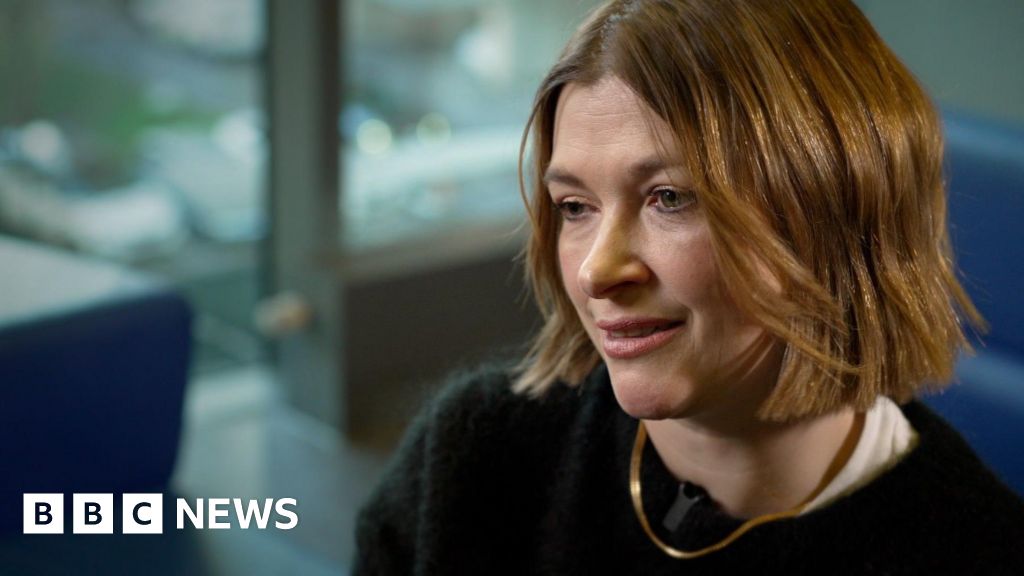
BBC News Nicki, who has a cropped bob hairstyle, looks to the side of the camera while chatting with the BBCBBC News

Nicki says the results have been life-changing

Doctors say they have achieved the previously impossible – restoring sight and preventing blindness in people with a rare but dangerous eye conditon called hypotony.

Moorfields hospital in London is the world’s first dedicated clinic for the disorder and seven out of eight patients given the pioneering treatment have responded to the therapy, a pilot study shows.

One of them – the first-ever – is Nicki Guy, 47, who is sharing her story exclusively with the BBC.

She says the results are incredible: “It’s life-changing. It’s given me everything back. I can see my child grow up.

“I’ve gone from counting fingers and everything being really blurry to being able to see.”

Currently, she can see and read most lines of letters on an eye test chart.

She is one line away from what is legally required for driving – a massive change from being partially sighted, using a magnifying glass for anything close up and having to navigate around the house and outside largely using memory.

“If my vision stays like this for the rest of my life it would be absolutely brilliant.

“I may not ever be able to drive again but I’ll take that!” she says.

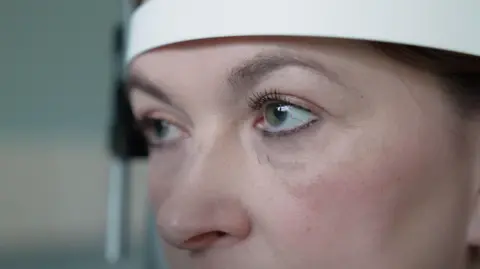
Nicki stares straight ahead while her eyes are being examined during a check up

Nicki has regular eye checks to see how she is progressing

With hypotony, pressure within the eyeball becomes dangerously low, leading it to cave in on itself.

It can happen if there is poor production of the natural jelly-like fluid inside the eye, following trauma or inflammation, for example.

Sometimes it’s a side effect of eye surgery or certain medications. Without treatment people can go blind.

Before now, doctors have tried using steroids and silicone oil to plump up the eye. But this can be toxic over long periods and doesn’t restore much vision.

Even when the cells at the back of the eye used for sight are working, the silicone oil is difficult to see through, causing blurry vision.

The experts from Moorfields decided to try a different approach with something they already had in their cupboard – a low-cost, transparent, water-based gel called hydroxypropyl methylcellulose or HPCM.

It’s already used in some types of eye surgery.

But rather than using it as a one-off, the Moorfield’s team decided to inject it into the main part of the eye as a new type of therapy.

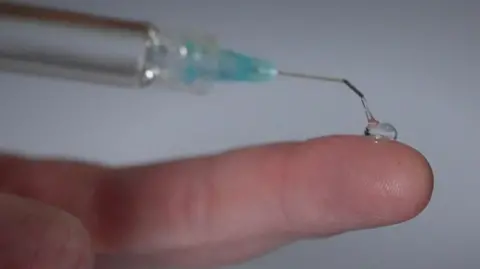
BBC News A blob of the clear gel on a fingertip, showing its viscosity and transparency.BBC News

The gel is clear or transparent, which allows better vision

When Nicki first had eyesight problems back in 2017, just after her son was born, she was initially given lots of silicone oil in her right eye, which was failing.

She says it had lost its normal shape and “sort of collapsed” or “crumpled like a paper bag” due to hypotony. The treatment did little to help.

And a few years later, her left eye started to fail in the same way.

“After I lost vision in my left eye, I thought, ‘there has to be something else we can try’,” she explains.

“Sheer determination. I was just like ‘I’m not giving up'”.

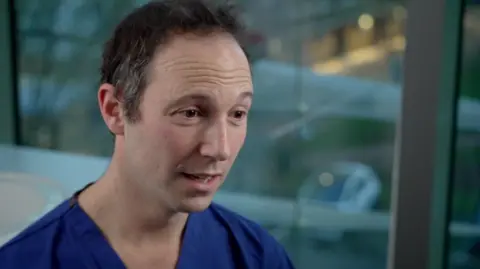
BBC News Mr Harry Petrushkin, who treated Nicki, is dressed in surgical scrubs and looks to the side of the cameraBBC News

Mr Harry Petrushkin is trying the treatment in more patients like Nicki

Her eye doctor Mr Harry Petrushkin said, together, they decided to do something entirely new – fill the eye with something that you can see through.

“The idea that we might be causing harm to somebody who has only really one eye with a treatment that may or may not work was nerve-wracking,” he recalls.

“We came up with this as a solution and amazingly it worked.

“Really, we could not have dreamt of her having the outcome that she has had.

“Somebody, who by all rights should have lost her vision in both eyes… is now living normally. That’s completely remarkable. We couldn’t have hoped for better.”

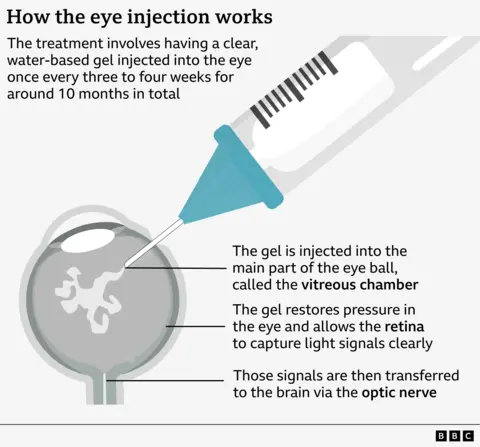
A graphic explaining how the eye injection treatment works. It shows a syringe positioned above an eyeball, with the needle entering the eye. A cutaway diagram of the eye labels the vitreous chamber as the area where a clear, water‑based gel is injected. Additional labels explain that the gel restores pressure inside the eye, helping the retina, lining the back of the eye, capture light signals clearly. The diagram also notes that these signals travel along the optic nerve to the brain. Text at the top states that the treatment involves injecting the gel every three to four weeks for about ten months.

He says the same treatment could potentially help hundreds or even thousands of people each year in the UK. It comes down to whether they still have viable cells at the back of the eye that allow vision.

“We knew with Nicki there was vision to gain and she would get better if we could make her eye round and hard again.”

They’ve treated 35 patients so far, thanks to funding from the Moorfields Eye Charity, and have now published the outcomes of the first eight in the British Journal of Ophthalmology.

The treatment is given once every three to four weeks for around 10 months in total.

The researchers hope that with time, they will get even better at working out who could benefit.

“It’s been a fantastic story. The results are really promising but it’s early days,” says Petrushkin.

Thin, yellow, orange and pink banner promoting the Upbeat newsletter with text saying, “Start your week on a high with uplifting stories in your inbox every Monday”. There is a pattern of shapes and different shades of colour on the right of the text.

Sign up here to receive our weekly newsletter highlighting uplifting stories and remarkable people from around the world.

New ‘filler’ treatment brings hope to people left blind by rare condition

0
Living Well

A groundbreaking medical advance has offered renewed hope to individuals suffering from a rare and untreatable form of blindness, with a low-cost gel injection successfully restoring sight.

This innovative procedure, which works by normalising pressure within the eye to improve vision, has been described by specialists as “not dissimilar to cosmetic fillers” due to its mechanism. The impact is already profound, as one participant in the study can now enjoy skiing with her son and anticipates regaining her driving licence.

The treatment targets hypotony, a debilitating condition affecting approximately 100 people in the UK annually, where abnormally low eye pressure distorts the eye’s shape. The pioneering research was spearheaded by London’s Moorfields Eye Hospital, supported by funding from Moorfields Eye Charity. Patients received injections of hydroxypropyl methylcellulose (HPMC), a clear, colourless gel, directly into their eyes.

HPMC is usually used in surgery to maintain the eye’s shape during operations, or to coat its surface for protection and to prevent it from drying out.

Harry Petrushkin, consultant ophthalmologist at Moorfields, said

“Everybody who’s ever had eye surgery will have had this gel in or on their eye at some point, but normally that gel is washed off or washed out at the end of surgery.

“We don’t leave it inside the eye, but it’s actually a really safe substance if you are leaving it inside certain people’s eyes, and it allows it to act a bit like a filler. So, in many ways, it’s not dissimilar to cosmetic fillers.

“It fills the space, but in this context, it fills the space with something that’s transparent and see through, and allows you to give a certain amount per patient to fill the eye up to the size it’s supposed to be.

“A bit like if you’re pumping up a ball, you can pump it up to exactly the right size, and then the eye can see much better.”

Nicki Guy, 47, who lives in London and took part in a study for a new treatment for hypotony, a rare condition which causes blindness
Nicki Guy, 47, who lives in London and took part in a study for a new treatment for hypotony, a rare condition which causes blindness (Nicki Guy/PA Wire)

Hypotony can be caused by “a number of different diseases”, according to Mr Petrushkin, as well as trauma, inflammation or complications after surgery.

He added: “Up till now, there’s really been no useful long-term management plan for it because we’ve had plans, but all of them have had quite a lot of problems.”

The current standard treatment for hypotony has been to fill the affected eye with silicone oil.

However, this can cause toxicity to the eye and is “not great” in the long-term, Mr Petrushkin said.

He told PA: “The fluid that fills our eyes is pretty similar to water in terms of seeing through it, whereas if you hold up a bottle of oil, it bends light more, and so if you’re trying to look through oil, your vision is going to be worse and very magnified.

“The advantage of using a gel rather than silicone oil is that you can actually see through it much better.

“And silicone oil, magical as it is, causes a lot of toxicity to the eye. So it has, up till now, been the gold standard but it’s not great.”

The research, published in the British Journal of Ophthalmology, included eight patients with hypotony whose eyes were injected with HPMC every couple of weeks.

Experts found that injecting the affected eye with HPMC not only restored its shape, but also restored sight in seven patients after 12 months of treatment.

Vision was measured using sight charts, and there have been “no serious side effects to date”, Mr Petrushkin said.

All patients needed regular check-ups during and after treatment and in some patients, injections were able to be stopped after the eye was restored to its normal size.

Nicki Guy, 47, who has been under Mr Petrushkin’s care since 2019 and took part in the study, told PA: “I’m so close to being able to drive again with my vision in my left eye.

“If it stays like this for the rest of my life, I would just be exceedingly happy.

“I’ve been able to take my son skiing. I love taking photographs, so I can do that again.

“There are still challenges with my vision as it is but, from where I was, it’s just phenomenal.”

Mr Petrushkin runs an all-day hypotony clinic at Moorfields – the only one of its kind in the world – but, prior to this, he said patients would have been told “there’s nothing more we can do”.

Speaking of Mrs Guy, he said: “She was a young patient who had a young family… I was just very frustrated that there was nothing that medicine could really do for her to keep her seeing.

“I’m lucky to work in a place with lots of amazing people, and we put our heads together, and thought that we would try injecting this gel, which is a gel that we’ve been using for decades.”

Moorfields has treated 35 hypotony patients in this way so far and Mr Petrushkin said the “results are holding up”.

He is now applying for funding for a large clinical trial to test different gels.

The goal is to figure out what gel involves injecting patients as few times as possible, he told PA.

“Ideally, we’d be able to find a product which expands slowly, so that we can inject a bit, but it slowly expands so we’re not having to top it up,” Mr Petrushkin added.

“We’re working with bioengineers all over the world, but particularly at UCL, to develop products that do that.”

Mr Petrushkin stressed that this treatment is not a cure for blindness, but could be used on people with other eye conditions.

“This is a treatment which is amazing for people who have visual potential, as in you are capable of good vision, but your eye is currently not letting you achieve that,” he said.

“It’s not a treatment to bring back blindness, where there is no vision at all.”

He added: “My hope would be that as the project develops, and as our knowledge in this area expands – our knowledge is really rudimentary – we understand where we can intervene to stop people from losing vision altogether.”

Kristin Davis dicusses fate of her Sex and the City character

0
Kristin Davis dicusses fate of her Sex and the City character

Kristin Davis says she doesn’t believe the chapter is closed for her Sex and the City character.

The actress, 60, was at the Golden Globe Awards’ Golden Eve event on Thursday, where she presented longtime friend and costar Sarah Jessica Parker with the Carol Burnett Award. 

At the same event, the press asked whether the end of Sex and the City marked a final chapter for her character, to which she said no. 

She also said the honour was well-deserved and praised Parker for shaping her character, Carrie Bradshaw, on and off-screen.

While no future projects in the Sex and the City universe have been announced, Davis made clear that, for her, the door remains open.

And Just Like That… aired its series finale on HBO Max in August after three seasons. The revival, which premiered in December 2021, followed Carrie Bradshaw (Parker), Miranda Hobbes (Cynthia Nixon), and Charlotte York Goldenblatt (Davis) more than a decade after the 2010 film Sex and the City 2. Kim Cattrall appeared briefly as Samantha Jones in a one-episode cameo.

The decision to end the show was announced just weeks before the finale aired. At the time, showrunner Michael Patrick King shared a statement explaining that while writing the final episode, he felt season three gave a natural stopping point. He added that the announcement was intentionally delayed so the word “final” would not overshadow the season itself.

Davis publicly reacted to the news by expressing sadness over the series ending, praising the cast, crew, and fans who supported the show. She later revealed that she was surprised by the decision in an appearance on The Drew Barrymore Show. During the show, she said she assumed the series would continue beyond its initial three-year commitment.

Paris Hilton assures fans Britney Spears is ‘doing good’

0
Paris Hilton assures fans Britney Spears is ‘doing good'

Paris Hilton shares update on Britney Spears

Paris Hilton is pushing back on growing concern surrounding Britney Spears, assuring fans that the pop star is in a good place despite recent headlines questioning her behavior. 

Speaking to the Daily Mail at the WWD Style Awards in Santa Monica on Friday, Hilton addressed the chatter directly and offered a calm, confident update about her longtime friend.

“She’s doing good,” Hilton said of the Gimme More singer. She then repeated the sentiment, adding, “She’s doing really good.”

The two have remained close over the years, and Hilton recently spent time with Spears along with her children, son Phoenix and daughter London.

Spears later shared a heartfelt Instagram post reflecting on the visit, describing a tender moment with Hilton’s son. 

“My relationship with little Phoenix was quite intense he actually let me hold him forever and he held my chest and looked up to me and his stunning mamma was miraculously so beautiful in letting me hold him for so long,” Spears wrote. 

She also praised Hilton’s role as a parent, adding, “I’m so proud of Paris for being such a strong, beautiful mother!!!!!!!” 

Spears ended the message by thanking Hilton for celebrating her birthday with her and writing, “You already know I love you sis!!!!”

Hilton’s reassurance comes after reports suggested Spears had distanced herself from members of her family. 

In November 2025, a family insider told the Daily Mail that the singer had stopped responding to messages. 

“She isn’t returning texts, won’t pick up calls, and won’t even read DMs,” the source claimed. 

Another family source described her behavior as “disturbing” and said it was raising “a lot of red flags right now,” leaving relatives unsure how to move forward.

Speculation continued in December when Spears was photographed returning from a Cabo trip carrying a baby carrier and wearing a mystery ring. 

Later that month, she spent Christmas with her younger son, Jayden, 19, while her older son, Sean Preston, 20, stayed with her sister Jamie Lynn Spears.

Spears appeared to address family tensions in a pointed Christmas Instagram post, writing, “Merry late Christmas to my beautiful family who have never disrespected me, harmed me, ever done anything completely unacceptable or caused unbelievable trauma, the kind you can’t fix …”

Despite the mixed signals playing out publicly, Hilton’s words offer a steady counterpoint. 

As someone who has known Spears for decades, her message is clear, from her perspective, there is no reason for alarm, and Britney Spears is doing just fine.

Zara Larsson steps up criticism against ‘evil’ policies

0
Zara Larsson steps up criticism against

Zara Larsson defends position against immigration policies

Zara Larsson, a Swedish singer, is stepping up her attacks on what she earlier called the “cruel” immigration policies of the current U.S. government.

In a new Instagram Story, she took aim at ICE agents, calling them out for their behaviour during the raids they conduct.

The Up Close hitmaker, in a note on social media, wonders why they behave in such a way, writing, “What went wrong? Is it toxic masculinity, a frail ego, fear of people, and low IQ all mixed up, like a disgusting cocktail? Red pill podcasts? Sprinkled with some absence of love from their parents in childhood?

Moreover, Zara claims that all agents of ICE involved in controversies were men and that no woman was among them.

“Seriously, what happened in their heads that led those men (mind you!! I have yet to see a female agent!!!) down this path???”

Zara Larsson steps up criticism against evil policies

She also raises the question of whether wearing a uniform boosts the ego to perform what the Lush Life singer described as “terrorizing” acts.

“Do you think they feel really cool when they come home after a day of terrorizing communities and families? Or only when the silly f***** outfit is on and their faces are fully covered?”

In the end, the Swedish singer, who is residing in the United States, suggested ICE agents should get therapy, “We need to teach little boys compassion and empathy, so they can grow up and view every person like a person. It’s just sooo unsexy to “just do their jobs” when the job is to be the most ridiculous evil clown on the planet. I don’t understand.”

This post comes before Zara shared how her boyfriend cannot enter the US for six years because of what she described as a minor offense of possessing marijuana. 

DEA zeroes in on Cartel of the Suns bosses as Maduro is hauled into US narco case

0
DEA zeroes in on Cartel of the Suns bosses as Maduro is hauled into US narco case

NEWYou can now listen to Fox News articles!

The early-morning arrest of Venezuelan President Nicolás Maduro sent shockwaves around the world, marking the most consequential move by the United States in its war against the dictator’s notorious “Cartel of the Suns.” 

Maduro was indicted alongside his wife, Cilia Flores, son and three alleged co-conspirators with federal gun and narcotics trafficking charges. The case, which mirrors original charges filed in the Southern District of New York in 2020, adds charges against Flores and was filed under seal last month. 

Maduro is facing four charges, including narco-terrorism conspiracy, cocaine importation conspiracy, possession of machine guns and destructive devices and conspiracy to possess machine guns and destructive devices.

Federal prosecutors allege that for years, the Cartel of the Suns – or “Cartel de los Soles” – has worked in tandem with the Revolutionary Armed Forces of Colombia (FARC) under Maduro’s leadership to execute a complex and large-scale cocaine trafficking network to funnel narcotics into the U.S.

IRAN AND MADURO TIES SUFFER MAJOR BLOW FOLLOWING U.S. OPERATION AND CAPTURE OF VENEZUELAN DICTATOR

Venezuelan President Nicolás Maduro addresses supporters during a rally marking the anniversary of the 19th-century Battle of Santa Ines in Caracas, Venezuela, on Dec. 10, 2025.  (Pedro Rances Mattey/Anadolu via Getty Images)

“The Venezuelan regime, once led by Nicolás Maduro Moros, remains plagued by criminality and corruption,” then-Attorney General William Barr said in a 2020 news release. “For more than 20 years, Maduro and a number of high-ranking colleagues allegedly conspired with the FARC, causing tons of cocaine to enter and devastate American communities.” 

U.S. officials’ war against Venezuela’s trafficking empire dates back to 1996, after the country was deemed one of the largest drug transit hubs within the Western Hemisphere, according to a 2009 report published by the United States Government Accountability Office. 

Venezuela’s shared border with Colombia – along with ongoing corruption within the country’s government – has long provided criminals with consistent resources to transport narcotics throughout the region.

TRUMP ISSUES DIRECT WARNING TO VENEZUELA’S NEW LEADER DELCY RODRÍGUEZ FOLLOWING MADURO CAPTURE

Venezuela's President Nicolas Maduro leads the celebration of the 22nd anniversary of late President Hugo Chavez's return to power after a failed coup attempt in 2002 wearing army fatigues and a matching baseball cap.

Venezuela’s Nicolas Maduro leads the celebration of the 22nd anniversary of late President Hugo Chavez’s return to power after a failed coup attempt in 2002, in Caracas, Venezuela April 13, 2024. (Reuters/Leonardo Fernandez Viloria/File Photo)

Since 2005, Venezuela’s cooperation with the U.S. regarding counternarcotic operations has significantly dwindled, denying visas to U.S. officials in 2007. One year later, then-President Hugo Chávez expelled the U.S. ambassador and recalled his ambassador from Washington, D.C., marking a significant blow to the two countries’ collaboration efforts. 

While Venezuela and the U.S. agreed to reinstate their ambassadors in 2009, Venezuelan officials insisted the country did not need to work alongside the U.S. in counternarcotic efforts due to the country’s own programs.

REBECCA GRANT: THE STRATEGIC LOGIC OF OPERATION ABSOLUTE RESOLVE

Venezuelan leader raises a hand while walking with his spouse.

Venezuela’s President Nicolas Maduro gestures next to his wife Cilia Flores as they leave the Capitolio, home of the National Assembly, after taking the oath during the presidential inauguration in Caracas on Jan. 10, 2025. (Juan Barreto/AFP via Getty Images)

In an effort to crack down on Venezuela’s trafficking networks, the Drug Enforcement Administration (DEA) has worked both within the country and domestically to capture the cartel’s key players. 

In 2018, the U.S. Department of the Treasury’s Office of Foreign Assets Control (OFAC) added Padrino Lopez, a general in the Venezuelan armed forces, to its Specially Designated Nationals List.

In 2020, the Department of Justice unsealed an indictment against Maduro and 14 co-conspirators, with charges stemming from investigations conducted in collaboration with the DEA.

SECOND FRONT: HOW A SOCIALIST CELL IN THE U.S. MOBILIZED PRO-MADURO FOOT SOLDIERS WITHIN 12 HOURS

Five years later, Hugo Armando Carvajal Barrios, a top general known as “El Pollo,” pleaded guilty to the same charges brought against Maduro. His conviction marked a notable victory for U.S. officials, with co-conspirator Cliver Antonio Alcala Cordones also pleading guilty to providing material support, including firearms, to the FARC. 

In 2025, OFAC sanctioned the Cartel of the Suns as a Specially Designated Global Terrorist due to its history of providing material support to Tren de Aragua and the Sinaloa Cartel. Despite the accusations, a U.S. intelligence assessment comprised of 18 agencies later found no direct evidence of a connection between the cartels, according to The Associated Press. 

However, the indictment filed against Maduro alleges he, along with his family, facilitated “cocaine-fueled corruption to flourish for his own benefit, for the benefit of members of his ruling regime, and for the benefit of his family members.”

CLICK HERE TO DOWNLOAD THE FOX NEWS APP

Federal prosecutors allege Maduro “provided law enforcement cover and logistical support,” such as facilitating transport – such as boats and airplanes – to cartels moving drugs throughout the region. 

“This cycle of narcotics-based corruption lines the pockets of Venezuelan officials and their families while also benefiting violent narco-terrorists who operate with impunity on Venezuelan soil and who help produce, protect, and transport tons of cocaine to the United States,” the indictment adds. 

The DEA did not respond to Fox News Digital’s request for comment. 

The Associated Press contributed to this report. 

Turn Your Rising Home Equity Into Cash You Can Use

0


Turn Your Rising Home Equity Into Cash You Can Use