Archaeologists in Spain have brought back the voice of the Neolithic by successfully playing ancient shells that had been buried for around 6,000 years. The instruments, made from large marine snail shells and discovered across several prehistoric sites in Catalonia, produced powerful, stable notes that researchers say were loud enough to carry across valleys and through underground spaces, hinting at an early system of long-distance communication.The findings, published in the journal Antiquity suggest these shell horns were not simple ornaments or ritual curiosities. Instead, they may have been designed as high-powered sound tools that allowed early farming communities to signal across landscapes where visibility was limited.
Ancient shells that still produce thunderous sound
The horns were made from Charonia lampas, a large Mediterranean sea snail whose shell shape naturally lends itself to producing resonant sound when modified. Researchers examined 12 shell horns recovered from five clustered archaeological sites in the Llobregat River basin, a region known for dense Neolithic settlement and activity.Despite their age, eight of the instruments were still acoustically functional. When tested, the best-preserved shells produced tones exceeding 100 decibels, with one reaching around 111.5 decibels measured from one metre away. That level of sound is comparable to a car horn or a brass instrument, intense enough to be heard over long distances outdoors.
Found across villages, caves and underground mines
One of the most striking aspects of the discovery is not just the sound, but where the horns were found. The shell instruments turned up in a range of Neolithic contexts, including open-air farming settlements, a high-altitude cave site overlooking steep valleys, and mine galleries used for extracting variscite, a prized green mineral used in ornaments.The sites lie within roughly a 10-kilometre radius along the river corridor, indicating the horns were part of a shared local tradition rather than isolated one-off objects. Their repeated appearance across multiple locations suggests they served a practical function understood by communities spread across the same region.
How Neolithic people turned seashells into signal horns
To transform a marine shell into a playable horn, prehistoric craftspeople removed the shell’s apex to create a mouthpiece. In many cases, this opening was around 20 millimetres wide, a size that researchers say tends to produce a stable pitch and consistent tone.The shells also showed signs of natural wear caused by marine organisms, including sponge boreholes and worm-like markings. That detail suggests the shells were likely collected after the animals had died, meaning they may have been chosen for their acoustic properties rather than harvested for food.Some of the horns contained small perforations that may have been used for attaching straps or cords, making the instruments easier to carry during work or travel.
More than one note, and maybe even primitive “melodies”
While shell horns are often imagined as blunt, one-note instruments, the tests revealed more flexibility than expected.Some horns were able to produce up to three distinct notes, including tones an octave and a fifth above the base note. The instruments also produced harmonic series that match the behaviour of conical wind instruments, meaning the sound was structured and repeatable rather than random noise.The horns were played and tested under controlled conditions by an archaeologist who is also a professional trumpet player, allowing researchers to measure both the physical performance and acoustic output in detail.
A prehistoric communication system in plain sight
The core idea behind the study is that sound can travel where sight cannot. In areas shaped by river corridors, valleys, cliffs and forested terrain, long-distance signalling would have been valuable. The researchers propose that these horns may have helped early communities coordinate activity, warn others of danger, or keep contact between dispersed groups working in different areas.The fact that shell horns were recovered from underground mining sites adds another layer to the theory. Neolithic mines were dark, confined and echoing, where voice communication would be difficult and visibility would be minimal. A loud horn signal could have served as an effective warning system or coordination tool in tunnels where other forms of communication were limited.
Why this discovery changes how we view Neolithic life
The Neolithic period is often framed through the lens of farming, pottery and settlement building. But these instruments hint at something more complex. If early communities were developing sound-based signalling traditions, it suggests a need for coordination and planning that goes beyond what many people imagine for the era.It also challenges the assumption that prehistoric wind instruments were mainly ceremonial. These shells appear carefully modified for acoustic performance and are found repeatedly in practical landscapes where communication would have mattered.
A technology that vanished without explanation
One of the biggest mysteries raised by the research is what happened next. The shell horns appear in multiple Neolithic phases, but their presence seems to end abruptly around 3600 BC. Later layers from the Chalcolithic and Bronze Age in the same region have not produced comparable finds.Researchers cannot yet say why the tradition disappeared. It may have been replaced by other communication methods, shifts in settlement patterns, or changing cultural practices. For now, the archaeological record does not provide a clear answer.
The sound of 6,000 years ago returns
What makes these shell horns so compelling is that they do not just represent the past visually, they bring it back in sound. The instruments still resonate with tones powerful enough to travel across landscapes, offering a rare glimpse into how people may have coordinated and connected long before written language or modern technology.For researchers, reviving these prehistoric “walkie-talkies” is more than a novelty. It is a reminder that even 6,000 years ago, humans were already engineering creative solutions to a timeless challenge: how to communicate across distance.
Mark Ruffalo and Jennifer Garner meetup at 2026 Golden Globes
Mark Ruffalo and Jennifer Garner gave fans a nostalgic moment at the 2026 Golden Globe Awards, quietly reuniting more than two decades after starring together in the beloved romantic comedy 13 Going on 30.
The two actors were spotted sharing smiles and conversation during a pre-show dinner at the Beverly Hilton in Los Angeles on Sunday, Jan. 11, turning the evening into an unexpected mini reunion that quickly caught attention.
Reporters at the 83rd annual Golden Globes observed Garner, 53, and Ruffalo, 58, mingling comfortably before the ceremony began.
While the interaction was brief, it was enough to remind fans of their on-screen chemistry in the 2004 film that remains a favourite for many.
In 13 Going on 30, Garner played Jenna Rink, a 13-year-old girl who magically wakes up as a 30-year-old magazine editor in New York City, while Ruffalo portrayed Matty, her childhood best friend who grows into her eventual love interest.
The film also featured Judy Greer, Andy Serkis and Kathy Baker.
Ruffalo attended the Globes as a nominee for his role in the HBO series Task.
He was up against Sterling K. Brown (Paradise), Diego Luna (Andor), Gary Oldman (Slow Horses), Adam Scott (Severance) and Noah Wyle, who ultimately won Best Performance by a Male Actor in a Television Series, Drama for The Pitt.
The timing of the reunion felt especially fitting.
13 Going on 30 marked its 20th anniversary in 2024, and Ruffalo has previously acknowledged how deeply the movie still resonates.
While no official reunion project has been announced, their Golden Globes moment offered a warm reminder of a film that continues to connect with audiences, proving that some on-screen friendships never really fade.
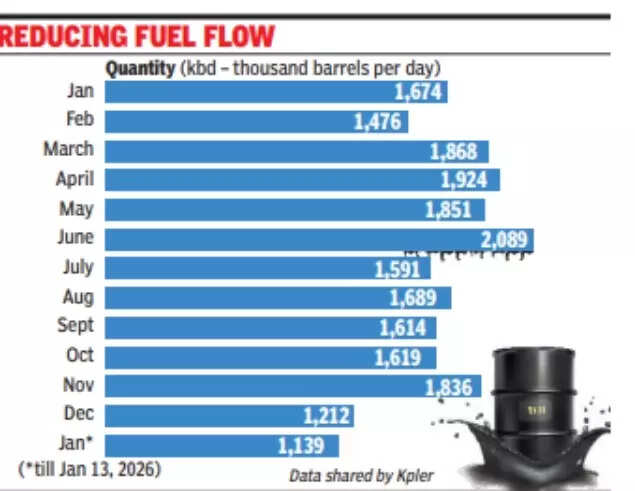
NEW DELHI: India’s import of Russian crude recorded a sharp 29% month-on-month decline, falling to the lowest volumes since implementation of the price cap policy, but is making a strong turnaround in January this year, Centre for Research on Energy and Clean Air (CREA) said in its monthly analysis of Russian fossil fuel exports for December.The report said the decline occurred despite total imports growing marginally. The drop was driven by a sharp reduction in imports by Reliance’s Jamnagar refinery – to the tune of nearly 49% – and a 15% cut by state-owned refineries in Dec. According to Kpler, a global real-time data and analytics provider, India imported over 20.4 million barrels of crude from Russia in 2025. The month of Dec saw imports of 1.2 million barrels, compared with 1.8 million barrels a month earlier. Till Jan 13 this year, India had already imported over 1.1 million barrels of crude oil from Russia.
In terms of value, India was the third-highest buyer of Russian fossil fuels – displaced by Turkiye from the second position – importing a total of EUR 2.3 billion of Russian hydrocarbons in Dec, CREA said in the report. While crude oil constituted 78% of India’s purchases, totalling EUR 1.8 billion, coal (EUR 424 million) and oil products (EUR 82 million) constituted the remainder of India’s monthly imports. India’s import of crude oil was recorded at EUR 2.5 billion in Oct and EUR 2.6 billion in Nov.The report added that the Jamnagar refinery cut its imports from Russia by almost half in Dec. “The entirety of their imports were supplied by Rosneft, albeit from cargoes purchased before the OFAC (Office of Foreign Assets Control in the US) sanctions came into effect. State-owned refineries also cut Russian imports by 15% in Dec,” the report stated.As per CREA analysis, Russia’s monthly fossil fuel export revenues saw a marginal 2% month-on-month decline to EUR 500 million per day – the second-lowest figure since the full-scale invasion of Ukraine. Monthly export volumes also witnessed a similar 2% month-on-month reduction. Total crude oil export revenues dropped by 12% to EUR 198 million per day.Russia’s fossil fuel exports remain highly concentrated, with China dominating coal and crude oil purchases, Turkiye dominating purchases of oil products, and the EU remaining the largest buyer of LNG and pipeline gas. While China remained the largest global buyer of Russian fossil fuels in Dec, accounting for 48% (EUR 6 billion) of Russia’s export revenues from the top five importers, The EU was the fourth-largest buyer of Russian fossil fuels, accounting for 11% (EUR 1.3 billion) of Russia’s export revenues from the top five importers.In December, five refineries in India, Turkiye and Brunei that use Russian crude exported EUR 943 million of oil products to sanctioning countries. The importers included the EU (EUR 436 million), the US (EUR 189 million), the UK (EUR 34 million) and Australia (EUR 283 million).
Chairman of the Naalakkersuisut, Greenland’s Prime Minister, Jens-Frederik Nielsen and Denmark’s Prime Minister Mette Frederiksen give a statement on the current situation at a press conference in the Hall of Mirrors at the Prime Minister’s Office in Copenhagen, Denmark January 13, 2026. — Reuters
FMs of Greenland, Denmark to meet US VP, Sec Rubio tomorrow.
Greenland residents support Denmark ties, wary of US intervention.
Danish, Greenlandic ministers seek diplomatic resolution with US.
Nuuk: Residents in Greenland’s snow-covered capital, Nuuk, expressed support for remaining part of Denmark and called for a pause in independence discussions ahead of high-level talks in Washington on Wednesday, as US President Donald Trump intensifies his interest in the Arctic island.
Greenlandic and Danish foreign ministers will meet US Vice President JD Vance and Secretary of State Marco Rubio in Washington on Wednesday after renewed threats of taking control of Greenland, an autonomous territory of Denmark.
Greenland’s Prime Minister Jens-Frederik Nielsen reiterated Greenland’s commitment to Denmark, dismissing the prospect of becoming a US territory.
“We face a geopolitical crisis, and if we have to choose between the US and Denmark here and now, then we choose Denmark,” Nielsen told reporters in Copenhagen on Tuesday, standing alongside Danish Prime Minister Mette Frederiksen. “We stand united in the Kingdom of Denmark.”
Greenland’s political landscape appears to be shifting, with leaders and residents focusing on long-term independence rather than immediate autonomy.
“In the current circumstances, I think it would be wise for Greenland to commit to Denmark for a very, very long time and remain under the NATO security umbrella,” said Finn Meinel, a Nuuk-based lawyer.
Some Greenlanders are worried about potential US intervention. Charlotte Heilmann, a pensioner in Nuuk, shared her reservations: “I can’t imagine living as an American. We are part of Denmark, and NATO, so I don’t understand why he keeps saying he wants to take our country.”
Casper Frank Moller, a tour operator, noted how US threats have brought Greenlanders closer together. “Last year, some people were still focused on fast independence. But after what has happened, there’s more unity among us because we have to stand against this possible annexation. Hopefully, tomorrow’s meeting will lead to a diplomatic solution.”
For us, it’s home
Greenland has been moving towards greater self-governance since 1979. However, cabinet minister Naaja Nathanielsen, responsible for business, energy and minerals, acknowledged there is no immediate rush.
“For others, this might be a piece of land, but for us, it’s home,” she said in London. Nathanielsen added that Greenlanders are content being part of Denmark and see themselves as allies of the US, not as Americans.
Trump’s administration has repeatedly claimed Greenland’s strategic importance to US national security. White House officials have been discussing various plans to bring Greenland under US control, including potential use of the US military and lump-sum payments to Greenlanders as part of a bid to convince them to secede from Denmark.
The hardest part is ahead
Danish Foreign Minister Lars Lokke Rasmussen and Greenlandic counterpart Vivian Motzfeldt had requested the upcoming meeting in Washington in response to Trump’s remarks. Rasmussen emphasised the importance of addressing disputes diplomatically. “Our aim is to move the discussion into a meeting room where we can look each other in the eye,” he said.
Denmark, which has managed Greenland for centuries, faces growing pressure to bolster Arctic defences to counter geopolitical tensions. Danish Defence Minister Troels Lund Poulsen plans to meet NATO Secretary General Mark Rutte in Brussels next week, with multinational NATO exercises in Greenland scheduled by 2026.
Danish Prime Minister Frederiksen acknowledged the challenges presented by the heightened US interest. “It is hard to stand up to the US, our most important ally,” she said on Tuesday. “But the hardest part may still be ahead of us.”
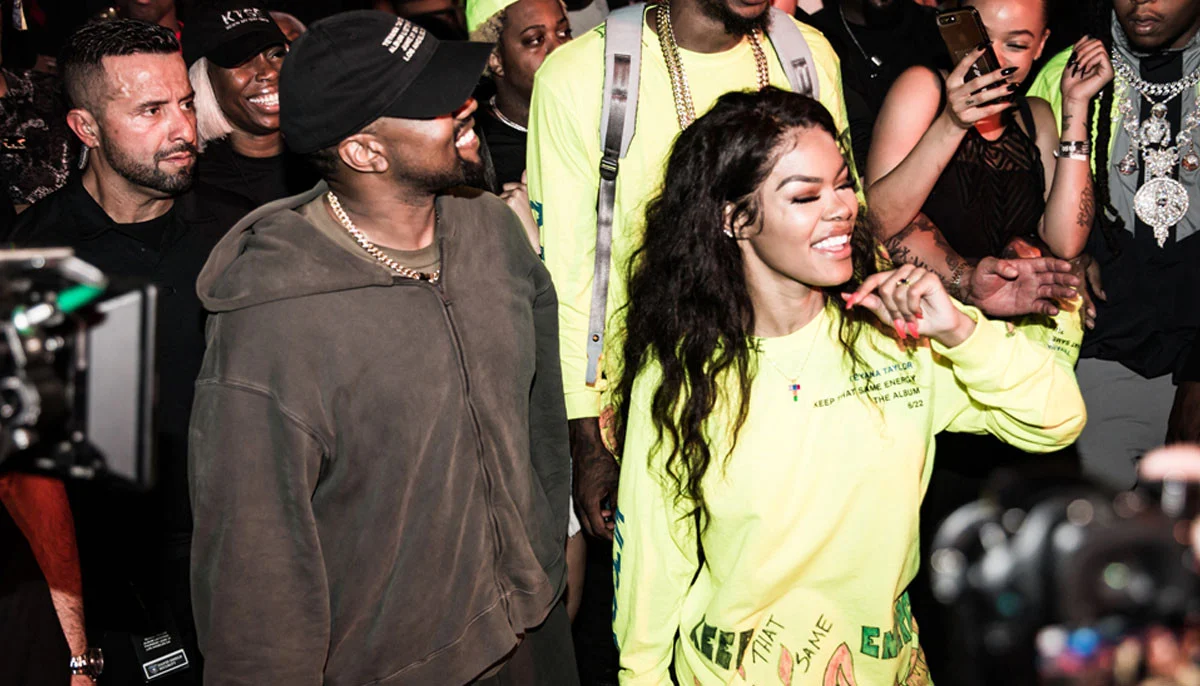
Teyana Taylor refuses to cut ties with Kanye West despite his controversies
Since Kanye West’s shocking anti-Semitic outbursts, several of his peers have cut ties with him. But not Teyana Taylor.
She, though, adds that she disagreed with Ye, with whom she worked on his album My Beautiful Dark Twisted Fantasy, Faye’s music track, and her album K.T.S.E., but will not cut ties with him.
“I don’t have to agree with everything that he do or say, but I’m not going to, like, abandon him and be like, ‘Yeah, eff that mother******,’” she tells Variety. My brothers do s*** that I don’t agree with…. I don’t get into any of that.”
Her remarks come during the 2026 Golden Globes, where she won one for her performance in One Battle After Another.
Taylor becomes a frontrunner for a nod in the Oscars in the Best Actress category on the heels of her Globes win.
Meanwhile, Kanye is set to launch his most anticipated album, Bully, which was delayed.
Ahead of the drop, Ye seemingly has been making amends for his past hateful rhetoric against the Jewish community. His meeting with Rabbi Yoshiayo Yosef Pinto, for example.
“It’s a big deal for me as a man to come and take accountability for all the things that I’ve said, and I really just appreciate you embracing me with open arms and allowing me to make amends. And this is the beginning and the first steps,” the Chicago rapper said to him.
US lawmakers introduces new bill to define crypto market rules
U.S. senators late on Monday, January 12, 2026, unveiled draft legislation that would create a regulatory framework for cryptocurrency, which would clarify financial regulators’ jurisdiction over the burgeoning sector, potentially boosting digital asset adoption.
The crypto industry has long pushed for such legislation, often arguing it is existential to the future of digital assets in the U.S. and necessary to fix core, longstanding problems for crypto companies.
Among other things, the legislation would define when crypto tokens are securities, commodities, or otherwise, giving the industry long-hoped-for legal clarity.
It would also give the U.S. Commodity Futures Trading Commission—the industry’s preferred regulator, as opposed to the U.S. Securities and Exchange Commission—authority to police spot crypto markets, reports Reuters.
Impact on banking sector and crypto industry
The bill also gives the banking industry a fix it had sought stemming from legislation signed into law last year to create a federal regulatory framework for dollar-pegged crypto tokens called stablecoins.
Bank lobbyists had urged Congress to close what they deemed a loophole in the bill that allowed intermediaries to pay interest on stablecoins.
Moreover, banks have argued this would lead to a flight of deposits from the insured banking system, potentially threatening financial stability.
Crypto companies have fought back against that assertion, contending that prohibiting third parties, such as crypto exchanges, from paying interest on stablecoins would be anti-competitive.
“What is threatening progress is not a lack of policymaker engagement, but the relentless pressure campaign by the Big Banks to rewrite this bill to protect their own incumbency,” said Summer Mersinger, CEO of the Blockchain Association, a crypto industry trade group.
“Their demands to eliminate stablecoin rewards are designed to choke off consumer choice and kill innovative financial products before they can compete.”
Monday’s bill, which could change as senators consider amendments, prohibits crypto companies from paying interest to consumers solely for holding a stablecoin.
However, it allows crypto companies to pay rewards or incentives to customers for certain activities, such as sending a payment or participating in a loyalty program.
The SEC and the CFTC would also be required to issue a joint rule requiring clear disclosures from crypto companies about rewards paid in connection with using stablecoins.
The Senate Banking Committee is scheduled to debate the bill and consider possible amendments on Thursday, January 15, 2026.
New ‘Crypto Debate’
The Senate Banking Committee is scheduled to debate the bill and consider possible amendments on Thursday, January 15, 2026.
In a statement, Cody Carbone, CEO of crypto industry trade group The Digital Chamber, said it was “encouraging to see the process continue to move forward.”
Trump courted industry cash pledging to be a “crypto president,” and his family’s own crypto ventures have helped to propel the sector into the mainstream.
The House of Representatives passed its version of the bill in July, but talks stalled in the Senate last year, with lawmakers divided over provisions on anti-money-laundering and requirements for decentralized finance platforms, which allow crypto users to buy and sell tokens without an intermediary, according to three sources familiar with discussions.
With Congress already pivoting to focus on the 2026 midterm elections, in which the Democrats could take the House, some lobbyists are skeptical that the crypto market structure bill could make it into law.
The recent release of the draft for Bitcoin and crypto market structure legislation in the US marks a pivotal moment for the cryptocurrency industry, potentially reshaping how digital assets are regulated and traded.
How it is important
This recent development comes at a time when Bitcoin BTC traders are closely monitoring regulatory shifts, as they often trigger significant price volatility and trading opportunities.
For instance, past regulatory announcements have led to sharp BTC price movements, with traders positioning for breakouts above key resistance levels like $60,000 or pullbacks to support around $50,000.
Additionally, according to Blockchain News, the cryptocurrency market experts see this legislation as a catalyst that could enhance liquidity in BTC/USD pairs on major exchanges.
It also believes that encouraging more traditional investors to enter the space and correlating with positive sentiment in stock markets tied to tech and fintech sectors.
CHICAGO, Ill. – The ex-husband of the Ohio dentist’s wife, charged in the couple’s murders, spent nearly a decade after their divorce moving from job to job across the country, with a former coworker saying a stint in Nevada marked the start of a “downward spiral” that preceded the alleged killings.
Michael David McKee, 39, was arrested after allegedly killing a couple in Columbus, Ohio, according to records. Police officers responded to a house located in Columbus’ Weinland Park neighborhood around 10 a.m. Dec. 30 and found Spencer Tepe, 37, and Monique Tepe, 39, both dead with gunshot wounds.
McKee is Monique’s ex-husband. Rob Misleh, Spencer’s brother-in-law, told NBC News that their family “quickly believed” that McKee was somehow involved in their deaths.
“He was an emotionally abusive person when they were together, that is all I know,” Misleh said.
Michael Mckee is charged with the murders of Spencer and Monique Tepe. McKee appeared in court on Monday afternoon.(Rob Misleh and WIFR via Pool)
McKee was booked at the Winnebago County Sheriff’s Office in Illinois just before noon Saturday, jail records show. He’s facing upgraded premeditated aggravated murder charges in Ohio in relation to Spencer and Monique’s deaths.
Divorce records obtained by Fox News Digital show that McKee and Monique got married on Aug. 22, 2015, and separated by March 2016, with the marriage lasting seven months. According to the initial divorce complaint filed by Monique, she and McKee were “incompatible.” By March 2016, Monique and McKee were living separately. The couple had no children during their short marriage.
At the time, McKee was in the process of completing his residency at the Virginia Tech Carilion Clinic making $51,000 in 2016, records show. They owned a home in Roanoke, Virginia, which had an estimated value of $219,500. McKee owned a 2004 Jeep Grand Cherokee and a 2007 Jeep Patriot Limited, while Monique owned a 2012 Jeep Grand Cherokee and a 2008 Toyota Rav 4.
Financial records included by Monique in her divorce filing indicated the couple hadn’t yet opened a joint bank account. Monique indicated that she didn’t know how much money McKee had in his bank account. Monique wrote “unknown” as the value of several of his financial accounts, stocks and retirement plan, indicating she didn’t know their value.
According to the separation agreement, “Differences have arisen between [the couple] and they are now living separate and apart from each other.” Monique and McKee kept most of their personal assets, including bank accounts, and split personal property to their “mutual satisfaction,” the records show. McKee kept possession of the house, which was in his name.
Here’s a timeline of McKee’s work history, according to records and sources:
2005 to 2009: Undergraduate student at Ohio State University.
2009 to 2014: Studied to earn his medical degree at Ohio State University.
Michael McKee appears in court at Winnebago County Justice Center, Monday, Jan. 12, 2026, Rockford, Illinois. McKee is facing extradition to Ohio for the murder of his ex-wife Monique Tepe and her husband, Spencer Tepe.(WIFR via Pool)
2020 to 2022: Vascular surgery fellowship at University of Maryland Medical Center.
2022 to 2025: Was licensed in several states, including California, Nevada and Illinois. From 2023 to 2024, he worked as a vascular surgeon at Las Vegas Surgical Associates.
2025 to 2026: Vascular surgeon at OSF Saint Anthony Medical Center in Rockford, Illinois.
Mourners depart a visitation service for Monique and Spencer Tepe in Upper Arlington, Ohio, Sunday, Jan. 12, 2026. The couple were found murdered in their Coulumbus home on Dec. 30.(Derek Shook for Fox News Digital)
According to a source who has worked with McKee who spoke with Fox News Digital, the vascular surgeon had “basically no experience” before he was hired at Las Vegas Surgical Associates. The source said McKee’s “downward spiral” began after a series of alleged surgical mishaps, one of which was detailed in a lawsuit filed in Nevada.
“He was always nice, he was always kind and you know, he wasn’t ever one of those that has these like emotional outbursts or anything like that within the operating room or when he gets into a stressful situation,” the source said of McKee.
The source added that it was “reckless” for those around McKee to continue allowing him to perform high-risk surgeries knowing his limitations.
“Why are you letting a guy that’s a year and a half out of fellowship, two years, free rein to do these crazy cases? How come there’s nobody putting a stop saying, ‘what are you thinking of doing?’” the source said.
CLICK HERE TO DOWNLOAD THE FOX NEWS APP
Spencer and Monique Tepe are pictured on their wedding day.(Rob Misleh)
Charging documents indicate police were able to identify McKee by linking him to a car that arrived in the Tepes’ neighborhood shortly before the murders and left just after the homicide. The car was then located in Rockford, Illinois, and police found evidence it belonged to McKee.
The couple was killed one month short of celebrating their five-year wedding anniversary, Misleh told WSYX.
Adam Sabes is a reporter for Fox News Digital. Story tips can be sent to Adam.Sabes@fox.com and on Twitter @asabes10.
LOS ANGELES — UCLA‘s athletic department has received $17.3 million from a late alumnus to benefit the football and men’s basketball programs.
The bequest from Lawrence Layne, who earned an MBA at the school in 1977, is part of an over $40 million pledge to multiple areas at the university, the school said Tuesday. Layne died in December 2024.
The gift comes at the same time the athletic department is seeking new sources of revenue after running up $219.55 million in debt during the past six fiscal years. An athletic department spokesperson told the Los Angeles Times that the deficit has been covered by the university and the balance is zero.
The football program will receive $9.6 million, while men’s basketball will get $7.7 million from Layne’s $17.3 million commitment.
“I am fortunate to have spent time with Larry and get to know his deep passion for UCLA Athletics, particularly his desire to help our football and men’s basketball programs thrive in this new era of collegiate sports,” athletic director Martin Jarmond said in a statement. “His investment in our programs positions us, and future generations of Bruin athletes, for long-term success.”
Layne’s pledge includes $11.4 million to UCLA Health, focused on the fields of research in cardiology and hepatology. The Anderson School of Management will receive $5.7 million; men’s rugby will get $3.8 million; and the Center for the Art of Performance will receive $1.9 million. Layne played rugby while at UCLA and was the first coach of its women’s rugby team.
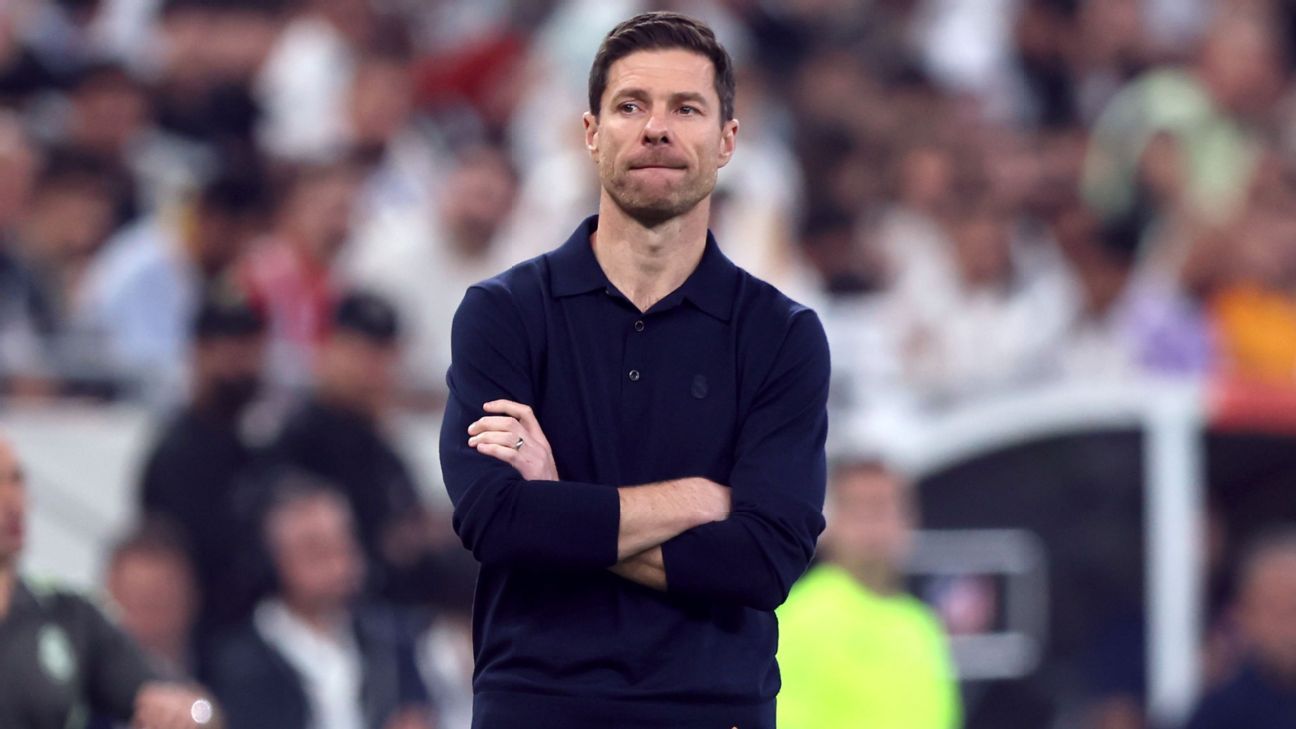
On Sunday night in Jeddah, Xabi Alonso was talking about the future. Real Madrid had just lost to Barcelona in the Spanish Supercopa final, missing out on the season’s first trophy, and their coach was keen to turn the page.
“We have to move on, as soon as possible,” Alonso told Spanish TV. “It’s the least important of the competitions we play. Now we have to look forward, get [injured] players and our morale back, and carry on.”
It’s true that this week, Real Madrid are moving on, but without Alonso. Less than a day after that 3-2 loss to their biggest rivals, the club announced that he was leaving. A short statement, released just after 6 p.m. Spanish time on Monday, read: “By mutual agreement between the club and Xabi Alonso, it has been decided to bring his time as first team coach to an end.”
Just 233 days after being appointed, Alonso — a Madrid legend as a player, and one of the most highly rated young coaches in world football — was gone. On Monday evening, his coaching staff were already collecting their things at the club’s Valdebebas training ground. Alonso’s successor had already been confirmed: his former teammate, friend and coach of reserve team Castilla, Álvaro Arbeloa.
The timing of Alonso’s exit — which, sources close to the coach told ESPN, was a sacking, and not “by mutual agreement” as stated by the club — was a surprise. But within the club, doubts about the coach had been growing for months. Sources close to both Alonso and the dressing room told ESPN those doubts started at the very top, with club president Florentino Pérez.
It wasn’t just the Supercopa defeat to Barcelona. It wasn’t just the UEFA Champions League losses to Manchester City and Liverpool. It wasn’t just the embarrassing 2-0 LaLiga home defeat to Celta Vigo, or the unacceptable 5-2 derby thrashing by Atlético Madrid. It wasn’t only Vinícius Júnior‘s angry, public reaction at being substituted in October’s Clásico, although with hindsight, that looks like a tipping point.
From the very beginning, last summer, there were questions inside the club — both at the executive level and within the squad — about aspects of Alonso’s management. Those questions got louder as results and performances dropped off, and Alonso’s relationships with key players deteriorated. The coach felt undermined by a lack of support from what sources close to him called a minority in the dressing room. He had tried to adapt and build bridges, they said, and there had been some, limited signs of improvement; but in the eyes of the club, it wasn’t enough.
The situation was not viewed as sustainable. Alonso’s departure was agreed. And now the postmortem of his time in charge begins.
Additional reporting by ESPN’s Rodra and Rodrigo Faez
Uncertain start
The strength of Alonso’s position as Madrid coach had one significant drawback from the start, club sources told ESPN. His arrival as coach had not been instigated by Pérez. Instead, Alonso’s champion was José Ángel Sánchez, the club’s popular director general. He spoke to Alonso when his Bayer Leverkusen team came to Madrid in January 2025, to play Atlético in the Champions League.
Sánchez and others felt that given his Real Madrid past and historic achievements at Leverkusen — winning the league and cup double without losing a single match — Alonso was the obvious candidate to replace Carlo Ancelotti. Pérez was concerned about Alonso’s relative inexperience, and viewed him as a gamble, but accepted the recommendation.
Sources within the club, and close to Alonso, said there was never the same degree of connection between Pérez and Alonso that had been there, at times, with Ancelotti or Zinedine Zidane. Alonso himself felt that Pérez had not completely bought into his methods, while some players felt Alonso’s decision-making was limited by a lack of support from the president. It was a major, eventually fatal handicap for the Alonso era, and one that was built into its foundations.
Alonso’s appointment was confirmed on May 25, 2025, with a formal presentation the following day. The coach had not wanted to take charge before the FIFA Club World Cup, believing it would be more advantageous to begin a new project with a more conventional preseason. The club had other ideas.
Alonso struggled to hide his feelings. “These are the circumstances,” he said at his unveiling, showing little enthusiasm for the summer tournament. “And as it’s like that, I see it as an opportunity.”
In the team’s time in the United States, the first fault lines between Alonso and senior members of the squad developed. Multiple sources close to the dressing room told ESPN that Alonso’s handling of Vinícius Júnior upset the player. Alonso first considered experimenting with Vinícius on the right wing, and then planned to drop him for Madrid’s semifinal with Paris Saint-Germain. Only a late reshuffle, forced by injury, changed his plans. The episode badly damaged the pair’s relationship.
There were disagreements with the club, too, over squad planning. Trent Alexander-Arnold, Dean Huijsen, Álvaro Carreras and Franco Mastantuono were signed last summer. None of them were the tempo-setting midfielder Alonso wanted. Martín Zubimendi, who joined Arsenal, had a close relationship with Alonso, having worked with him at Real Sociedad. The club didn’t believe such a signing was necessary, pointing to the squad’s existing midfield options. Sources close to the coach told ESPN that Alonso felt that decision had significantly hindered the teams’ possibilities of success this season.
Alonso had the misfortune to succeed Ancelotti, a genius at squad management and perhaps the coach best-qualified to deal with Madrid’s star-studded, ego-filled roster. Despite his success at Leverkusen, and his past as an elite player, it was a challenge Alonso had never faced.
Locker room sources told ESPN that early in the season, Alonso — a man with clear ideas, determined to implement them — gave the players little leeway. He wanted to change various features of the players’ daily routine, and their habits. He wanted to see an improvement in punctuality. He wanted to see fewer outside figures — people close to players, but not part of the squad and coaching staff — present at the training ground. It was a change which was not well received by some in the dressing room.
Clásico flash point
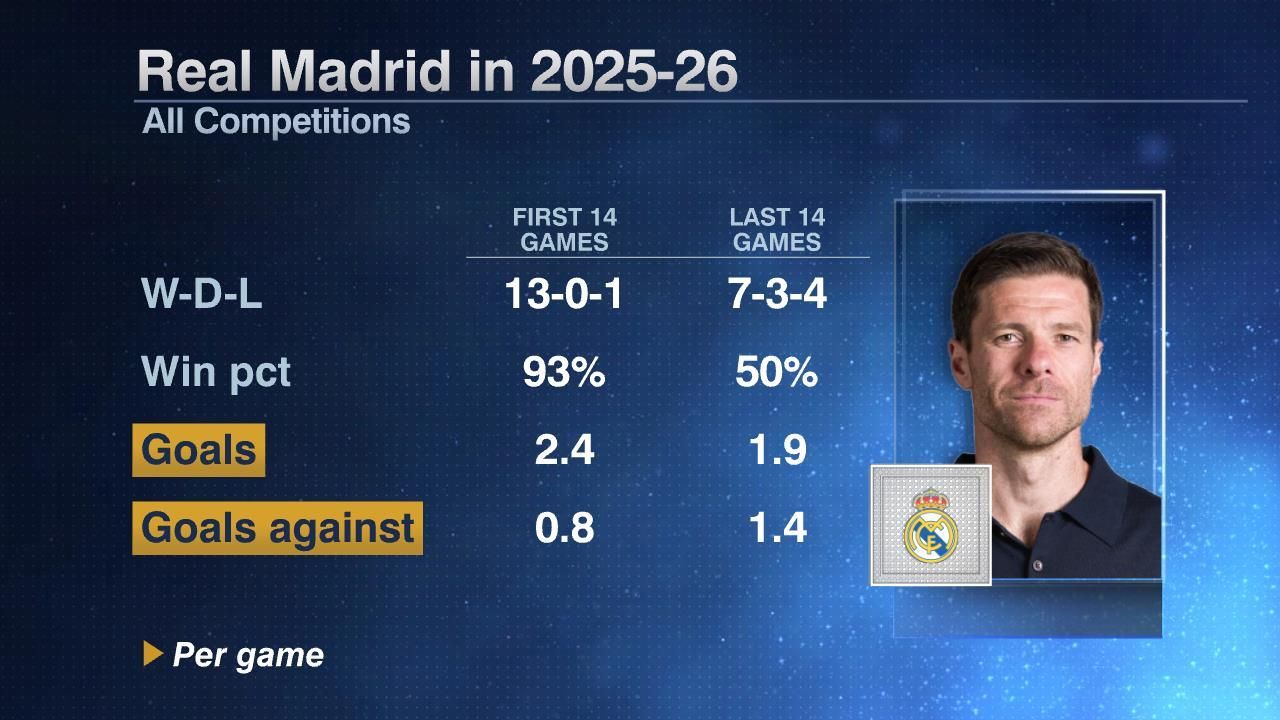
It would be unfair not to recognize the high points of Alonso’s brief reign. There were early signs of change and improvement in the team’s play at the Club World Cup. When 2025-26 started, Madrid won 13 of their first 14 games. The season peaked with a 2-1 Clásico win over Barcelona at the Bernabéu in LaLiga, on Oct. 26. A year earlier, Ancelotti’s Madrid had lost the same fixture 4-0.
It felt like progress, but a result that should have served as confirmation that Alonso’s Madrid were heading in the right direction was undermined by one, headline-grabbing moment: Vinícius Júnior’s furious reaction at being substituted in the 72nd minute. “Me voy del equipo” (“I’ll leave, shall I?”),” TV images appeared to show Vinícius shouting as he left the field and headed down the tunnel. “Mejor me voy” (“Best that I leave”).
Alonso had already omitted the Brazil forward from the starting XI for games against Real Oviedo and Marseille. His management of the player, starting at the Club World Cup, had raised eyebrows inside the club, with senior executives questioning the wisdom of Alonso’s approach, with Vinícius’ contract renewal — his deal up in 2027 — in the balance. Now, Vinícius’s reaction, in the most public setting possible, a packed Bernabéu, the biggest game of the season, had laid bare the extent of the tension.
Just as damaging for Alonso was the reaction in the days that followed, as Vinícius apologised to everyone — except his manager. Sources close to the locker room told ESPN that other players, already unhappy, now sensed weakness in Alonso and his lack of support from within the club. In his first real crisis, the coach hadn’t received the backing he needed; instead, his decision to substitute Vinícius had been undermined.
Downward turn
Then came a run of desperately bad form and results, the kind of run from which few Madrid coaches have successfully recovered. The team lost 1-0 at Liverpool, drew 0-0 at Rayo Vallecano and drew 2-2 at Elche. An unconvincing 4-3 win at Olympiacos was followed by a 1-1 draw at Girona. A 3-0 victory at Athletic Club was an outlier, and what came next left Alonso hanging by a thread: a 2-0 home defeat to Celta, and a 2-1 loss to City three days later.
The team’s form was not helped by an injury crisis that robbed Alonso of a number of senior players, and forced him to rely excessively on others, to their detriment. Eight first-team players were missing for the City game, including star striker Kylian Mbappé. Senior executives have raised concerns about the number of injuries. Alonso’s decision to sideline Antonio Pintus — previously responsible for the physical preparation of the first team, working with Zidane and Ancelotti — was debated. A day after Alonso’s sacking, Pintus was back working with the team at Valdebebas, alongside Arbeloa. In the face of mounting problems and growing pressure, Alonso tried to adapt, and improve his relationship with the squad. Sources in the locker room said that he relaxed some of his earlier rules, gave the players more days off, tried to make Vinícius feel more important, a more ‘Ancelotti style’ approach.
“As Real Madrid coach you have to be ready to deal with these situations,” Alonso said. “It’s not about changing, it’s about adapting. I know the culture at Real Madrid. That’s why it’s the biggest job in the world. You need to adapt, you need to learn.
“There’s a process, an interaction with the players. Some days are good, some days are not so good, but in every game we take steps. We’re in this position now, and we have to face it with energy and positivity.”
There was little sign of that energy and positivity on the pitch, but Alonso survived until Christmas with three wins in a week against Alavés, Talavera and Sevilla. Sources told ESPN that most of the squad supported the coach, and the players were willing to accept some of the features of Alonso’s management style — such as an increased emphasis on video analysis — which they had rejected at first. However, there was also a recognition that at Real Madrid, when the team is on the kind of run they faced in November and December, the usual outcome is that the coach loses his job.
Alonso urged journalists to “keep calm” in his last words before the Christmas break, suggesting he expected to remain in charge. 2026 began with a 5-1 win over Real Betis, and then the Supercopa. Madrid were fortunate to beat Atlético 2-1 in the semifinal, and then competed against Barcelona while adopting a pragmatic, defensive approach.
In the aftermath of the Supercopa, his position was viewed as fragile, but intact, with even journalists close to Pérez confidently writing that Alonso had bought himself time. As it turned out, it was just a few hours.
Adiós
Sources close to the coach told ESPN that Alonso leaves Real Madrid disappointed on multiple fronts: disappointed with the contributions of some key players; disappointed that, unlike at Leverkusen, he had not had the freedom to implement his ideas; disappointed with himself, believing he could have handled certain situations differently.
A number of issues had hindered the team, sources said. Alonso felt some players were not looking after themselves properly, citing concerns with their diet. The coach was also concerned with the number of dressing-room leaks appearing in the media, a feeling shared by some of the players who backed him.
Sources close to the coach pinpointed an influential, vocal minority of players who had been unwilling to take on board his ideas. They named three senior players: Vinícius Júnior in particular, but also Jude Bellingham and Federico Valverde.
A source told ESPN that Bellingham had been reluctant to accept Alonso’s tactical vision, although — unlike with Vinícius — those differences had not played out in public. Bellingham denied reports of dressing room unrest this month, saying the squad were “all behind” the manager and that claims of behind-the-scenes issues were “fabricated” and “exaggerated.” (Bellingham then took to his JB5 app on Tuesday, following the release of this story, to further deny any unrest or issue with Alonso.)
At board level, there was frustration at various aspects of Alonso’s management, with injuries, and the coach’s handling of Vinícius, two of the main concerns, as well as one, inescapable reality: the team had not been playing well, consistently, for months. One club source said that Alonso’s downbeat demeanor at the training ground in recent weeks had not gone down well with executives as the coach tried, and failed, to unlock the team’s potential. In the end, the club reached the conclusion that it wasn’t going to happen.
“If we carry on like this, we’d better leave it,” Sánchez told Alonso in a conversation after the Supercopa, according to one source. The terms of his departure mean Alonso will only be paid for one of the three years anticipated in his contract.
“It didn’t go as we would have liked,” Alonso posted on social media on Tuesday. “Coaching Real Madrid has been an honour and a responsibility. I leave with respect, gratitude and pride that I did my best.”