Teyana Taylor shares valuable lesson she learned from Iman Shumpert split
Teyana Taylor has shared the valuable lesson she learned from her divorce to NBA player Iman Shumpert.
The One Battle After Another actress opened up about her split from Iman on Tuesday while chatting with Vanity Fair.
“Divorce, to me, is you’re grieving the death of a living being,” said Teyana. “I think once children are involved, you understand the importance of really still having to show up for each other.”
“At least for the next 18 years, and being the best co-parents that we can be,” she added.
Despite that, the 35-year-old actress told the publication that she doesn’t “want people to start feeling scared of marriage, because marriage is a beautiful thing.”
“One thing I don’t do is rewrite history,” added Teyana. “When I love, my love is real. So whatever you’ve seen was a real display of love until there was no more. And that’s okay.”
For those unversed, Teyana called it quits with Iman in 2023 after seven years of marriage. The former couple shares two daughters – Iman, 10, and Rue, 5.
On the professional front, Teyana is currently gearing up for the release of her upcoming film, The Rip. The crime thriller will premiere on Netflix on January 16.
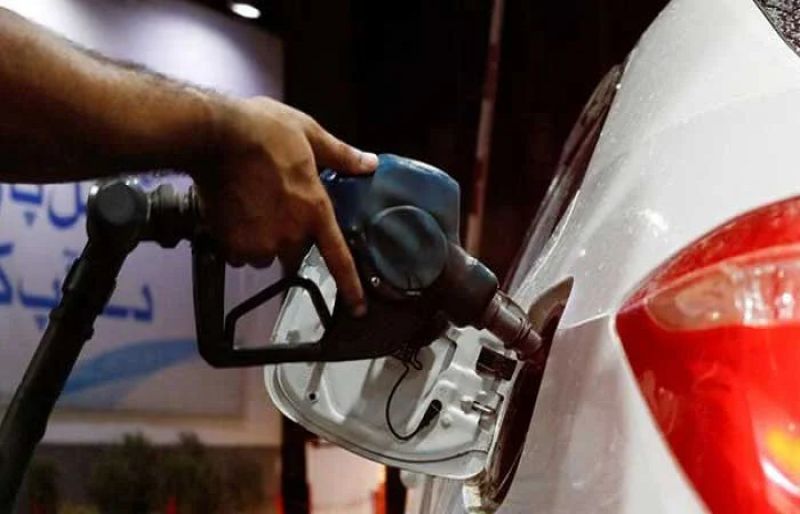
Petroleum product prices are expected to fall by up to Rs4.59 per litre from January 16 for the next fortnight. According to estimates prepared by the government and industry sources, petrol may drop by Rs4.59 per litre, high-speed diesel (HSD) by Rs2.70, kerosene by Rs1.82 and light diesel oil (LDO) by Rs2.08 per litre.
The anticipated reduction is attributed to fluctuations in the international oil market driven by geopolitical risks, supply concerns and changing demand dynamics.
Following the United States’ increased control over Venezuelan crude oil exports, global oil prices came under downward pressure.
However, persistent uncertainty has caused prices to oscillate in both directions.
Oil market forecasters have largely predicted that prices in 2026 will fall further than in 2025, when global benchmarks lost nearly 20% of their value.
Brent crude is forecast to average below $60 per barrel, while West Texas Intermediate (WTI) is expected to hover around $50 per barrel, with the possibility of falling even lower during the year.
Based on current projections, the revised prices are expected to stand at Rs248.58 per litre for petrol, Rs254.38 for HSD, Rs169.06 for kerosene and Rs144.10 per litre for LDO.
In the previous price review, the government slashed petrol and high-speed diesel prices by Rs10.28 and Rs8.57 per litre, respectively.
Arizona tightened its hold on the top spot in The Associated Press Top 25 men’s college basketball poll on Monday while Vanderbilt‘s unbeaten season has landed the Commodores in the top 10.
A week ago, Arizona led then-No. 2 Michigan by a single point for the top spot to barely avoid what would have been only the second-ever tie at No. 1 in the poll’s 78-year history. But with Wisconsin handing the Wolverines their first loss, the Wildcats (16-0) became the easy choice at the top by earning 60 of 61 first-place votes in the latest poll.
Iowa State got the other and moved up one spot to No. 2, followed by UConn. Michigan fell two spots to No. 4, followed by Purdue, Duke and Houston in their same positions from last week.
Nebraska spent a second straight week in the top 10 and continued its seasonlong climb by moving up two spots to No. 8, matching that program’s all-time highest ranking set in February 1966. Gonzaga was ninth, followed by the Commodores to round out the top 10. Vanderbilt has not been in the top 10 since the 2011-12 preseason poll.
Reigning national champion Florida returned to the poll at No. 19 to headline four new additions to the rankings. Clemson checked in at No. 22, followed by Utah State at No. 23 and No. 25 Seton Hall, which is ranked for the first time since January 2022.
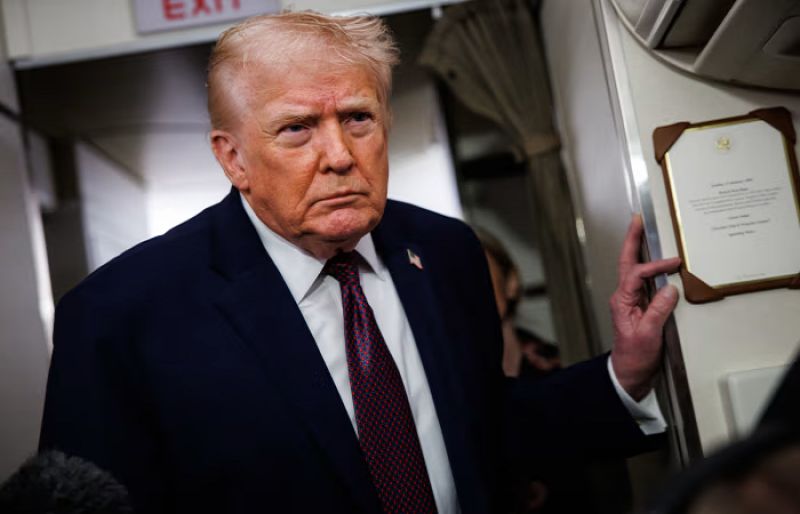
US President Donald Trump urged Iranians on Tuesday to keep protesting and said help was on the way, without giving details, as Iran’s government tackled the biggest demonstrations in years.
“Iranian Patriots, KEEP PROTESTING – TAKE OVER YOUR INSTITUTIONS!!!… HELP IS ON ITS WAY,” Trump said in a post on Truth Social, adding he had canceled all meetings with Iranian officials until the “senseless killing” of protesters stopped.
The unrest, sparked by dire economic conditions, has posed the biggest internal challenge to Iran’s rulers for at least three years and has come at a time of intensifying international pressure after Israeli and US strikes last year.
Tehran has accused the US president of encouraging political destabilisation, inciting violence, and threatening the country’s sovereignty, territorial integrity, and national security, Iran’s UN Ambassador Amir Saeid Iravani wrote to the UN Security Council.
“The United States and the Israeli regime bear direct and undeniable legal responsibility for the resulting loss of innocent civilian lives, particularly among the youth,” he wrote in the letter, which was also sent to UN Secretary-General Antonio Guterres.
He wrote the letter in response to a social media post by Trump earlier on Tuesday.
An Iranian official, speaking to Reuters, said that people he called terrorists were behind the deaths of both protesters and security personnel.
The official, who declined to be named, did not give a breakdown of who had been killed.
On Monday evening, Trump announced 25% import tariffs on products from any country doing business with Iran — a major oil exporter.
Trump has also said more military action is among options he is weighing to punish Iran over the crackdown, saying earlier this month “we are locked and loaded”.
Tehran has not yet responded publicly to Trump’s announcement of the tariffs, but it was swiftly criticised by China. Iran, already under heavy US sanctions, exports much of its oil to China, with Turkey, Iraq, the United Arab Emirates and India among its other top trading partners.
Russia condemns ‘subversive external interference’ Russia condemned what it described as “subversive external interference” in Iran’s internal politics, saying on Tuesday that US threats of new military strikes against the country were “categorically unacceptable.”
“Those who plan to use externally inspired unrest as a pretext for repeating the aggression against Iran committed in June 2025 must be aware of the disastrous consequences of such actions for the situation in the Middle East and global international security,” the Russian Foreign Ministry said in a statement.
Despite the protests, which come at a particularly vulnerable moment for authorities, given the scale of economic problems, and years of external pressure, there are as yet no signs of fracture in the security elite that could bring an end to the system in power since the 1979 Revolution.
However, underscoring the international uncertainty over what comes next in Iran, which has been one of the dominant powers across the Middle East for decades, German Chancellor Friedrich Merz said he believed the government would fall.
“I assume that we are now witnessing the final days and weeks of this regime,” he said, adding that if it had to maintain power through violence, “it is effectively at its end”.
He did not expand on whether this forecast was based on intelligence or other assessments.
Iranian Foreign Minister Abbas Araqchi dismissed Merz’s criticisms, accusing Berlin of double standards and saying he had “obliterated any shred of credibility”.
Melissa Gilbert speaks out after Timothy Busfield’s police surrender in abuse case
Melissa Gilbert has come out in support of her husband, Timothy Busfield, after two children accused him of sex abuse.
On Tuesday, the West Wing actor surrendered to law enforcement four days after a warrant was issued for his arrest. For those unversed, Timothy is accused of inappropriately touching 11-year-old twin boys on the set of the TV show, The Cleaning Lady, in 2022.
However, the 68-year-old actor denied the claims while speaking to TMZ on January 13.
Now, Melissa’s representative, Ame Van Iden, has released a statement on her behalf, saying she “stands with and supports him.”
“Melissa Gilbert is not making public statements at this time,” the statement began. “Any purported ‘statements’ circulating online — including AI-generated deepfakes of her ‘breaking her silence’ — should not be treated as coming from her.”
“She is honoring the request of Tim’s lawyers not to speak publicly while the legal process unfolds,” the statement continued.
“During this period, her focus is on supporting and caring for their very large family, as they navigate this moment. Melissa stands with and supports her husband and will address the public at an appropriate time. We ask that their privacy be respected,” added Melissa’s rep.
Finance minister says digital innovation will be pursued in line with regulation and national interest
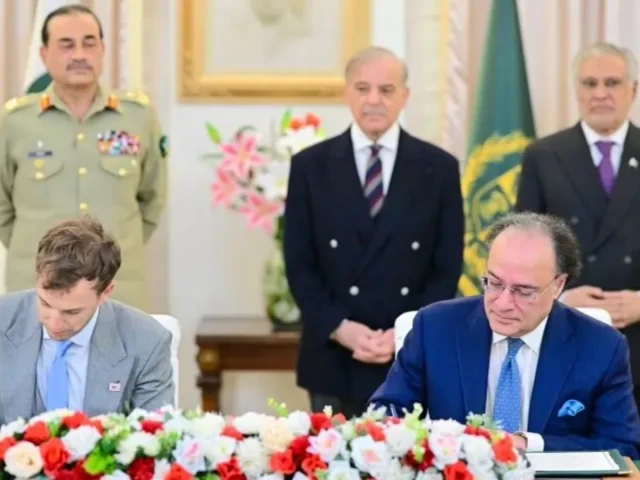
Finance Minister Muhammad Aurangzeb signs a memorandum of understanding with SC Financial Technologies on January 14. — Photo via X/@PakistanVARA
Pakistan has signed an agreement with a company affiliated with World Liberty Financial, the main crypto business linked to the family of US President Donald Trump, to explore the use of a dollar linked stablecoin for cross border payments, the government said on Wednesday.
The Pakistan Virtual Asset Regulatory Authority said it had signed a memorandum of understanding with SC Financial Technologies, which it described as an affiliated entity of World Liberty Financial. The agreement will allow dialogue and technical engagement around “emerging digital payment architectures”.
Today, World Liberty Financial signed an MoU with the Ministry of Finance to explore innovation in digital finance, particularly the use of stablecoins for cross-border transactions, signalling growing global interest in Pakistan as a key market for digital assets. pic.twitter.com/rYzbfHYysd
— Pakistan Virtual Assets Regulatory Authority (@PakistanVARA) January 14, 2026
The development marks one of the first publicly announced partnerships between World Liberty Financial, a crypto based finance platform launched in September 2024, and a sovereign state. It also comes amid warming ties between Pakistan and the United States.
Under the agreement, SC Financial Technologies will work with Pakistan’s central bank to explore integrating its USD1 stablecoin into a regulated digital payments framework, allowing it to operate alongside Pakistan’s own digital currency infrastructure, a source involved in the deal told Reuters.
The announcement coincided with a visit to Pakistan by Zach Witkoff, co founder and chief executive of World Liberty Financial and chief executive of SC Financial Technologies. Witkoff is the son of US special envoy Steve Witkoff.
According to the regulator, Witkoff met with senior Pakistani stakeholders to discuss digital payment infrastructure, cross border settlement and foreign exchange processes.
“Our focus is to stay ahead of the curve by engaging with credible global players, understanding new financial models, and ensuring that innovation, where explored, is aligned with regulation, stability, and national interest,” Finance Minister Muhammad Aurangzeb said.
SC Financial Technologies, registered in Delaware, co owns the USD1 stablecoin brand with World Liberty Financial, according to documentation on the token’s reserves from July 2025.
Stablecoins, which are digital tokens typically pegged to the US dollar, have expanded rapidly in recent years. Under President Trump, the United States has introduced federal rules widely viewed as favourable to the crypto sector, while countries globally are assessing the role of stablecoins in payment systems.
Pakistan has been exploring digital currency initiatives as it seeks to reduce cash usage and improve cross border payments, including remittances, a key source of foreign exchange. The central bank governor said in July that Pakistan was preparing to launch a pilot for a digital currency and finalising legislation to regulate virtual assets.
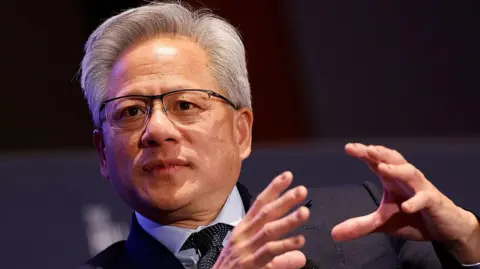
The US government has given chip giant Nvidia the green light to sell its advanced artificial intelligence (AI) processors in China, the Department of Commerce said on Tuesday.
The H200, Nvidia’s second-most-advanced semiconductor, had been restricted by Washington over concerns that it would give China’s technology industry and military an edge over the US.
The Commerce Department said the chips can be shipped to China granted that there is sufficient supply of the processors in the US.
President Donald Trump said last month that he would allow the chip sales to “approved customers” in China and collect a 25% fee.
Nvidia’s spokesperson told the BBC that the company welcomed the move, saying it will benefit manufacturing and jobs in the US.
The Commerce Department’s Bureau of Industry and Security said its revised export policy applies to Nvidia’s H200 chips, as well as less advanced processors. Chinese customers must also show “sufficient security procedures” and cannot use the chips for military uses.
The H200 chip is a generation behind Nvidia’s Blackwell processor, which is considered to be the world’s most advanced AI semiconductor and remains blocked from sale in China.
Chinese embassy spokesman Liu Pengyu told the BBC on Wednesday that Beijing has consistently opposed the “politicisation and weaponisation of tech and trade issues”.
“We oppose blocking and restricting China, which disrupts the stability of industrial and supply chains,” he said. “This approach does not serve the common interests of both sides.”
Nvidia has been caught in a geopolitical tug-of-war between the US and China – two sides of a global AI race.
Trump reversed the chip-selling restriction last July, but demanded that Nvidia pay a cut of its earnings from China to the US government.
Beijing then reportedly ordered its tech companies to boycott Nvidia’s China-bound chips and prioritise semiconductors made domestically. That move was designed to bolster China’s tech industry, though experts have consistently said that the country’s chips still lag behind the US.
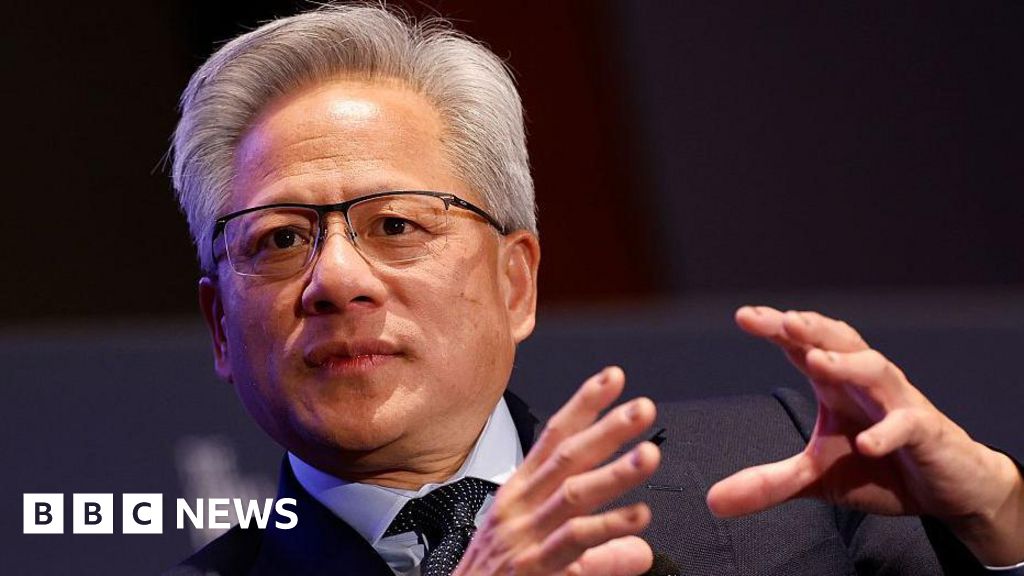
Throughout 2025, Nvidia CEO Jensen Huang continually lobbied Washington to allow the sale of the firm’s high-powered chips to China, arguing that global market excess is essential for America’s competitiveness.
Some officials in the US, however, have expressed concerns that the chips would benefit Beijing’s military and hurt America’s progress in AI development.
While Beijing is likely concerned about domestic firms becoming over-reliant on Nvidia, local firms will be eager to secure H200 chips – at least until homegrown alternatives get better, said semiconductor analyst Austin Lyons.
Nvidia will also be happy to get any revenue from China, even if it comes at a lower margin due to the US government taking a cut of the sales, Lyons added.
Trump’s “unique” proposal to collect a cut of Nvidia’s sales could also set a precedent for his negotiations in other trade tariffs, said Marc Einstein from Counterpoint Research.
“It will be interesting to see if this tariff model expands to other sectors.”
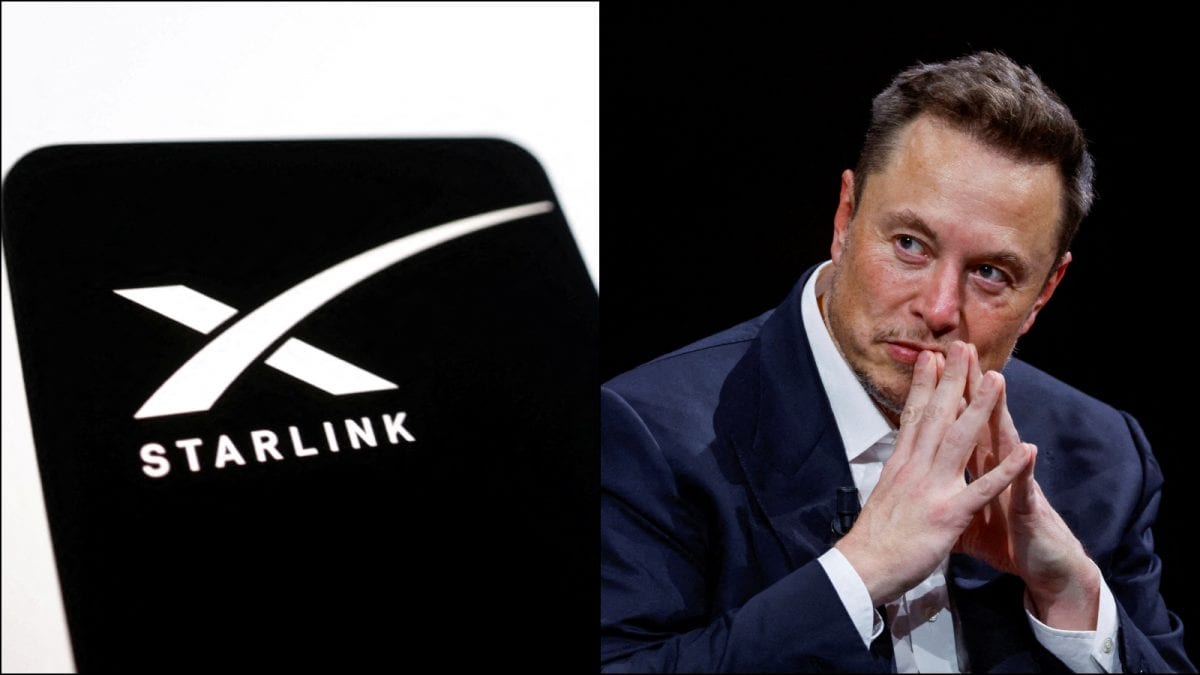
Elon Musk’s Starlink offers free satellite internet in Iran amid regime crackdown on protests, with support from Donald Trump, helping bypass digital blackouts.
Starlink is reportedly offering free internet service to users in Iran.
Elon Musk’s Starlink is offering free internet service through satellite to users in Iran, overcoming the State-led restrictions and crackdown on the flow of information due to anti-government protests, according to a report of CNN.
Citing a tech expert, CNN reported that Starlink has restored the earlier inactive connections and waived off their subscription fees amid the brutal crackdown by the regime.
Earlier, US President Donald Trump and Elon Musk had a phone call discussing allowing access of Internet in Iran.
Iran’s regime is facing one of the biggest protests, in which over 1800 people have been reportedly killed. Authorities have attempted to crack down on protestors by cutting off internet access, which is termed as one of the regime’s largest ever digital blackouts.
CNN reported that Starklink’s attempt to provide internet access is paltry, as it will help only a small percentage of Iran’s 92 million population get online and the possibility of jamming Starlink by the regime.
Starlink offers internet service to users through its chains of satellites orbiting the Earth. The technology is known to provide internet access even in the harsh and remote parts of the world, including higher mountains, secluded islands, and dense jungles.
US President Donald Trump issued a sharp public message backing protests in Iran, cancelling all meetings with Iranian officials and warning that those responsible for violence against demonstrators would “pay a big price.” In a post on his social media platform Truth Social, Donald Trump urged Iranians to continue protesting and to document alleged abuses by authorities, ahead of a meeting with his national security team to discuss options in Iran.
“Iranian Patriots, KEEP PROTESTING – TAKE OVER YOUR INSTITUTIONS!!! Save the names of the killers and abusers. They will pay a big price,” he wrote.
Newsbusiness Elon Musk’s Starlink Offers Free Satellite Internet In Iran Amid Protest Crackdown: Report
Disclaimer: Comments reflect users’ views, not News18’s. Please keep discussions respectful and constructive. Abusive, defamatory, or illegal comments will be removed. News18 may disable any comment at its discretion. By posting, you agree to our Terms of Use and Privacy Policy.
Celebrate Pongal and Makar Sankranti with traditional South Indian recipes like sweet pongal, ven pongal, ellu sadham, adhirasam, and kootu, curated by a professional chef.
Celebrate this Pongal with love, gratitude, and happiness, making every moment a memory to cherish forever. (Image: AI-generated)
As harvest festivals go, Pongal and Makar Sankranti are deeply rooted in gratitude towards the sun, the land, and the rhythms of nature that sustain us. Food lies at the heart of these celebrations, with dishes that are nourishing, symbolic, and steeped in tradition. From the sweetness of jaggery and rice to the warmth of ghee, pepper, and lentils, each recipe reflects abundance, balance, and seasonal wisdom.
These festive preparations are as much about technique as they are about emotion. “Pongal dishes are meant to be simple yet soulful,” explains Owaize Ahmed Khan. “They rely on humble ingredients, slow cooking, and careful tempering to bring out depth of flavour without excess.” Whether sweet or savoury, each dish celebrates rice, lentils, coconut, and sesame, ingredients that nourish the body while honouring tradition. Here are classic recipes, streamlined for the modern kitchen, yet faithful to their roots.
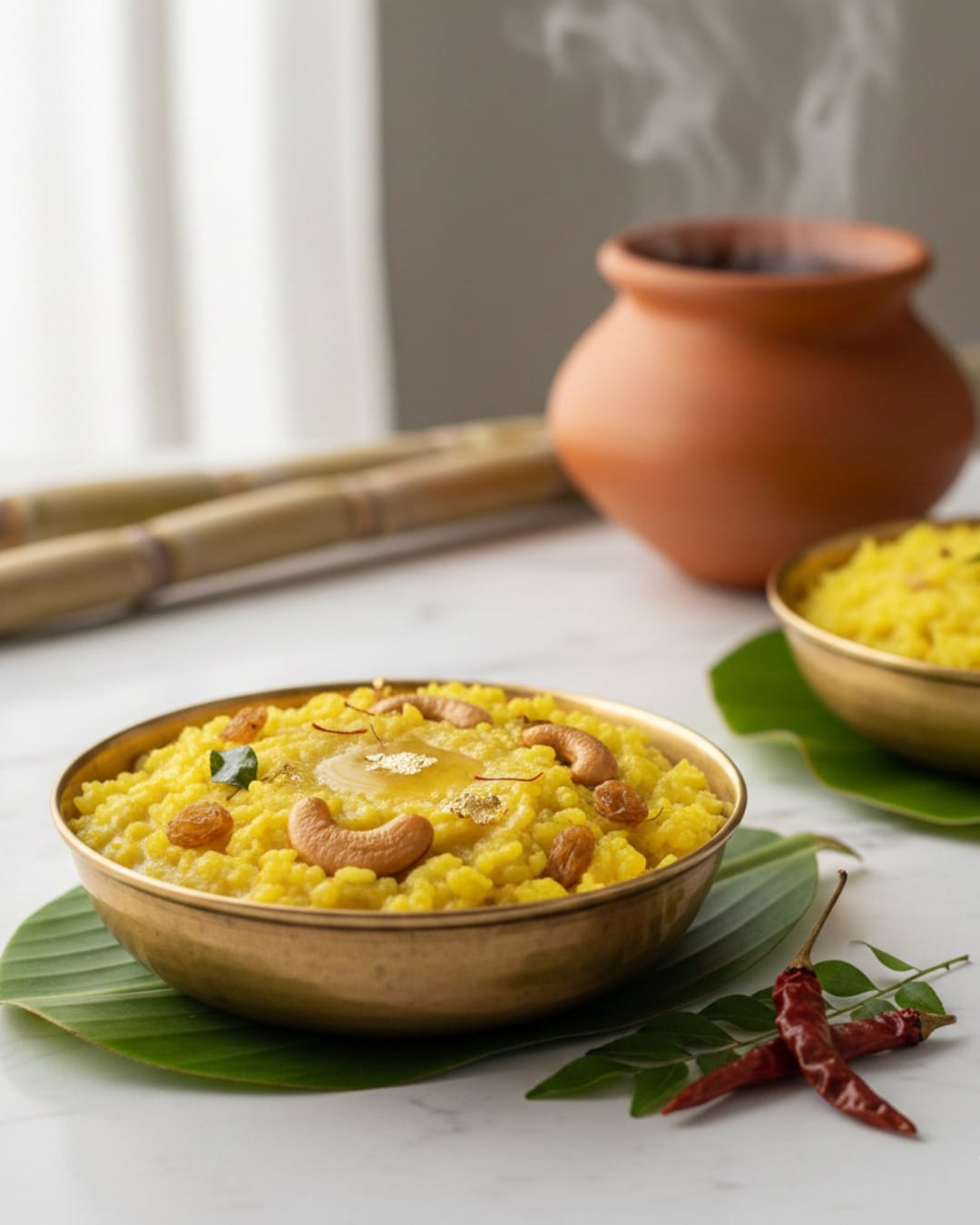
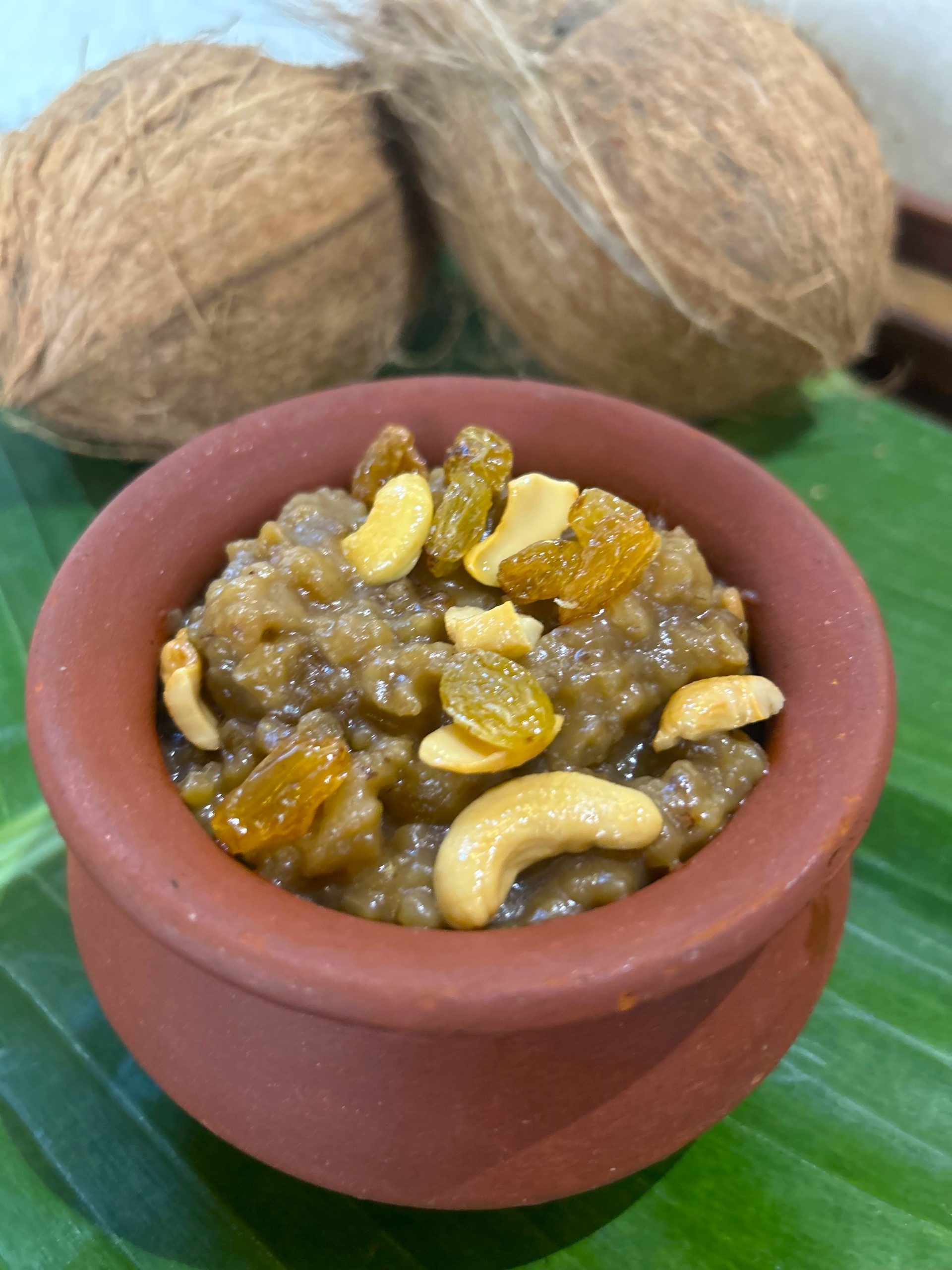
Sweet Pongal (Sakkarai Pongal) recipe by Owaize Ahmed Khan, Executive Chef, Novotel Bengaluru Outer Ring Road
Ingredients
Raw rice – ½ cup
Moong dal – ¼ cup
Jaggery – ¾ to 1 cup (grated)
Water – 3½ to 4 cups
Ghee – 3 tbsp
Cashew nuts – 10–12
Raisins – 1 tbsp
Cardamom powder – ½ tsp
Dry ginger powder – ¼ tsp (optional)
Method
Roast the moong dal lightly and wash it along with the rice. Pressure cook both until soft and mushy. Melt jaggery with a little water, strain, and simmer briefly. Add the cooked rice-dal mixture and mix well. Stir in cardamom and ginger powder. Fry cashews and raisins in ghee, add to the pongal, and simmer until glossy. Serve hot.
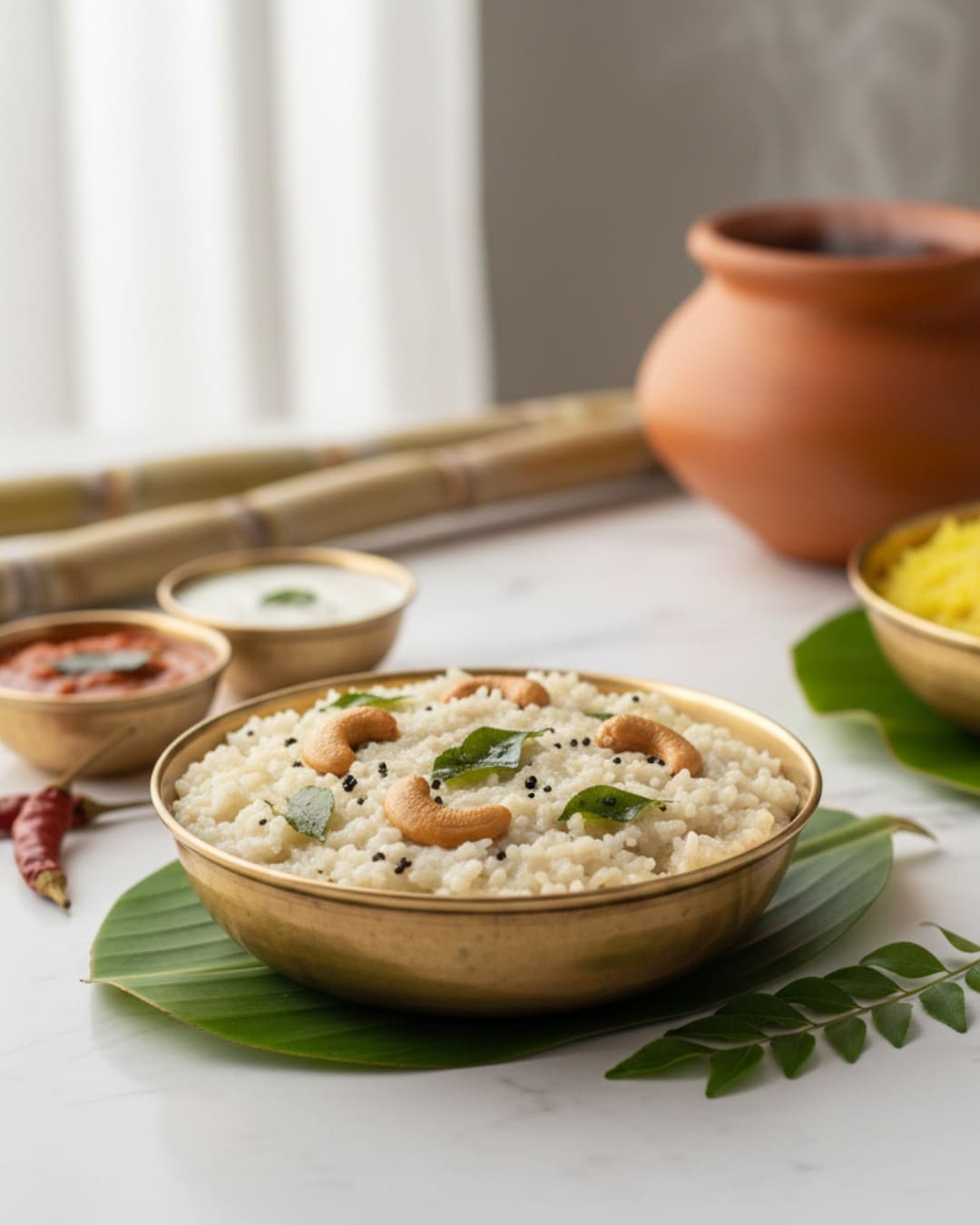
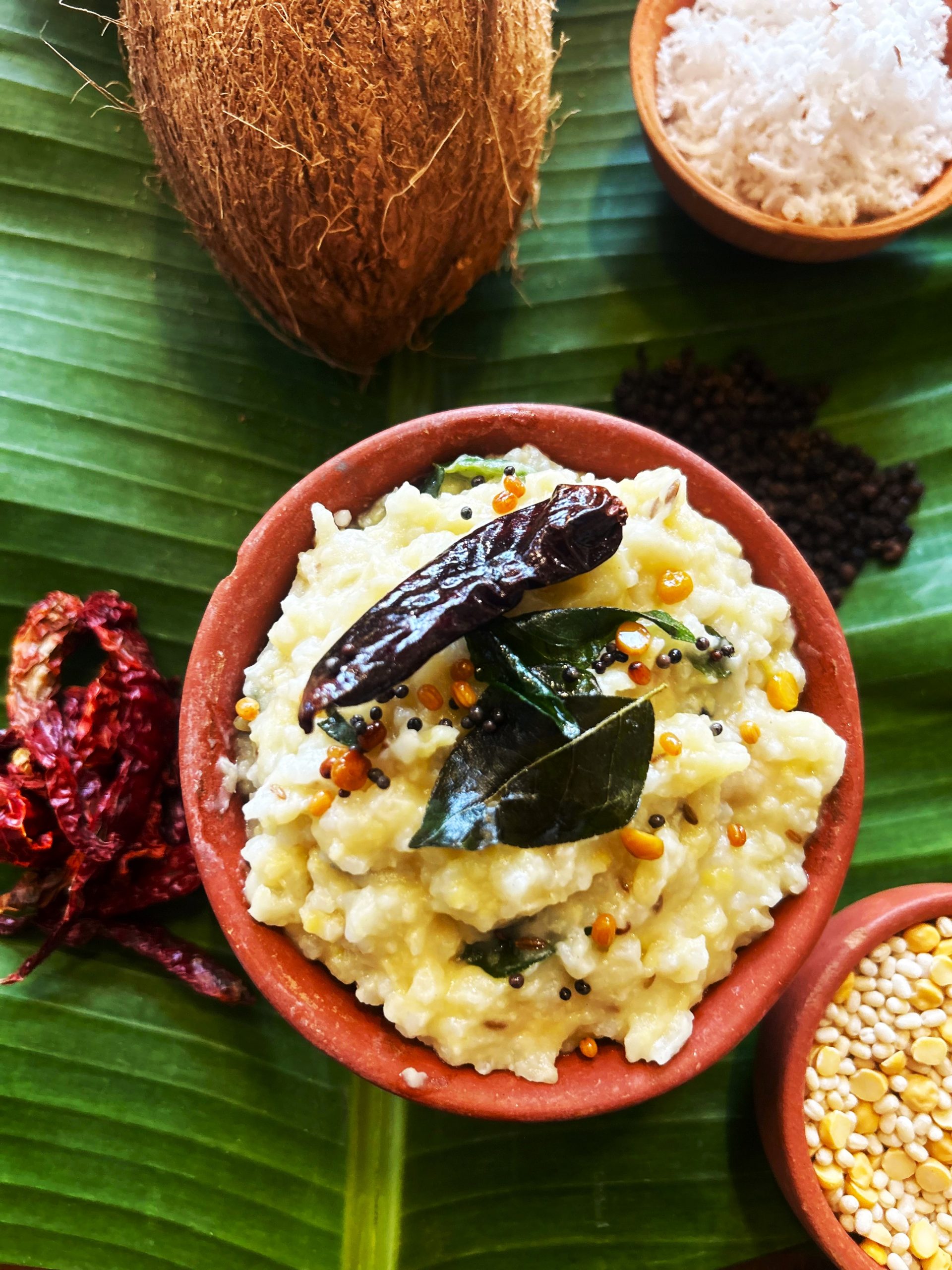
Ven Pongal (Khara Pongal) recipe by Owaize Ahmed Khan, Executive Chef, Novotel Bengaluru Outer Ring Road
Ingredients
Raw rice – 1 cup
Moong dal – ½ cup
Water – 4–5 cups
Ghee – 3 tbsp
Black pepper – 1½ tsp (crushed)
Cumin seeds – 1½ tsp
Ginger – 1 tbsp (chopped)
Green chillies – 2 (slit)
Curry leaves – 10–12
Cashew nuts – 10
Method
Dry roast the moong dal lightly. Cook rice and dal together until soft and mushy. Heat ghee, fry cashews until golden, and set aside. In the same ghee, add pepper, cumin, ginger, green chillies, and curry leaves. Mix this tempering into the pongal, garnish with cashews, and serve hot.
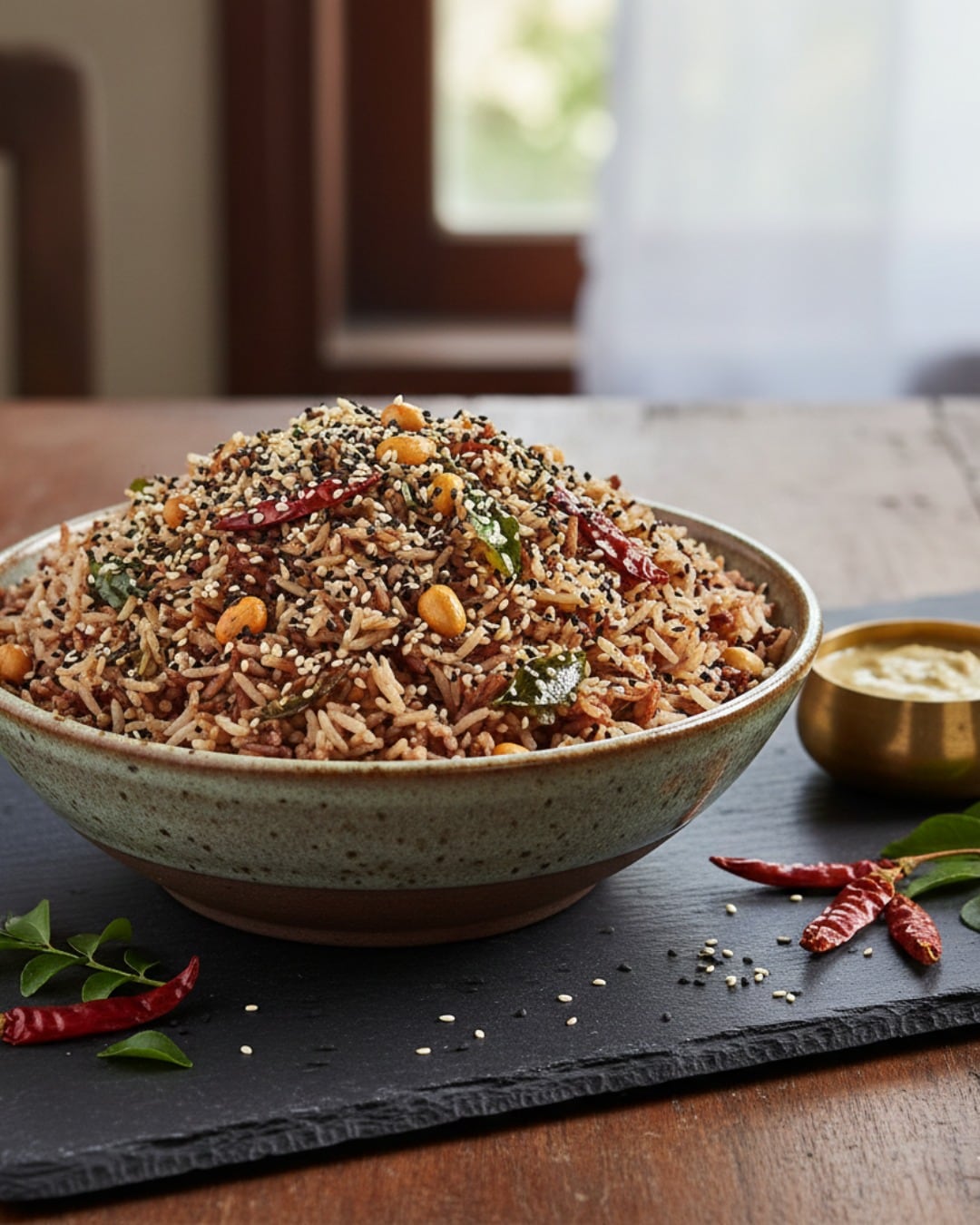
Ellu Sadham (Sesame Rice) recipe by Owaize Ahmed Khan, Executive Chef, Novotel Bengaluru Outer Ring Road
Ingredients
Cooked rice – 3 cups
Black sesame seeds – 3 tbsp
Dry red chillies – 4–5
Urad dal – 1 tbsp
Chana dal – 1 tbsp
Tamarind pulp – 1 tbsp
Gingelly oil – 3 tbsp
Salt – to taste
Method
Dry roast sesame seeds and grind coarsely. Heat gingelly oil, add mustard seeds, urad dal, chana dal, and red chillies. Stir in tamarind pulp, salt, and sesame powder. Add cooked rice, mix gently, and serve warm.
Adhirasam
Ingredients
Raw rice – 1 cup
Jaggery – 1 cup
Water – ¼ cup
Cardamom powder – ½ tsp
Dry ginger powder – ¼ tsp
Sesame seeds – 1 tbsp
Oil – for frying
Method
Soak rice, drain, and dry slightly before grinding into a fine flour. Melt jaggery with water, strain, and boil to soft-ball consistency. Add flour, spices, and sesame seeds to form a dough. Rest overnight. Shape into discs and deep fry on medium heat until golden.
Traditional South Indian Kootu recipe by Owaize Ahmed Khan, Executive Chef, Novotel Bengaluru Outer Ring Road
Cook vegetables with turmeric, salt, and little water until tender. Add cooked dal and mix. Grind coconut, green chillies, and cumin into a coarse paste and stir into the mixture. Simmer for 5 minutes. Prepare tempering and pour over the kootu. Mix gently and serve hot with rice.
Chef’s Tips:
Kootu should be semi-thick
Avoid boiling after adding coconut paste
A pinch of asafoetida aids digestion
Jaffna Pukkai Pongal by Sunil Kumar Panduranga Raj, Executive Sous Chef, Sheraton Grand Bangalore Hotel at Brigade Gateway
Ingredients
Red rice – 350 g
Yellow moong dal – 150 g
Jaggery (grated) – 150 g
Milk – 5 litres
Ghee – 100 g
Cashew nuts – 20 nos
Raisins – 20 nos
Cardamom powder – 2 g
Pandan leaf – 1
Water – 4 tbsp (for jaggery)
Method
Wash the red rice and moong dal. Soak the rice for 4 hours, then drain.
Transfer rice and dal to a pressure cooker. Add milk, ghee, and pandan leaf.
Pressure cook for 4 whistles. Allow pressure to release naturally.
In a pan, melt the jaggery with 4 tbsp water to form a syrup. Strain if needed.
Heat ghee in another pan and roast cashews and raisins until golden.
Add the jaggery syrup and cardamom powder to the cooked rice mixture and mix well.
Finish by adding roasted cashews and raisins.
Serve hot.
Chettinadu Millet Pongal with Long Pepper by Sunil Kumar Panduranga Raj, Executive Sous Chef, Sheraton Grand Bangalore Hotel at Brigade Gateway
Ingredients
Foxtail millet – 350 g
Moong dal – 150 g
Whole long pepper (coarsely crushed) – 2–3 pcs
Black pepper – 5 g
Cumin seeds – 10 g
Ginger (julienned or grated) – 10 g
Curry leaves – a few sprigs
Ghee – 100 g
Water – 1.5 litres
Salt – to taste
Method
Wash foxtail millet and moong dal together.
Cook with water and salt until soft and porridge-like in consistency.
Heat ghee in a small pan. Add cumin seeds and let them splutter.
Add ginger, curry leaves, crushed long pepper, and black pepper. Sauté until aromatic.
Pour the tempering over the cooked millet-dal mixture and mix well.
Adjust consistency with water if required and simmer for 2–3 minutes.
Serve hot, finished with a drizzle of ghee.
These dishes together form a complete festive spread balanced, comforting, and deeply symbolic, perfect for celebrating the spirit of Pongal and Makar Sankranti.
First Published:
January 13, 2026, 17:24 IST
Newslifestylefood Pongal And Makar Sankranti: Traditional South Indian Recipes To Celebrate The Harvest
Disclaimer: Comments reflect users’ views, not News18’s. Please keep discussions respectful and constructive. Abusive, defamatory, or illegal comments will be removed. News18 may disable any comment at its discretion. By posting, you agree to our Terms of Use and Privacy Policy.
The California fires of January 2025 were one of the most expensive weather-related disasters in US history
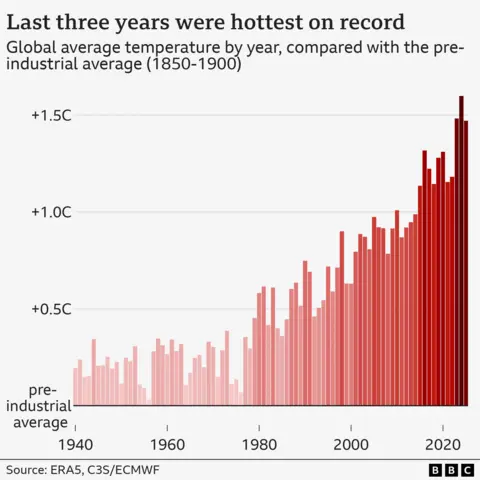
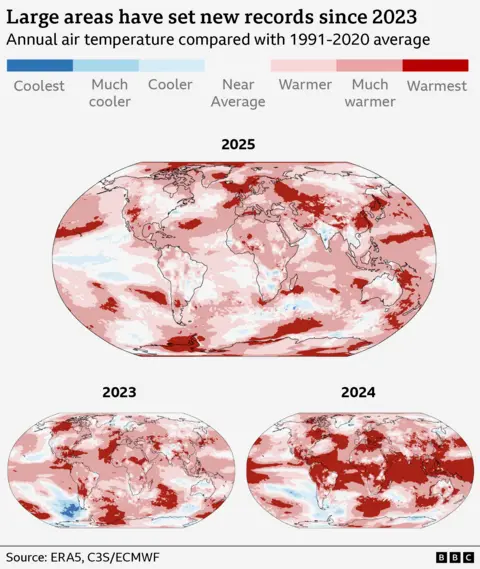
Global temperatures in 2025 did not quite reach the heights of 2024, thanks to the cooling influence of the natural La Niña weather pattern in the Pacific, new data from the European Copernicus climate service and the Met Office shows.
But the last three years were the world’s warmest ever recorded, bringing the planet closer to breaching international climate targets.
Despite natural cooling from La Niña, 2025 was still much warmer than temperatures even a decade ago, as humanity’s carbon emissions continue to heat the planet.
That will inevitably lead to further temperature records – and worsening weather extremes – unless emissions are sharply reduced, scientists warn.
“If we go twenty years into the future and we look back at this period of the mid-2020s, we will see these years as relatively cool,” said Dr Samantha Burgess, deputy director of Copernicus.
The global average temperature in 2025 was more than 1.4C above “pre-industrial” levels of the late 1800s – before humanity started burning large amounts of fossil fuels – according to Copernicus and Met Office data.
The precise figures vary slightly between major climate groups, owing mainly to small differences in how the pre-industrial temperature is calculated. But there is no debate about the world’s long-term warming trend.
“We understand very well that if we continue to pump greenhouse gases into the atmosphere, the concentrations of those gases increase in the atmosphere, and the planet responds by warming,” explained Prof Rowan Sutton, director of the Met Office Hadley Centre.
Last year might not have been the hottest on record worldwide but extreme weather events linked to global warming continued.
Global warming means that hurricanes like Melissa – which brought mass flooding to Haiti as well as devastation elsewhere in the Caribbean – can bring stronger winds and heavier rainfall
That was agreed by nearly 200 countries in 2015, with the aim of avoiding some of the much more severe consequences of climate change that 2C of warming would bring.
“Looking at the most recent data, it looks like we’ll exceed that 1.5 degree level of long-term warming by the end of this decade,” said Burgess.
While long-term warming is the result of human activities, individual years can be slightly warmer or cooler because of natural variability.
One such variable is the switch between the weather patterns El Niño and La Niña.
They primarily affect weather in the Pacific but have a knock-on effect on temperatures worldwide. El Niño years tend to be warmer as a global average, while La Niña years are typically cooler.
The return of La Niña conditions is thought to have suppressed warmth in 2025. But the fact that temperatures have remained so high in a La Niña year “is a little worrying”, according to Dr Zeke Hausfather, a climate scientist at Berkeley Earth in the US.
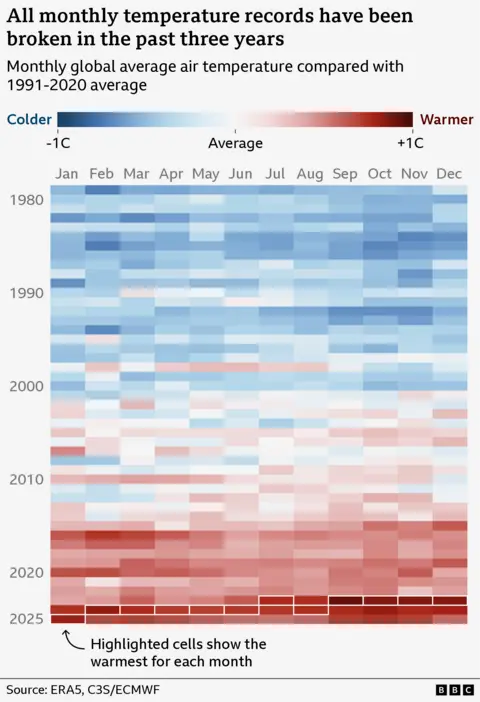
The last three years have seen global temperature records broken by significant margins. As the chart below shows, records for each month of the year have been set since 2023, according to Copernicus data.
“We are seeing rapid warming at the upper end of our longer-term expectations,” agreed Sutton.
But whether the last three years have significiant implications for the longer term “is not yet clear”, he added, with more data needed before making firm conclusions.
While scientists expect more records to be broken in the years ahead, they emphasise that the future impacts of climate change are not set in stone.
“We can strongly affect what happens,” said Sutton, “both by mitigating climate change – that’s by cutting greenhouse gas emissions to stabilise warming – and of course also by adapting, by making society more resilient to ongoing changes.”