
NEW DELHI: Centre on Sunday announced the Padma Awards for 2026 on the eve of Republic Day, conferring the Padma Bhushan on veteran banker and industrialist Uday Kotak for his exceptional contribution to the financial sector, a government statement said.The Padma Awards, among India’s most prestigious civilian honours, are given in three categories—Padma Vibhushan, Padma Bhushan and Padma Shri.On Republic Day eve, the government announced 131 Padma awards for 2026, including five Padma Vibhushan, 13 Padma Bhushan and 113 Padma Shri awards. The total includes two cases in which the award for two individuals is counted as one, the statement said.The awardees span a wide range of fields, including public life, arts, cinema, literature, sports, science and social service.Padma Vibhushan awardeesFormer Kerala chief minister and veteran communist leader V S Achuthanandan and actor Dharmendra have been awarded the Padma Vibhushan, posthumously, for 2026, the government said.Former Supreme Court judge K T Thomas (public affairs), Hindustani classical musician and violinist N Rajam (art), and eminent Malayalam journalist P Narayanan (literature and education) have also been named Padma Vibhushan awardees.Padma Bhushan recipientsAmong those awarded the Padma Bhushan are playback singer Alka Yagnik, former Uttarakhand chief minister Bhagat Singh Koshyari, and actor Mammootty, the Home Ministry said.Advertising veteran Piyush Pandey, Jharkhand Mukti Morcha founder Shibu Soren, BJP leader V K Malhotra, and tennis legend Vijay Amritraj have also been conferred the Padma Bhushan.Padma Shri awardeesActor and comedian Satish Shah has been awarded the Padma Shri, posthumously, the ministry said. Cricketer Rohit Sharma, India women’s cricket captain Harmanpreet Kaur, and hockey player Savita Punia are among those named Padma Shri awardees.Former Jawaharlal Nehru University vice-chancellor M Jagadesh Kumar, former Prasar Bharati CEO Shashi Shekhar Vempati, and actors R Madhavan and Prosenjit Chatterjee have also been awarded the Padma Shri.The list includes 90 women awardees, six persons from the categories of foreigners, NRIs, PIOs and OCIs, and 16 posthumous awards, the statement added.
After second Minneapolis shooting, Congress hurtles toward a partial government shutdown over DHS funding

Senate Minority Leader Chuck Schumer, D-N.Y., speaks during the Senate Democrats’ news conference in the U.S. Capitol on the deadline for the release of the Epstein files on Tuesday, Dec. 16, 2025.
Bill Clark | CQ-Roll Call, Inc. | Getty Images
The U.S. government is nearing the brink of a partial shutdown by the end of the week after federal immigration agents shot and killed a U.S. citizen in Minnesota on Saturday, the second such incident this month.
The Senate is set to vote this week on a massive House-passed $1.2 trillion package to fund the Department of Homeland Security, along with a wide swath of government, before the Jan. 30 deadline. But the shooting of 37-year-old ICU nurse Alex Pretti in Minneapolis is now threatening to derail the funding package as a growing chorus of Democrats warn they will oppose it unless funding for the Department of Homeland Security is stripped out.
“Democrats sought common sense reforms in the Department of Homeland Security spending bill, but because of Republicans’ refusal to stand up to President Trump, the DHS bill is woefully inadequate to rein in the abuses of ICE. I will vote no,” said Senate Minority Leader Chuck Schumer, D-N.Y., in a statement on Saturday night.
“Senate Democrats will not provide the votes to proceed to the appropriations bill if the DHS funding bill is included,” he said.
The funding package needs 60 votes to overcome the filibuster and pass the Senate. Republicans hold a 53-47 vote majority in the Senate, meaning Democratic support will be needed to pass the measure. Of the 47, two are independents who caucus with Democrats.
Some Democrats were already opposed to the funding measure, which, in addition to DHS, includes the departments of Defense; Health and Human Services; Labor; Housing and Urban Development; Transportation; Education; State and Treasury.
But Pretti’s death is rapidly galvanizing Democratic opposition to the measure.
“Federal agents cannot murder people in broad daylight and face zero consequences,” said Senate Appropriations ranking member Patty Murray, D-Wash., on X Saturday. “I will NOT support the DHS bill as it stands. The DHS bill needs to be split off from the larger funding package before the Senate—Republicans must work with us to do that.”
It’s unclear if the Senate can split the DHS portion off from the rest of the funding bill to minimize a partial shutdown. While the House passed the DHS bill separately from the rest of the bills, they were all tied together into one bill to be sent to the Senate, meaning the majority Republicans would need to support splitting the bill up.
The House, which left Washington last week for a pre-scheduled recess, would likely need to return to approve any changes the Senate makes.
Complicating matters further is a massive snowstorm over Washington, D.C., and wide stretches of the U.S. The Senate canceled votes on Monday due to the storm, shortening an already tight timeline to avoid a shutdown.
This story is developing. Please check back for updates.

PCB announces player auction date for PSL 11

The Pakistan Cricket Board (PCB) on Sunday announced the date for the players’ auction for the 11th edition of the Pakistan Super League (PSL), following consultations with all participants during a comprehensive workshop held at Gaddafi Stadium.
The session was chaired by PCB chairman Mohsin Naqvi and PSL CEO Salman Naseer and attended by all eight franchise representatives, PSL officials, members of Pakistan’s T20 World Cup squad, PCB officials, and other capped players.
Top performers from previous PSL editions, including leading run-scorers Babar Azam and Fakhar Zaman and leading wicket-takers Hasan Ali and Shaheen Shah Afridi, were also present.
During the workshop, the PSL management presented a detailed overview of the retention and auction process, engaging all participants in consultation.
It was confirmed that the PSL 11 Player Auction will take place on Wednesday, 11 February.
During the workshop, PCB also revealed the base prices for players for the upcoming auction, along with the minimum incremental bids in PKR.
The base prices have been set at Rs42 million, Rs22 million, Rs11 million, and Rs6000,000, giving franchises a clear framework for player valuations.
The minimum bid increments were also announced, with Rs250,000 applicable for bids under Rs11 million, Rs500,000 for bids under Rs22 million, Rs1,000,000 for bids under Rs42 million, and Rs1,500,000 for bids above Rs42 million.
Franchises may bid higher than the minimum increments. Each squad will include 16 to 20 players, with five to seven foreign players depending on squad size, and must field three to four foreign players in the playing XI.
A minimum of two uncapped Under-23 players must be in the squad, with one in the playing XI.
Players retained or picked in PSL 11 will sign two-year contracts with their franchises.
Franchises can retain a maximum of seven players for PSL 12, followed by a grand auction where a maximum of five players can be retained. Released players will return to the auction pool.
Franchises may also directly sign one foreign player who did not participate in PSL 10. The team purse of Rs450 million may be extended to Rs505 million to accommodate these signings, with PCB support for elite foreign players.
In the session, chairman Naqvi highlighted the importance of collaborative planning in shaping the future of PSL.
He said that the consultative session brought together franchises, players, and management, fostering an environment for strategic decision-making aimed at strengthening the league.
“Today’s consultative session brought together franchises, players, and management to make strategic decisions that will shape a bright future for the PSL. The Player Auction model offers players better financial opportunities and makes the league more competitive and transparent,” Naqvi said.
Salman Naseer, CEO of PSL, underlined the transformative impact of the auction system on the league’s operations.
He described the current phase as a “new era” for the PSL, explaining that the auction modernises player recruitment, encourages fairness, and boosts the league’s overall appeal to players, franchises, and fans alike.
“The PSL’s new era is here. The auction system modernises recruitment, promotes fairness, and enhances the league’s appeal for players, franchises, and fans. The feedback from today’s workshop will guide a successful auction next month, with more excitement to come,” Naseer said.
The invisible skin struggle women face as they transition into mid-life

NEWYou can now listen to Fox News articles!
Menopause might be best known for hot flashes and mood swings, but it can also come with many other less talked-about symptoms, including skin changes.
Studies have shown that a majority of women report skin problems as they age — in particular, one they might not have experienced since their teen years.
Dr. Amy Wechsler, a dual board-certified dermatologist and psychiatrist in Manhattan, specializes in treating perimenopausal and menopausal women who are battling acne — sometimes for the first time in their lives.
FDA MOVES TO LIFT ‘BLACK BOX’ WARNINGS FROM HORMONE THERAPIES FOR MENOPAUSE SYMPTOMS
“And for them, it’s just horrible because they’ve never had it — it’s so foreign to them,” she told Fox News Digital. “There’s so much psychological overlap and effects of acne on people in terms of lowering self-esteem and self-confidence, and causing anxiety and sometimes depression.”
The mid-life paradox
For most women, there are two “peaks of acne” — one during adolescence and another at perimenopause and menopause, according to the doctor.
Studies have shown that a majority of women report skin problems as they age. (iStock)
“So there are many women who have been clear of acne for 20 years, and then, starting at around 40-ish, they start to break out again,” she said. “And this time it’s centered around their lower face, chin and jawline, which is where hormonal acne tends to occur.”
“Women often come to see me, age 35 to 55, complaining about wrinkles and pimples, and they feel too young for their wrinkles and too old for their pimples,” she said.
EATING A COMMON VITAMIN-C PACKED FRUIT MIGHT TOTALLY TRANSFORM SKIN, STUDY FINDS
While men who have a genetic predisposition for acne may continue to break out into older adulthood, for women, “there’s a particular hormonal component from the late 30s through the early 50s, around perimenopause and menopause.”
The breakouts usually stop when menopause is finished, Wechsler said.

For most women, there are two “peaks of acne” — one during adolescence and another at perimenopause and menopause. (iStock)
Some studies have suggested that taking GLP-1 weight loss and diabetes medications could increase acne prevalence, but others have not identified a link.
“I see patients all day long who are taking GLP-1s, so I would imagine if there were a link, I probably would have picked up on something by now,” Wechsler said.
Treatments for adult acne
The main remedy for aging-related acne is to take hormone-related medications.
“Spironolactone is specifically for hormonal acne in women,” Wechsler said. “It blocks testosterone from binding to the testosterone receptors in the lower face.”
Going on hormone replacement therapy or a birth control pill can also help with acne, she noted, but treatments will vary based on each person’s situation.
CLICK HERE FOR MORE HEALTH STORIES
“Some people come in with just small blackheads and whiteheads, and they might not need something oral,” she said.
“That’s when we might prescribe something topical, often a retinoid with the brand names of Differin, Retin-A or Tretinoin. Those are often very helpful for the smaller pimples. Also they’re anti-aging, which is nice. They grow collagen.”
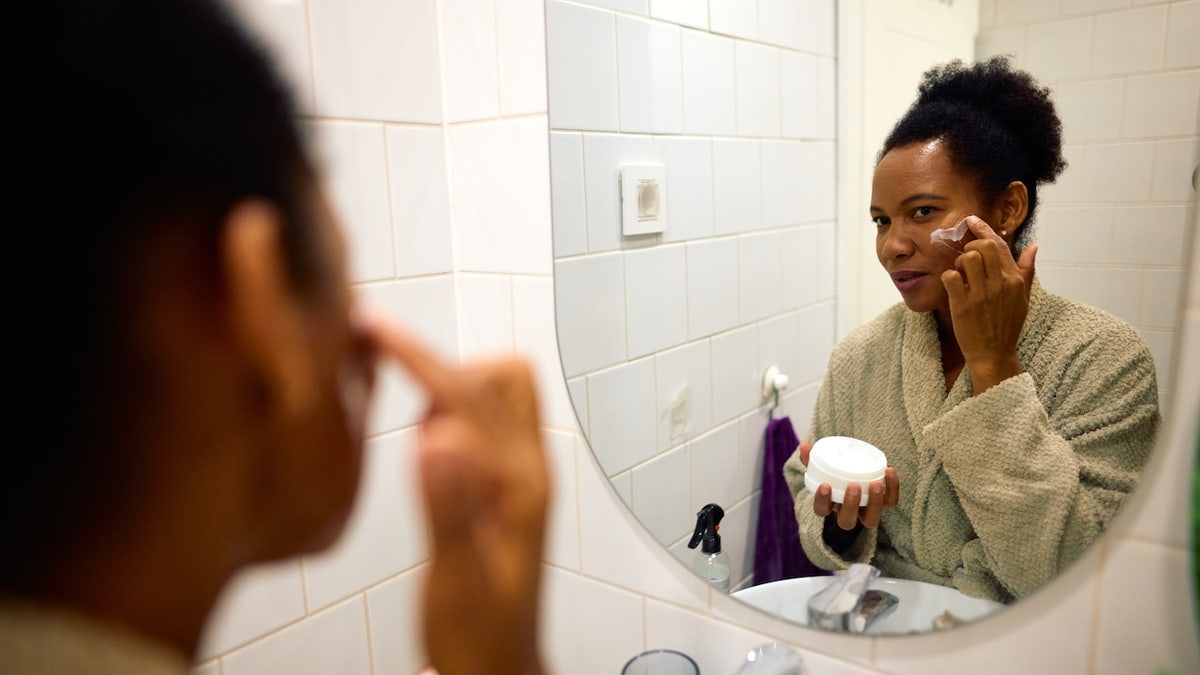
The main remedy for aging-related acne is to take hormone-related medications, a doctor said. (iStock)
Wechsler said she sometimes prescribes a low dose of doxycycline, an antibiotic that also works as an anti-inflammatory.
“If the acne is different or covering more of the face or the upper face, sometimes we’ll try a low dose of Accutane,” she added. “It really depends on the individual and how bad the acne is.”
Proactive defense
While genetics and hormones can contribute to acne, stress can also affect the skin, the doctor said. One of the best ways to address this is to get optimal sleep, which is the “anti-inflammatory” time when the body heals.
CLICK HERE TO SIGN UP FOR OUR HEALTH NEWSLETTER
“Unfortunately, many Americans don’t get enough sleep,” Wechsler said. “Adults need seven-and-a-half to eight hours. That’s when the stress molecule, cortisol, is at its lowest, and when all the healing molecules, like beta-endorphins and growth hormones and oxytocin, are at their highest.”
CLICK HERE TO DOWNLOAD THE FOX NEWS APP
In addition to sleep, the doctor recommends looking for ways to lower cortisol levels during the day to help reduce stress levels, such as exercising, getting fresh air, connecting with friends, stretching or deep breathing.

One way to prevent skin issues is to get optimal sleep, which is the “anti-inflammatory” time when the body heals, an expert advised. (iStock)
For people who are acne-prone, Wechsler also emphasized the importance of choosing the right skincare products.
“It’s really important that all products are non-comedogenic, or oil-free,” she recommended. “That means the company has tested the product and that it will not clog your pores and cause pimples.”
TEST YOURSELF WITH OUR LATEST LIFESTYLE QUIZ
It’s also important to wash your face after exercising and at the end of the day, and to never go to sleep in makeup, the doctor advised.
For those who are bothered by acne and have not seen results after two months of taking over-the-counter products, Wechsler recommends seeing a dermatologist for help.
Let’s Talk Sex | Can A Woman Have Two Vaginas? Doctors Explain The Rare Condition Called Uterus Didelphys
Last Updated:
A woman can have what appears to be two vaginas, but the explanation lies in embryological development, not exaggeration or fiction



Despite its prevalence, PMS is often minimized.

In this article, we explain the science behind a rare reproductive condition that many people first encounter through curiosity-driven headlines, but which has a clear medical explanation.
The idea that a woman can have two vaginas often sounds unbelievable, even fictional. However, from a medical and embryological standpoint, this phenomenon is scientifically real and well-documented. The medical name for this condition is uterus didelphys, a rare congenital variation of the female reproductive system. While uncommon, it offers an important reminder that the human body does not always follow a single blueprint.
The Science Behind Female Reproductive Development
To understand uterus didelphys, it is essential to understand how the female reproductive system forms in the womb. During early fetal life, around the 6th to 12th week of gestation, two symmetrical structures called the Müllerian ducts (paramesonephric ducts) develop. In a typical developmental process:
These two ducts move toward each other
They fuse in the midline
They form a single uterus, single cervix, and a single upper vagina
Any disruption in this fusion process leads to Müllerian duct anomalies.
What Goes Wrong in Uterus Didelphys?
In uterus didelphys, this natural fusion process does not complete. Instead of merging into one structure, the Müllerian ducts remain separate. As a result, a woman may be born with:
Two uteruses
Two cervixes
And sometimes a partition inside the vagina, called a vaginal septum
This septum can create the impression of two vaginas, even though externally everything may appear normal. Doctors emphasise that this is not caused by lifestyle, food habits, sexual activity, or anything a woman or her mother did wrong. It is simply a variation in embryological development.
How Rare Is This Condition?
Uterus didelphys is considered rare, affecting roughly one in a few thousand women. Because many women experience no discomfort or visible symptoms, the condition often remains unnoticed. In fact, many women discover it:
During a routine gynaecological check-up
While being evaluated for menstrual concerns
During pregnancy scans
Or sometimes completely by accident
According to doctors, this late discovery is one reason the condition feels “sudden” or alarming. Most women assume their anatomy is exactly the same as everyone else’s. So, when they hear about uterus didelphys, it comes as a surprise, even though they may have lived with it their entire life.
Does Having Two Vaginas Affect Daily Life?
For many women, it doesn’t affect daily life at all. Periods may be normal. Sexual desire may be normal. There may be no pain, no visible difference, and no health complaints. However, if a vaginal septum is present, some women may experience:
Discomfort during intercourse
Difficulty using tampons
Recurrent vaginal infections
Or pain during penetration
In such cases, doctors may recommend treatment—not because the condition is dangerous, but because quality of life matters.
What About Periods and Hormones?
Hormonal activity in women with uterus didelphys is usually completely normal. The ovaries function as expected, producing hormones and releasing eggs in the usual way. Menstrual experiences, however, can vary depending on whether one or both uteruses are functional. The ovaries function as they should, releasing hormones and eggs in the usual way. Menstrual flow, however, can vary:
Some women have regular periods
Some notice irregular or uneven bleeding
Rarely, bleeding may occur from both sides if both uteruses are active
Again, experiences differ from person to person.
Can Women with Uterus Didelphys Get Pregnant?
Yes, many women with uterus didelphys conceive naturally and deliver healthy babies. That said, pregnancy is often monitored more closely. Doctors classify it as higher risk due to:
Smaller uterine space
Higher chances of preterm delivery
Increased likelihood of breech position
A greater chance of requiring a caesarean section
Very rarely, medical literature has even recorded cases where a woman carried pregnancies in both uteruses at the same time, an extremely uncommon but scientifically documented event.
Is Treatment Always Necessary?
Treatment is not always required. In fact, most women with uterus didelphys do not need any medical intervention at all. Doctors recommend treatment only when symptoms such as pain, recurrent infections, or reproductive complications affect quality of life. In selected cases, minor surgical correction of a vaginal septum may be advised to improve comfort, particularly during intercourse or menstruation.
Why Awareness Matters More Than Sensation
The fascination around “two vaginas” often reflects gaps in public understanding of female anatomy. Sensational headlines can distort a medical reality and make women feel anxious or stigmatised about a condition that is simply a natural variation. Medical experts emphasise that rarity does not equal abnormality and that increased awareness helps replace fear with informed understanding.
Uterus didelphys reminds us that the human body is not uniform. Development is complex, and variation does not equal dysfunction. Many women live full, healthy lives without ever knowing they have this condition, while others discover it and simply gain a deeper understanding of their own anatomy.
Yes, a woman can have what appears to be two vaginas, but the explanation lies in embryological development, not exaggeration or fiction. Uterus didelphys is rare, real, and medically understood. When explained clearly and without sensationalism, it becomes not a source of shock, but an example of how diverse and resilient the human body truly is.
January 25, 2026, 19:14 IST
‘We knew the truth’: How parents uncovered Scottish hospital’s infected water scandal

Calum Watson,BBC Scotlandand
Lisa Summers,Scotland health correspondent
 BBC
BBCFor years they felt stonewalled, lied to and gaslit. Now they’re angry.
Karen Stirrat and Charmaine Lacock are mothers of children they say were exposed to infections while being treated for cancer at Glasgow’s flagship “super hospital”.
They were some of the first parents to voice fears that something in the way the buildings were constructed was inherently unsafe.
Dozens of vulnerable children like theirs with cancer or blood disorders became even more unwell while being treated at the hospital. Some of them died.
Yet for years the body that runs the Queen Elizabeth University Hospital campus refused to accept evidence that water and ventilation systems could be to blame for infections.
“From the very beginning we campaigned, with other families, and we got slated for that,” says Karen.
“We knew the truth, but we kept getting told we were just imagining things.”
A week ago, NHS Greater Glasgow and Clyde performed a jaw-dropping U-turn.
The health board, the equivalent of an NHS Trust elsewhere in the UK, now says it accepts that on the “balance of probabilities” the hospital environment, particularly the water system, caused some infections.
In its closing submission to a public inquiry it also admits that:
- the hospital opened in 2015 before it was ready
- there was “pressure” to deliver the project on time – though the health board clarified on Saturday evening that this pressure was internal
- maintenance in the early years was insufficient
- infection control doctors who tried to raise the alarm were badly treated
The belated admissions, which contradict some positions taken by the health board during the six-year inquiry, have been welcomed.
But they have also left parents frustrated – and in some cases furious – that it’s taken so long.
“For them to now backtrack… it’s too little, too late,” Karen says.
“It’s a day of sheer and utter anger at the fact it’s got to this stage.”


Charmaine Lacock’s daughter Paige was three when she picked up a “life threatening” infection while undergoing cancer treatment in early 2019.
When doctors gave her the news, Charmaine says she felt like her little girl had already been placed in a casket.
“A hospital is supposed to be your safe place where you go to ask for help,” she said.
Paige recovered and is now cancer free – but Charmaine still feels traumatised.
“We live in fear that our kids will relapse and have to go back and maybe the second time they won’t be as lucky.
“I think we’re broken as parents having to fight this.”
She and Karen Stirrat also live with “survivor’s guilt” that their children are alive when others, whose parents they have met through years of campaigning, have died.
 Karen Stirrat
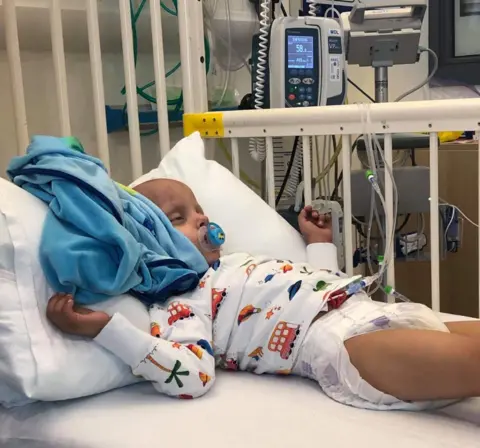
Karen’s son Caleb is still receiving treatment for the side effects of a brain tumour which was diagnosed while he just three.
He had to begin his treatment in the adult hospital in 2019 because cancer wards in the children’s hospital were by then closed due to infection risks.
She says one of the early clues that something was seriously amiss came when she took him to the US for specialist proton treatment.
American doctors were surprised that he had been prescribed a strong antibiotic.
Karen believes it was a precautionary measure because doctors in Glasgow were so worried he would pick up an infection inside their hospital.
When Caleb resumed his treatment at the Queen Elizabeth University Hospital he was put back on the drugs, but no-one would tell her why.
She doesn’t blame those doctors or nurses – she says they had been forbidden by managers from telling parents about the problems with the water system and the infection risk.
“A doctor was crying at me, saying she wished she could but management wouldn’t let her. That’s unforgivable,” she said.
 PA Media
The impressive new hospital campus welcomed its first patients in April 2015 and was officially opened by Queen Elizabeth during the summer.
One of the biggest hospital complexes in Europe, it had cost more than £840m.
With typical gallows humour, Glaswegians dubbed it the “Death Star” after the Empire space station in the Star Wars film.
But the building seemed to offer new standards of care and comfort – in contrast with the drab corridors of several Victorian-era facilities it was replacing.
Beside it, the Royal Hospital for Children with its brightly coloured windows presented a reassuring space for children and their worried families.
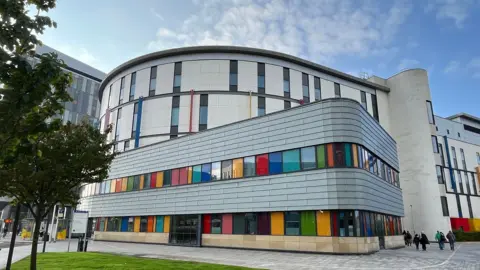
“It was a nice building from the outside, a nice building from the inside – it looked clean,” recalls Charmaine Lacock.
“We never thought anything could go wrong in a hospital. We had just had this diagnosis… we were in the best place we could be and they were going to fix it.”
In fact, there had been issues with the hospital from the start.
Within weeks of opening there were reports of difficulties during the patient transfer and long waits for admission.
We now know that 200 contractors were still on site when it opened, rushing to complete the project on time, and NHS facilities staff were overwhelmed by their workload as they tried to fix faults.
But it took years for a more disturbing story to emerge, of higher than expected infection rates and deaths of several patients with hospital-acquired infections.
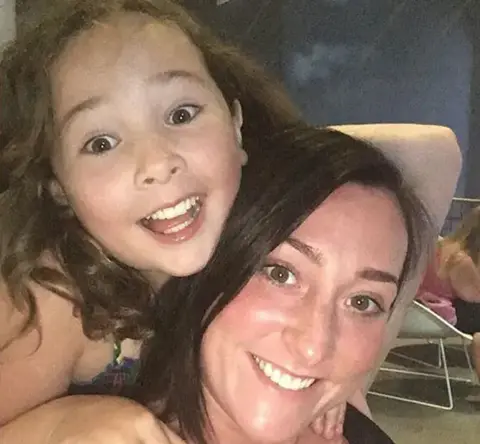 Kimberly Darroch
In 2017, 10-year-old Milly Main was recovering well from a stem cell transplant at the children’s hospital when she picked up an infection from an intravenous line used to administer drugs. She developed sepsis and died.
Her mother Kimberly Darroch told a BBC Disclosure documentary that she had hoped the stem cell treatment would give her daughter a second chance at life.
“Which it did, it worked – only for her to get a line infection which changed everything.”
Milly’s parents came to suspect the hospital water system was the source of the infection, but the health board insisted it was not possible to establish a causal link.
It still does not accept the faults were to blame for specific individual cases.
Kimberly would later become a powerful champion of parents who felt stonewalled and “lied to” by the authorities.
The year after Milly’s death, there was a cluster of infections. Higher than expected levels of bacteria that could harm patients with a weakened immune system were found in water in the children’s hospital.
“The first thing for me was seeing the notice up about the sink, saying this is a handwash sink only,” says Charmaine.
“Then they came in with bottled water and said don’t use the tap water to brush your teeth.”
Eventually most vulnerable young patients were transferred to the adult hospital while the infections were investigated and remedial work took place.
The two women were also noticing other faults – showers that flooded, blinds that wouldn’t open. Karen became so worried about the water she would pack her own cutlery and water jug.
At the start of 2019 another issue hit the headlines.
It emerged that a fungal infection often linked to pigeon droppings had been listed as a contributory factor in the death of a 10-year-old boy.
Suspicion fell on the ventilation system. Could a lack of filters or problems with air pressure have allowed dirty air to enter spaces where vulnerable patients were being treated?
A plant room on the roof near a ventilation intake that had been colonised by pigeons was initially identified as a likely source of the fungus, although a subsequent investigation contradicted that finding.
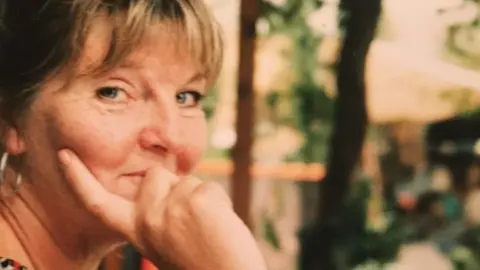 Armstrong family
Although it admits that the water system probably caused some infections, Glasgow’s health board continues to cast doubt on a link between infections and the ventilation system even though they accept it does not meet national specification standards.
That’s little comfort to the family of Gail Armstrong, who also died with the same Cryptococcus infection as the young boy a few weeks later.
Although the 73-year-old had cancer, her family believe it hastened her decline.
Her daughter Sandie thinks the health board’s new and caveated admissions add “insult to injury”.
“It makes us feel more distressed, more confused and more angry because we feel that they are just trying to limit the damage to their reputation.
“They’re not interested in actually coming forward and speaking openly and transparently to us.”
The timeline of the hospitals controversy
By late 2019, the growing scandal was being discussed in the Scottish Parliament where Anas Sarwar, now the Scottish Labour leader, raised the case of Milly Main.
He had obtained leaked reports which showed experts were warning about the safety of the water system even as the hospital was accepting its first patients.
With public concern mounting and a ventilation problem delaying the opening of a separate hospital in Edinburgh, Scottish Health Secretary Jeane Freeman ordered a public inquiry into their design, construction commissioning and maintenance.
That inquiry, now drawing to close after six years, has heard from 186 witnesses, painting a picture of what some clinicians described as a “defensive” management culture at NHS Greater Glasgow and Clyde.
One microbiologist, Dr Teresa Inkster, said she felt discouraged from speaking up at infection control meetings.
Another microbiologist and senior doctor, Christine Peters, said she was advised by a senior colleague to “pipe down” or she would find things “hard” professionally.
She has previously told BBC News she had been flagging concerns about the buildings since 2014 and was advised not to put anything in writing.

NHS Greater Glasgow and Clyde, now under a new chief executive, accepts whistleblowing procedures fell short and has apologised to staff who didn’t feel “listened to”.
But it denies there was any cover-up. While it concedes communication was poor, it says it didn’t want to worry patients needlessly before the facts were established.
The failings, it argues, were systemic rather than the fault of individuals who were under great pressure as they dealt with a situation which was not of their making.
That makes Karen Stirrat angry. She believes that some people tried to conceal the truth – and says this lets them off the hook.
“We had looked into those buildings, we had the truth there in black and white… If that’s not saving your own skin, I don’t know what is.”
Infection levels returned to normal by late 2020 after remedial work on the water systems.
The ventilation system still falls short of national standards but the health board claims alternative infection controls measures mean the hospitals on the site are now “wholly safe”.
Lawyers for the public inquiry, whose role is to represent the public interest, have questioned that and suggested that for some vulnerable patients, in certain circumstances, there could still be a heightened risk.
 Karen Stirrat
The final report from inquiry chairman Lord Brodie is expected to be published later this year but there has already been political fallout.
In fiery exchanges in the Scottish Parliament, opposition leaders demanded to know where the “pressure” to open the hospital on time was coming from. Was it a coincidence that the opening took place just days before a general election?
First Minister John Swinney responded with an emphatic “no” when asked if political pressure was applied. And he said SNP ministers were not alerted to problems with the water system until nearly three years later, in March 2018.
For parents like Karen Stirrat and Charmaine Lacock it’s less about the politics but more about finally getting answers to questions they have been asking for years.
They still have their children. For them it’s a time of healing both physically and psychologically.
But Charmaine still finds it hard to forgive those who she believes tried to conceal the truth.
“It has taken over our lives. This will haunt us forever.”
Sindh issues update on winter school timings
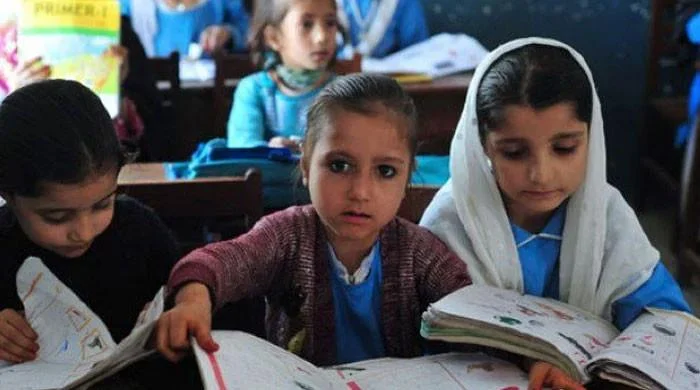
KARACHI: The School Education and Literacy Department on Sunday extended the reduced school timings — following which education institutions were ordered to begin classes at 9am — across Sindh until February 4 as the ongoing cold wave continues to grip the province.
The Sindh Education Department on January 10 had announced revised school timings, ordering all public and private schools to open at 9am while keeping closing hours unchanged.
“In continuation of this department’s notification of even number dated 10th January 2026, the timing of all public and private educational institutions under the administrative control of the School Education and Literacy Department, government of Sindh, shall continue till 4/2/2026,” read the notification.
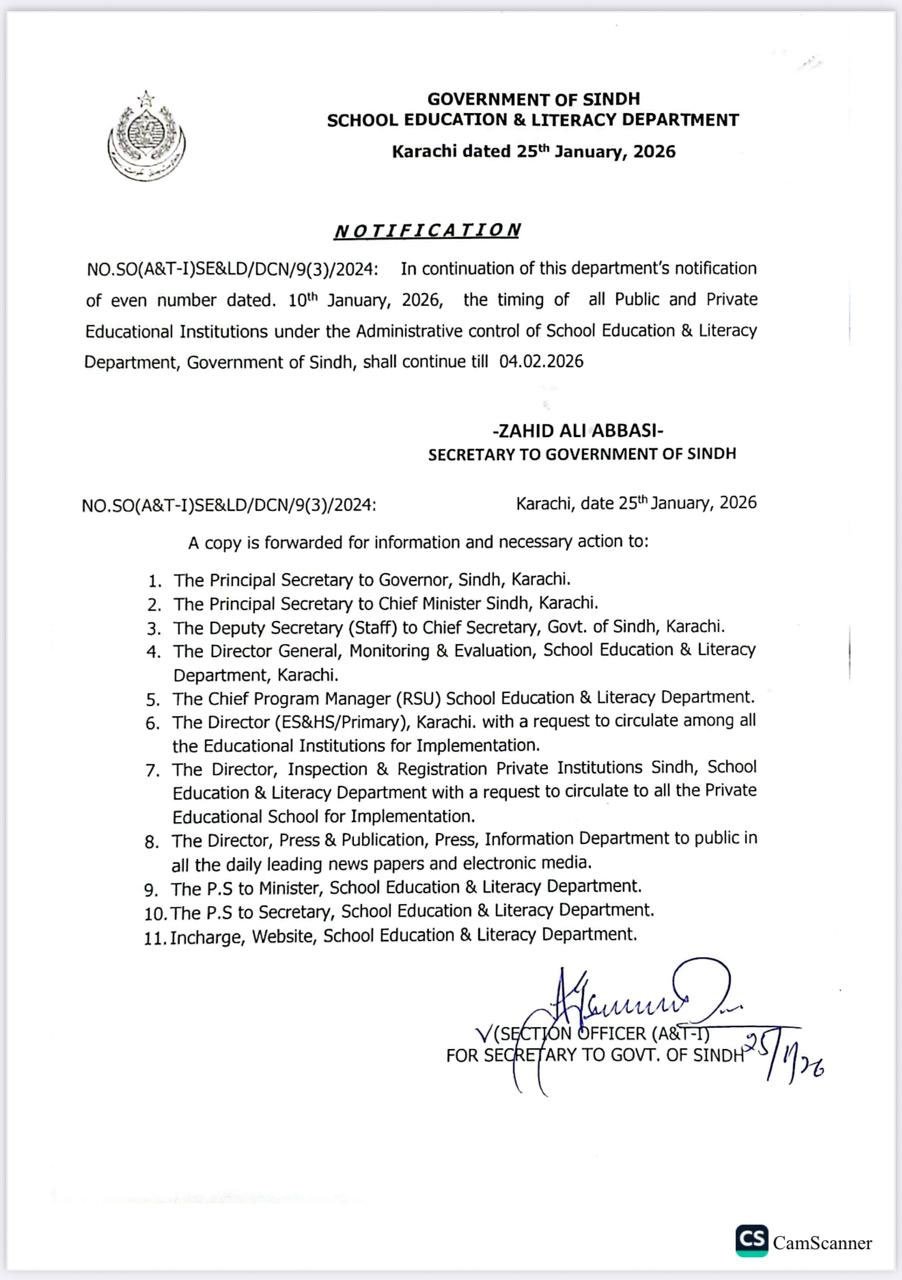
In a statement, a spokesperson of the education department said the decision was taken due to the intensified cold weather across the province.
Acting on the directives of Sindh Education Minister Syed Sardar Ali Shah, the revised timings have been extended until February 4, the spokesperson added.
The education department had initially extended the revised school timings until January 26 amid a severe cold wave across the province.
Separately, the Pakistan Meteorological Department (PMD) on Saturday said that temperatures in Karachi could fall to single digits over the weekend.
The Met Office had said that the port city’s weather is likely to remain cold and dry with occasional winds.
Meanwhile, the PMD predicted more rain and snowfall across various parts of the country from Sunday to Tuesday.
Australian Open as it happened: Alex de Minaur cruises into quarters; Ukraine’s Oliynykova targets Sabalenka again

MELBOURNE, Australia — World No. 1s Carlos Alcaraz and Aryna Sabalenka made light work of their fourth round Australian Open opponents to advance to the quarterfinals of the tournament. It wasn’t so simple for top-ranked American Coco Gauff, who was made to fight deep into a deciding set against 19th-seed Karolina Muchova.
The Day 8 evening session was headlined by Australia’s Alex de Minaur who dominated Alexander Bublik. World No. 3 Alexander Zverev continues to fly under the radar with a straight-sets win, but Daniil Medvedev, a three-time runner-up at Melbourne Park, was stunned by Learner Tien.
Meanwhile, Novak Djokovic‘s fourth-round opponent Jakub Mensik has withdrawn from tomorrow night’s clash, meaning the 10-time champion gets a free passage through to the quarterfinals.
Catch up on all the latest news, results, match schedules, and more from Day 8 at the Australian Open.
Budget 2026: CREDAI seeks major policy push to boost housing affordability

New Delhi: As the government gears up to present the Union Budget 2026–27, the real estate sector has placed its expectations on the table. The Confederation of Real Estate Developers’ Associations of India (CREDAI) has urged the Centre to take immediate steps to make housing more affordable and ensure a steady supply of homes across the country.
Highlighting the sector’s key role in job creation and urban growth, the industry body said its recommendations are aligned with national goals such as ‘Housing for All’ and urban development, while also addressing long-standing issues in finance, taxation and regulations. According to CREDAI, timely and targeted policy support will be crucial to revive demand and move closer to the vision of a ‘Viksit Bharat’.
Call to Redefine Affordable Housing Limits After Eight Years
A key demand in CREDAI’s submission is the urgent revision of the affordable housing definition, which has not been updated since 2017. At present, affordable homes are capped at a value of Rs 45 lakh and must meet specific size limits. However, CREDAI says these thresholds no longer match ground realities, as land prices and construction costs have risen sharply over the years. The body believes that without revising these limits, the goal of making homes truly affordable for buyers will remain difficult to achieve.
Proposal to Revise Size Norms and Remove Price Cap
To address the issue, CREDAI has suggested increasing the carpet area limit for affordable housing to 90 square metres in metro cities and 120 square metres in non-metros. At the same time, it has recommended doing away with the existing price cap altogether. The industry body believes shifting to a purely area-based definition will help boost the supply of practical and viable housing in urban centres. It also argues that this move would reduce confusion and simplify processes, as different government schemes currently follow varying definitions of affordable housing.
To directly benefit homebuyers, CREDAI is advocating for a significant overhaul of housing loan interest deduction limits. The current Rs 2 lakh cap has been static for over a decade, even as property prices and interest rates have climbed.
In most major cities, middle-income earners now face annual interest payments between Rs 4 and Rs 6 lakh, making the existing tax benefit negligible. The association recommends removing this cap for first-time, self-occupied homes and extending these deductions to the new tax regime to ensure all taxpayers are treated fairly. This reform is expected to improve disposable income and encourage more citizens to transition from renting to home ownership.
The recommendations also address the difficulties low-income and informal-sector households face when trying to secure formal bank loans due to a lack of documentation. CREDAI has proposed the creation of a dedicated Credit Guarantee Scheme for affordable housing, which would de-risk lenders and expand credit to underserved segments. This self-sustaining model would be funded through nominal fees from borrowers, meaning it would place no upfront fiscal burden on the national budget while helping to bring more people into the formal financial system. Additionally, the body is pushing for a rationalisation of GST rates on construction and residential units to lower effective costs for both developers and buyers.
Finally, looking toward the future of urban migration, CREDAI has called for the launch of a National Rental Housing Mission to develop organised rental stock in major cities through fiscal incentives and tax relief.
Shekhar Patel, President of CREDAI, highlighted the importance of these combined efforts, stating, “Housing remains a critical engine of economic growth, employment generation, and urban transformation. To keep pace with India’s rapid urbanisation, it is vital to strengthen affordability, expand access to formal finance, and develop a robust rental housing ecosystem.” He further noted that these reforms would “unlock investment, reinforce homebuyer confidence, improve financial inclusion, and enable sustained housing supply, while supporting affordable rental options in urban centres for lower-income groups and contributing to improved living conditions and the gradual reduction of slums.” (With ANI Inputs)