Former President Bill Clinton said on Sunday, after another fatal shooting in Minneapolis involving federal immigration agents, that agents are engaging in “increasingly aggressive and antagonistic tactics” and that the Trump administration told Americans not to believe what they can see for themselves.
Alex Pretti, 37, was shot and killed on Saturday by Border Patrol agents while recording federal immigration operations in Minneapolis. An ICU nurse, Pretti appeared to be attempting to attend to a woman agents knocked down when he was sprayed with an irritant, pushed to the ground and beaten.An agent was seen pulling Pretti’s gun from his waistband before other agents fired several shots and killed him.
The shooting follows recent unrest over the ICE-involved killing of Renee Nicole Good in the same city earlier this month.
“In recent weeks, we’ve watched horrible scenes play out in Minneapolis and other communities that I never thought would take place in America. People, including children, have been seized from their homes, workplaces, and the street by masked federal agents,” Clinton said in a statement.
Former President Bill Clinton issued a statement following another Minneapolis shooting involving federal immigration authorities.(Jamie McCarthy/Getty Images)
“Peaceful protesters and citizens exercising their constitutional right to observe and document law enforcement have been arrested, beaten, teargassed, and most searingly, in the cases of Renee Good and Alex Pretti, shot and killed,” he continued.
Clinton said “this is unacceptable” and “should have been avoided.”
“To make matters even worse, at every turn, the people in charge have lied to us, told us not to believe what we’ve seen with our own eyes, and pushed increasingly aggressive and antagonistic tactics, including impeding investigations by local authorities,” he said.
A screengrab from a video shows a law enforcement officer spraying irritants at Alex Pretti before he was fatally shot by federal agents in Minneapolis on Jan. 24, 2026.(Reuters)
CLICK HERE TO DOWNLOAD THE FOX NEWS APP
“Over the course of a lifetime, we face only a few moments where the decisions we make and the actions we take will shape our history for years to come,” the former president added. “This is one of them. If we give our freedoms away after 250 years, we might never get them back. It is up to all of us who believe in the promise of American democracy to stand up, speak out, and show that our nation still belongs to We the People.”
The daughter of a senior Iranian official, who publicly criticized President Donald Trump and U.S. involvement in Iran’s protests, has been fired from her teaching post at a top U.S. college, according to reports.
The Emory Wheel, Emory University’s news outlet, reported the School of Medicine Dean announced in an email Jan. 24 that Fatemeh Ardeshir-Larijani was no longer a university employee.
Ardeshir-Larijani was an assistant professor in the department of hematology and medical oncology at Emory’s medical school.
“The announcement follows a Jan. 19 protest where Iranian-American demonstrators gathered outside Emory’s Winship Cancer Institute to oppose the employment of Fatemeh Ardeshir-Larijani by the University,” the outlet said.
Ali Larijani, a senior Iranian official and former parliamentary speaker, arrives in Beirut, Lebanon, on Sept. 27, 2025, to attend a memorial service for Hezbollah leader Hassan Nasrallah.(Courtney Bonneau/Middle East Images via AFP/Getty Images)
Ardeshir-Larijani’s Emory faculty page and her Emory Healthcare pages were also no longer visible online.
The group also cited the professional profile on Emory Healthcare’s official website as showing a listing for a woman called Ardeshir-Larijani who is a U.S.-trained hematologist-oncologist and practicing in Atlanta.
The claims had first drawn attention amid escalating tensions between the U.S. and Iran following the outbreak of protests and reports of deaths during an intense crackdown from Dec. 28.
Trump warned of potential U.S. action in response.
In a Jan. 2 Truth Social post, the president warned that if Iran “violently kills peaceful protesters” the U.S. “will come to their rescue,” saying “we are locked and loaded and ready to go.”
Trump’s remarks prompted warnings from senior Iranian officials, who said any American interference would cross a “red line.”
“The American people must know that Trump is the one who started this adventure,” he wrote, “and they should pay attention to the safety of their soldiers.”
AAIRIA responded by urging U.S. authorities to review the immigration and visa status of Ardeshir-Larijani and her husband.
The group urged officials to determine whether continued residence in the U.S. aligns with U.S. law, national security considerations and principles of accountability and human rights, in a statement shared online.
Larijani’s daughter has reportedly been relieved of her teaching job at Emory University.(Str/Xinhua via Getty Images)
Rep. Buddy Carter, R-Ga., also called on Emory to dismiss Ardeshir-Larijani and the state’s medical board to revoke her medical license.
Ardeshir-Larijani’s dismissal also arrived two weeks after sanctions had been placed on her father by the Treasury Department, who said that he “is responsible for coordinating the response to the protests on behalf of the Supreme Leader of Iran and has publicly called for Iranian security forces to use force to repress peaceful protesters,” and has publicly defended the regime’s actions.
Ali Larijani has portrayed the U.S. as a hostile power in the past.
CLICK HERE TO DOWNLOAD THE FOX NEWS APP
A 2018 report by The Washington Times highlighted what critics described as a double standard among Iranian officials whose relatives live or work in Western countries.
Fox News Digital has reached out to the White House and the Department of Homeland Security for comment and Emory University for comment.
Emma Bussey is a breaking news writer for Fox News Digital. Before joining Fox, she worked at The Telegraph with the U.S. overnight team, across desks including foreign, politics, news, sport and culture.
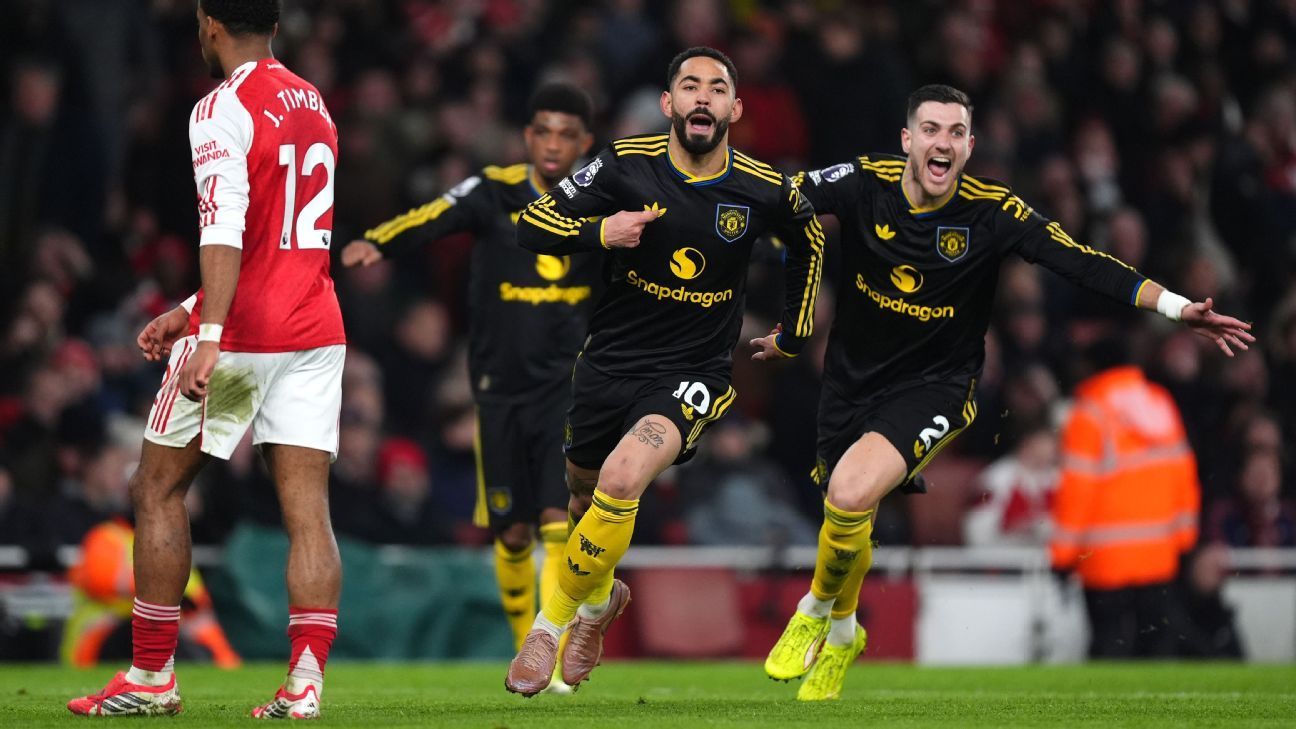
The Gunners end the day just four points clear of Manchester City and Aston Villa after losing at home for the first time since May 2024 in a pulsating contest. Fresh from beating City in his first game as interim boss, Michael Carrick has now led United to their first victory at Arsenal since December 2017 with a mature display of counterattacking.
Lisandro Martínez inadvertently turned the ball into his own net under pressure from Jurriën Timber to give Arsenal a 29th-minute lead, but the home side still looked nervous in possession. Martín Zubimendi gifted Bryan Mbeumo the chance to equalize eight minutes later as his wayward pass put the Cameroon international through on goal and he rounded David Raya with a clever finish.
United went in front five minutes after the restart as Patrick Dorgu collected Bruno Fernandes‘ pass and struck a fabulous 25-yard effort that crashed in off the underside of Raya’s crossbar. Arsenal thought they had salvaged a point when Mikel Merino bundled the ball over the line following a goalmouth scramble at a Bukayo Saka corner, but substitute Cunha had the last laugh, curling in a fine effort from the edge of the box to give United a famous win. — James Olley
Beating Arsenal puts Man United into title race
Has Carrick worked a miracle by turning Manchester United into title contenders after just two games in charge?
OK, that might sound ridiculous, but after an incredible 3-2 win against leaders Arsenal at the Emirates, United climbed into fourth position and are now 12 points off top spot. Their fans sang “We’re gonna win the league” after the final whistle.
In any other season, a 12-point gap at this stage of the season would usually rule out the fourth-place team, but this is such an unpredictable campaign that anything is possible. Neither Arsenal nor second-place Manchester City — both beaten by United in the past eight days — are playing like champions right now, and Aston Villa moved to within four points of top spot by beating Newcastle United earlier in the day, having lost at home to Everton last Sunday.
With the three teams ahead of them still facing a busy run of UEFA Champions League and domestic cup fixtures, distractions are in front of each them between now and the end of the season. United? They have only league games to focus on now, so Carrick and his players have 15 games to make their season a success.
Right now, that means securing a top-four finish and Champions League football, but Carrick has turned United into big-game winners, and they have momentum. Next week’s home game against Fulham is the start of a run of very winnable games in February, but those fixtures have tripped United up in recent months.
But the challenge is now there. Can United consolidate top four and then push for the title? It’s unlikely, but the unique circumstances of this season might just play in their favor. — Mark Ogden
Nerves creep into Arsenal’s title challenge
There was a strange atmosphere inside Emirates Stadium all afternoon.
Arsenal have made significant strides in improving the matchday experience and creating an intimidating environment for opposing sides, but the magnitude of the opportunity before them — winning their first Premier League title since 2004 — seemed to inhibit everyone connected to the Gunners on Sunday. Zubimendi made the error that led to Mbeumo’s equalizer, but there were mistakes from several other players, including a surprisingly unsettled William Saliba.
Their game management raises questions about their mentality to see out the title race from here. It follows on from goalless draws against Liverpool and Nottingham Forest, two matches where timidity and caution crept into their play.
Manager Mikel Arteta made a highly unusual quadruple change just before the hour mark, but Arsenal did not find any more fluidity. After being his usual bundle of energy and agitation with the scores level, he was curiously static as Arsenal tried to find a way back.
There is plenty for him to ponder, even if they remain favorites to win the league. — Olley
United look liberated without Amorim
Ruben Amorim’s reputation as one of Europe’s best young coaches took a massive hit during his 14-month reign as United manager. The former Sporting CP coach turned a bad United team into an even worse one, recording the club’s lowest-ever Premier League finish in the process last season.
If the shine had been taken off Amorim’s reputation prior to his departure earlier this month, though, Carrick’s two games in charge will have sent Amorim ducking for cover. In two games, Carrick has liberated this United team by simply playing a formation they are comfortable with and selecting players in their best positions.
Amorim rarely did either and made a simple job extremely complicated. His inflexible approach ultimately cost him his job.
United look a team transformed under Carrick and his coaching staff, and they are now playing with the confidence and swagger that the club expects of its players.
Amorim will work again after his United experience, but Carrick is not helping him polish his record. — Ogden
Squad depth glossing over Arsenal’s ineffective attack
Arsenal’s attack has not consistently clicked this season.
It seems like a faintly absurd point to raise given they are at the top of the Premier League and the Champions League, but their position in both competitions has been founded on defensive resilience rather than dynamism in attack. And so, when the defense falters, suddenly those issues grow.
This was only the sixth time in 117 home matches that Arsenal have conceded three goals in a league game under Arteta.
play
1:14
Carrick: Casemiro ‘desperate’ to finish Man Utd career on a high
Michael Carrick previews Manchester United’s trip to Arsenal, and reacts to the news that Casemiro will leave the club at the end of the season.
Viktor Gyökeres‘ difficulties since arriving from Sporting last summer have been glossed over to some extent, but Arteta’s decision to start Gabriel Jesus here was an acknowledgment that the Sweden international is not yet the man for every big occasion. Jesus, who scored a brace against Internazionale in midweek, had arguably earned his shot, but he was ineffective here and substituted before the hour mark. He had 26 touches but just one shot with an expected goals figure of 0.01. Gyökeres got half an hour at the end but managed just seven touches.
They might still win trophies without a prolific No. 9, such is the strength in depth they possess, but any hopes Jesus could provide a quick solution were dispelled here. — Olley
Dorgu’s fortunes change dramatically under Carrick
Dorgu is approaching the first anniversary of his £25 million move to Manchester United from Lecce, and for the majority of his time at Old Trafford, the 21-year-old has looked out of his depth. The Denmark winger almost personified Amorim’s dismal 14-month reign as manager due to his inability to impress in a red shirt.
Dorgu failed to score in any of his first 26 league games for United, and his confidence seemed shattered by the time Amorim left the club earlier this month. But his stunning long-range strike at the Emirates, which put United up 2-1, was his third goal in his past six league games and came hot on the heels of his goal in last week’s 2-0 win against Manchester City.
Confidence is a huge thing for any soccer player, and Dorgu is showing how much a little patience and TLC from a manager can change one’s fortunes.
He limped out of this game with what seemed to be a muscle injury in the final stages, so United will be hoping it is nothing that will keep Dorgu sidelined. A month ago, nobody at Old Trafford would have cared if Dorgu was unavailable. — Ogden
Surveillance video captured a daytime smash-and-grab at an Anaheim Hills, California, jewelry store, showing masked suspects ransacking display cases after a vehicle smashed through the front entrance before fleeing in two getaway cars that later crashed during separate police pursuits.
FOX 11 in Los Angeles reported the suspects used a vehicle to smash their way into the store.
Surveillance footage shows two men sitting inside the jewelry store. Through the glass front door, a vehicle is seen outside, lined up with the entrance. It suddenly accelerates forward, crashing through the door, shattering the glass and knocking out the frame.
The next clip shows three suspects dressed in black and wearing masks rummaging through glass cases and grabbing merchandise, while a fourth suspect stands by the door and appears to act as a lookout.
Surveillance video shows masked suspects smashing into an Anaheim Hills jewelry store, looting display cases and fleeing in getaway cars. (KTTV)
Throughout the robbery, a man seated near the front of the store stands frozen with his phone in his right hand, appearing stunned by what is unfolding.
All four suspects then flee through the damaged entrance with merchandise in hand and appear to enter a white vehicle before driving away. The man holding the phone runs to the doorway to record the getaway, while the other man inside the store reappears on camera and looks around at the wreckage.
“Eight to ten guys run in with masks, trash cans, and crowbars, hammers, and smash every showcase,” store owner Ramcy Tabelo told the station. “My gun was on the table, they grabbed my gun and at that point I thought I was going to get shot.”
The owner of the jewelry store said the suspects stole his gun.(KTTV)
Police said both getaway vehicles crashed during pursuits, with the first crash involving multiple vehicles and the second happening about five minutes later, according to the Fullerton Police Department.
Investigators recovered trays of stolen jewelry from the vehicles.
CLICK HERE TO DOWNLOAD THE FOX NEWS APP
Authorities said all suspects involved in both crashes fled on foot, though at least five suspects have been taken into custody.
Greg Wehner is a breaking news reporter for Fox News Digital.
Story tips and ideas can be sent to Greg.Wehner@Fox.com and on Twitter @GregWehner.
The price of gold has risen above $5,000 (£3,659) an ounce for the first time, extending a historic rally that saw the precious metal jump by more than 60% in 2025.
It comes as tensions between the US and NATO over Greenland have added to growing concerns about financial and geopolitical uncertainty.
US President Donald Trump’s trade policies have also worried markets. On Saturday he threatened to impose a 100% tariff on Canada if it strikes a trade deal with China.
Gold and other precious metals are seen as so-called safe-haven assets that investors buy in times of uncertainty. On Friday, silver topped $100 an ounce for the first time, building on its almost 150% rise last year.
Demand for precious metals has also been driven by a range of other factors including higher-than-usual inflation, the weak US dollar, buying by central banks around the world and as the US Federal Reserve is expected to cut interest rates again this year.
Wars in Ukraine and Gaza, as well as Washington seizing Venezuelan President Nicolás Maduro, have also helped push up the price of gold.
One of the biggest appeals of gold is its relative scarcity. Only around 216,265 tonnes of the metal have ever been mined, according to the World Gold Council trade association.
That’s enough to fill between three to four Olympic-sized swimming pools. The majority of that was only extracted from the earth since 1950, as mining technology advanced and new deposits were discovered.
The US Geological Survey estimates that another 64,000 tonnes of gold can still be mined from underground reserves, although the supply of the metal is predicted to plateau in the coming years.
“When you own gold, it’s not attached to the debt of somebody else like a bond is or an equity where the performance of a company will drive performance,” said Nicholas Frappell, global head of institutional markets at ABC Refinery,
“It’s a really good diversifier in a very uncertain world,” he added.
‘People go to gold’
Gold saw a blockbuster year in 2025, with its biggest annual gain since 1979 as investors flocked to precious metals.
With financial markets spooked by concerns including Trump’s tariffs and fears that artificial intelligence-related stocks are overpriced, gold repeatedly hit new record highs.
“I think a large part of that is the extreme uncertainty we have around US policy,” said Nikos Kavlis from research consultancy Metals Focus.
While economic concerns can help to push up the price of gold, it also tends to rise when investors expect interest rates to be cut.
Lower rates typically mean smaller returns for investments such as bonds, so investors look to assets like gold and silver.
The US Federal Reserve is widely expected to cut its main interest rate twice this year.
“It’s inversely correlated because the opportunity cost of keeping the money in a [government bond] is really not worth it anymore, so people go to gold,” said Ahmad Assiri, Research Strategist at Pepperstone.
Getty Images
In many cultures, gold is purchased during festivals or given as a gift at celebrations
It’s not just investors who have been buying up gold.
Last year, central banks added hundreds of tons of bullion to their reserves, according to the World Gold Council.
Central banks in China, Poland and Azerbaijian were among the leading buyers in 2025.
“There’s a very clear shift away from the US dollar, which is benefiting gold immensely,” said Kavalis.
The start of this year has seen gold’s rally but Frappell warns the “news-driven” market could also result in a fall in the price of gold.
“There’s got to be scope for unexpected news that actually might be positive for the world and not necessarily positive for gold,” he said.
But not everybody is buying gold for purely investment reasons.
In many cultures, the metal is purchased during festivals or given as a gift at celebrations such as weddings.
In India, the annual Diwali festival is believed to be an auspicious occasion to buy precious metals in order to bring on wealth and luck.
According to the US investment bank Morgan Stanley, Indian households held a staggering $3.8tn of gold, equivalent to 88.8% of the country’s GDP.
Neighbouring China is the world’s largest single consumer market for gold, with many believing that its purchase will bring fortune.
“We often see a seasonal uptick in demand around Chinese New Year, which we are seeing at the moment to an extent,” said Kavalis, referencing the upcoming Year of the Horse which begins in February.
Natalie Portman says her kids skip even her ‘Star Wars’ films: Here’s why
Natalie Portman’s kids are not fond of watching her big screen roles, including the iconic Star Wars films, and she “appreciates” the reason behind it.
The 44-year-old actress, who shares son Aleph, 14, and daughter Amelia, eight, with her ex husband, Benjamin Millepied, revealed that her kids are not interested in seeing her movies.
The Avengers: Endgame actress told E! News at The Gallerist premiere at Sundance, “My kids are so resistant to seeing anything that I’m in.”
“I was always like, ‘Yeah, if you want to see it, like if some of your friends have seen it or whatever.’ And they were like “’No, thanks.’”
Portman revealed the reason behind this is that her kids just want to see the Oscar winner, just as their mother.
“They kind of just want to see me as me, which I appreciate,” she added.
However, Portman’s kids showed interest in the animated movie, Arco, which she produced.
She revealed in a previous chat with People how the kids’ movie, which recently gained an Oscar nomination, feels relatable to her kids.
Natalie shared the film’s futuristic topic “raised so many interesting conversations from why the parents are holograms and not at home to, of course, the climate challenges that the kids face in it, to some of the solutions that the kids come up with, like ‘Is that really possible in life, living on platforms above the earth to let the earth rest?'”
“Things like that are amazing conversations I got to have with the kids because of the movie.”
The doting mom of two added, “The story dealt with very pressing issues and offered so much inspiration and hope and encouragement of imagination for children.”
“I think that it takes kids very seriously. It doesn’t try and gloss over things. Kids are living through all of these experiences right now, and I think need to be talked to with a lot of respect,” she noted.
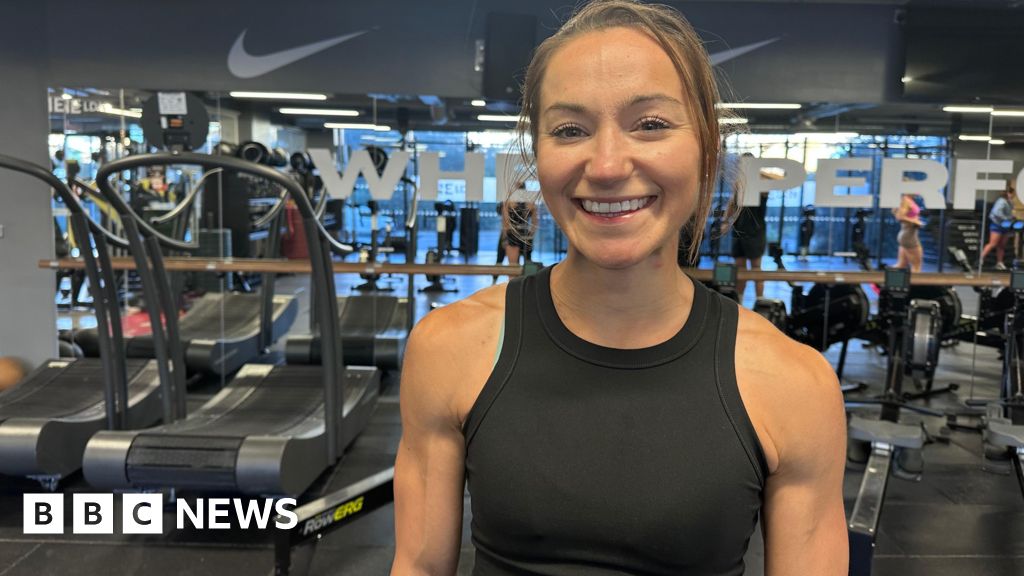
Allana Falconer has competed in 20 different Hyrox races since taking it up in 2023
Hyrox is a fitness craze that shows no signs of dying out – with 1.3m people expected to compete in an event somewhere in the world this year.
The competition, which is split between running and fitness exercises, has proven particularly popular with young millennials and Generation Z – people in their twenties to early forties.
Its rapidly growing popularity has been attributed to social media.
Fashionable looks are often a non-negotiable for competitors, with many choosing to compete in high-end fitness brands, matching their outfits with their team members.
Allana Falconer, who works in sustainability and started competing in 2023, says she has “fallen in love” with it.
She has competed in 20 different races across six countries and 12 different cities.
The 29-year-old says the most she has spent so far was £2,000, when she travelled to Chicago for the World Championships last year.
Exercise is part of their identity
ONE LDN
Evgenia Koroleva spent £75,000 creating a bespoke Hyrox space in her London gym
“For competitions abroad, I normally spend approximately £400 per trip for two nights’ stay and travel and £120 for a ticket,” she adds.
As she is racing so much, she says she needs lots of fitness kit too, adding that “I burn through ridiculous amounts of shoes.”
Evgenia Koroleva, the founder of ONE LDN gym, says for anyone that takes fitness competitions seriously, “the costs can be absolutely astronomical”.
She estimates an athlete travelling to compete in a Hyrox competition will spend between “£500 to £1,000” in one weekend, with the ticket alone about £120.
“Hyrox has created this addiction for people who do it because they never really do one race. When they do their first race they then sign up for another one and because the course is the same it creates this level of competition with yourself,” she adds.
The cost of participation is higher than a marathon, and some people have criticised it. “Travelling abroad plus the costs involved to run around a bit and get out of breath is a stretch for me,” said one former participant on Reddit.
Fran Sirl, personal trainer and owner of parkfit, who runs outdoor fitness classes in Richmond Park, says sports like this can feel intimidating and says he reminds his clients you don’t need specialist kit or equipment to get fit.
“I take groups out into the park. Sometimes we start out with a walk, then add lunges and push-ups on a bench.
“Exercise doesn’t need to be expensive or complicated. It’s about finding something that makes you want to go back and do it again, whether that’s a high intensity workout or just going for a walk.”
Most athletes the BBC spoke to felt the prices for Hyrox were fair due to the cost of hiring large event spaces, specialist equipment and judging panels.
Evgenia says the fact people are willing to pay so much reflects a wider “cultural shift” in how much people in their 20s and 30s spend on exercise.
“Exercise is non-negotiable and part of their identity,” she adds.
Spending money on fitness is a priority for those born between 1997 and 2012 (Gen Z), according to exercise app Strava.
Its survey suggests that a third of them plan to spend more on fitness this year with almost two thirds saying they would rather spend money on new gym clothes than a date.
“Mara-cations” (marathon vacations) and Hyrox holidays are now so popular that some travel companies are offering bespoke trips abroad for competitions.
In Hyrox, UK competitions often sell out quickly, which is why many of those wanting to take part travel further afield.
Hyrox, which hosted its first competition in 2021, has a near 50/50 gender split.
The race involves doing a one-kilometre run eight times, broken up with exercises such as burpee broad jumps, sled pulls and rowing.
Those taking part can compete on their own or with a partner – either in a mixed or same sex team.
Dr Florence Kinnafick, a senior academic at Loughborough University who specialises in physical activity and mental health, says the different disciplines can mean competing becomes “addictive”.
The “emphasis on competition isn’t attractive to everybody,” she says.
Kinnafick also warns of a risk of overtraining, if people get “obsessed” with improving their time.
But when it comes to the exercises themselves, she says whilst it is a hard event, there’s nothing “particularly technical” making it safe for newcomers.
‘I’ve caught the bug’
Jorell has competed in 10 different Hyrox races across Europe.
Jorell Hill, who has competed in 10 races so far, says he has “definitely caught the bug”.
“I did my first one [Hyrox] in December 2024 and since then I haven’t been been on a single holiday abroad that hasn’t been for a half marathon, marathon or Hyrox.”
The 27-year-old, who fits his training around his job as a firefighter, says his life “used to be going out, seeing mates, going to the pub and drinking a lot” but now nearly all his holidays involve “fitness retreats and competitions”.
He has travelled to “six or seven different countries for competitions” and hopes to compete in America and further afield this year.
Jorell, who moved to London just over a year ago, has made most of his friends through fitness.
“Instead of spending money on going out clothes, I’m just buying new fitness kit,” he says.
One kilogram gold bars stacked at the Perth Mint Refinery, operated by Gold Corp.
Matt Jelonek | Bloomberg | Getty Images
Gold climbed to a fresh all-time high, crossing $5,000 an ounce on Monday and extending its record-breaking run as investors seek the safety of the yellow metal amid rising geopolitical tensions and global fiscal risks.
Spot gold prices and U.S. gold futures for February gained 1.2%, trading at $5,042 and $5,036 an ounce, respectively.
The precious metal’s surge comes as recent flashpoints from Greenland and Venezuela to the Middle East underscore higher geopolitical risk, reinforcing gold’s appeal as a hedge against uncertainty.
“The recent further leg up in gold and silver prices has arrived on the back of geoeconomics issues related to Greenland,” HSBC wrote in a note last week.
Silver also rallied Monday, with spot prices jumping 3% to $106.1 per ounce, also benefiting from industrial demand.
Analysts at Union Bancaire Privée said Friday that prices have rallied on the back of sustained demand from both institutional and retail buyers.
“We anticipate that gold should enjoy another strong year, reflecting ongoing central bank and retail investment demand, with a year-end target price of USD 5,200 per ounce,” UBP said.
Goldman Sachs sees the demand base for gold to have broadened beyond traditional channels. Western ETF holdings have climbed by about 500 tonnes since the start of 2025, while newer instruments used to hedge macro-policy risks, including physical purchases by high-net-worth families, have become an increasingly important source of demand.
The investment bank recently lifted its December 2026 gold price forecast to $5,400 an ounce, up from $4,900 previously, arguing that hedges against global macro and policy risks have become “sticky,” effectively lifting the starting point for gold prices this year.
Central bank purchases also remain robust. Goldman estimates central-bank purchases are now averaging around 60 tonnes a month, far above the pre-2022 average of 17 tonnes, with emerging-market central banks continuing to shift reserves into gold.
Crucially, the bank assumes that hedges against global macro-policy risks, including concerns around fiscal sustainability, will remain in place through 2026, unlike election-related hedges that unwound quickly after the U.S. vote in late 2024.
“We assume that hedges of global macro policy risks remain stable as these perceived risks (e.g. fiscal sustainability) may not fully resolve in 2026,” Goldman said last week.
The new project could link offshore wind farms in the North Sea to more than one country via ‘interconnectors’
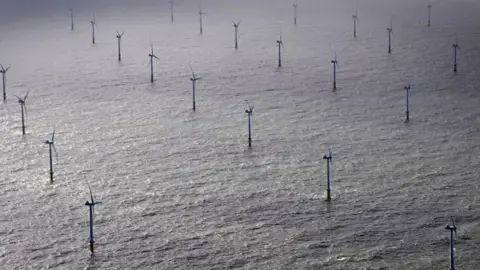
The UK is set to back a vast new fleet of offshore wind projects in the North Sea alongside eight other European countries including Norway, Germany and the Netherlands.
The government says the deal will strengthen energy security by offering an escape from what it calls the “fossil fuel rollercoaster”.
For the first time, some of the new wind farms will be linked to multiple countries through undersea cables known as interconnectors, which supporters say should lower prices across the region.
But it could prove controversial as wind farm operators would be able to shop around between countries to sell power to the highest bidder – potentially driving up electricity prices when supply is tight.
Energy Secretary Ed Miliband will sign a declaration on Monday at a meeting on the future of the North Sea in the German city of Hamburg, committing to complete the scheme by 2050.
Jane Cooper, deputy CEO of industry body RenewableUK, said the deal would “drive down costs for billpayers” as well as increasing “the energy security of the UK and the whole of the North Sea region significantly”.
But Claire Countinho, shadow energy secretary, warned “we cannot escape the fact that the rush to build wind farms at breakneck speed is pushing up everybody’s energy bills.”
National Grid
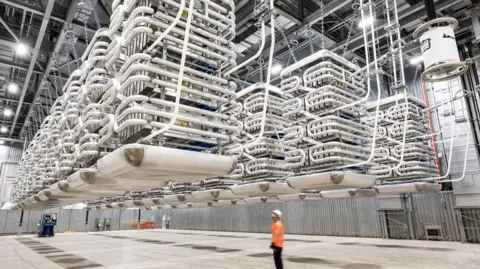
A valve hall inside a converter station that will form part of ‘interconnector’ onshore infrastructure
A network of undersea cables already connect the electricity grids of European countries – the UK has 10 such cables – but connecting wind farms directly to multiple countries will be a first.
Most energy economists agree more connections between the UK and other European grids should reduce costs and improve the security of supply.
The UK National Grid published a paper earlier this month suggesting such an arrangement could cut so-called constraint payments, made when wind farms are asked not to generate power because the electricity network is too congested.
National Grid said the cables help smooth spikes in prices because, thanks to time zone differences, surplus energy generated off-peak elsewhere can be sold cheaply to the UK.
But interconnectors have proved controversial in Norway where there have been concerns that selling power to foreign countries could reduce supplies for Norwegian customers and therefore increase the price they pay.
To stop this happening, the government brought in new rules to restrict electricity exports when domestic supply could be at risk.
Norway also refused permission for a new interconnector to Scotland.
Nato and the European Commission are also taking part in the summit, which is expected to include pledges to strengthen security for offshore energy infrastructure amid rising concerns over sabotage and unsafe maritime activity.
The agreement underlines Europe’s continued commitment to wind power, despite renewed criticism from US President Donald Trump, who again attacked what he called “windmills” during a speech at the World Economic Forum in Davos.
The North Sea countries pledged to develop 300 gigawatts (GW) of offshore wind capacity three years ago. This new deal means 100GW of the total will be built jointly. It is expected to say 20GW of that should be under way by 2030.
China currently leads the world in offshore wind, with 43GW of the world’s 83GW of installed capacity, according to a report last year from industry body RenewableUK.
The government was criticised by the Conservatives for “locking in” high offshore wind prices.
Reform has also repeatedly attacked the cost of net zero, but the Lib Dems and Greens both support the expansion of renewables to tackle the threat of climate change and boost green jobs.
SNP and Plaid Cymru also support the growth of offshore wind, but argue Scotland and Wales should have control of their energy resources.
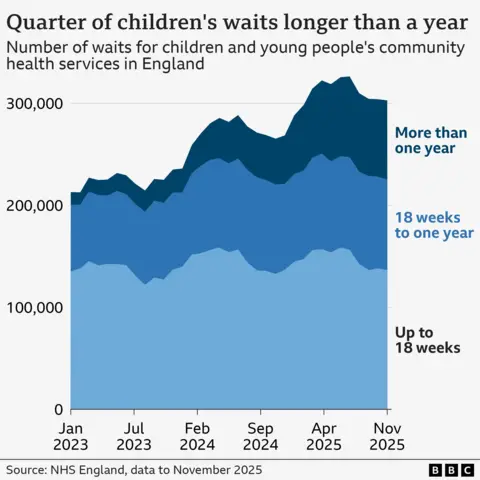
Tens of thousands of children in England have spent more than a year waiting for NHS community care such as hearing services, speech and language therapy and disability support, the BBC has found.
The analysis shows a quarter of the 300,000 children on waiting lists have been waiting more than 12 months.
NHS leaders and doctors say the delays are “catastrophic”, harming not only their health but also development – and are calling for the same priority to be given to tackling these long waits as has been given to the hospital backlog.
The government says the long waits are unacceptable, but under its 10-year plan greater investment in community services will improve access to care.
‘Waiting list after waiting list’
Tiya Currie’s six-year-old son, Arun, struggled to get the support he needs.
He has had difficulties with his speech since he was just a toddler. But when Tiya, 46, from London, tried to get help she faced “waiting list after waiting list”, she said.
“I was completely in the dark and I was tearing my hair out. That was really stressful.”
After two years of waiting, Tiya and her husband felt they had no choice but to use £4,000 of their savings to pay privately for speech therapy and a formal diagnosis, which revealed Arun had developmental language disorder (DLD).
Other
Tiya and her husband waited two years for the NHS, before paying privately for speech and language therapy for their son, Arun
DLD is a diagnosis given to children who have significant, ongoing difficulties understanding or using spoken language.
Tiya said: “It absolutely crushes me that there are so many people out there who need access to speech and language therapists, but aren’t getting it due to long waiting lists and it not being affordable.”
Arun’s progress has improved significantly with speech therapy and proper school support, but Tiya said the need for better early intervention and resources for children is key.
“I know how stretched NHS services are, but children should be prioritised because they’re still developing and they need that support now, not in years’ time,” she said.
Harmful waits
The community waits for under 18s have got worse over the last three years.
Since the start of 2023, there has been a six-fold rise in children waiting more than a year, with more than 77,500 in England now in that position.
Year-long waits for adults in the community are not common, with just 1% waiting that long compared with 26% of children.
While the figures cover only England, the Royal College of Paediatrics and Child Health (RCPCH) says longer-than-usual waits are also being reported elsewhere in the UK.
Many of the children facing long waits have complex needs, such as learning and physical disabilities. Some of the young children waiting will include those needing autism or ADHD assessments. For older children, mental health services tend to take the lead.
Elliot Howard-Jones, chair of the Robinson Group, which represents specialist community NHS services, said he was really worried about how the delays were affecting children.
“Getting this support is fundamental to their development journey – that’s why waits are so harmful.”
To illustrate the point, he gave the example of a child who struggles with hearing, which leads to them becoming disruptive and disengaged.
“For an adult, waiting is annoying, painful and difficult. But for a child, waiting means your peer group moves on while you don’t. You fall behind and never catch up.”
Howard-Jones said there needed to be greater focus and investment in community services, similar to what has already been happening for hospital treatments – tackling that backlog was at the heart of Labour’s manifesto and NHS trusts are get extra money for making progress.
Chronic underinvestment
His warnings have been echoed by other senior NHS leaders.
Richard Kirby, chair of the NHS Confederation and NHS Providers’ community network, said demand was outstripping capacity.
“Without more help, children will continue to wait longer and fall further behind – that is a situation none of us should accept.”
And Dr Ronny Cheung, from the RCPCH, added: “Chronic underinvestment and a lack of focus on children’s health and services have meant that staff are unable to meet increasing demand.
“Long waits are unacceptable for any patient, but for children and young people the waits can be catastrophic.
“Many treatments need to be given by a specific age or developmental stage to prevent long-lasting complications, and for many children these long waits mean we miss crucial chances to intervene in time.”
Kate Lawson, head of policy at disability charity Sense, said there were many “heartbreaking stories” of families battling to access essential care and therapies, with significant numbers having to resort to paying privately.
“It’s essential that the government addresses this issue to give every child the best start in life,” she added.
The Department of Health and Social Care agreed the waits were unacceptable.
It said it was taking “firm action” by introducing a new target to get community health services to work towards seeing patients within 18 weeks – the same as hospitals are expected to do.
And a spokeswoman added under the government’s 10-year NHS plan there would be greater investment in community services.
“Our vision for neighbourhood health will bring care closer to babies, children and young people, with more staff, better digital tools and services working together so children get the right support in the right place,” she said.