
Last Updated:
Organ donation can save up to eight lives and transform many more.Donor registration in India can bridge the gap between patients waiting and organs available.




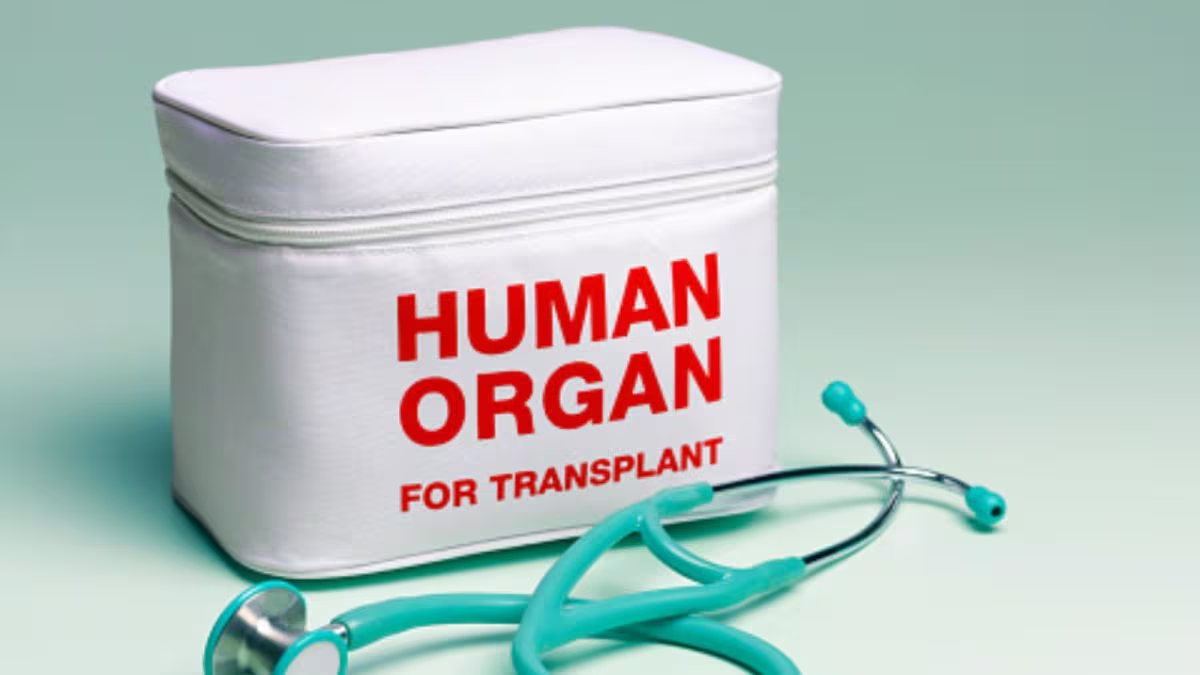
National Donor Day highlights the life-changing impact of organ, tissue, marrow, platelets, and blood donation in today’s healthcare system (Getty Images)
In moments of profound loss, organ donation represents something extraordinary, the possibility of renewal. It is often described as the “gift of life,” but its impact extends far beyond a single recipient. One decision can restore multiple lives, rebuild families, and create a ripple effect that continues across generations.
“National Donor Day highlights the life-changing impact of organ, tissue, marrow, platelets, and blood donation in today’s healthcare system,” says Dr Swaminathan Sambandam, Senior Consultant & Lead, Multi-Organ Transplant, Kauvery Hospital, Vadapalani, Chennai. “For patients with advanced organ failure, transplantation is often the only complete medical solution that enables them to regain health and achieve long-term survival.”
A Growing Need, A Persistent Gap
India’s demand for organ transplantation is steadily increasing. Rising rates of chronic diseases, lifestyle-related conditions, and improved diagnostic capabilities mean more patients are identified early but access to organs remains a challenge.
“The need for transplantation is significantly increasing in India,” explains Dr Sambandam. “Yet the number of transplants performed annually remains far lower than the number of patients waiting. The gap between demand and availability continues to be a critical issue.”
Despite this challenge, progress is visible. In 2024, India recorded a landmark achievement.
“In 2024, India performed a record 18,900 organ transplants, the highest ever in a single year, ranking the country third globally,” notes Dr Suresh Rao KG, Co-Director, Institute of Heart and Lung Transplant, MGM Healthcare, Chennai. “Kidney transplants account for nearly 85–90% of all procedures in India.”
While these numbers signal advancement, they also underscore the urgency of strengthening organ donation awareness and registration.
The Power of One Decision
A single organ donor can save up to eight lives and improve many more through tissue donation. The heart can restore circulation. Kidneys can free a patient from lifelong dialysis. A liver can revive metabolic function. Corneas can restore sight. Bone marrow and blood products can support cancer treatments and complex surgeries.
“One donor has the remarkable ability to save and transform multiple lives,” says Dr Sambandam. “Organ donation not only restores vital functions but gives patients the opportunity to return to active, meaningful lives to pursue careers, care for families, and contribute to society.”
Dr Rao describes organ donation as a “tree of life”, a powerful metaphor for its generational impact.
“One organ donor can save up to eight lives,” he says. “The impact stretches far beyond the operating room. It allows recipients to raise families, return to work, and live fully creating a ripple effect that continues across generations.”
Hope at the Intersection of Fragility
For families facing organ failure, transplantation represents more than a medical procedure, it is often the only remaining hope.
“Patients with organ failure sometimes spend weeks or months simply trying to survive,” Dr Rao explains. “Their families endure immense emotional and financial strain. In such moments, organ donation becomes a lifeline.”
Even amid tragedy, donation introduces the possibility of renewal. “Organ donation stands at the intersection of fragility and hope,” Dr Rao says. “It ensures that even in loss, there is life.”
Awareness and Registration: The Way Forward
Experts agree that bridging the gap between demand and availability requires public education, streamlined registration systems, and open family conversations.
“The solution lies in increasing donor registration and building awareness,” Dr Sambandam emphasises. “When individuals register and communicate their decision to their families, they create opportunities to transform lives every year.”
Family consent remains crucial at the time of donation. Clear communication ensures that a person’s wishes are honoured when it matters most.
Across specialities, cardiology, nephrology, hepatology, critical care, the shared mission remains the same: preserve life whenever possible.
“Organ donation embodies this goal in its purest form,” reflects Dr Rao. “It allows one life to branch into many.”
A Legacy Beyond a Lifetime
In healthcare, few acts carry such enduring significance. Organ donation is not simply a medical intervention; it is a conscious decision to extend compassion beyond one’s lifetime.
Registering as an organ donor and informing family members about that choice is a simple yet profound step. One decision has the power to rebuild futures, sustain families, and strengthen communities.
A single donor does not just save lives. They create a living legacy, a tree of life whose branches continue to grow long after they are gone.
February 15, 2026, 16:31 IST
