





Oil likely to hold near $80 unless infrastructure is hit, analyst says
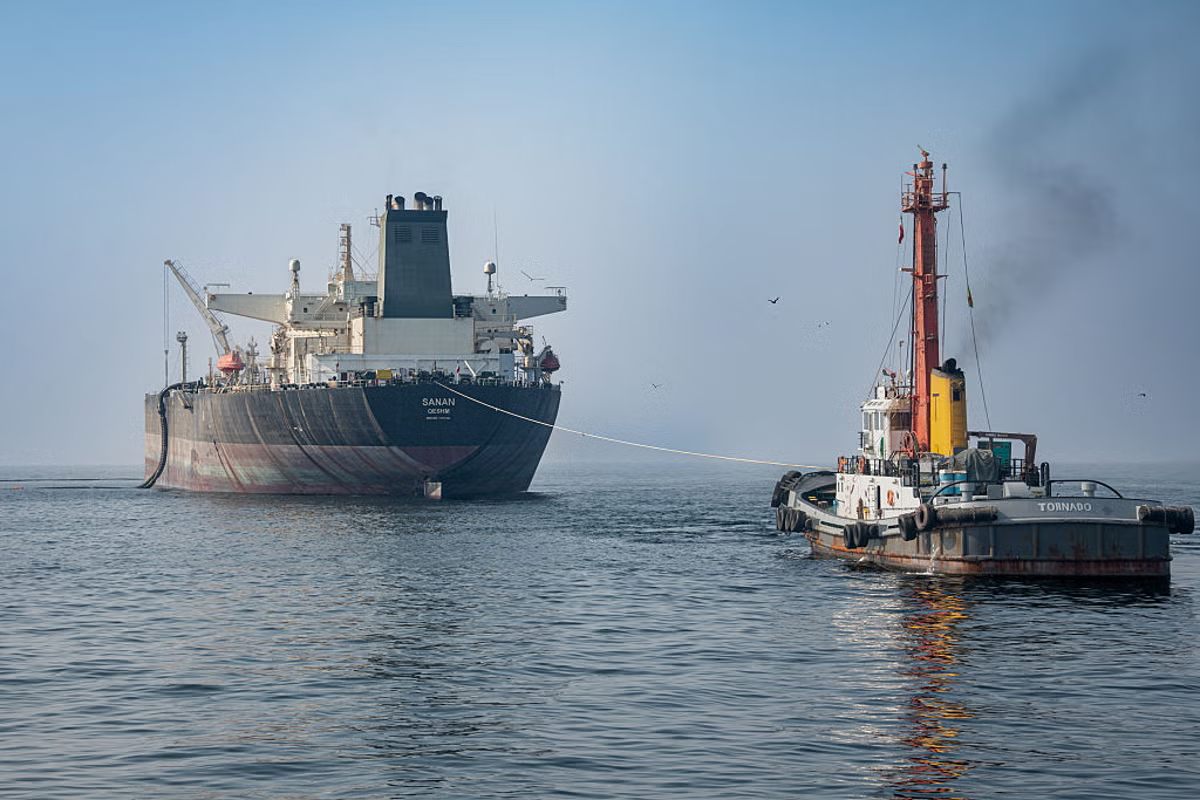
A cargo ship is pictured off coast city of Fujairah, in the Strait of Hormuz in the northern Emirate on February 25, 2026.
Giuseppe Cacace | Afp | Getty Images
Amrita Sen, founder of Energy Aspects, told CNBC’s Europe Early Edition this morning that oil markets are likely to hold at around $80 a barrel for now after an initial spike, noting, “we’ve kind of stabilized a little bit,” and adding, “I do think we will hold around that 80 level for some time right now,” as there has been no direct hit to core Gulf energy infrastructure.
The bigger concern is the Strait of Hormuz. Sen said Energy Aspects calculates that “about 15 million barrels” per day of oil and “about 80 million tonnes of LNG” passed through the strait last year. While she does not expect Iran to formally shut the waterway, she warned that “what the U.S. will not be able to do is control these one-off attacks on tankers.”
Those incidents are “enough to kind of make the market extremely cautious about sending vessels in,” creating delays and disruption.
Sen said prices would likely stay near current levels unless there is “actual damage to energy infrastructure.” Without that, she said, the market holds steady — but “further damage and yes, we go up.”
— Spriha Srivastava
How Iran chooses its supreme leader, and who could be next?
FILE PHOTO: Iran’s Supreme Leader Ayatollah Ali Khamenei speaks in Tehran January 8, 2007.
Stringer Iran | Reuters
Ayatollah Ali Khamenei’s death following joint U.S.-Israeli airstrikes has thrust Iran’s leadership into the urgent process of selecting a new supreme leader.
Under Iran’s constitution, the supreme leader is appointed by the Assembly of Experts. When the position becomes vacant, the Assembly convenes to deliberate and select a successor. The decision requires a simple majority vote.
In the interim, a provisional three-member leadership council assumes the supreme leader’s duties until a replacement is formally appointed.
On Sunday, local media reported that the temporary council comprises President Masoud Pezeshkian, Judiciary Chief Gholam-Hossein Mohseni-Ejei and Ayatollah Alireza Arafi, who serves as the Guardian Council’s representative.
On Polymarket, traders are pricing Mohseni-Ejei as the narrow frontrunner at roughly 18%. Other top contenders include Arafi and Iranian cleric Hassan Khomeini.
Read the full story here.
—Lee Ying Shan
Saudi Aramco’s Ras Tanura refinery hit by drone: Industry source
Oil pipelines sit on the quayside beside the Arabian Sea at the North Pier terminal in Saudi Aramco’s Ras Tanura oil refinery and oil terminal in Ras Tanura, Saudi Arabia, on Monday, Oct. 1, 2018. Photographer: Simon Dawson/Bloomberg via Getty Images
Bloomberg | Bloomberg | Getty Images
Saudi Aramco’s Ras Tanura refinery has been hit by a drone, an industry source has told CNBC.
The facility had been closed as a precaution amid the ongoing conflict in the region.
The source says a small fire has been contained and is under control.
Saudi Aramco did not immediately respond to an emailed request for comment.
— Emma Graham
European stocks set to slump
European stocks are expected to start the new trading week firmly in negative territory as global markets drop after the U.S. and Israel launched widespread attacks on Iran at the weekend.
The U.K.’s FTSE index is seen opening 0.6% lower, Germany’s DAX down 1.5%, France’s CAC 40 down 1.4% and Italy’s FTSE MIB 1.2% lower, according to data from IG.
— Holly Ellyatt
AWS hit with outage after ‘objects’ hit UAE data center
Amazon Web Services said Sunday it was working to fix a disruption it suffered in the United Arab Emirates after unidentified “objects” struck one of its data centers, sparking a fire and leading to a power cut.
It comes as the UAE is being targeted by Iran’s retaliatory missile and drone strikes following U.S. and Israeli attacks on the country over the weekend.
AWS said on its health dashboard that the issue had led to some ongoing connectivity disruptions, but customers were able to reroute to unaffected zones.
In its latest update, AWS said it still did not have an estimated time for power restoration. “We are investigating additional connectivity issues and error rates in the ME-CENTRAL-1 Region [UAE],” the company said.
— Dylan Butts
Blasts heard in Dubai, Abu Dhabi for a third day
Loud blasts were heard for a third day in Dubai and Abu Dhabi. CNBC’s team in the United Arab Emirates said the explosions occurred shortly after 9 a.m local time.
The UAE’s Ministry of Defence said in a post on X that the country’s air force and air defence units had intercepted “165 ballistic missiles, two cruise missiles and 541 Iranian drones since the start of the Iranian attack.”
Among the locations targeted were Dubai’s iconic Burj Al Arab hotel, the Fairmont Hotel on the Palm, Jebel Ali Port, Abu Dhabi’s Etihad Towers and the international airports in the two emirates.
— Emma Graham
Iran security chief Ali Larijani rejects U.S. talks, blames Trump for chaos
Iran’s security chief Ali Larijani attends a ceremony by the Lebanese Shiite movement Hezbollah marking the first anniversary of Israel’s assassination of their longtime leader Hassan Nasrallah, in Beirut’s southern suburbs on September 27, 2025.
Anwar Amro | Afp | Getty Images
Iran’s security chief Ali Larijani said that Tehran has no plans to engage in negotiations with the United States.
“We will not negotiate with the United States,” the former adviser to the late supreme leader said in a post on X, dismissing reports that it is seeking to restart negotiations with Washington.
“Trump has plunged the region into chaos with his ‘false hopes’ and is now worried about further casualties of American troops,” he wrote in an earlier post.
— Lee Ying Shan
Kuwait reports drone interceptions as Iran continues retalitory strikes
An Iran-made unmanned aerial vehicle (UAV), the Shahed-136, is displayed in a rally commemorating the 47th anniversary of the Islamic Revolution’s victory in Azadi (Freedom) Square in western Tehran, Iran, on February 11, 2026.
Nurphoto | Nurphoto | Getty Images
Kuwait’s Director General of Civil Defense said Monday that the country’s Air Defense forces had successfully intercepted a majority of hostile Iranian drones approaching its borders through maritime routes.
The Kuwaiti official also confirmed that no injuries were reported from the interception operations, according to a report by state-backed media.
According to the Gulf Cooperation Council, Iran unleashed waves of drones and missiles on several Arab nations, including Kuwait, the United Arab Emirates, Bahrain, Saudi Arabia, Oman, and Qatar, over the weekend.
Since then, countries like Bahrain and the UAE have reported successful interceptions of hundreds of Iranian drones.
According to Bahrian officials, the attacks have included Iran’s Shahed-136 type drones, a cheap, locally made drone that can act like a guided missiles that travel to a predetermined target.
— Dylan Butts
UAE recalls ambassador, closes Tehran embassy after missile strikes
The United Arab Emirates recalled its ambassador from Iran Monday and shuttered its embassy in Tehran in response to missile strikes over the weekend that it said targeted civilian infrastructure, including Jebel Ali Port and airports in Dubai and Abu Dhabi.
The UAE Ministry of Foreign Affairs also summoned the Iranian Ambassador and delivered a note of protest over what it described as “terrorist attacks.”
Abu Dhabi downgraded ties with Tehran in 2016 after attacks on Saudi diplomatic missions in Iran. Relations deteriorated further after the UAE joined the Abraham Accords in 2020.
In recent years, however, ties had begun to improve. The UAE’s national security advisor, Sheikh Tahnoon bin Zayed al Nahyan, visited Tehran in 2021, in a rare move aimed at warming ties.
About half a million Iranians are estimated to live in the Emirates, many of them in Dubai. The Emirate is home to an Iranian hospital, at least one Shiite mosque in Jumeirah and numerous businesses selling Iranian goods. Despite periodic diplomatic strains, the two countries have maintained significant trading ties. Iran and the UAE are also at odds over three contested islands in the Persian Gulf.
Saudi Arabia, which recently restored diplomatic relations with Iran in 2023 under a deal brokered by China, also condemned the attacks on the Gulf States and summoned its ambassador from Tehran.
— Emma Graham
U.S. and Gulf nations issue joint warning to Iran, vowing ‘self- defense’
A group of Middle Eastern countries and the U.S. issued a joint statement Sunday night stateside, condemning Iran’s missile and drone attacks and affirming their right to self-defense.
“The Islamic Republic’s actions represent a dangerous escalation that violates the sovereignty of multiple states and threatens regional stability. The targeting of civilians and of countries not engaged in hostilities is reckless and destabilizing behavior,” according to the statement.
“We stand united in defense of our citizens, sovereignty, and territory, and reaffirm our right to self-defense in the face of these attacks. We remain committed to regional security and commend the effective air and missile defense cooperation that has prevented far greater loss of life and destruction.”
— Anniek Bao
Marco Rubio to brief congressional leaders as Iran conflict escalates
U.S. Secretary of State Marco Rubio is scheduled to update top leaders of the Senate and House at 4 p.m. ET on Monday.
This comes on the back of coordinated strikes by the United States and Israel on Iran, and Tehran’s retaliation that has seen it target U.S. bases in the region, including those in the UAE and Saudi Arabia.
— Lee Ying Shan
Israeli forces retaliate against Lebanon-based militant group Hezbollah
Israel Defense Forces said they were retaliating against Lebanon-based militant group Hezbollah for targeting Israeli civilians.
“In response to projectile fire toward northern Israel, the IDF is striking Hezbollah targets across Lebanon,” the IDF said in statement posted on X.
“Hezbollah is operating on behalf of the Iranian regime, opening fire against the Israeli civilians, and bringing ruin to Lebanon. IDF troops have prepared for such a scenario as part of Operation ‘Roaring Lion’, and are prepared for an all-fronts scenario,” the statement read.
The IDF in 2024 killed Hezbollah’s leader Hassan Nasrallah, who had led the Iran-backed militant group for more than three decades.
— Vinay Dwivedi
U.K. lets U.S. use bases to target Iranian missiles after ‘scorched earth’ strategy
British Prime Minister Sir Keir Starmer speaks following the incident at Heaton Park Hebrew Congregation synagogue in Crumpsall, Manchester, at 10 Downing Street, London, Britain, Oct. 2, 2025.
James Manning | Via Reuters
The U.K. has granted permission for the U.S. to use its military bases in the Middle East in an effort to destroy Iranian missiles and missile launchers, Prime Minister Keir Starmer said in an address on Sunday posted to X.
Starmer framed his decision as one of self defense.
The move follows Iranian strikes across the region that have put British interests, citizens and allies in harm’s way, despite the U.K. not having been involved in the initial U.S. and Israeli attacks on Iran, the prime minister said.
“We all remember the mistakes of Iraq, and we have learned those lessons,” Starmer said. “We were not involved in the initial strikes on Iran, and we will not join offensive action now.”
“But Iran is pursuing a scorched earth strategy,” he added. “So we are supporting the collective self defense of our allies and our people in the region. Because that is our duty to the British people. It is the best way to eliminate the urgent threat and prevent the situation spiraling further.”
Against this backdrop, the U.K.’s decision to allow the U.S. to use its bases is consistent with international law, he said.
—Greg Iacurci