









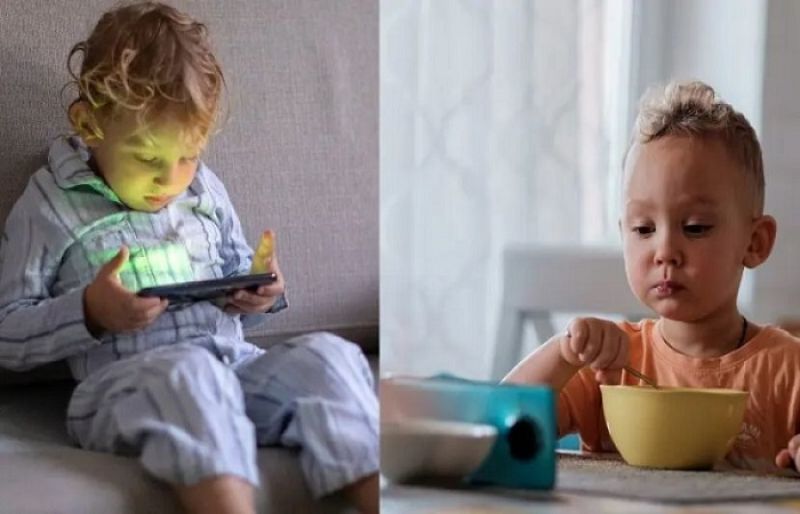
Handing over screens to young children is becoming a norm these days, but this norm has actually become a silent threat. The early years of life, in which a child’s brain develops rapidly, are now often spent in front of mobile screens, which is proving to be very harmful to their language, behavior, emotions and habits.
What provides parents with temporary peace, silence and convenience is limiting the natural learning process of children.
The most worrying aspect of making children addicted to mobile phones is that its negative effects do not appear immediately, but gradually become part of the children’s personality, health and mental abilities, and by then this habit has taken root.
In a restaurant or home environment, children often appear calm, but this calm silence is not a sign of health.
Remember that giving children mobile phones during meals seems easy, but it is dangerous for their health and habits.
This leads to children not eating mindfully and reduces communication and emotional connection with parents, which are essential for the development of language, behavior and social skills.
Doctors say that most parents do not realize that spending time with screens can affect children’s sleep, speech ability, attention span and emotional stability.
Some children are also showing vision or weight problems at an early age. These symptoms may not seem immediately dangerous, but repeated habits can have a lasting impact on children’s development.
According to pediatricians, the first two years of a child’s life are the foundation for their life.
According to Dr. Suzanne Sethi, during this time, neural connections are formed in the brain that affect learning, emotional control, behavior and overall health. Excessive screen time limits the ability to learn language, focus and form social relationships.
Irregular sleep and eating habits can hinder brain development and emotional balance, while parental distraction reduces the necessary emotional connection with the child.
Today’s parents often resort to screens because they provide temporary peace, quiet and convenience. According to Riddhi Doshi Patel, psychologist and parenting counselor, in most homes, childcare and household responsibilities are focused on the woman, even if she is employed. In a busy life and lack of support, screens become a quick solution, so that parents can take care of other tasks or reduce their fatigue.
The nuclear family system has also increased this habit. Where grandparents or maternal grandparents used to help with children’s time and activities, that environment is no longer available.
Our home environment plays a major role in making children addicted to mobile phones. The personal lives and experiences of some families can also help to understand the impact of these problems. According to NDTV, Delhi housewife Stuti Bhardwaj says that when her in-laws were with her, the children were busy with walks, temple visits and other activities. There was no need for mobiles or screens, but after they moved, it became difficult to handle the children alone and the screen gradually became a part of everyday life.
For some parents, the screen also becomes an emotional support. Ahmedabad resident Sarshti Singh says that her son fell ill with dengue at the age of one, and videos were the only thing that comforted him during the illness. Later, she got used to reducing the child’s stubbornness and anxiety in this way.
Doctors say that direct communication, games and conversations with parents are the most important for the mental and emotional development of children.
According to Dr. Arvind Garg of Noida, constant screen time affects children’s sleep, which also affects physical development and hormones related to hunger. Along with this, screen use during meals can also affect children’s healthy eating and future tendencies.
Experts make it clear that children do not need entertainment all the time. They need adequate sleep, physical activity and full attention of parents.
Involving children in daily tasks, such as helping with cooking, gardening or simple games, can be helpful in strengthening their language, attention and emotional connection.
If screens have already become a part of their daily lives, it is better to adopt a gradual reduction approach. Some time can be reduced every week and replaced with games, conversations or joint activities. Experts also recommend creating a “boredom kit”, which includes colors, paper, toys, musical instruments and puzzles, so that children can stay busy without screens.
Concerns are also seen in the world of film and showbiz in this regard. In this regard, actress Kareena Kapoor said at an event that she and her husband Saif Ali Khan do not use TV or mobile while putting their children to sleep at night, because children learn by watching their parents’ behavior, and the practical behavior of parents is the biggest lesson for children.
Experts say that when the screen is made a ‘substitute’ for emotional connection and real time with children, it becomes a silent but worst-case threat to the mental, physical and emotional health of children. No screen can ever fully provide parental attention, love and shared time.