
- Iran rejects demands permanent end to conflict via Pakistan.
- Iran’s response includes lifting sanctions, safe passage in Hormuz.
- Trump threatens severe action if Iran does not agree to deal.
Iran said on Monday it wanted a lasting end to the war with the US and Israel, and pushed back against pressure to swiftly reopen the Strait of Hormuz under a temporary ceasefire as the Americans and the Iranians weighed a framework plan to cease their five‑week-old conflict.
Iran conveyed its response to the US proposal for ending the war to Pakistan, rejecting a ceasefire and emphasising the necessity of a permanent end to the war, the official IRNA news agency said on Monday.
The Iranian response consisted of 10 clauses, including an end to conflicts in the region, a protocol for safe passage through the Strait of Hormuz, lifting of sanctions, and reconstruction, the agency added.
President Donald Trump, who has threatened to rain “hell” on Tehran if it did not make a deal by 8pm EDT Tuesday (midnight GMT) to open the vital route for global energy supplies, rejected the Iranian proposal on Monday and said his deadline was final.
“They made a proposal, and it’s a significant proposal. It’s a significant step. It’s not good enough,” Trump told reporters at an annual White House Easter event, referring to Iran.
Iran responded to US and Israeli attacks in February by effectively closing Hormuz, a conduit for about a fifth of the world’s oil and natural gas supply. The waterway’s stranglehold on the global economy has proved a powerful Iranian bargaining chip and on Monday it showed reluctance to relinquish it too easily.
The Pakistani-brokered framework for ending the war emerged from intense overnight contacts and proposes an immediate ceasefire, followed by talks on a broader peace settlement to be concluded within 15 to 20 days, a source aware of the proposals said on Monday.
Chief of Army Staff (COAS) and Chief of Defence Forces (CDF), Field Marshal Asim Munir, was in contact “all night long” with US Vice President JD Vance, special envoy Steve Witkoff and Iranian Foreign Minister Abbas Araqchi, the source said.
Iran’s foreign ministry spokesperson Esmaeil Baghaei said on Monday that Tehran’s demands “should not be interpreted as a sign of compromise, but rather as a reflection of its confidence in defending its positions.” He added that earlier US demands, such as a 15-point plan, were rejected as “excessive”.
Ceasefire proposal ‘one of many ideas’
“This is one of many ideas, and (Trump) has not signed off on it. Operation Epic Fury continues,” White House official told Reuters, referring to the US name for the operation against Iran.
Brent crude futures LCOc1 were up 0.5% to $109.60 a barrel at 1545 GMT.
In a post laden with expletives on his Truth Social platform on Sunday, Trump threatened further strikes on Iranian energy and transport infrastructure if Iran failed to make a deal and reopen the Strait by Tuesday.
Anwar Gargash, an adviser to the president of the United Arab Emirates, said any settlement must guarantee access through Hormuz. He warned that a deal that failed to rein in Iran’s nuclear programme and its missiles and drones would pave the way for “a more dangerous, more volatile Middle East”.
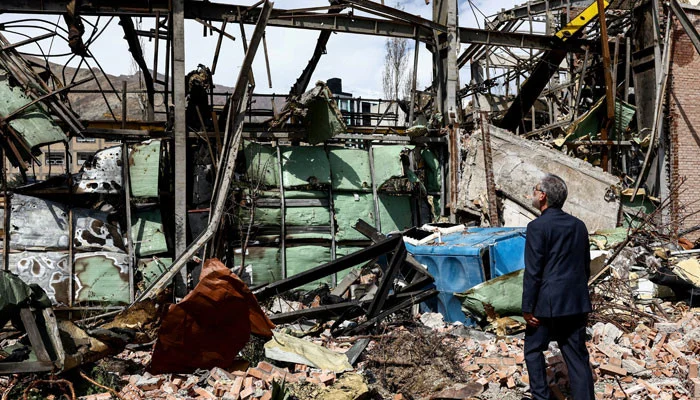
Fresh aerial strikes were reported across the region on Monday, more than five weeks since the US and Israel began pounding Iran in a war that has killed thousands and damaged economies by sending oil prices surging.
Iranian state media said the Revolutionary Guards’ intelligence chief, Majid Khademi, has died. Israel on Monday claimed responsibility for his death.
A US-Israeli attack hit the data centre at Sharif University of Technology in Tehran, damaging infrastructure underpinning the country’s national artificial intelligence platform and thousands of other services, Fars News Agency said on Sunday.
Iran continues to fight back
Iranian weekend strikes on petrochemical facilities and an Israeli-linked vessel in Kuwait, Bahrain and the UAE underscored the country’s ability to fight back despite Trump’s repeated claims to have knocked out its missile and drone capabilities.
Israel saw a heavy day of rocket volleys on Monday, with the sounds of sirens and missile interception booms ringing out across the country throughout the day.
Israel’s military told Reuters there had been 20 missile launches from Lebanon and five from Iran during the day. Several of the attacks resulted in impacts, although it was unclear whether it was from falling missile debris or direct strikes.
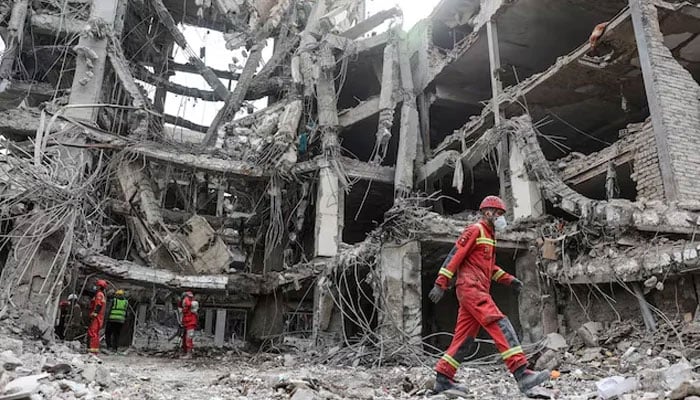
A missile hit Haifa overnight, tearing a building apart and killing four under the rubble, taking the death toll in Israel to 23, according to Israel’s ambulance service.
Yemen’s Iran-aligned Houthis said on Monday that they also carried out missile and drones attack against Israel.
About 3,540 people have been killed in Iran in the war, including at least 244 children, said US-based rights group HRANA.
Israel has also invaded southern Lebanon and struck Beirut in a fight against Iran-backed Hezbollah that has become the most violent spillover of the war on Iran.
Lebanon’s heavy casualties include 1,461 killed, including at least 124 children, Lebanese authorities say.
Thirteen US service members have died and hundreds of others have been wounded.
