








The recent headlines detailing US-Israeli strikes on Iran and the looming threat of wider conflict have once again plunged many into a state of heightened anxiety, dominating conversations and social media feeds. As the world grapples with escalating tensions, medical experts are highlighting the critical need for individuals to protect their mental well-being amidst the relentless news cycle.
It is entirely normal to experience stress and a sense that global events are spiralling into chaos, according to psychiatrists. Michael S Ziffra, a professor and psychiatrist at Northwestern Feinberg School of Medicine, reassures that such reactions are a natural human response. “Fear, sadness, confusion… these are very normal reactions to very extreme circumstances,” he told The Associated Press. “People shouldn’t feel guilty, or they shouldn’t feel like it’s wrong to feel anxiety. It’s a very normal human response. The key is to know how to manage it.”
Since 2020, a year marked by the devastating Covid-19 pandemic, widespread social and political unrest, and numerous climate-related disasters, Professor Ziffra has observed a significant rise in patients reporting anxiety triggered by current affairs. While some express frustration or obsessively scroll through social media, these feelings, though challenging, can sometimes be channelled into positive action, such as engaging in advocacy or contacting lawmakers. However, moderation is key, as Ziffra warns against “wallowing” in distress. “The problem is, for a lot of people, they just kind of wallow in it. They ruminate and obsess and just sort of stew in it,” he explained.
In today’s hyper-connected world, information is constantly at our fingertips, often pushed by algorithms or phone alerts. The 24/7 news cycle, coupled with the instant dissemination of images and videos from disaster zones, means people are “much more exposed” to current events than ever before, notes Dana Rose Garfin, a psychologist and professor at the University of California, Los Angeles. Her research into “cascading collective traumas” has shown how continuous media coverage, such as during the Covid pandemic, can significantly amplify anxiety.

Professor Garfin explains that while it is a “logical, rational and helpful reaction” for people to seek information during a crisis, this often leads to a detrimental cycle. “What we’ve seen in our research is there’s this sort of reciprocal effect. An event happens, people learn about it, they turn to the media to learn more about it, and they’re really distressed,” she said. This distress then fuels a desire for more information, creating a loop that is difficult to break: “It sort of activates these processes where then they’re both more distressed and want to know more about this event because they’re distressed.”
To avoid becoming overwhelmed and emotionally exhausted, experts advise a conscious effort to manage news intake. A primary recommendation is to reduce or eliminate “doomscrolling” on social media. Roxane Cohen Silver, a psychologist at the University of California, Irvine, who co-authored a study with Professor Garfin, consciously limits her social media use. “I don’t immerse myself in social media, and that’s a very conscious decision on my part to protect my own mental, and physical, health,” she stated, highlighting concerns about the repeated exposure to graphic images and videos. “I think that one can stay informed without immersing oneself in graphic images.”
Professor Garfin suggests opting for more “enjoyable” and controlled ways to consume news, such as reading informative articles, listening to podcasts, or watching dedicated news segments, rather than passively allowing algorithms to dictate content. Practical steps include setting screen time limits on devices and carefully selecting news sources. Professor Ziffra advises choosing neutral outlets: “Try to avoid things where it’s very partisan and where there’s going to be a lot of inflammatory content, because that’s going to likely exacerbate your anxiety and make you feel anxious, angry, scared.”

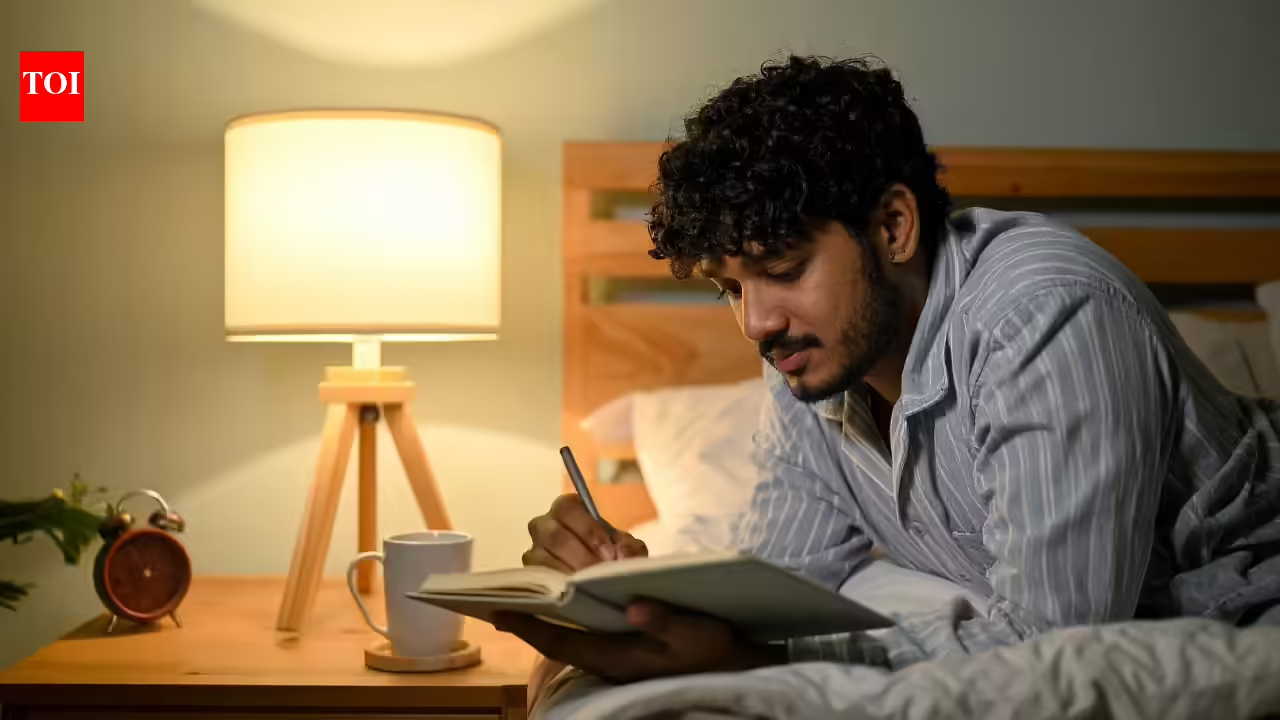
Even when global events unfold thousands of miles away, their psychological impact can be profound. Therefore, identifying and utilising personal coping mechanisms is crucial. Professor Garfin notes that “People have a lot of inherent knowledge of what helps them… and things that they find comfort in, which is different for everybody.” Experts recommend redirecting attention through activities like breathing exercises, walks, engaging in hobbies, connecting with friends, seeking therapy, or pursuing creative outlets. As Professor Ziffra concludes, these are “Things that are going to get your mind off of all of the obsessing and worrying and really putting your thoughts on something more positive.”