
IT ministry proposes technological solutions to facilitate a targeted subsidy mechanism for petroleum products
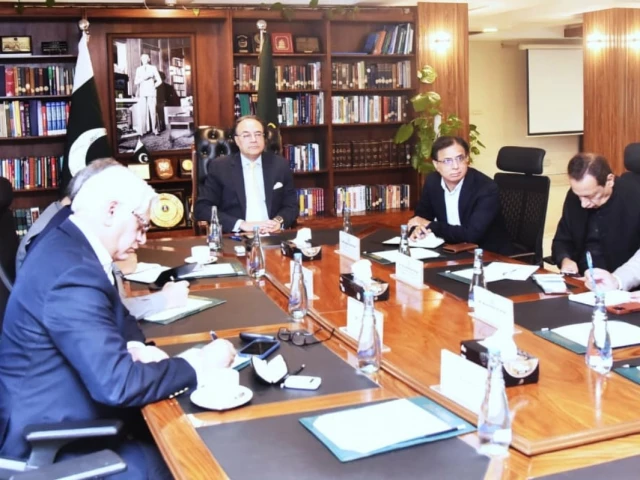
Minister for Finance and Revenue Senator Muhammad Aurangzeb chairs a high-level meeting to review the country’s petroleum products situation. Photo: X
The federal government and provinces agreed on Friday to implement a targeted fuel subsidy framework leveraging technology, with an emphasis on transparency, efficient delivery and promotion of fuel conservation through behavioural measures.
The decision came during a high-level consultative meeting chaired by Finance Minister Muhammad Aurangzeb to review the country’s petroleum products situation. The meeting included representation from all four provinces.
According to a press release issued by the finance ministry, the meeting was held in line with directions from the president and the prime minister.
“The meeting commenced with a detailed presentation by the Petroleum Division on the current status of petroleum products’ availability in the country. It was noted with satisfaction that the fuel supply situation remains stable and adequate across the country.”
Finance Minister Chairs Consultative Session on Petroleum Prices and Subsidy Reforms
Federal Minister for Finance and Revenue, Senator Muhammad Aurangzeb, chaired a high-level consultative meeting on the petroleum products situation today at the Finance Division, in line with… pic.twitter.com/jnjKDI8qrT
— Ministry of Finance, Government of Pakistan (@Financegovpk) March 27, 2026
The Ministry of Information Technology and Telecommunication presented proposed technological solutions to facilitate a targeted subsidy mechanism for petroleum products, highlighting transparency and efficient delivery.
Participants agreed to expedite efforts to finalise the targeted subsidy framework using technological solutions, while maintaining coordination between federal and provincial authorities.
Provincial leaders shared their perspectives on the prevailing situation and policy options. Sindh Chief Minister Syed Murad Ali Shah appreciated the federal government’s efforts to maintain uninterrupted fuel availability while stressing the importance of behavioural measures to encourage fuel conservation.
Read: PM Shehbaz rejects summary for fuel price increase, says govt to absorb Rs56b burden
Punjab Senior Minister Marriyum Aurangzeb, representing the provincial government, emphasised the need to develop multiple policy scenarios in response to fluctuating petroleum prices.
She underlined that any reduction in international petroleum prices should be passed on effectively to consumers and highlighted the role of behavioural aspects in ensuring sustainable consumption patterns during a crisis.
Representing Khyber-Pakhtunkhwa, Finance Minister Muzzammil Aslam lauded the federal finance and petroleum ministers for their management of the country’s oil supply, noting that Pakistan’s performance remained comparatively better than several regional peers.
Balochistan Finance Minister Mir Shoaib Nosherwani also shared his views during the session.
The Finance Division briefed participants on the fiscal situation, noting that available fiscal space was limited and primarily dependent on revenues from the petroleum levy. It was emphasised that any relief measures must be carefully calibrated to maintain macroeconomic stability.
Addressing the meeting, Aurangzeb stressed that the current situation should be treated as an opportunity to undertake structural reforms rather than a constraint.
He underlined the importance of data-driven decision-making in taxation and subsidy design to ensure transparency, efficiency and targeted relief. The finance minister also highlighted the need to promote responsible consumption and ensure policy measures remained fiscally prudent while maximising public relief.
The meeting was attended by chief secretaries of all four provinces; Minister for Information Technology and Telecommunication Shaza Fatima Khawaja; federal secretaries of finance, petroleum and IT; as well as senior officials.
Also Read: Pakistan playing ‘pivotal role’ in ending US-Iran war: Khawaja Asif
Earlier this month, the government sharply increased diesel and petrol prices by Rs55 per litre, or 20 per cent, citing the ongoing US-Israel and Iran conflict, which has disrupted global supply chains and pushed crude oil prices to a two-year high.
In response to the crisis, both federal and provincial governments have introduced a series of austerity measures. These include an additional weekly holiday, a reduction in free petrol allocations for ministers, curbs on protocol vehicles, and proposals to provide subsidised fuel for students.
Last week, the government also approved a significant increase of Rs200 per litre in the fuel levy on high-octane fuel used in luxury vehicles, raising the total levy to Rs300 per litre and the price to Rs600 per litre.
