








Last Updated:
China’s numbers are alarming as for the first time in three decades, investment in housing, manufacturing and infrastructure- all declined in the same year.




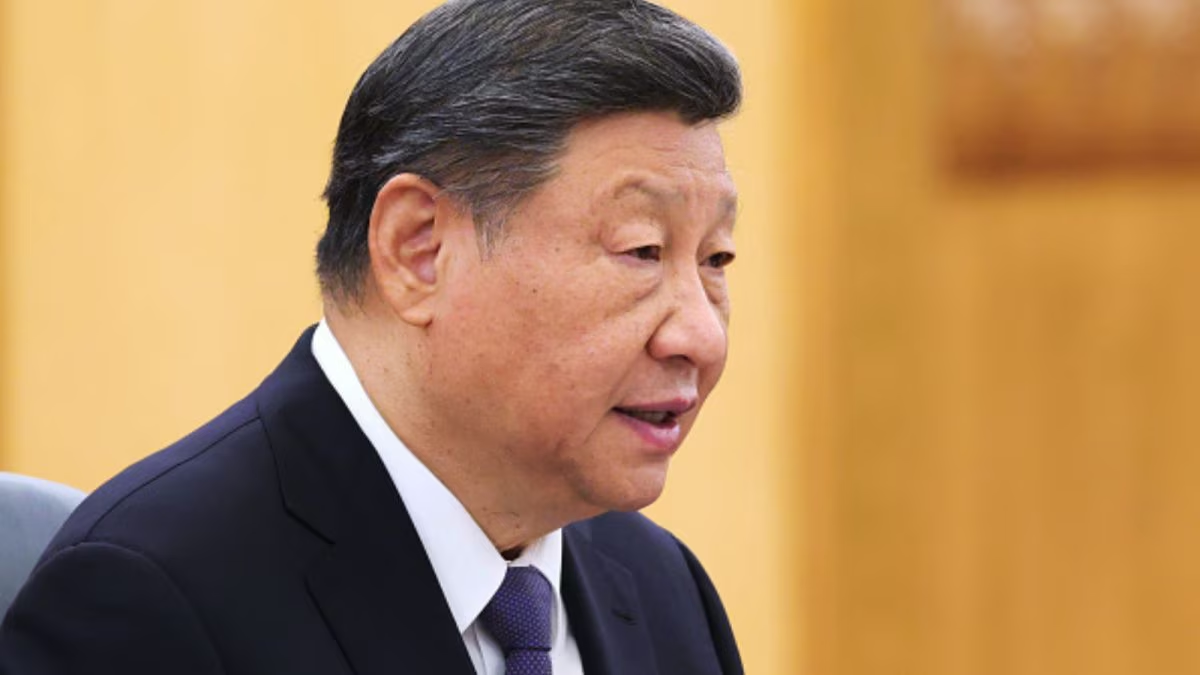
Chinese President Xi Jinping (Getty Images)
China’s official economic growth target for 2026 is 4.5 to 5%, announced by Premier Li Qiang at the opening of the National People’s Congress- the country’s annual legislative gathering of nearly 2,900 delegates in Beijing. It is a step down from three consecutive years of targeting “around 5%” growth from 2023 to 2025.
More significantly, it is the lowest target Beijing has set since it began announcing such figures in the early 1990s. The only year the government aimed lower was 2020- when Covid-19 nearly paralysed the economy.
Read more: Trump Is Bombing Iran Without A War Declaration. Can A US President Get Away With It?
Premier Li said that “rarely in many years have we encountered such a grave and complex landscape, where external shocks and challenges were intertwined with domestic difficulties and tough policy choices” and that the economy remained in the midst of “deep-seated structural problems.”
Did China Hit Its Previous Targets?
Yes but unevenly. China met its “around 5%” goal last year. However, only half of its provinces achieved their individual growth targets. Helen Chiao, chief Greater China economist at Bank of America, said the lowered target reflected an acknowledgement that “domestic demand weakness is probably going to be challenging to remove.”
What Do Numbers On Property And Investment Say?
China’s numbers are alarming as for the first time in three decades, investment in housing, manufacturing and infrastructure- the three pillars that drove China’s decades-long growth- all declined in the same year. That has not happened since China launched its economic reforms in the late 1970s. The property sector is now in its fifth consecutive year of crisis. Sales and investment continue to slump. Since real estate has historically been one of the primary engines of Chinese growth and a primary store of household wealth, its prolonged deterioration is dragging down consumer confidence and spending across the broader economy.
Deflationary pressure compounds the problem. Industries from electric vehicles to e-commerce are gripped by overcapacity, with cutthroat price competition driving prices downward across multiple sectors. Beijing has maintained its annual inflation target at around 2% but deflationary forces remain stubborn.
Where Are The Numbers Pointing Upward?
Technology. China committed to a 10% increase in its annual science and technology budget for 2026- consistent with growth over the past two years. Premier Li pointed to artificial intelligence, robotics and biomedicine as sectors performing “at the forefront globally.” The new Five-Year Plan identifies semiconductors, aerospace, biotechnology, quantum technology and AI as frontier priorities. Beijing is betting heavily on innovation in these sectors to achieve its stated goal of doubling per capita GDP from 2020 levels by 2035.
What About China’s Defence Spending?
Rising, despite the economic slowdown. China’s defence budget for 2026 increased by 7%- only marginally lower than the 7.2% annual increases recorded over the previous three years which means that military spending is growing faster than the overall economy.
 Click here to add News18 as your preferred news source on Google.
Follow News18 on Google. Join the fun, play games on News18. Stay updated with all the latest business news, including market trends, stock updates, tax, IPO, banking finance, real estate, savings and investments. To Get in-depth analysis, expert opinions, and real-time updates. Also Download the News18 App to stay updated.
March 05, 2026, 18:31 IST
Read More