
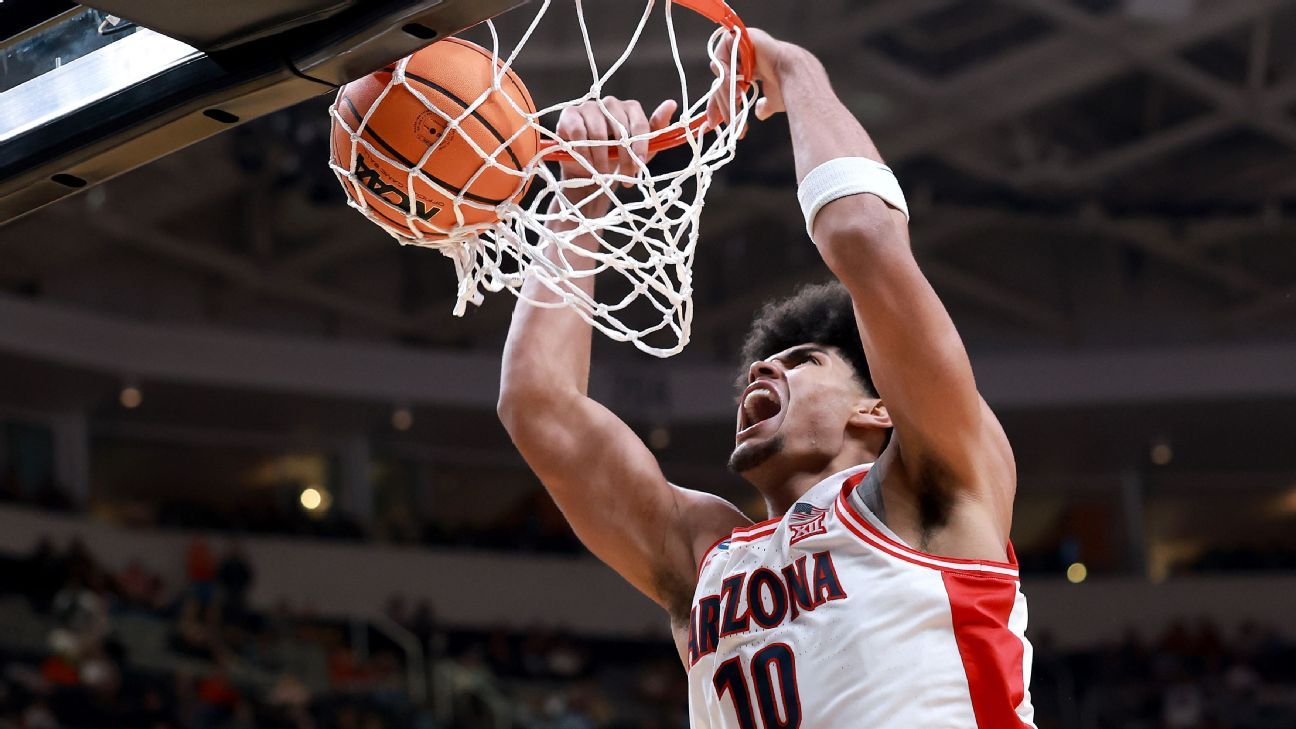
SAN JOSE, Calif. — On the morning of the biggest game of his head coaching career, Tommy Lloyd woke up confused. It had been two days since his Arizona Wildcats dominated John Calipari’s Arkansas Razorbacks in the Sweet 16. Now just one win from the program’s first Final Four in 25 years, he had forgotten the game had even happened for a moment.
Perhaps groggy from the rigors of postseason travel — Arizona had played seven games since its last home game on March 2 — Lloyd needed to recalibrate.
“I thought: Are we in the Sweet 16 or the Elite Eight?” Lloyd said after the Wildcats beat the Purdue Boilermakers to advance to the Final Four.
Confidence can come from many places, and for Lloyd, this momentary lapse in awareness became an unlikely source. Here he was on the doorstep of college basketball history, completely unphased.
“I knew we were all right,” Lloyd said, “because I knew we weren’t making too big of a deal out of this.”
It’s a safe bet that much of the University of Arizona and Tucson community didn’t wake up Saturday morning similarly unaware of what was at stake later that day. The Wildcats last reached the Final Four in 2001 — an eternity for the basketball-crazed fan base — and this was a moment many had envisioned for years. They had reached the Sweet 16 in three of the four previous seasons under Lloyd but hadn’t reached the Elite Eight since 2015. After riding the best start in program history (23-0) to nine straight weeks at No. 1 in the AP poll and sweeping the Big 12 regular-season and conference titles, though, it seemed like everything had been building toward a trip to Indianapolis.
From the moment Lloyd arrived in 2021, following a 20-season run as an assistant at Gonzaga, he has been inundated with tales from the past. The four Final Fours the Wildcats reached under Hall of Fame coach Lute Olson might as well be lived experiences now for Lloyd, who reached the national championship game twice as Mark Few’s top assistant.
“The people of Tucson are basketball historians,” Lloyd said. “The number of stories I’ve heard consistently about things that happened 10, 20, 30 years ago, it’s impressive. I mean, they really hold on to the things this program accomplishes, and they hold on to our struggles as well.”
It’s not that Arizona has struggled since Gilbert Arenas led the Wildcats to the national semifinals in 2001, at least not in a conventional sense. They have missed the NCAA tournament just four times in that span, have regularly competed for — and won — conference titles in the Pac-12 and Big 12, but their performances in March always ended the same way. And the longer it had been since they reached the final stage, the more the external pressure grew. Regular-season success only means so much in a sport where tournament performance is what the average fan remembers.
Associate head coach Jack Murphy is this team’s link to the past. He first arrived in Tucson as a student manager under Olson before returning as an assistant under Sean Miller in 2019, giving Murphy a perspective that spans generations of Arizona basketball.
“I feel like every year I’ve been here he’s just telling us the history,” said senior guard Jaden Bradley, who transferred to Arizona from Alabama in 2023. “Knowing the players that came before us, even the managers and everybody that came before us, the coaches. … I feel like they’re going to tell us even if you don’t want to hear it.”
Now, regardless of what happens against fellow No. 1 seed Michigan, this Arizona team will be remembered alongside the best in school history. Its Elite Eight win against Purdue broke the single-season record for wins (36) and ensured Arizona will finish with no more than three losses for the first time since 1988, when it reached the Final Four for the first time.
Before the Sweet 16 even tipped off, former Arizona coach Miller — who was also at the West regional with Texas — sang Lloyd’s praise.
“My perspective of just watching Arizona, they couldn’t have hired a better coach,” said Miller, who made three trips to the Elite Eight over 12 years in Tucson. “I mean, what he has done is just — it’s like legendary. I know that the team that they have this year might be the best team at Arizona, one of the best ever.”
For all the history that surrounds the program, one of this team’s defining traits has been its ability to stay in the present. It showed again Saturday.
There was no panic when they entered halftime down seven points to Purdue. Lloyd simply delivered his message and got out of the way.
“This is when we’re at our best,” Lloyd said. “I said, ‘Guys, the coaching staff and I are going to leave right now. You guys got a few minutes to talk amongst yourselves and kind of figure this deal out, and let’s go kick their ass in the second half.”
And that’s what happened. Even a veteran-led team such as Purdue had no way of slowing Arizona after the break, as the Wildcats ran away with a 79-64 win that punched their ticket and reinforced the idea that they are capable of winning it all.
Lloyd’s incredible track record of recruiting and developing international players is well-documented. It’s part of what turned tiny Gonzaga into a national power and part of what has helped Arizona become the winningest program in college basketball over the past five years. Half of this season’s 16-player roster is from abroad.
But for as worldly as this program has become, the standout performer of the regional was an Arizona native: freshman forward Koa Peat. He was named the Most Outstanding Player of the West Regional after averaging 17.5 points, 6.8 rebounds and a pair of assists.
Peat is something of an Arizona high school legend. At Perry High in Gilbert, he won four straight state titles and was the state Player of the Year three times.
“They call him Mr. Arizona,” Lloyd said. “Koa is special.”
When recruiting Peat, Lloyd was drawn to the obvious physical gifts that made him one of the most sought-after players in the 2025 class, but all the winning he did in high school — plus the four gold medals he won in FIBA international competitions with USA Basketball — made him even more of a top priority.
Despite growing up 100 miles outside of Tucson, though, Peat said he wasn’t really a big fan of college basketball. He was generally aware of the Wildcats’ standing, of course, but it wasn’t until he started being recruited did he really dive into the history.
“When you put on the Arizona jersey, you know you’re playing for people that played before you,” Peat said. “So it’s bigger than yourself; it’s the program.”
Lloyd echoed a similar sentiment in a way that might have Wildcats fans feeling a bit anxious with rampant speculation about his possible candidacy for the opening at North Carolina.
“The sun may be shining on this team and me coaching it right now, but when it’s shining on you, you got to fight like hell to protect it and build it,” Lloyd said. “So that’s what I feel like my No. 1 responsibility is, to fight to protect the program and fight to build it for those who came before me and for those that are going to follow after me, because you know what, Arizona is going to have another good coach after me. I promise you. The place is special.”
