





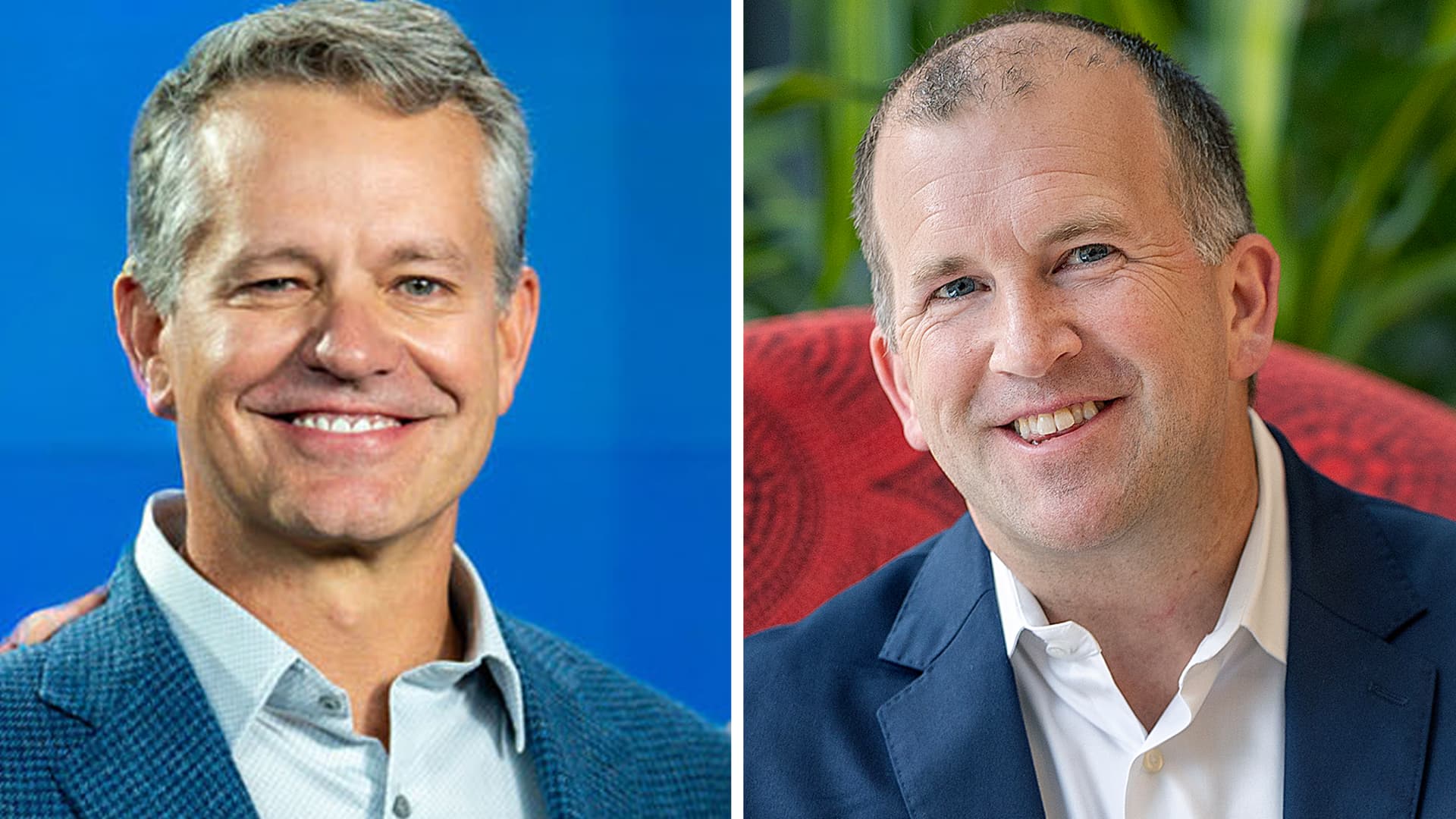
Walmart CEO John Furner, left, and Target CEO Michael Fiddelke.
Walmart (L) | Getty Images (R)
When Walmart and Target report holiday earnings this quarter, investors may quickly brush off those results.
Instead, they will likely focus more on the two big-box retailers’ futures under new CEOs and the outlook for U.S. consumers in 2026.
Both companies had leadership changes this month: Walmart CEO John Furner and Target CEO Michael Fiddelke, both longtime company insiders, took on their roles on Feb. 1.
The rival retailers have contended with the same economic challenges. U.S. consumers are still spending, but buying selectively, as inflation and tariffs fuel higher prices for groceries and other essentials and cause some shoppers to think twice about discretionary purchases.
Yet while both Walmart and Target have new CEOs, their paths forward look distinctly different.
Walmart’s stock has shot up by about 163% over the past five years and has risen about 24% over the last year, as of Tuesday’s market close. It hit a 52-week high Tuesday. Shares of Target, on the other hand, have tumbled by about 40% over the past five years and dropped 9% over the past year.
The retailers’ stock market performances reflect their sharp divergence in sales results. Walmart is attracting shoppers across incomes and gaining momentum with online sales and higher-margin businesses like advertising. Target is struggling with slower sales and weaker store traffic. Walmart expects its full-year net sales to rise by 4.8% and 5.1%. Target, on the other hand, is on track for a full-year sales decline.
Walmart CEO John Furner inherited a business that’s “fundamentally sound” and “on a great trajectory,” said Neil Saunders, managing director and retail analyst at GlobalData.
“In many ways, his job is to keep the ship steady and see what he can do to add to the speed,” he said.
On the other hand, Target CEO Michael Fiddelke has to “sell the Target of the future” after four years of roughly flat annual sales, Saunders said.
“What I think he’ll want to do is to inject some excitement, to say, ‘Look, I’m really excited about this role. I’m really excited about where Target could go. We are going to change things. We’re going to become a different business. We’re going to get back to what we were before,'” he said.
Here’s a closer look at what we know so far about the CEOs’ plans and what investors will listen for during earnings:
Walmart Inc. signage during the company’s listing at the Nasdaq MarketSite in New York, US, on Tuesday, Dec. 9, 2025.
Michael Nagle | Bloomberg | Getty Images
Walmart: Extending the winning streak
Walmart will report its fiscal fourth-quarter earnings before the bell on Thursday.
The retail giant has had a busy few months: Along with getting a new CEO, Walmart’s market cap surpassed $1 trillion in early February. The company also switched its stock listing from the New York Stock Exchange to the tech-heavy Nasdaq 100 in January, a nod to its aim to be perceived by investors more like its key rival Amazon.
When longtime CEO Doug McMillon stepped down from the role, he said in an interview on CNBC’s “Squawk Box” that he was passing the torch to Furner as the company accelerates its artificial intelligence adoption and reshapes its business and the way its customers shop.
Walmart has announced deals with two major AI chatbot platforms, OpenAI’s ChatGPT and Google’s Gemini, to make it easier for shoppers to find and buy its products.
Furner, who like his predecessor moved up the ranks at Walmart during decades at the Arkansas-based company, oversaw the largest segment of the company in his previous role as CEO of Walmart U.S. Furner got picked in part because of his success expanding Walmart’s digital business, a pivotal piece of its future, said Kate McShane, a retail analyst for Goldman Sachs.
Walmart Inc. (NYSE: WMT) announced that its Board of Directors has elected John Furner, 51, to succeed Doug McMillon, 59, as President and Chief Executive Officer of Walmart Inc., effective February 1, 2026.
Courtesy: Walmart Inc.
Walmart in May posted its first profitable quarter for its e-commerce business in the U.S. and globally, as its home deliveries, ads business and third-party marketplace all grow.
Corey Tarlowe, a retail analyst for Jefferies, said Walmart investors “want more of the same” — namely more e-commerce gains, grocery success and market share gains with a wider range of customers, including more affluent shoppers.
Yet Walmart’s results for the holiday quarter could mark an inflection point in the world of retail. Amazon could take the crown as the largest retailer by annual revenue for the first time, even though the company makes a lot of its money from tech services like cloud computing and advertising.
Saunders said the comparison isn’t apples to apples, but is “symbolically important” as the two competitors try to outmatch one another. Walmart has grown in part by leaning on stores to deliver groceries and offer pickup for online orders. Amazon, which recently announced it would shutter Amazon Fresh and Go stores and turn some into Whole Foods locations, had tried to “bolt on” fresh food to its huge existing volume of online orders, he said.
As the nation’s largest grocer by revenue, Walmart also is fending off the expansion of privately held discounter Aldi, and could feel the heat turned up by supermarket operator Kroger, which recently hired Walmart alumnus Greg Foran as its new CEO.
In a memo sent to employees on his second day at CEO, Furner said his leadership will be shaped by his more than 32 years at Walmart, adding he believes the company “is well-positioned to lead in this next era of retail.”
“This next era will unlock new ways to bring our people-led, tech-powered vision to life,” he said in the memo. “By leveraging our global scale, we can better serve customers and members with speed, reliability, and greater experiences, wherever they choose to shop with us.”
He said that strategy is already coming to life as “technology and AI are helping reduce friction in our work, simplify decisions, improve inventory flow, and free up time so you can focus on what matters most: serving customers and members and one another.”
Customers shop at a Target store on Feb. 10, 2026 in Chicago, Illinois.
Scott Olson | Getty Images
Target: Chasing a comeback
For Fiddelke, Target’s earnings report could be the deepest look yet at the cheap chic discounter’s roadmap to return to growth.
The company is chasing a comeback and plans to share its holiday-quarter results and current fiscal year expectations on March 3 at a financial meeting at its Minneapolis headquarters.
The big-box retailer has struggled with a laundry list of challenges, including declining visits to its stores and website, customer complaints about store conditions and backlash to the company’s political and social stances, such as its rollback of diversity, equity and inclusion pledges and its decision not to publicly oppose the surge of immigration enforcement in its hometown.
As sales decline, Target has shrunken its workforce. It cut 1,800 corporate roles last year in its first major layoff in a decade.
Target’s earnings report is more highly anticipated than Walmart’s because there are so many questions about its turnaround strategy and how long it may take, Goldman Sachs’ McShane said. Investors have debated how much the company may need to invest in merchandising, marketing and store labor to boost its sales.
“Walmart has pursued a much more aggressive digital agenda than Target between their omnichannel and their automation and their marketplace,” she said.
She added that while Target doesn’t want to be Amazon or Walmart, “they have to figure out who they want to be and how to compete.”
Target’s Chief Operating Officer Michael Fiddelke will take over as CEO from Brian Cornell.
Courtesy of Target
Already, Fiddelke has sent signals that he is making changes. Last week, he announced in an email to employees that the company will step up store staffing, though Fiddelke and the company declined to say how much it would invest in additional hours for employees. It is also cutting about 500 roles at distribution centers and regional offices.
Fiddelke shook up Target’s leadership team effective Sunday, bringing back the role of chief merchant and announcing a high-profile departure. Cara Sylvester, formerly chief guest experience officer, became Target’s chief merchandising officer, and Lisa Roath, formerly chief merchandising officer of food, essentials and beauty, succeeded Fiddelke as chief operating officer.
At the same time, Chief Commercial Officer Rick Gomez is leaving the company after more than a decade, and Jill Sando, chief merchandising officer for apparel and accessories, home and toys and entertainment division Fun101, will retire.
Target has also opened a new concept store in New York City’s SoHo neighborhood. While the location is one of a kind, its focus on fashion may inspire more changes at stores across the country and in the suburbs, McShane said.
That push to feature stronger products is a major piece of Fiddelke’s strategy. In an email to employees and customers during his first week, Fiddelke laid out four priorities: sharpening Target’s merchandising, improving the customer experience, speeding along technology and strengthening the company’s workforce and its surrounding communities.
Jefferies’ Tarlowe said Target’s upcoming investor event is “a chance for them to essentially communicate to everybody and say ‘We hear what you want. Here’s how we are going to deliver on it.'”
“Change is happening, it’s a question of does the market see it and appreciate it,” he said.